All posts by Wintery Knight

https://winteryknight.com/

Canada’s single payer health care: pay up front, take a number and wait until you die

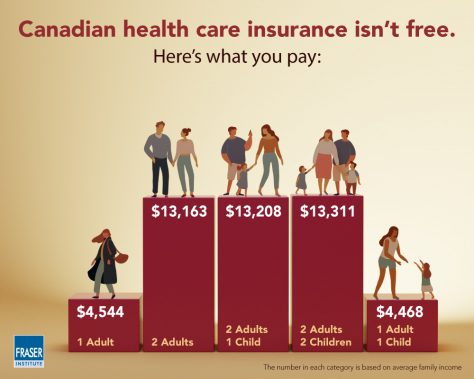
Price of healthcare per Canadian household (Source: Fraser Institute)

I post a lot of research from Canada’s Fraser Institute, but they are not the only think tank that publishes research on the efficiency and costs of single payer health care in Canada. This time, I found a report from the Heritage Foundation, where they go over quality of care, taxes, out of pocket costs, coverage, rationing, waiting lists, staff shortages, substandard equipment, and outdated drugs.

Here’s the report from the Heritage Foundation. I’ll focus on the differences.

Canadians pay slightly less in out of pocket costs:

The OECD calculates that Canadians spend 1.6 percent of GDP on out-of-pocket health spending, compared to 1.9 percent in the U.S.

[…]While these numbers are very close, they are actually getting closer. Since 1970, U.S. out-of-pocket spending as a percentage of total medical spending has been falling steadily, from 33 percent in 1970 to about 10 percent in 2017.19

Meanwhile, Canadian out-of-pocket spending has been falling much slower, so that by 2016 it totaled 15 percent of total medical spending—a higher proportion than in the U.S.20

 As a result, Statistics Canada warned in early 2020 that the percentage of Canadians experiencing large out-of-pocket burdens is growing, writing that “[b]etween 1998 and 2009…the percentage of households spending more than 10% of their total after-tax income on health care rose by 56%.”

Canadians pay more in federal and state taxes:

Federal taxation excluding social security contributions, then, comes to 28 percent of GDP in Canada, compared to just 19 percent in the U.S.—meaning 51 percent more.

[…]This excess taxation is largely a result of health spending, which has bloated provincial budgets to nearly three times the taxes of U.S. states.

Provincial taxes have grown to nearly the same level as federal taxation. Meanwhile, provincial health costs have risen to fully 37 percent of provincial budgets in 2016—up from 33 percent in 1993 – —and range as high as 42 percent.

Canada’s Fraser Institute has estimated this excess tax burden from public health costs at roughly $9,000 for a household of two adults with or without children or $750 per month in additional taxes.
When I wanted an MRI I was scheduled the same week

Canadians wait far longer for treatment than Americans:

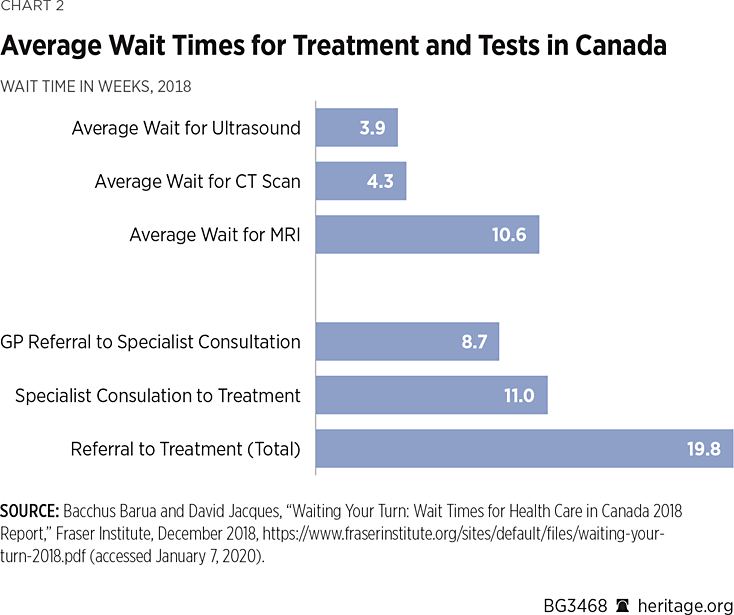
Medical waiting times have become a national crisis in Canada, and continue to worsen. The average wait time for medically necessary treatment between referral from a general practitioner and a consultation with a specialist was 8.7 weeks in 2018, 136 percent longer than in 1993. Patients then have to wait again between seeing the specialist and the actual treatment, another 11 weeks on average, 97 percent longer than in 1993.

From referral to treatment, then, it takes an average of 19.8 weeks (see Chart 2) to be treated, in addition to the original wait to see the family doctor in the first place—this for “medically necessary” treatment, not cosmetic surgery.

In contrast, nearly 77 percent of Americans are treated within four weeks of referral, and only 6 percent of Americans report waiting more than two months to see a specialist.

As for appointments, a 2017 survey of American physicians in the 15 largest U.S. cities found that it took just 24 days on average to schedule a new-patient physician appointment, including 11 days for an orthopedic surgeon and 21 days for a cardiologist.

As a result of these long waits, by one recent estimate, at any given moment, over one million Canadians—3 percent of the entire population—are waiting for a medical treatment.

These lists can average six months, and often much longer in rural areas, which tend to suffer from doctor shortages so severe that many do not even have a family doctor. Overall, 15 percent of Canadians did not have a regular health care provider in 2017.

The shortages ripple through the system; one doctor in Ontario called in a referral to the local hospital, only to be told there was a four-and-a-half year wait to see a neurologist.

In Canada, people die or become inoperable on waiting lists:

A Montreal man was finally called for his long-delayed urgent surgery two months after he had died. One 16-year-old boy in British Columbia waited three years for an “urgent” surgery, during which time his condition deteriorated so much that he became a paraplegic.

Canadians have to travel abroad to countries with functioning health care systems in order to be treated:

These cases are, unfortunately, not isolated; a survey of specialists found that average wait times exceed what is deemed clinically “reasonable” for fully 72 percent of conditions in Canada. The situation continues to worsen every year: In 1994, the average gap between clinically reasonable delay and actual delay was only four days, and by 2018 had grown to 23 days.

[…]With one million waiting, many Canadians turn in desperation to U.S. health care—the very system some U.S. policymakers propose to transform. In 2017 alone, Canadians made 217,500 trips to other countries for health care, of which 52,500 were to the U.S., paying out of pocket to skip the waiting.

Outdated equipment, outdated drugs, staff shortages:

 While the average employer-sponsored private insurance plan in Canada covers between 10,000 and 12,000 drugs, most public plans in Canada only cover 4,000. Canada has 35 percent fewer acute care beds than the U.S., and only one-fourth as many magnetic resonance imaging (MRI) units per capita—indeed, it has fewer MRI units per capita than Turkey, Chile, or Latvia.

[…]Some common treatments are simply unavailable to Canadians. For new pharmaceuticals, for example, Canada’s policy of forcing down prices so that American consumers essentially pay for Canada’s research and development has led to years-long delays for Canadian patients.

[…]Cutting corners on facilities and using outdated drugs show up in Canadian mortality rates. Thirty-day in-hospital mortality rates in Canada are 20 percent higher than in the U.S. for heart attacks, and nearly three times the U.S. level for strokes. Cancer age-standardized mortality is 10 percent higher in Canada than in the U.S.—despite far healthier lifestyles.

[…]When it comes to personnel, Canada underspends on medical staff and doctors, ranking 29th out of 33 among high-income countries for doctors per 1,000 population, accounting for a large part of those wait times. Canada has half as many specialist physicians per capita as the U.S.

[…]With such shortages and waiting lists, Canadian emergency rooms are packed. So packed that Canadians sometimes just give up and go home. Of Canadian ER visitors who are seen, 29 percent report wait times of over four hours, three times the U.S. level.

[…]Canadian seniors are 65 percent more likely to have visited the emergency room (ER) four or more times in the past year than American seniors.

Ultimately, nearly 5 percent of Canadian ER visitors end up leaving without ever being treated, giving up on a medical system that is perennially “free” but out of stock at the moment. In one study at two ERs in Alberta, 14 of the 498 walkaways were subsequently hospitalized, and one died within the week.

And keep in mind how things work in a single payer system. You pay up front through your taxes. The harder you work, the more you pay into the system. When you want treatment, you just get in line behind people who never paid one dime into the system – like all those low-skill refugees that Canada imports from Middle Eastern countries to build up the socialist voting bloc.


Both of Trump’s Supreme Court picks declare Louisiana pro-life law Constitutional

I'm Scheming Unborn Baby, and I don't approve this decision
I’m Scheming Unborn Baby, and I don’t approve this decision

This post is just a round-up of some interesting points about the disappointing SCOTUS decision from Monday.

Life News reported:

Though pro-lifers mourned another loss at the U.S. Supreme Court on Monday in the fight to protect unborn babies and mothers, many found hope in the fact that both of President Donald Trump’s nominees rejected the majority opinion.

Justices Neil Gorsuch and Brett Kavanaugh dissented in June Medical Services v. Russo. The case involved a Louisiana law that requires abortionists to have hospital admitting privileges so that they can treat patients with potentially life-threatening complications.

On Monday, the four liberal justices and Chief Justice John Roberts decided that the law imposes an “undue burden” on women’s right to abortion. Roberts’ ruling was a huge disappointment for pro-life advocates. Many believed Roberts, a nominee of Republican President George W. Bush, would at least agree to uphold the modest abortion regulation for the sake of women’s health and safety, but he did not.

But pro-life leaders were happy with how Trump’s two choices ruled in the matter.

“We are pleased that the two Justices appointed by President Trump voted to protect women and to uphold the Louisiana pro-life law,” said James Bopp, general counsel for National Right to Life.

Gorsuch wrote a strong, critical dissent of the majority opinion, slamming the justices for ignoring “an array of rules” that keep the judiciary branch in check.

The rules make “sure that we are in the business of saying what the law is, not what we wish it to be,” Gorsuch wrote in his dissent. “Today’s decision doesn’t just overlook one of these rules. It overlooks one after another.”

At length, he listed Louisiana’s concerns for women’s health, including dozens of health and safety violations at abortion facilities, botched abortions, and new evidence suggesting abortion facilities may not have reported the rape of a young girl to authorities.

“At least one Louisiana abortion provider’s loss of admitting privileges following a patient’s death alerted the state licensing board to questions about his competence, and ultimately resulted in restrictions on his practice,” he wrote.

Gorsuch said Louisiana lawmakers had good reasons to pass the admitting privileges law. He said they heard testimony from women and emergency room physicians about abortion practitioners’ record of abandoning their patients.

My favorite justice Clarence Thomas added:

In dissent, Justice Clarence Thomas wrote, “Today a majority of the Court perpetuates its ill-founded abortion jurisprudence by enjoining a perfectly legitimate state law and doing so without jurisdiction.”

“Our abortion precedents are grievously wrong and should be overruled,” he added, saying that the high court has “neither jurisdiction nor constitutional authority to declare Louisiana’s duly enacted law unconstitutional.”

Thomas’ dissent makes it clear that the abortion activists who brought the lawsuit didn’t even have standing to bring it, since petitioners who file lawsuits are supposed to bring such suits on their own behalf concerning their own abrogated rights or grievances, not on behalf of others.

Thomas made that problem clear: “As is often the case with legal challenges to abortion regulations, this suit was brought by abortionists and abortion clinics. Their sole claim before this Court is that Louisiana’s law violates the purported substantive due process right of a woman to abort her unborn child. But they concede that this right does not belong to them, and they seek to vindicate no private rights of their own. Under a proper understanding of Article III, these plaintiffs lack standing to invoke our jurisdiction.”

Both of Obama’s picks (Kagan and Sotomayor) voted in favor of the abortion clinics, saying that states cannot legislate common sense safety rules for abortion providers.

And here was Trump’s reaction, reported by Life News:

On behalf of President Donald Trump, the White House issued a statement slamming the ruling and saying it “devalued the lives of unborn children.”

“In an unfortunate ruling today, the Supreme Court devalued both the health of mothers and the lives of unborn children by gutting Louisiana’s policy that required all abortion procedures be performed by individuals with admitting privileges at a nearby hospital,” the White House said. “States have legitimate interests in regulating any medical procedure—including abortions—to protect patient safety. Instead of valuing fundamental democratic principles, unelected Justices have intruded on the sovereign prerogatives of State governments by imposing their own policy preference in favor of abortion to override legitimate abortion safety regulations.”

The two oldest judges on the Supreme Court (Ruth Bader-Ginsburg and Stephen Breyer) are almost certain to be replaced in the next federal election. It will be interesting to see what pro-lifers do in order to get Trump re-elected. So far, his picks have been solid on the abortion issue. But not everyone who claims to be pro-life is practical about getting pro-life outcomes. A lot of pro-lifers are cynical and conspiracy-minded, so that they find ways to think themselves righteous without getting involved and being effective.

Make sure you have a plan to replace Bader-Ginsburg and Breyer by getting Trump re-elected in November 2020.

Feminist single mother confused when daughter seeks male attention with sexy photos

Marriage and family
Marriage and family

Captain Capitalism shared this story about a single mother in radically-leftist French Canada. And she raised her fatherless daughter with all sorts of feminist propaganda, especially rejecting traditional femininity. But what happens when her fatherless girl has to choose between feminist theory and her need to get approval from men?

The story is from the CBC:

Last summer, I stumbled onto my teenage daughter’s social media account. What I found confirmed my worst fear: I had failed to raise a feminist.

There, among the pouty-faced selfies, was a photo of her posing, Sports Illustrated-style, on a jet ski in her bikini, brandishing her middle finger at the camera with a smirk on her face.

[…]All her life, I’ve tried to model feminism: taking her on marches for women’s rights, reading to her from books like Chimamanda Ngozi Adichie’s We Should all be Feminists and surrounding her with a community of strong, independent female friends.

I realize now that the wisdom of my mother’s “Women’s Lib” generation doesn’t cover the challenges of raising a feminist daughter in the 21st century.

[…]We want our girls to grow up brave, confident and assertive.

On this blog, I’ve written many times about the harm that feminism does to women. Basically, in the old days, women could be honest about what they really wanted. They wanted a husband to care for them, give them economic security, and they wanted to raise children and keep a home. They might get a degree and work while looking for a husband, but they really wanted a stable marriage, and to be needed by their husband and children most of all.

But feminism taught young women that traditional goals were “sexist” and therefore to be avoided. Instead of marrying early and having children, women were taught to delay marriage for their careers. Instead of  learning how to objectively evaluate a man for his ability as a provider, protector, moral leader and spiritual leader, women were taught to prefer men who gave them entertainment and excitement in the moment.

Well, this single mother obviously has feelings about how to achieve the goal of having a daughter who is brave confident and assertive. But what does the objective research say about how to achieve that goal?

Here’s an article from the pro-feminist Institute for Family Studies:

Today’s fathers also seem to be having a greater impact on their daughters’ academic and career choices than fathers in previous generations. For example, women who were born in the 1970s are three times more likely than those born at the beginning of the twentieth century to work in the same field as their fathers—a finding that researchers have attributed not just to society’s changing gender roles but also to daughters receiving more mentoring from their fathers.

Another question on many people’s minds is: how does a father influence his daughter’s romantic life—who she dates, when she starts having sex, and the quality of her relationships with men? Not surprisingly, a girl who has a secure, supportive, communicative relationship with her father is less likely to get pregnant as a teenager and less likely to become sexually active in her early teens. This, in turn, leads to waiting longer to get married and to have children—largely because she is focused on achieving her educational goals first.

The well-fathered daughter is also the most likely to have relationships with men that are emotionally intimate and fulfilling. During the college years, these daughters are more likely than poorly-fathered women to turn to their boyfriends for emotional comfort and support and they are less likely to be “talked into” having sex. As a consequence of having made wiser decisions in regard to sex and dating, these daughters generally have more satisfying, more long-lasting marriages. What is surprising is not that fathers have such an impact on their daughters’ relationships with men, but that they generally have more impact than mothers do.

Their better relationships with men may also be related to the fact that well-fathered daughters are less likely to become clinically depressed or to develop eating disorders. They are also less dissatisfied with their appearance and their body weight. As a consequence of having better emotional and mental health, these young women are more apt to have the kinds of skills and attitudes that lead to more fulfilling relationships with men.

An emerging body of research suggests one more way that dads may shape their daughters’ mental health and relationships in adulthood: scholars have found an intriguing link between the way daughters deal with stress as adults and the kind of relationships they had with their dads during childhood. For example, undergraduate women who did not have good relationships with their fathers had lower than normal cortisol levels. And people with low cortisol levels tend to be overly sensitive and overly reactive when confronted with stress. Indeed, the low cortisol daughters were more likely than the higher cortisol daughters (who had the better relationships with their dads) to describe their relationships with men in stressful terms of rejection, unpredictability or coercion.

If the single mother in our story really wanted her daughter to be brave, confident and assertive, then she should have 1) made herself into the kind of person that a commitment-minded man is attracted to, and 2) evaluated men for their commitment-ability and then chosen one to have babies with based on their ability to commit. For example, if she had chosen a Christian man who took the Bible seriously on morality and spirituality, then that man would have stuck around, modeled how to love his wife, and taken an interest in his children. Someone who is able to make commitments and keep his word. And according to the research, that (traditional, “sexist”) approach would have done a lot more to reach the goal of having a brave, confident and assertive daughter. The feminist approach to raising children is exactly what DOESN’T work.

The problem with the single mother feminist is that her feminist worldview is based on her feelings instead of on research. She probably had bad experiences with the hot bad boys she freely chose, and then drew the wrong conclusions from those experiences. E.g. – “I gave my body to a hot bad boy to make him like me, and he dumped me. I felt weak, but it wasn’t my fault for choosing him. It was his fault for not changing into a good man after I gave him premarital sex. Now I’m going to stop being a weak girl, and drink like a man, have sex like a man, and have a career like a man, and this will work to raise a strong daughter. Welfare, daycare and public schools are all I need!”

The priceless gift that mothers give their daughters when they marry a good man is the gift of teaching them how to make a man like them without appealing to them with exposed skin and commitment-free sex. When a man is present in the home, and is treated with respect by his wife, the daughters learn which male behaviors are best for marriage, and how to encourage and support good men who demonstrate those behaviors. Daughters who have fathers don’t feel the need to seek male attention with skin and sex, the way that many fatherless girls do. They get attention from their fathers for having good character, for developing useful skills and for caring for other people around them. They are attracted to men who give them attention for their character and achievements, just like their fathers did.