
All posts by Wintery Knight

https://winteryknight.com/

47-year-old divorced woman with kids sues dating agency for failing to find her a rich husband

Today, many women put off marriage while they’re in their 20s, when they are most attractive to marriage-minded men. Some marry, but they marry based on spontaneity and feelings, and it turns into divorce. What happens next? Here’s an example from the UK Daily Mail. (H/T Dina)

Excerpt:

A divorced mother-of-three who sued an ‘exclusive’ dating agency after it failed to find her a rich boyfriend has been handed her money back by a top judge.

Tereza Burki paid £12,600 to Seventy Thirty to hunt for ‘possibly the man of my dreams, the father of my child’, she told the High Court in London.

The 47-year-old said the agency assured her it only dealt in ‘creme de la creme’ matches and could introduce her to ‘bachelors you dream of meeting’.

But Judge Richard Parkes QC today ordered the agency to repay her fee, ruling that she had been ‘deceived’ by Seventy Thirty’s then-managing director.

And, as well as giving her her money back, the judge awarded her £500 for the ‘disappointment and sadness’ she suffered. Her total award was £13,100.

Women’s fertility declines sharply at age 27, then takes a nose-dive at age 35. By 40, it’s nearly impossible to get pregnant, which is why women who want children ought to focus on finding a good man in their early-to-mid-20s.

More:

When she signed up with the agency in 2014, Mrs Burki’s requirements for the men she wanted to meet were ‘not modest’, the judge added.

She wanted a wealthy man with ‘a lifestyle similar or more affluent than her own’ and, ideally, ‘multiple residences’.

But the most important factor for Mrs Burki, who lives on an upmarket street in Chelsea, West London, was that her soulmate would be prepared to have more children, as she wanted four.

[…]Giving evidence during the case, Mrs Burki told the judge: ‘You shouldn’t promise people who are in a fragile state of mind, in their mid-40s, the man of their dreams.

Marriage-minded men are interested in a wife during a certain time window when the support of a woman really makes a difference. That time period is the stressful period of a man’s life, when he first graduates from college or trade school and has to start his career. The first years of a career are the most stressful. And that’s when having the physical, emotional, and practical support of a young, attractive, chaste woman really makes a difference. Married men do better at things like earning, saving, health, etc. than single men. Naturally, the best time to GET THIS SUPPORT is the time when the man is doing things that determine his earning, saving, health, etc.

It’s not that older women have no value. It’s that the woman has to be present during the critical time when a man is trying to do hard things, and he doesn’t have the safety net of savings, a resume, etc. Many men move for their first jobs, which just adds another level of difficulty to those early years. When I moved for my first job, everything was difficult: eating, sleeping, cleaning, being content with chastity, etc. I had no family nearby, and I left behind all my friends. It would have been nice to have had the support of a young, and beautiful marriage-minded woman at the critical time when I needed it.

But now, after the degrees have been earned, the gapless resume filled out, the retirement accounts filled, and the house paid for, it’s hardly the time for a woman over 40 to show up and demand her share, when she never invested anything into the enterprise.

And yet, many women apparently DO think like this. Many seem to have no concept of what a man wants out of marriage, and that’s why they waste their 20s doing what feels good to them, and just expecting marriage to happen without any self-denial or self-sacrifice or self-control. If they really cared about marriage, then they would prioritize understanding what marriage-minded men want and need. They would be developing marriage skills and marriage character – things like cooking, caring for others, being good with money, child care, being sober, being faithful, etc. If a woman wants a husband, then she ought to be concerned with helping him to do the things that she expects him to do as a husband.

There used to be some awareness in young women that premarital sex with hot bad boys was bad for her future husband. That focusing on partying and travel was bad for her future husband. That doing easy degrees, getting easy jobs, while going into debt was bad for future husband. Now it seems that women are making all their decisions based on what feels good for them in the moment, in total ignorance of how that ruins their ability to invest in the man who wants to marry them later. They just can’t (or won’t) understand how being selfish today has consequences to marriage and family tomorrow.

Do women not look at marriage-minded men doing what we are doing and think “I don’t want him to have to do that alone. I want to help him, so that it’s not so difficult. And if I have to learn how to do things that help him, then I will put my own needs and feelings second, and learn to do what helps him”. Is there any woman out there who looks at a good, marriage-ready man, and thinks about what he needs? And about what she can do to help him? If not, then is it any wonder that men have lost interest in marriage?

I noticed that Dalrock also posted on this, and some of the comments are interesting.
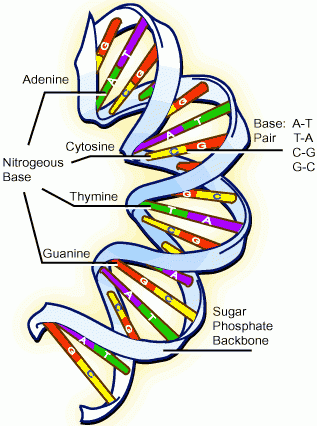
Yale University computer science professor takes a look at protein formation probabilities

How did life begin?
How did life begin?

When I was in graduate school, we studied a book called “Mirror Worlds”, authored by famous computer science professor David Gelernter at Yale University. This week, I noticed that Dr. Gelernter had written an article in the prestigious Claremont Review of Books. In his article, he applies his knowledge of computer science to the problem of the origin of life.

Evolution, if it is going to work at all, has to explain the problem of how the basic building blocks of life – proteins – can emerge from non-living matter. It turns out that the problem of the origin of life is essentially a problem of information – of code. If the components of proteins are ordered properly, then the sequence folds up into a protein that has biological function. If the sequence is not good, then just like computer code, it won’t run.

Here’s Dr. Gelernter to explain:

How to make proteins is our first question. Proteins are chains: linear sequences of atom-groups, each bonded to the next. A protein molecule is based on a chain of amino acids; 150 elements is a “modest-sized” chain; the average is 250. Each link is chosen, ordinarily, from one of 20 amino acids. A chain of amino acids is a polypeptide—“peptide” being the type of chemical bond that joins one amino acid to the next. But this chain is only the starting point: chemical forces among the links make parts of the chain twist themselves into helices; others straighten out, and then, sometimes, jackknife repeatedly, like a carpenter’s rule, into flat sheets. Then the whole assemblage folds itself up like a complex sheet of origami paper. And the actual 3-D shape of the resulting molecule is (as I have said) important.

Imagine a 150-element protein as a chain of 150 beads, each bead chosen from 20 varieties. But: only certain chains will work. Only certain bead combinations will form themselves into stable, useful, well-shaped proteins.

So how hard is it to build a useful, well-shaped protein? Can you throw a bunch of amino acids together and assume that you will get something good? Or must you choose each element of the chain with painstaking care? It happens to be very hard to choose the right beads.

Gelernter decides to spot the Darwinist a random sequence of 150 elements. Now the task the Darwinist is to use random mutation to arrive at a sequence of 150 links that has biological function.

[W]hat are the chances that a random 150-link sequence will create such a protein? Nonsense sequences are essentially random. Mutations are random. Make random changes to a random sequence and you get another random sequence. So, close your eyes, make 150 random choices from your 20 bead boxes and string up your beads in the order in which you chose them. What are the odds that you will come up with a useful new protein?

[…]The total count of possible 150-link chains, where each link is chosen separately from 20 amino acids, is 20150. In other words, many. 20150 roughly equals 10195, and there are only 1080 atoms in the universe.

What proportion of these many polypeptides are useful proteins? Douglas Axe did a series of experiments to estimate how many 150-long chains are capable of stable folds—of reaching the final step in the protein-creation process (the folding) and of holding their shapes long enough to be useful. (Axe is a distinguished biologist with five-star breeding: he was a graduate student at Caltech, then joined the Centre for Protein Engineering at Cambridge. The biologists whose work Meyer discusses are mainly first-rate Establishment scientists.) He estimated that, of all 150-link amino acid sequences, 1 in 1074 will be capable of folding into a stable protein. To say that your chances are 1 in 1074 is no different, in practice, from saying that they are zero. It’s not surprising that your chances of hitting a stable protein that performs some useful function, and might therefore play a part in evolution, are even smaller. Axe puts them at 1 in 1077.

In other words: immense is so big, and tiny is so small, that neo-Darwinian evolution is—so far—a dead loss. Try to mutate your way from 150 links of gibberish to a working, useful protein and you are guaranteed to fail. Try it with ten mutations, a thousand, a million—you fail. The odds bury you. It can’t be done.

Keep in mind that you need many, many proteins in order to have even a simple living cell. (And that’s not even considering the problem of organizing the proteins into a system).

So, if you’re a naturalist, then your only resources to explain the origin of life are chance and mutation. As Dr. Gelernter shows, naturalistic explanations won’t work to solve even part of the problem. Not even with a long period of time.  Not even if you use the entire universe as one big primordial soup, and keep trying sequences for the history of the universe. It just isn’t possible to arrive at sequences that have biological function in the time available, using the resources available. The only viable explanation is that there is a computer scientist who wrote the code without using trial and error. Something that ordinary software engineers like myself and Dr. Gelernter do all the time. We know what kind of cause is adequate to explain functioning code.

New study: college students drink more before casual sex than relationship sex

It turns out that college students use MORE alcohol and drugs when they have sex with strangers, and LESS alcohol and drugs when they have sex with people they are in a relationship with.

Sex events measured against intimacy level (for women only)

This study was reported by the far-left Psychology Today.

Excerpt:

A recent study published in the Journal of Sex Research sheds some light on these questions. A research team headed by Jennifer Walsh analyzed alcohol use in almost 500 casual and 1400 romantic sexual intercourse events that happened to 300 college women on a monthly basis over a period of 12 months. Alcohol use was not very common during romantic sex: 20% of romantic encounters involved some drinking and only 5% involved heavy drinking (defined as four or more drinks). Hookups, on the other hand, were a different story: Women drank during 53% of their hookups, and drank heavily during 38% of all hookups.

But not all hookups are created equal. There was an almost perfect linear relationship between drinking and partner closeness: The less known the partner, the more likely women drank before sex, and the more likely they drank a lot. Look at the graph I created based on their data. When the casual partner was an ex-boyfriend, for example, only 30% of hookups involved drinking and 17% heavy drinking. When the partner was a random stranger, however, 89% of hookups involved drinking and 63% involved four or more drinks!

The writer explains why this happens:

Alcohol also provides an excuse to those who need one. In a world that encourages hooking up but also judges those (especially women) who engage in it too much, many seem to need it. You’re a slut if you hook up with people just because you want to: Good girls don’t actively want to hook up, and being sober means taking full responsibility for your actions. But if you can blame it on the alcohol, you’re absolved of guilt. You can still be a good girl who just happened to make a mistake.

It’s like they want to do reckless and irresponsible things, but they want plausible deniability, so they can’t be judged by anyone.

This study agrees with a study I blogged about before from the University of Virginia, which explained that college students drink before hook-ups in order to be able to explain to their friends why it wasn’t their fault:

A Rutgers University student commented, “If you’re drinking a lot it’s easier to hook up with someone… [and] drugs, it’s kind of like a bonding thing… and then if you hook up with them and you don’t want to speak to them again, you can always blame it on the drinking or the drugs.”

Other women observed that being drunk gives a woman license to act sexually interested in public in ways that would not be tolerated if she were sober. For instance, a University of Michigan student said, “Girls are actually allowed to be a lot more sexual when they are drunk…”

A University of Chicago junior observed, “One of my best friends… sometimes that’s her goal when we go out. Like she wants to get drunk so I guess she doesn’t have to feel guilty about [hooking up].”

Now, the first thing I thought of when I saw this article in Psychology Today was: “I wonder what criteria these college students are using in order to decide which strangers they have sex with”. And then I realized. For perfect strangers, it would have to be something obvious, like physical appearance. A study found that it takes a woman 3 minutes to decide if she likes a man or not. Whatever assessment is being made in that 3 minutes surely isn’t adequate to determine commitment ability.

Don’t judge me, it wasn’t my fault

It reminds me of something I read a while back in a Theodore Dalrymple book. Theodore Dalrymple is the famous psychiatrist who writes books about culture in the UK.

In the chapter “Tough Love” from one of his books, he talks about the nurses he works with:

All the more surprising is it to me, therefore, that the nurses perceive things differently. They do not see a man’s violence in his face, his gestures, his deportment, and his bodily adornments, even though they have the same experience of the patients as I. They hear the same stories, they see the same signs, but they do not make the same judgments. What’s more, they seem never to learn; for experience—like chance, in the famous dictum of Louis Pasteur—favors only the mind prepared. And when I guess at a glance that a man is an inveterate wife beater (I use the term “wife” loosely), they are appalled at the harshness of my judgment, even when it proves right once more.

This is not a matter of merely theoretical interest to the nurses, for many of them in their private lives have themselves been the compliant victims of violent men. For example, the lover of one of the senior nurses, an attractive and lively young woman, recently held her at gunpoint and threatened her with death, after having repeatedly blacked her eye during the previous months. I met him once when he came looking for her in the hospital: he was just the kind of ferocious young egotist to whom I would give a wide berth in the broadest daylight.

Why are the nurses so reluctant to come to the most inescapable of conclusions? Their training tells them, quite rightly, that it is their duty to care for everyone without regard for personal merit or deserts; but for them, there is no difference between suspending judgment for certain restricted purposes and making no judgment at all in any circumstances whatsoever. It is as if they were more afraid of passing an adverse verdict on someone than of getting a punch in the face—a likely enough consequence, incidentally, of their failure of discernment. Since it is scarcely possible to recognize a wife beater without inwardly condemning him, it is safer not to recognize him as one in the first place.

This failure of recognition is almost universal among my violently abused women patients, but its function for them is somewhat different from what it is for the nurses. The nurses need to retain a certain positive regard for their patients in order to do their job. But for the abused women, the failure to perceive in advance the violence of their chosen men serves to absolve them of all responsibility for whatever happens thereafter, allowing them to think of themselves as victims alone rather than the victims and accomplices they are. Moreover, it licenses them to obey their impulses and whims, allowing them to suppose that sexual attractiveness is the measure of all things and that prudence in the selection of a male companion is neither possible nor desirable.

Often, their imprudence would be laughable, were it not tragic: many times in my ward I’ve watched liaisons form between an abused female patient and an abusing male patient within half an hour of their striking up an acquaintance. By now, I can often predict the formation of such a liaison—and predict that it will as certainly end in violence as that the sun will rise tomorrow.

At first, of course, my female patients deny that the violence of their men was foreseeable. But when I ask them whether they think I would have recognized it in advance, the great majority—nine out of ten—reply, yes, of course. And when asked how they think I would have done so, they enumerate precisely the factors that would have led me to that conclusion. So their blindness is willful.

According to Dalrymple’s experience, it’s not that women don’t know that bad boys are lousy at marriage and fatherhood. They know it, but they choose to blind themselves to it, because it’s just too much self-denial to have to be serious about making responsible choices with men and sex and marriage.

My friend Dina often reminds me to evaluate women based on their past choices, not based on the picture of themselves that they paint with words. Wise advice. And it works for women to judge men, too.