All posts by Wintery Knight

https://winteryknight.com/

Christian woman takes on Democrats for voting by feelings instead of to get results

I found an amazing article about the Afghanistan situation over on An Affair with Reason. Laura has a background in defending Christianity to Muslims. She’s traveled all over the Middle East. So, she has a lot of experience in that area, having conversations with those people. I know she’s been to Afghanistan, so she knows what’s going on there. And she’s not happy.

Here’s the post.

She talks about how the Taliban have retaken Afghanistan, are capturing 12-year-old girls for sex slavery, and they are going door to door searching for Christians and U.S. allies to murder them. ISIS, (which nearly took over Iraq under Obama, then was crushed under Trump), is reforming and gaining strength. You might remember that ISIS is famous for sex-trafficking underage female captives. She mentions how China, which runs concentration camps and is a huge human rights violator, has also been emboldened by our weakness.

Since she wrote the article, more news has emerged. You may have heard that 13 American soldiers have been killed by the Taliban, and billions of dollars of high-tech military equipment has  been captured by the Taliban terrorists. Officers who are critical of these policies are being taken off duty and told not to comment on the Biden administration’s failures. The Biden administration is blocking efforts to evacuate Christians. Almost none of the people being evacuated are Christians. 

So, she asks this question for people who supported Biden:

Did our leaders calculate the cost of American lives being lost and decide that it just wasn’t worth it? Did they make the very difficult decision to turn our backs on our allies, abandon 15,000 American citizens in Afghanistan, allow women to be raped and killed, leave Christians to be beheaded and crucified, and permit the rise of terror cells because preventing all of that just wasn’t worth the massive numbers of American lives that were being lost daily in the war in Afghanistan? No! There had not been a single American casualty in Afghanistan in 18 months!! The cost in U.S. lives was down to zero! The huge price had already been paid and now our volunteer-registration military were maintaining a small presence of about 2500 soldiers to keep from losing all that had been gained by the tremendous sacrifice of Americans over the past two decades, both in lives lost and in trillions of dollars spent since September 11, 2001. There was no war, in the traditional sense. There was a small, strategic presence, and it was working magnificently.

The reality is that this decision was made because it’s what the American people demanded. As of April of this year, 69% of Americans wanted a full withdrawal from Afghanistan. And why did Americans think that was a good idea? Because short, catchy, popular phrases that make us look good to others are in, and thoughtful, well-researched, informed positions that go against the tides of culture are out.

We want to be on the side of “Black Lives Matter”, even though the policies of this organization overtly destroy black families and black lives. We want to be on the side of “Science is real”, even though this slogan is used to cover for a definition of science that excludes the supernatural, rejects objective morality, and, well…denies scientific facts. And we buy into foolishness like, “No more endless wars”, when the reality is that our way of life must be defended against the evil that seeks to destroy us.

We have been so dumb for so long, watching trash on television instead of reading great books, receiving our “education” from a government-run system that has rejected the principles upon which this country was built in order to fulfill a demonic agenda, and surrounding ourselves with people who are just as dumb, that we have lost our ability to think critically and to act morally. The drive to withdraw the troops from Afghanistan was no exception.

As Dan Crenshaw, member of the U.S. House of Representatives and a former Navy SEAL who lost his eye during combat in Afghanistan, has said, the argument for bringing home the troops was purely an emotional one. It was not an informed, fact-based decision in which voters and the leaders who represent them weighed the pros and cons and came to a sensible conclusion. Rather, like so many people’s policy positions today, it was driven by an emotion-driven slogan that sounds nice but doesn’t work in the real world. In this case, that slogan was “No more endless wars!”

Politics begins and ends for Democrat voters with their own feelings. They read almost nothing that would help them understand how the world works. They just try to watch social media and TV to see what slogans they need to spout in order to feel good and be liked. It doesn’t matter to them what happens next if policies are enacted. The important thing is to find out what is being praised on social media and TV, and then spout those slogans to their friends.

Consider policies like raising the minimum wage, or fixing the amount that landlords can charge for rent. Democrats support these policies, because they sound “nice”. And they want to feel generous – with other people’s money. But minimum wage hikes results in higher unemployment for low-skilled workers, and rent control results in housing shortages and slums. But if you only care about yourself, then these bad results don’t matter to you. And how can you predict the bad results? You read non-fiction books on economics – something no Democrat is willing to do. They want to feel good, and have an easy life. Reading books is boring and too much work. If they read anything, it’s devotions, self-help, romance novels and entertaining fiction.

That’s why Democrats look at the condition of blacks in America, and they don’t want to criticize the root causes: fatherlessness and government-run schools. It’s easier for them to blame some other successful ethnic group than to tell people who are making mistakes “you need to make decisions like Asians, if you want Asian life outcomes”. Instead of telling the truth, they lie, so that they look good to others.

We really need to do better than voting feelings and peer approval at election time. It’s about the direction of the country – not about your feelings or your need to virtue signal.


New poll: few Millennials describe belief in God as “very important”

Beliefs of millennials and boomers

I saw a very interesting article that compared the attitudes of young people about things like patriotism, religion, freedom, etc. The numbers are very discouraging.

So, here’s the article from the Washington Examiner:

The importance of patriotism, faith in God, and having children is significantly lower among millennials and Generation Z, compared to previous generations.

In a new poll conducted by the Wall Street Journal and NBC News, nearly 80% of people aged 55-91 said being patriotic is important to them, while only 42% of millennials and Generation Z, or those aged 18-38, said the same. Thirty percent of millennials and Generation Z said religion was important, compared to the over 75% of baby boomers, with just over 30% of millennials and Generation Z saying it was important to have children.

Areas where the younger generations had placed higher importance compared to boomers were tolerance for others and self-fulfillment, with financial security being almost tied between the two age groups.

I’m sure that everyone has seen other polls showing the decline of Christianity, especially in mainline and Catholic churches. Evangelicals are declining less, but they are still declining.

The reason I linked to this post is because I’ve noticed that some Christians don’t really think that there is anything to be concerned about. Everything is working fine, they say. Whatever we’re doing right now must be working, because there is no decline. We’re winning, and if you think otherwise, then you’re just complaining.

Well, I don’t really know why there is this decline, all I can do is speak from my experiences. I’ve met people through my blog who did lose their faith in college, and I’ve met ex-Christians in my office, too. I asked them what the problem was, and it seems to be that when they were growing up, they often bullied into behaving like a Christian without being able to ask any questions about whether it was true. And then as soon as they got to college away from their parents and pastors, they just dumped the whole thing.

I remember listening to an amazing lecture a while back by Dr. Scott Waller. I think it was a lecture he gave for the Stand to Reason “Masters Series in Christian Thought” in 2003. The lecture was about Postmodernism in the University. Postmodernism is the view that there are no true or false views, especially with “soft” issues like religion and morality. In the lecture, he talked about how a father had sent his devout Christian son to university, and the son had returned an atheist after one semester. I remember Dr. Waller quoting the son telling his parents “I have come to think of my time growing up in this house as the dark period of my life”. The father was very upset. So Dr. Waller told him what to do. He said, you’re going to need to read a few books on the most common questions that your son has, and then work through the answers with him. And he made a little pile of books about common questions that college students ask, and pushed the pile across the table to the father. And the father pushed the books back across the table to Dr. Waller, and said “well, I don’t have time for reading so many books… but could you just talk to him instead?”

Another thing that seems to cause a lot of young people to  leave the faith in college is sex. Now if I were trying to convince someone to be responsible about sex, I’d try to show them studies and statistics to explain why there really are best practices to relationships and marriage. For example, I’d might show them that the number of premarital sex partners increases marital instability, or that sliding into cohabitation early tends to make marriages less stable. But this takes a bit of work, and you have to work through it with the young people. I just don’t know if parents really reason with their kids like this. But in churches, I’ve noticed that trying to make an argument using evidence isn’t very popular. To me, if I were trying to be convincing to someone about something, I would use evidence. It’s just natural to me to make a case if I’m trying to be persuasive. But making a case just hasn’t been a really big priority in the churches I’ve attended.

So, I guess if I had to give any advice to parents of children, or pastors in churches, it would be that Christianity is in decline, and we need to do more than just order people to memorize Bible verses and creeds, go to church, etc. It’s hard for me to know what’s really going on in everyone’s home, and in everyone’s church. But I don’t think that whatever we’re doing in our homes and churches is working to convince young people that belief in God is very important.

New study: nearly half of millenials reject monogamy

Marriage and family
Marriage and family

Study reported on by The Stream:

A new report found nearly half of American millennials don’t want monogamous relationships.

YouGov revealed the research on monogamy and cheating, showing couples under 30 are significantly less monogamous than older generations.

Only 51 percent of people under 30 reported desiring a “completely monogamous” relationship, compared to 58 percent from the 30-44 age bracket, 63 percent from the 45-64 age bracket, and 70 percent from the 65 plus age bracket polled.

[…]Reports also show that men and women are cheating at almost equal rates.

It’s not just adultery that millenials don’t care about any more, it’s premarital sex. An article from the Washington Post found that both men and women no longer desire their romantic partners to be chaste:

Dating has changed hugely over the past generations, and so have cultural ideas about what men and women value most in a mate.

This idea is perfectly illustrated by a chart that economist Max Roser, who created the blog Our World in Data, recently put out on Twitter. The chart is made with data from a study published in the Journal of Family Issues in 2013, in which three researchers compared how heterosexual men and women ranked the importance of 18 traits in wives and husbands, first in 1939, and then again in 2008.

[…]For both men and women, the importance of chastity nose-dived, from #10 in 1939 to #18 in 2008. Emotional stability and maturity, a pleasing disposition, good health, and refinement and neatness also declined for both sexes.

For women, a similar religious background and a desire for home and children became less important in their mates, while men placed less value on ambition and industriousness in their wives.

It goes without saying that adultery is more like to reduce marriage stability. And studies also show that marriage stability is severely impacted by the number of premarital sex partners.  That’s why chastity matters: it’s a predictor of marital stability. If a person can control themselves before marriage when they don’t get any sex, it’s easier to control themselves when that need is being supplied safely and generously. Also, chastity just reinforces the idea that sex is something that is done within a lifelong commitment, not something that is done outside of a commitment for fun and thrills. I don’t that the millenial approach of premarital unchastity and post-marital non-monogamy is going to help them keep their marriages together.

But young people today aren’t interested in looking at studies to figure out how to do marriage right so that it will last. They make their decisions with their feelings. They value what the culture tells them to value, rather than picking a mate who has the skills and abilities to make the marriage last.

How well is picking mates based on emotions rather than demonstrated ability working out? The marriage rates are plummeting:

Gallup poll:

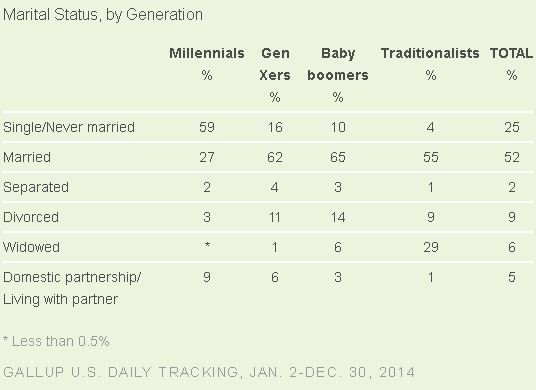
Contrary to what we would expect, given normal demographic patterns of adolescents’ movement into early adulthood and family formation, the data show that significantly more millennials are currently single/never married than was true for those in older generations, and considerably more are in domestic partnerships. Specifically, more than half of all millennials (59%) have never married, and 9% are in domestic partnerships. Gallup has noted a trend toward fewer young adults being married in recent years.

In the 2014 Gallup Daily tracking data, just 27% of millennials were married. According to historical U.S. Census Bureau data, 36% of Generation Xers, 48% of baby boomers and 65% of traditionalists were married when they were the age that millennials are now. For millennials currently aged 18 to 30, just 20% are married, compared with nearly 60% of 18- to 30-year-olds in 1962, according to the U.S. Census. When Gen Xers were the same age, 32% were married; for baby boomers, it was more than 40%.

Millennials are clearly delaying marriage longer than any generation before them, in spite of evidence suggesting that many millennials intend to marry at some point. For example, a 2013 Gallup poll found that 86% of single/never married Americans aged 18 to 34 (roughly equivalent to the millennial generation) wanted to get married someday.

Table:

Marriage rates across different generations of Americans

Who can keep a relationship going when the top criterion is ability to entertain rather than ability to commit self-sacrificially? I hear lots of Christian women say they want to get married “some day”, but there they are in their mid 30s, unemployed, penniless, with empty resumes, backpacking through Europe. The words “some day” sound good to their parents and pastors, but the actions are all about hedonism and thrill-seeking – just what the culture told them to do, in order to have a meaningful life.

Is there a cost to the younger generation turning their backs on traditional marriage, including the norms of chastity, fidelity and permanence?

I saw an article on the Public Discourse that talked about the fiscal costs of abandoning traditional marriage.

It says:

In 1965, liberal Harvard political scientist Daniel Patrick Moynihan was astonished to find that about 25 percent of African-American children were born out of wedlock. Moynihan was deeply worried about this finding because he knew exactly what being born out of wedlock means for a child. Decades of social science confirm what common sense has always taught us: that children born out of wedlock are disadvantaged in every way. They are more likely to be physically and mentally ill, more likely to be poor and unhappy, more likely to have trouble in school and with education generally, more likely to be abused sexually, more likely themselves to abuse others sexually, more likely to abuse alcohol or other drugs, and more likely to engage in criminal activity and to have a disdain for authority.

This, in turn, invariably increases the size and scope of the power of the state. The state must expand to replace fathers who have abandoned their families by providing for single mothers. It must increase its public-health efforts to provide for children whose single parents cannot pay for private healthcare and to treat victims of violence committed by those who have been raised in an environment that has failed to equip them for a robust and peaceful social life. It must create and maintain adoption agencies to care for children whose parents are unfit or absent. It must commit more funds to police departments to address crime that results from families breaking apart (or failing to form in the first place), and hence failing to instill virtue in children. It must commit funds to the creation of prisons where criminals are to be kept. The list goes on and on.

The economic costs of abandoning social conservatism, then, run quite high—in addition to all of the unquantifiable social costs of broken families, deaths, broken relationships, and ruined lives. It is no surprise that leftists, committed to consolidating power in the state, have sought to undermine the family: they realize—better than many fiscal conservatives do—that a flourishing marriage culture is required for free markets and limited governments to exist.

So, there really is a cost to the embrace of moral relativism. When morality goes, expensive things happen, and government grows to pick up the costs. The bigger the government grows, the taxes are required to pay for it, leaving you with less of your own money – less of your own freedom to live how you want to live.