All posts by Wintery Knight

https://winteryknight.com/

Most Americans think cohabitation leads to a stable marriage, but what does the data say?

Men who cohabitate are not certain that the relationship is permanent

If there’s one thing that ought to lead people to Christianity, it’s the proven ability of the Christian moral rules to guide believers away from the sins that destroy them. A lot of modern “Christians” have reduced Christianity to being about their feelings and their community, while allowing the culture to determine their goals and moral boundaries. But that won’t protect them from danger.

Cohabitation describes the situation of a couple moving into the same home and being sexually active, but without any legally-recognized commitment. It’s extremely popular among young people today, and even Christians.

Consider this article from The Federalist about cohabitation:

A new Pew Research Center study shows Americans both cohabitate (“live with an unmarried partner”) and find cohabitation acceptable more than before.

[…]More young adults have cohabited than have married. Pew’s analysis in the summer of 2019 of the National Survey of Family Growth found that, for the first time ever, the percentage of American adults aged 18-44 who have ever cohabited with a partner (59 percent) exceeded the percentage of those who have ever married (50 percent).

I thought this was very interesting, especially for the Christian parents and pastors who imagine that their lovely pious daughters all have a Christian worldview just because they sing in the church choir:

Just 14 percent hold a view consistent with a biblical sexual ethic, that cohabitation with an unmarried romantic partner outside of marriage is “never acceptable.”

Just to be clear, in my life I’ve met about 6 non-Christian men who cohabitated with women, and every single one of them cohabitated with a Christian-raised woman. That should tell you what young women are being told about relationships in their homes and churches about sex and marriage. “Do whatever you want”.

So what purpose does cohabitation serve?

A majority of Americans (69 percent) say that “it is acceptable for an unmarried couple to live together even if they don’t plan to get married.” They may assume that they can decrease their chances of a bad marriage and increase their chances of a good one by giving the relationship a cohabitation “test run.”

[…]A plurality of Americans believe cohabitating before marriage yields more successful unions. Nearly half of Americans (48 percent) believe that couples who live together before marriage “have a better chance of having a successful marriage.” This view is even more prevalent among young adults aged 18-29 (63 percent).

Another 38 percent of all Americans say cohabitation “doesn’t make much difference” on marital success. Only 13 percent of Americans believe cohabiting couples have “a worse chance” of having a successful marriage.

[…]Most Americans believe cohabitating couples raise children just as well as married couples. Pew also surveyed people’s opinions about cohabiting couples raising children, and 59 percent of Americans declared that cohabiting couples “can raise children just as well as married couples.” Again, the younger respondents were most likely to have a favorable view of cohabitation: among adults aged 18 to 49, 67 percent agreed cohabiting couples do just as well, while 32 percent said: “Married couples do a better job raising children.”

Yes, cohabitation seen as a test run, and it’s supposed to make stable marriage more likely and not be harmful to children at all.

But why think that a test run should be part of getting married? After all, when I buy a parrot from the pet store, I don’t expect to later return that parrot. Why not? Because I am not buying the parrot to enhance MY life. I am buying the parrot to make a commitment to care for the parrot. Whether the parrot fulfills any of my needs is irrelevant to me. I want the bird in my house so that I can decide what it eats, what it drinks, and invest myself into making it happy, according to its birdish nature. This is because I think that parrots have value in and of themselves, and they deserve a certain quality of life. When I buy the parrot, I am guaranteeing a permanent commitment to the bird to provide for its needs, physical and emotional. And that commitment carries forward to the time (now) when the bird is elderly, and can’t even fly up to his cage or down to the floor. He calls for me, and I go over and pick him up and move him. That’s commitment.

Cohabitation, on the other hand, is the practice of saying to another human being: “I am going to try you out as an entertaining commodity in my home, but if you don’t fulfill my needs then I’m going to send you right back.” That’s not a commitment. That’s self indulgence. It’s defining a relationship as entertainment that is designed to meet my needs and make me happy. And that’s because the concept of commitment in relationships is not presented to young people at any time in their lives. Not from parents. Not in churches. Not in the secular left culture as a whole. Everything is a consumer good designed for the purpose of entertainment – including people. It was only the Christian worldview that had a view of people as creatures made by God for eternal life, so that marriage was about guarding the other person’s faith, and building them up to achieve all the things that God wanted them to achieve for his purposes.

But does cohabitation really work to create stable relationships? After all, anyone can find a partner when they’re young and pretty. The real question is whether that partner will stick around when you’re old and ugly and can’t be as “fun” as you used to be.

Here’s a recent (2018) study on cohabitation and stability:

A new study published in the Journal of Marriage and Family finds that the “premarital cohabitation effect” lives on, despite what you’ve likely heard. The premarital cohabitation effect is the finding that those who live together prior to marriage are more likely, not less, to struggle in marriage.

[…]Michael Rosenfeld and Katharina Roesler’s new findings suggest that there remains an increased risk for divorce for those living together prior to marriage, and that prior studies suggesting the effect has gone away had a bias toward short versus longer-term effects. They find that living together before marriage is associated with lower odds of divorce in the first year of marriage, but increases the odds of divorce in all other years tested, and this finding holds across decades of data.

Strategy advice to those who debate this issue: just be aware that Team Secular Leftist is using papers that have short-range samples, which don’t show the instability problem, because they deliberately cherry-pick recently married couples.

And what about children raised in cohabitating relationships?

While Americans are optimistic about the ability of cohabiting couples to raise children, a study published by the American College of Pediatricians in 2014 reported that children whose parents cohabit face a higher risk of: “premature birth, school failure, lower education, more poverty during childhood and lower incomes as adults, more incarceration and behavior problems, single parenthood, medical neglect and chronic health problems both medical and psychiatric, more substance, alcohol and tobacco abuse, and child abuse,” and that “a child conceived by a cohabiting woman is at 10 times higher risk of abortion compared to one conceived in marriage.”

I’m just going to be blunt here. The majority of young people are progressives, and they vote for candidates who believe in abortion through all nine months of pregnancy, and even after birth. Why? Because they don’t want to have their right to seek happiness impacted by the needs of other people. Progressives believe that children, if they exist at all, should enhance the lives of their adult owners. No one should be surprised that people who think that killing inconvenient children is moral are willing to inflict other bad outcomes on them by raising them in an unstable cohabitation environment.

Is there evidence of systemic racism in the United States?

Systemic racism is the idea that people can’t lift themselves out of poverty by making good decisions, because powerful groups in society that hold the poor down, regardless of their decisions. Do you think that America is a place where no matter what choices you make, you’ll never be able to be more prosperous? That’s what the leaders of Black Lives Matter think.

Here’s what Nikole Hannah-Jones, creator of the 1619 Project, says in the New York Times (a former newspaper):

To summarize, none of the actions we are told black people must take if they want to “lift themselves” out of poverty and gain financial stability — not marrying, not getting educated, not saving more, not owning a home — can mitigate 400 years of racialized plundering.

Got that? It doesn’t matter what individual choices a non-white person takes in America, they’re going to be poor. The “systemic racism” of the powerful whites will always keep them down. Single motherhood doesn’t make people poor, and marriage doesn’t make people wealthier. Dropping out of high school doesn’t make you poor, and getting a Masters degree in computer science won’t make you wealthier.

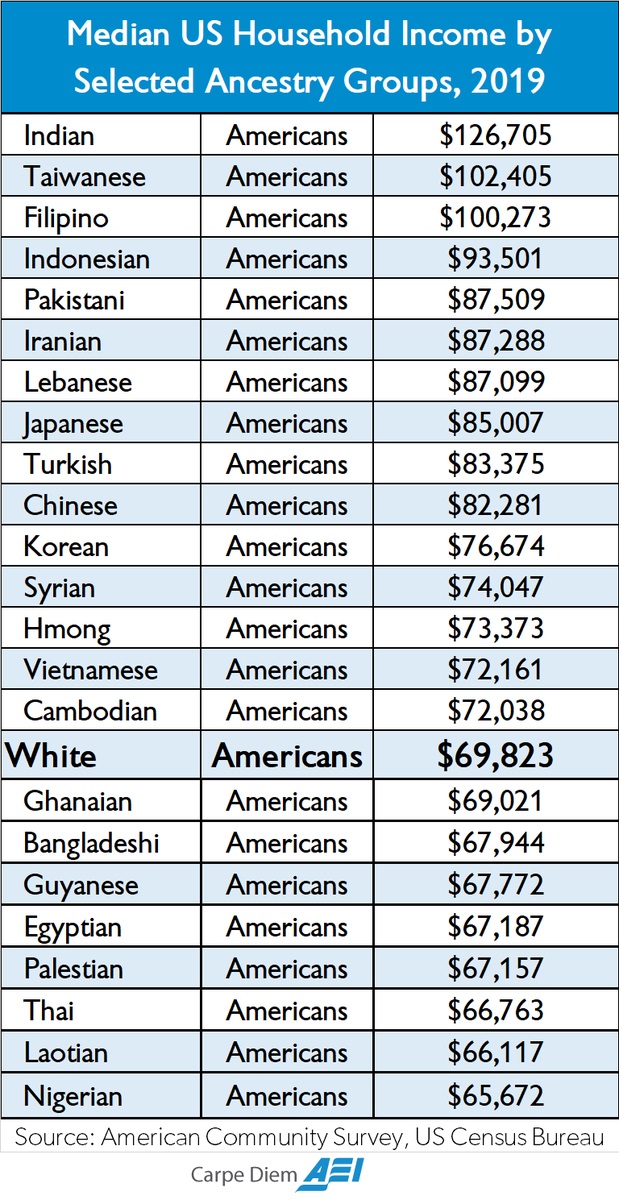
But let’s take a look at the data from the 2019 Census, and see the evidence:

Income By Ethnicity in America

White people are doing a bad job of keeping non-whites down

Well, it looks like at least SOME people of color are able to do well in America despite all the “systemic racism” that keeps non-whites down. And do you know what those non-white groups at the top have in common? They’ve made good decisions, they’ve worked hard, they haven’t blamed other people when they fail, and they’ve saved their money instead of spending it on shiny junk.

Let’s look at some decisions that the non-whites who are prosperous have made, that those further down have not.

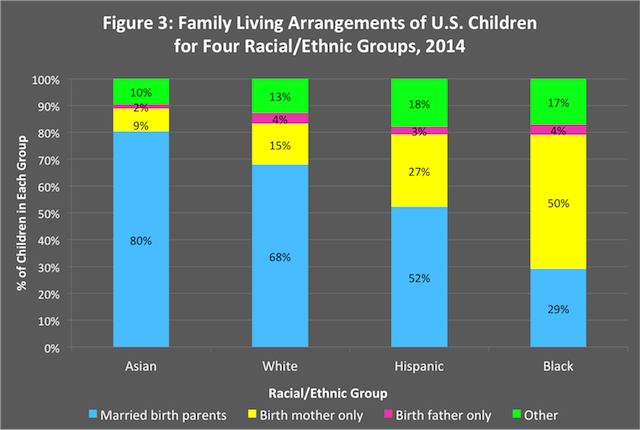
Asians marry before they have children, so the kids have two parentsAsians marry before they have children, so the kids have two parents

Education and marriage

This article is written by the far-left radical Nicholas Kristof, writing in the radically-leftist New York Times (a former newspaper).

Excerpt:

A new scholarly book, “The Asian American Achievement Paradox,” by Jennifer Lee and Min Zhou, notes that Asian-American immigrants in recent decades have started with one advantage: They are highly educated, more so even than the average American. These immigrants are disproportionately doctors, research scientists and other highly educated professionals.

It’s not surprising that the children of Asian-American doctors would flourish in the United States. But Lee and Zhou note that kids of working-class Asian-Americans often also thrive, showing remarkable upward mobility.

[…]There’s also evidence that Americans believe that A’s go to smart kids, while Asians are more likely to think that they go to hard workers… Asian-American kids are allowed no excuse for getting B’s — or even an A-. The joke is that an A- is an “Asian F.”

One reason Asians students do so well is because their parents are usually married:

Strong two-parent families are a factor, too. Divorce rates are much lower for many Asian-American communities than for Americans as a whole, and there’s evidence that two-parent households are less likely to sink into poverty and also have better outcomes for boys in particular.

American blacks have a 73% out-of-wedlock birth rate. A huge difference compared to Asians.

So, when Nikole Hannah-Jones tells you that education and marriage don’t matter, she’s just wrong.

Compound interest

Education and marriage are important, but so is saving your money. The wealthiest people in America are typically the ones who are experts at saving money early, and investing it. They know about the law of compound interest. If you invest money early and leave it alone, then it will grow into a fortune by the time you are read to stop working.

This graph explains compound interest:

Don't trust people with non-STEM degrees to tell you how to get richInvesting $24,000 from age 21 to 41 vs investing $24000 from age 47 to 67

What does Nikole Hannah-Jones say when she looks at that graph? She doesn’t think that saving money makes a difference to having more or less wealth. She thinks skin color determines whether saving money makes you wealthy or not. The graph clearly shows what we should be recommending to young people of color. They need to stop spending money and start saving it, and the earlier the better. It doesn’t matter what your skin color is, saving money early JUST WORKS.

Similarly, when she says that home ownership doesn’t make you more wealthy, this is just terrible advice. It’s always better to pay down your own mortgage (at least when interest rates are low like they are now) than to pay someone else rent. You have to live somewhere, and paying for your own home is better because it costs about the same as rent, and then you get to keep the home when you’re done paying for it.

Communism

Nikole Hannah-Jones does have a “solution” to disparities in wealth. Her solution is communism. She wants to transfer money from those who earn, to those who don’t. But we already have tried that in the 20st century and it resulted in the deaths of over 100 million people. That’s not my opinion, that’s all documented in a book published by Harvard University Press.

Socialism Communism Countries Per Capita GDP Income

You don’t even have to read the book to know the truth – just look at countries that score low on the Index of Economic Freedom, and compare their GDP per capita to countries that score high on the Index of Economic Freedom. The more communist a nation goes, the less wealth there is for the citizens. That’s why people in Venezuela are eating zoo animals and selling their bodies in prostitution for food, while nearby capitalist countries like Panama and Chile prosper. Nikole Hannah-Jones wants to reduce economic freedom, but we know by looking at other countries that this lowers per-capita GDP.

There’s a lot more than could be said here, but the point is that we need to be telling American blacks to make decisions that match the decisions of other successful non-white communities in America. We need to start teaching young people basic economics so they don’t fall prey to charlatans.

Why don’t men go to church anymore? The decline of male church attendance

I most recently spent half a year at a PCA church, and then another half a year at a Southern Baptist church. I attended Sunday services as well as Wednesday night Bible study. I am now looking for a new church. For now, I just look around for a sermon I like and listen to that. In this post, I’ll explain why I think men don’t like church.

There are three areas where churches fail to attract men:

    1. Apologetics
    2. Feminism, sex and marriage
    3. Policy and current events

Apologetics

The PCA church discouraged me from becoming a member of the church because they said that conversion to Christianity due to reason and evidence was contrary to their teachings, and a “red flag”. Their words. I didn’t try to fight them on it, because they are Reformed Presbyterian, and this is their actual view. Their approach to apologetics was “pre-suppositional”, which is to say, they try to convince people to become Christians by asking them to assume that the Bible is infallible, without any argumentation or evidence. Naturally, this doesn’t work, so they aren’t trained to answer any serious questions from non-Christians. (1 Pet 3:15-16)

The Reformed Baptist SBC church is led by people like Russell Moore and Al Mohler, who take the “magic words” approach to evangelism. I.e. – they think that people become Christians just by speaking Bible verses out of context to them. So, when the atheist asks “do you have any evidence for God’s existence?” or “do you have any evidence for Jesus’ resurrection?”, their response is to quote Bible verses to the atheist, which have nothing to do with those topics. Christianity has lost so much influence in the culture under their approach, which is not even Biblical. (Mat 12:38–41)

These approaches to evangelism are not used in any other area of human endeavor. No one replies to questions about auto mechanics, or software engineering, or gardening, or cooking, by spouting Bible verses. In literally every other area of human endeavor, the laws of logic and supporting evidence are seen as assets when making claims to know something about the world to someone who disagrees with you.

Feminism, Sex and Marriage

First wave feminism simply asked for women to be given the same liberty and opportunity as men. That was good. But later versions of destroyed all distinctions between men and women. By destroying femininity, feminism directed women away from the traditional life plan of marriage, children and home-making.

Feminism changed how women voted. Today, about 75% of young, unmarried women vote for policies like taxpayer-funded birth control, taxpayer-funded abortion, no-fault divorce, affirmative action for women in schools and in the workplace, taxpayer-funded daycare, public schools, single-mother welfare, social security, etc. These policies and programs raised tax rates, and grew government, making it easier for women to have children without having to choose a marriage-ready man she wasn’t attracted to. Instead, she could choose men she was attracted to, and just use government programs as a substitute provider if it didn’t “work out”. Thanks to feminism, we have a 42% out-of-wedlock birth rate, and it’s rising. Few female college graduates are debt-free. About 5% of women emerge from college as virgins.

Under feminism, the traditional male roles and virtues were deemed “sexist”. Women were shamed for choosing early marriage, large families, and stable men who were good at being husbands and fathers. Instead, women today chose men based on appearance. They spend their 20s and early 30s giving men who will not commit to them premarital sex. The men who are getting sex thrown at them have no interest in Judeo-Christian values, chastity, fidelity, commitment or raising children. Women mistake the men’s willingness to have sex and cohabitate as signs that they are close to marriage. But in fact, chasing the hot bad boys just eats up the chastity, youth and beauty that could have made them interesting to the marriage-minded men they scorned. Later on, they realize that they’ve wasted their 20s on bad boys, but by then they are not attractive for marriage.

What has the response been to feminism from pastors and churches? They accept the anti-male, anti-marriage policies, that came out of feminism. They accept the promiscuity, and the marriage-delaying that came from feminism. Today, pastors just try to bully the men who were passed over to marry the women who had previously rejected them, despite the higher risk of divorce caused by the women’s past behavior.

Policy and current events

Most pastors are anti-intellectual, and they believe that this is a virtue, since they are focused narrowly on what the Bible explicitly says. Because of this, they aren’t able to understand which laws and policies allow Christianity and Christian families to flourish. I agree that what the Bible speaks about is of the highest importance. But we need to understand how to achieve the goals that the Bible states, as well as how to counter the forces that threaten the achievement of those goals.

For example, Christianity thrives when marriage thrives. Christianity is passed on from parents to children. Anything that threatens marriage, or interferes with parental authority, weakens the influence of Christianity. So, policies like higher taxes, no-fault divorce, SOGI laws, all harm the Christian family, while policies like lower taxes, protections for Christian businesses, protection for Christian schools (statements of faith, moral codes), etc. are all good for Christian families. But most pastors never talk about policies or laws, because they don’t think about how to defend the Christian worldview, how to educate Christian children, how to promote marriage, how promote Christian moral values in the public square. Even protecting the right to life of unborn children is ignored.

As the churches lose relevance, it becomes tempting for pastors to accept what the secular left promotes as good and true and beautiful. The big one is pastors pushing for redistribution of wealth by the secular government as a solution to “poverty”, even though the Bible only sanctions voluntary charity. This diminishes the cultural relevance of the church and elevates the secular government. SBC leaders like Russell Moore champion amnesty for refugees and unskilled illegal immigrants, not realizing how it will harm Christian institutions and values down the road to import large numbers of people who will eventually vote for policies like higher taxes, bigger government, etc.