All posts by Wintery Knight

https://winteryknight.com/

Greg Koukl offers eight tips for effective witnessing

A tactical approach makes Christianity like mixed martial arts
A tactical approach makes Christianity more fun

From Stand to Reason – some excellent tactical advice from a master apologist.

Here’s the setup:

I overheard a conversation on the airplane coming back from my vacation in Wisconsin.  A Christian gentleman was vigorously sharing his faith with a gentleman in the seat directly behind me.  There are some things we can learn, both good and bad, from what I overheard and take his effort—which was a good one—and channel it in a little bit more constructive direction.

So I am going to give you eight points of application.

And here are my favorites from his list:

3.  Try to stay away from religious language, terminology, and religious affect. This person was very religious in his whole approach.  I think this is hard for us as Christians because we are brought up in a Christian environment and it’s natural for us to talk this way, but it sounds weird to people outside of that environment.  I think there are a lot of people who may be, in principle, interested in a bona fide, genuine relationship with God through Jesus Christ but who are not interested in the Christian religion as they perceive it.  This is where I think a lot of the emergent guys have a legitimate bone to pick with Evangelicalism.  Let’s try not to sound like Bible-thumping fundamentalists if we can avoid it, even if that’s what we are, because there’s no need to sound that way if it puts people off.  Find another way to communicate the message.  Just talk in a straightforward manner.  Be conscious of using religious language the other person may not understand or may think is strange.  Avoid all of that so they can hear the message you’re trying to communicate.

4.  Focus on the truth, not personal benefits of Christianity. I appreciated the gentleman’s approach in that he kept talking about truth.  One person he was talking to said he liked reincarnation.  The Christian man said that even if he liked reincarnation that that didn’t make it true if it’s not true.  Liking something is not going to change reality.  That’s a great point.  He was focusing on the truth claims of Jesus.  He wasn’t giving a bunch of promises.  He wasn’t saying, “Jesus is my ice cream.  He’s a great flavor.  Try him to see if you like him, too.”  Or, “Try Jesus because he’ll make your life so wonderful.”  Focus on truth and not personal benefits.

5.  Give evidence. This gentleman was giving all kinds of evidence for his seatmates to consider.  Good for him!  You should too.  You know why?  Because people in the Bible did, too.  Jesus, Paul, Peter, all the Apostles.  If you look at the details of how they communicated their faith they gave evidence for the truth of what they were saying about Jesus.  In fact, if you want to get the content of the Gospel, one of the most famous passages for the articulation of the Gospel is the beginning of 1 Corinthian 15.  Paul gives all kinds of evidence.  It’s all right there as he is explaining the Gospel.  We see that all through the New Testament.  So give evidences.  It’s appropriate.  People do respond to that even in a postmodern age.

I remember that I was once working in Chicago, and after a particular good apologetics discussion with a team of engineers, I apologized to them all for being so exclusive and a fundamentalist. These guys all had MS and PhD degrees in computer science from top schools like Stanford, Purdue, U of I, NIU and Northwestern. They said “you’re not a fundamentalist”. And I said, “but I am ultra-conservative in my theology!”. And they said “That’s ok – as long as you have considered different points of view and you have objective evidence, then somehow it doesn’t sound fundamentalist”.

I think that’s something that we need to work on. When Christianity is about truth, it’s open to investigation using public evidence. At work, I have explained the structure of DNA molecules in the office and had people rolling their chairs out of their cubicles to come and see me draw amino acid chains on a white board, and calculate the probabilities with a calculator. (You have to have the calculator – otherwise the whole thing doesn’t work!). You can be a fundamentalist, without sounding like a fundamentalist. You just have to focus on truth. If the truth out there is fundamentalist, then you can be a fundamentalist.

Look here:

Make religion about truth – not personal preferences. They respect that way of talking – as long as you bring the science and the history. My advice is to study all the physics, astronomy, chemistry, math and biology you can. Study all the new testament and ancient history you can.

More Greg Koukl

Jim Wallace and the case-making Christian

To make a good case, you need to be prepared

I found an interesting post by Jim Wallace of Please Convince Me. (H/T The Poached Egg)

Wallace responds to the alarming statistics of Christians abandoning their faith as soon as they get to university, often because of intellectual doubts. He also notes that many young Christians who don’t fall away don’t really have a Biblical worldview at all.

Here’s the problem:

Many students are walking away from Christianity because they no longer believe it is true. In a survey conducted by sociologists Christian Smith and Melinda Denton and recorded in their book, “Soul Searching: The Religious and Spiritual Lives of American Teenagers” (Oxford University Press, 2005), 32% of former believers said they left because of intellectual skepticism…

The young Christians who were surveyed said that they believed in the existence of a God who created and ordered the world and watches over human life here on earth. They also believe that this God wants people to be good, nice, and fair to each other, (as they claimed the Bible teaches, and as most other world religions also teach). They said that the central goal of life is to be happy and to feel good about oneself. They did not believe that God needed to be involved in one’s life except when He is required to solve a problem, and they said that good people go to heaven when they die. Not much of this version of “Christianity” resonates with the classic, orthodox truth of the Christian Worldview, does it?

And here’s his solution, passionately argued:

When asked what it means to be a Christian, few of us would respond that being a Christian means becoming a ‘defender of the faith’. Most of us shy away from challengers and those who hold opposing beliefs; many of us are uncomfortable with the potential confrontation. But being a Christian demands that we become proficient “case makers”. Think about it for a minute. We would all agree that our salvation does not depend on our ability to defend what we believe. After all, we are saved when we trust Jesus for our salvation and recognize that we are fallen, sinful creatures in need of a Savior. When we recognize that Jesus is God incarnate and paid the penalty that we deserve, we begin to embrace the promise of God to rescue us from ourselves! This trust in Christ as Lord and Savior is what saves us.

But we need to recognize that our Christian life is more than one of trust. It is also a life of knowledge and expression. God has called us to think about what we believe and defend it to those who might challenge us or simply ask questions (more on that HERE). Christian “case makers” who have accepted this challenge are often called “apologists”. The word “apologist” comes from the Greek word “apologia” which simply means “speaking a defense”. The term does have some liability, however, for a couple of reasons. First, the related term, “apology” leaves many with the impression that Christians think they have something to apologize for when they engage in “apologetics”. Nothing, of course, could be further from the truth. Secondly, our present culture has a tendency to view apologists as professional speakers of one kind or another. Even Christians tend to think of apologetics as something to be done by professionals, rather than an important responsibility to be embraced by each and every Christian. It’s time to recognize the fact that all Christians are called to be a Christian “case makers”; the situation couldn’t be more urgent.

[…]There’s a reason why God calls us to worship Him with our minds, understand the value of evidence, examine our beliefs until we are convinced, and then become Christian “case makers” (more on that HERE)! While it is our faith and trust in Christ that saves us, it is our ability to make the case for Christ that protects us and transforms our world. We need to become “case makers” just as Paul was a “tent maker”. “Case making” needs to be a part of our Christian identity, and all of us need to be apologists for the Christian Worldview. We cannot continue to delegate this responsibility to well known apologists and Christian authors. We don’t need one ‘million dollar apologist’; we need a million ‘one dollar apologists’. All of us can be equipped to defend our faith; it doesn’t require a master’s degree in apologetics; it doesn’t require a library full of books, or a radio show, or a podcast. It simply requires the personal commitment to learn the truth and defend it to others.

This article is pretty long, but it has a lot of information based on his experience as a cold case police detective.

Here’s a snippet that should get you to read the whole thing:

Call Witnesses Selectively

Once the Opening Statements have been made, it’s time to begin presenting the evidence to the jury. Much of this evidence will simply be the testimony of important expert witnesses. The attorneys have to select these witnesses carefully and judiciously. Each case is different and will require specific types of experts. Some cases require DNA experts, others require experts in material evidence; some cases require coroners or doctors, others require weapons specialists. The attorneys have the burden of deciding which types of experts will be needed to best make the case.

As a Christian…

I’ve got to do something very similar if I want to be a “Case Making” Christian. While I may be very familiar with the scientific or philosophical work that has been done on a particular topic, I have to be careful not to overload the conversation with the opinions of too many “expert witnesses”. I have to be specific and targeted in the way that I bring experts into the conversation. I also need to be well versed in the work that these experts have done so that I can accurately quote them.

A “Case Making” Tip:

Become a specialist. It’s important to have a broad understanding of a number of apologetic issues, but I know there are some places where I am weak, and some places where I am stronger. I try to focus on those areas that are off special interest to me and it’s in these areas that I am most familiar with the experts in the field. See yourself as the foreman on a jury. You and I don’t have to BE expert witnesses; we simply need to be able to reiterate what the expert witnesses have said once we get back in the jury room with the other jurors.

This is point #3 in his list of 7 points. He’s basically saying that you have to be able to represent the work of the experts intelligently, instead of just reading what they’ve written out loud, which could take forever. You need to read the experts, and then support your case with relevant quotes from the experts, showing how they support arguments that you understand – because you made them. And this preparation and specialization is not based on what is easy for you, or based on what you like, but is instead based on what is effective for your audience. If your audience finds science appealing, then to science you will go. Hint: most men like science, math and computers. Whatever you choose, logic, science, history – it has to be focused on demonstrating the truth of Christianity – NOT Christianity as life-enhancement.

Call Witnesses Selectively
Once the Opening Statements have been made, it’s time to begin presenting the evidence to the jury. Much of this evidence will simply be the testimony of important expert witnesses. The attorneys have to select these witnesses carefully and judiciously. Each case is different and will require specific types of experts. Some cases require DNA experts, others require experts in material evidence; some cases require coroners or doctors, others require weapons specialists. The attorneys have the burden of deciding which types of experts will be needed to best make the case.
As a Christian…
I’ve got to do something very similar if I want to be a “Case Making” Christian. While I may be very familiar with the scientific or philosophical work that has been done on a particular topic, I have to be careful not to overload the conversation with the opinions of too many “expert witnesses”. I have to be specific and targeted in the way that I bring experts into the conversation. I also need to be well versed in the work that these experts have done so that I can accurately quote them.
A “Case Making” Tip:
Become a specialist. It’s important to have a broad understanding of a number of apologetic issues, but I know there are some places where I am weak, and some places where I am stronger. I try to focus on those areas that are off special interest to me and it’s in these areas that I am most familiar with the experts in the field. See yourself as the foreman on a jury. You and I don’t have to BE expert witnesses; we simply need to be able to reiterate what the expert witnesses have said once we get back in the jury room with the other jurors.

Republicans introduce national right-to-work legislation

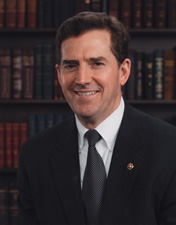
Sen. James Demint

From the Hill.

Excerpt:

Eight Republican Senators introduced a bill Tuesday giving workers a choice as to whether to join labor unions, which they argue will boost the nation’s economy and provide an increase in wages.

Sen. Jim DeMint (R-S.C.), introduced the National Right to Work Act to “reduce workplace discrimination by protecting the free choice of individuals to form, join, or assist labor organizations, or to refrain from such activities,” according to a statement.

Seven other Republicans signed onto the effort: Sens. Tom Coburn (Okla.), Orrin Hatch (Utah), Mike Lee (Utah), Rand Paul (Ky.), James Risch (Idaho), Pat Toomey (Pa.) and David Vitter (La.).

“Facing a steady decline in membership, unions have turned to strong-arm political tactics to make forced unionization the default position of every American worker, even if they don’t want it,” Hatch said. “This is simply unacceptable. At the very least, it should be the policy of the U.S. government to ensure that no employee will be forced to join a union in order to get or keep their job.

“Republicans cited a recent poll they said shows that 80 percent of union members support having their policy and that “Right to Work” states outperform “forced-union” states in factors that affect worker well being.

From 2000 to 2008, about 4.7 million Americans moved from forced-union to right to work states and a recent study found that there is “a very strong and highly statistically significant relationship between right-to-work laws and economic growth,” and that from 1977 to 2007, right-to-work states experienced a 23 percent faster growth in per capita income than states with forced unionization.

“To see the negative impacts of forced unionization, look no further than the struggling businesses in states whose laws allow it,” Vitter said. “It can’t be a coincidence that right-to-work states have on balance grown in population over the last 10 years, arguably at the expense of heavy union-favoring states.”

DeMint blamed the problems faced by U.S. automakers on the unions.

“Forced-unionism helped lead to GM and Chrysler’s near bankruptcy and their requests for government bailouts as they struggled to compete in a global marketplace,” he said. “When American businesses suffer because of these anti-worker laws, jobs and investment are driven overseas.”

If you want to attract businesses, then you need to have pro-business laws. That’s where jobs come from – businesses.

Here’s an article about states who are trying to pass these laws to attract more employers.

Excerpt:

Currently 14 states beyond Indiana and Wisconsin are considering legislation that would limit union benefits and/or collective bargaining power. They are: Alaska, Hawaii, Maine, Michigan, Minnesota, Missouri, Montana, New Hampshire, New Mexico, Ohio, Pennsylvania, Virginia, Washington (state) and West Virginia. In any number of these states, supporters have planned or held rallies against the measures. But public support might be less than deep. According to a Rasmussen Poll conducted late last week and released Monday, 48 percent of likely U.S. voters sided with Wisconsin Governor Walker whereas only 38 percent sided with his union opponents; the other 14 percent were undecided. And 50 percent of the respondents favored reducing their home state’s government payroll by one percent a year for 10 years either by reducing the work force or reducing their pay. Only 28 percent opposed such action.

This is how we are going to turn the recession around. Cut off the spending on left-wing special interests – NPR, PBS, ACORN, Planned Parenthood, Unions. They all will have to pay their own way, just like the grown-ups do.