All posts by Wintery Knight

https://winteryknight.com/

Should Christians be socialists?

Philosopher and theologian Jay Wesley Richards discusses Christianity, the Bible, capitalism and socialism in the leftist Washington Post. He is responding to someone who thinks that Christianity is somehow socialist.

Excerpt:

His assertion that Jesus and Christianity are inherently socialist fares no better. Although he refers to Jesus as a socialist, the only biblical texts he appeals to are from the book of Acts (chapters 2-5), which describes the early church in Jerusalem (after Jesus ascension into heaven). The central text is worth quoting:

Now the whole group of those who believed were of one heart and soul, and no one claimed private ownership of any possessions, but everything they owned was held in common. . . . There was not a needy person among them, for as many as owned lands or houses sold them and brought the proceeds of what was sold. They laid it as the apostles’ feet, and it was distributed to each as any had need. (Act 4:32-35)

Mr. Paul insists, “Now folks, that’s outright socialism of the type described millennia later by Marx-who likely got the general idea from the gospels.” No serious biblical scholar, or economist, would mistake the practice of the early Jerusalem church for Marxism. First of all, Marx viewed private property as oppressive, and had a theory of class warfare, in which the workers would revolt against the capitalists-the owners of the means of production-and forcibly take control of private property. After that, Marx thought, private property would be abolished, and the state would own the means of production on behalf of the people. There’s none of this business in the books of Acts. These Christians are selling their possessions and sharing freely.

Second, the state is nowhere in sight. No Roman centurions are breaking down doors and sending Christians to the lions (that was later). No government is confiscating property and collectivizing industry. No one is being coerced. The church in Jerusalem was just that-the church, not the state. The church doesn’t act like the modern communist state.

Mr. Paul completely misreads the later text in Acts 5, in which Peter condemns Ananias and Sapphira for keeping back some of the money they received from selling their land. Again, it helps to actually read the text:

Ananias . . . why has Satan filled your heart to lie to the Holy Spirit and to keep back part of the proceeds of the lands? While it remained unsold, did it not remain your own? And after it was sold, were not the proceeds at your disposal? How is it that you have contrived this deed in your heart? You did not lie to us but to God! (Acts 5:3-4)

Mr. Paul asks, “Does this not sound like a form of terror-enforced-communism imposed by a God who thinks that Christians who fail to join the collective are worthy of death? Not only is socialism a Christian invention, so is its extreme communistic variant.” The only problem is that the text says exactly the opposite. Peter condemns Ananias and Sapphira not for failing to join the collective, but for lying about what they had done. In fact, Peter says explicitly that the property was rightfully theirs, even after it was sold. This isn’t communism or socialism.

Here’s a related lecture that Jay Richards did for the Family Research Council, on the topic of Christianity and Economics. It’s a very good lecture that discusses some basic economic principles and some common economics myths. You can also listen to the MP3 file, but it’s 60 megabytes.

I really recommend the following books for Christians trying to understand economics:

  • “Intellectuals and Society” by Thomas Sowell
  • “Money, Greed and God” by Jay Richards
  • “Basic Economics” by Thomas Sowell
  • “Politics According to the Bible” by Wayne Grudem

These are all must-reads.

Related posts

How to apologize effectively: responsibility, restitution, repentance

One of my friends recommended this book “Things I Wish I’d Known Before We Got Married” by Gary Chapman, so I got it and read it this weekend. The book re-capped one of his other books about the 5 languages of apologies or something.

Here’s a re-cap of his five languages of apologies.

Here are the two that I want to emphasize:

Apology Language #3: Making Restitution

In the public arena, our emphasis upon restitution is based upon our sense of justice. The one who commits the crime should pay for the wrongdoing. In contrast, in the private sphere of family and other close relationships, our desire for restitution is almost always based upon our need for love. After being hurt deeply, we need the reassurance that the person who hurt us still loves us.

“How could they love me and do that?” is the question that lingers in our minds. The words “I’m sorry; I was wrong” may not be enough.

For some people, restitution is their primary apology language. For them the statement, “It is not right for me to have treated you that way,” must be followed with “What can I do to show you that I still care about you?” Without this effort at restitution, this person will question the sincerity of the apology. They will continue to feel unloved even though you may have said, “I am sorry; I was wrong.” They wait for the reassurance that you genuinely love them.

The question, then, is how do we make restitution in the most effective way? Since the heart of restitution is reassuring the spouse or family member that you genuinely love him or her, it is essential to express restitution in the love language of the other person.

[…]If restitution is the primary apology language of an individual, then this becomes the most important part of the apology. “I’m sorry; I was wrong” will never be taken as sincere if these words are not accompanied by a sincere effort at restitution. They wait for the assurance that you still genuinely love them. Without your effort to make amends, the apology will not have the desired results of forgiveness.

Apology Language #4: Genuinely Repenting

The word repentance means “to turn around” or “to change one’s mind.” In the context of an apology, it means that an individual realizes that his or her present behavior is destructive. The person regrets the pain he or she is causing the other person, and he chooses to change his behavior.

Without genuine repentance, the other languages of apology may fall on deaf ears. What people who’ve been hurt want to know is, “Do you intend to change, or will this happen again next week?”

How then do we speak the language of repentance?

  • It begins with an expression of intent to change. When we share our intention to change with the person we have offended, we are communicating to them what is going on inside of us. They get a glimpse of our heart—and this often is the language that convinces them we mean what we say.
  • The second step down the road of repentance is developing a plan for implementing change. Often apologies fail to be successful in restoring the relationship because there is no plan for making positive change.
  • The third step down the road of repentance is implementing the plan. Following through with the plan gives evidence to the offended party that your apology was sincere.

Most people do not expect perfection after an apology, but they do expect to see effort.

Thus, expressing your desire to change and coming up with a plan is an extremely important part of an apology to this person. Inviting the offended person to help you come up with a plan for change is perhaps the best way to effectively show repentance.

I think this is somewhat useful, but I wanted to add some of my own thoughts to make it more practical.

Here are some practical tips that I recommend to someone who has done something morally wrong and who wants to apologize.

To fix the problem you need more than talk

To me, the only thing that needs an apology is breaking a moral rule – you can’t beat someone up for just making a mistake. Whenever someone breaks a moral rule with me, like disrespecting me or being selfish, then I pick out a book for them to read and ask them to read it and then write something about how what they learned in the book applies to what they did to me. I don’t pick very long books! But I do this for a very important reason.

The very important reason is that I don’t trust people who just agree with me. I don’t trust people’s words. If someone is really sorry about something, then I want them to read something that describes the moral rule that they broke, and explains what place the moral rule has in some plan for achieving some greater goal. Let me give an example.

Suppose that I am friends with a young lady who wants me to help her to get her atheist uncle, who has a degree in physics, to consider whether Christian theism might not be true. I accept her quest and begin to negotiate with Dr. Michael Strauss, a particle physicist who does research on the top quark at Fermilab, and also teaches physics at the University of Oklahoma – Norman. I contact Dr. Strauss, and contact Lawrence Krauss, the atheist physicist, and I set up a debate between them at the local university. I notify her of my plan, and she promises to bring her uncle to the debate.

The day of the debate comes and it goes off without a hitch – Strauss demolishes Krauss, and Krauss cries for his mommy. The audience laughs at Krauss and he runs away sobbing into the night, clutching his Darwin doll tightly. I beam with delight at a plan perfectly executed, and then look around for the young lady and her uncle, so that we can all go out for a late dinner with Dr. Strauss. But she and her uncle are nowhere to be found! I rush around the auditorium frantically, but to no avail. Finally, in desperation, I call her cell phone.

She answers. I say “where are you? where is your evil uncle Dawkins? The debate is over and we won!”. She says “Oh, I totally forgot. The worship leader at the local mega church had a better idea anyway. She invited me over to her church with my uncle to try snake-handling instead.” Me: “You did what???!!!” She (excited): “Yes, this is a lot more fun than a stuffy debate, and my uncle is about to play patty-cake with a harmless rattlesnake, and… uh oh”. Me: “Oh no…” She: “Um, I’ll call you back. I need to make a call right now.“. Click.

Wow, that’s pretty awful.

So here’s what I would expect from her by way of apology.

  1. Read something on science apologetics as a make-up assignment. Something like Edgar Andrews’ “Who Made God?“.
  2. Listen to Dr. Michael Strauss’ lecture on science apologetics, which he delivered at Stanford University.
  3. Go back to the uncle and sit down with him and watch Dr. Michael Strauss’ lecture on science apologetics from Stanford University, which is up on Youtube.
  4. When the lecture is over, talk with the uncle about his remaining questions, and be available should he think of any more questions.

This would make up for all the work I put into the event because it fixes the problem, and it makes sure that it will never happen again.

The goals of this apology is not just to hear the words “I’m sorry”. It’s not even just about making me feel better. I think the real customer of a mistake like this is God, who is not well served by ineffective Christians. My goal is to prepare her for future evangelism, and for future nurturing of any children she might have. The only way to convince someone to take the right course of action the next time is to change their mind between the time they failed and the next time they try again. There is no way to change how a person behaves unless they convince themselves by reading about the issues, on their own time, through their own effort.

For more on how beliefs change, see this lecture by J.P. Moreland, entitled “Love Your God With All Your Mind“.

Did George W. Bush’s tax cuts cause Obama’s trillion dollar budget deficits?

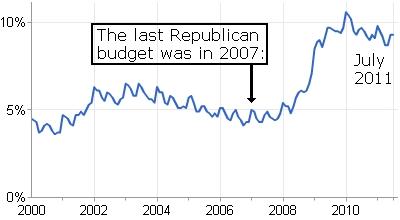
Let’s take a look at the budget deficits again, keeping in mind that the last Republican budget was the 2007 budget. In January of 2007, the Democrats took control of the House and Senate, and all spending was in Democrat control until January of 2011, when the Republicans took back the House.

Obama Budget Deficit 2011

Next, let’s see what impact the Bush tax cuts from 2001 and 2003 had on tax revenue:

Federal receipts after Bush tax cuts
Federal receipts (1994-2008)

From the chart:

  • Revenue in 2001 was 2.0 trillion in the year of the first round of tax cuts
  • Revenue in 2003 was 1.8 trillion in the year of the second round of tax cuts
  • Revenue then rose in each subsequent year, ending at 2.6 trillion in 2007, when the Democrats took over the House and Senate
  • In 2007, Bush was only spending about 2.8 trillion – very close to what he was taking receiving in tax revenues
  • The budget deficit went down in each year after both tax cuts were in place (2004), until the Democrats took over the House and Senate
  • Obama is currently spending over 3.8 trillion per year, but he is only receiving about 2.2 trillion in revenue.
  • It’s a spending problem, not a revenue problem

Doug Ross explains:

According to the OMB’s own figures, the Bush tax cuts resulted in an explosion of revenue to the U.S. government.

That’s not to say Bush wasn’t a profligate spender — he was. But in virtually no cases were Democrats arguing that he spend less (unless you count national security).

In fact, fiscal conservatives opposed Bush’s absurd policies on spending, amnesty and the expansion of Medicare.

But no one in world history has ever spent money like Barack Obama.

These statements are indisputable.

Which is why they are certain to be rejected by the diminishing cadre of Obama-Democrat drones, who appear to be completely immune to facts, logic and reason.

And let’s just see what happened to the unemployment rate since the Democrats took over spending in January of 2007:

Unemployment Rate (Not seasonally adusted)

There are a lot of people who don’t know about these numbers because they watch Jon Stewart and Stephen Colbert on the Comedy Channel, or Rachel Maddow and Ed Schulz on MSNBC.

I actually spoke to someone who voted for Obama about these numbers. He said that 2.6 trillion in tax revenues was worse than 2.0 trillion in tax revenues. And he said that a 4.3% unemployment rate was WORSE than a 9.2% unemployment rate. And he also said that a $160 billion dollar deficit was WORSE than a $1650 billion dollar deficit. Ok I just made that up, but still. That’s how Democrats think. Tax and spend.