In celebrating Ohio’s comeback, Obama is unintentionally repudiating his own policies. It turns out that, in spite of Obama, Ohio is 4th in the nation in job creation and tops in the Midwest. In the previous four years before Republican Gov. Kasich came into office, Ohio was 48th.
Even the states that are ahead of Ohio in job creation are far larger. Check out the other members of the top five job-creating states: Texas, New York, California and Florida. All are far more populous than Ohio. Florida, for instance, has 6.5 million more people, yet Ohio edged it out in job creation.
In fact, February’s BLS data showed that Ohio created more jobs than any other state. When was the last time that happened? Can’t tell, because the BLS doesn’t offer data prior to the Clinton era, so it’s been at least that long.
In short, Ohio proves that conservative fiscal policies work in spite of Barack Obama. While Obama’s “leadership” destroyed America’s pristine AAA credit rating, S&P was simultaneously upgrading Ohio’s rating.
[…]Kasich has a damn good record when it comes to fiscal policies. Bill Clinton won’t ever admit it in public, but the real architect of the much-ballyhooed ‘Clinton Surplus’ was none other than John Kasich, the Paul Ryan of Newt Gingrich’s House of Representatives.
John Kasich is one of three governors that I am watching closely. The other two really good ones are Scott Walker in Wisconsin and Bobby Jindal in Louisiana. I personally think that Kasich is the best governor in the United States of America. And Ohio has a great Senate candidate too, named Josh Mandel.
Unborn baby scheming about making abortion unthinkable
Scott Klusendorf is a tough, practical pro-life debater. When you listen to him talk about moral issues, it’s like listening to Tim Tebow talk about running the two-minute offense. Even if you are not into bio-ethics, you will have a good time listening to him work through the topics. Anyone who likes to understand issues strategically and operationally will enjoy this interview. It’s extremely practical because Scott is the top pro-life debater in the world. He has had to defend all of his views on the field.
Details:
Today’s interview is witth Scott Klusendorf, president of Life Training Institute. LTI is the first place to look for excellent resources to get better equipped to defend the pro-life position. Scott talks about defining abortion and its terms, the issue of the debate, the legal history of abortion, defending the pro-life view using science and philosophy, the four pillars of the pro-life argument, answering a litany of objections to the pro-life position, the right and wrong use of emotional appeals, taking on the right tone in the debate, how to get better equipped, and more.
If you like this interview, please be sure and buy the best basic book on pro-life apologetics – Scott Klusendorf’s “The Case for Life“. I do have to mention that Scott is an evangelical Christian. Evangelicals are very much into understanding and debating pro-life and pro-marriage positions – we want to understand and we want to explain why we believe what we believe.
Learn more by reading
You can learn more by reading basic pro-life apologetics… from Francis Beckwith. You might recognize Frank Beckwith as the author of “Defending Life: A Moral and Legal Case Against Abortion Choice“. He wrote that book for Cambridge University Press, a top academic press. But before Cambridge University Press, Beckwith wrote easy-to-understand essays for the Christian Research Journal.
Here are four essays that answer common arguments in favor of legalized abortion.
Anyone who keeps up with the many pro-choice demonstrations in the United States cannot help but see on pro-choice placards and buttons a drawing of the infamous coat hanger. This symbol of the pro-choice movement represents the many women who were harmed or killed because they either performed illegal abortions on themselves (i.e., the surgery was performed with a “coat hanger”) or went to unscrupulous physicians (or “back-alley butchers”). Hence, as the argument goes, if abortion is made illegal, then women will once again be harmed. Needless to say, this argument serves a powerful rhetorical purpose. Although the thought of finding a deceased young woman with a bloody coat hanger dangling between her legs is — to say the least — unpleasant, powerful and emotionally charged rhetoric does not a good argument make.
The chief reason this argument fails is because it commits the fallacy of begging the question. In fact, as we shall see, this fallacy seems to lurk behind a good percentage of the popular arguments for the pro-choice position. One begs the question when one assumes what one is trying to prove. Another way of putting it is to say that the arguer is reasoning in a circle. For example, if one concludes that the Boston Celtics are the best team because no team is as good, one is not giving any reasons for this belief other than the conclusion one is trying to prove, since to claim that a team is the best team is exactly the same as saying that no team is as good.
The question-begging nature of the coat-hanger argument is not difficult to discern: only by assuming that the unborn are not fully human does the argument work. If the unborn are not fully human, then the pro-choice advocate has a legitimate concern, just as one would have in overturning a law forbidding appendicitis operations if countless people were needlessly dying of both appendicitis and illegal operations. But if the unborn are fully human, this pro-choice argument is tantamount to saying that because people die or are harmed while killing other people, the state should make it safe for them to do so.
A woman who becomes pregnant due to an act of either rape or incest is the victim of a horribly violent and morally reprehensible crime. Although pregnancy as a result of either rape or incest is extremely rare, [1] there is no getting around the fact that pregnancy does occur in some instances.
[…]Despite its forceful appeal to our sympathies, there are several problems with this argument. First, it is not relevant to the case for abortion on demand, the position defended by the popular pro-choice movement. This position states that a woman has a right to have an abortion for any reason she prefers during the entire nine months of pregnancy, whether it be for gender-selection, convenience, or rape. [3] To argue for abortion on demand from the hard cases of rape and incest is like trying to argue for the elimination of traffic laws from the fact that one might have to violate some of them in rare circumstances, such as when one’s spouse or child needs to be rushed to the hospital. Proving an exception does not establish a general rule.
[…]Fourth, this argument begs the question by assuming that the unborn is not fully human. For if the unborn is fully human, then we must weigh the relieving of the woman’s mental suffering against the right-to-life of an innocent human being. And homicide of another is never justified to relieve one of emotional distress. Although such a judgment is indeed anguishing, we must not forget that the same innocent unborn entity that the career-oriented woman will abort in order to avoid interference with a job promotion is biologically and morally indistinguishable from the unborn entity that results from an act of rape or incest. And since abortion for career advancement cannot be justified if the unborn entity is fully human, abortion cannot be justified in the cases of rape and incest. In both cases abortion results in the death of an innocent human life. As Dr. Bernard Nathanson has written, “The unwanted pregnancy flows biologically from the sexual act, but not morally from it.” [5]Hence, this argument, like the ones we have already covered in this series, is successful only if the unborn are not fully human.
Some ethicists argue that the unborn becomes fully human sometime after brain development has begun, when it becomes sentient: capable of experiencing sensations such as pain. The reason for choosing sentience as the criterion is that a being that cannot experience anything (i.e., a presentient unborn entity) cannot be harmed. Of course, if this position is correct, then the unborn becomes fully human probably during the second trimester and at least by the third trimester. Therefore, one does not violate anyone’s rights when one aborts a nonsentient unborn entity. [13]
There are several problems with this argument. First, it confuses harm with hurt and the experience of harm with the reality of harm. [14] One can be harmed without experiencing the hurt that sometimes follows from that harm, and which we often mistake for the harm itself. For example, a temporarily comatose person who is suffocated to death “experiences no harm,” but he is nevertheless harmed. Hence, one does not have to experience harm, which is sometimes manifested in hurt, in order to be truly harmed.
Second, if sentience is the criterion of full humanness, then the reversibly comatose, the momentarily unconscious, and the sleeping would all have to be declared nonpersons. Like the presentient unborn, these individuals are all at the moment nonsentient though they have the natural inherent capacity to be sentient. Yet to countenance their executions would be morally reprehensible. Therefore, one cannot countenance the execution of some unborn entities simply because they are not currently sentient.
Someone may reply that while these objections make important points, there is a problem of false analogy in the second objection: the reversibly comatose, the momentarily unconscious, and the sleeping once functioned as sentient beings, though they are now in a temporary state of nonsentience. The presentient unborn, on the other hand, were never sentient. Hence, one is fully human if one was sentient “in the past” and will probably become sentient again in the future, but this cannot be said of the presentient unborn.
There are at least three problems with this response. First, to claim that a person can be sentient, become nonsentient, and then return to sentience is to assume there is some underlying personal unity to this individual that enables us to say that the person who has returned to sentience is the same person who was sentient prior to becoming nonsentient. But this would mean that sentience is not a necessary condition for personhood. (Neither is it a sufficient condition, for that matter, since nonhuman animals are sentient.) Consequently, it does not make sense to say that a person comes into existence when sentience arises, but it does make sense to say that a fully human entity is a person who has the natural inherent capacity to give rise to sentience. A presentient unborn human entity does have this capacity. Therefore, an ordinary unborn human entity is a person, and hence, fully human.
Second, Ray points out that this attempt to exclude many of the unborn from the class of the fully human is “ad hoc and counterintuitive.” He asks us to “consider the treatment of comatose patients. We would not discriminate against one merely for rarely or never having been sentient in the past while another otherwise comparable patient had been sentient….In such cases, potential counts for everything.” [15]
Third, why should sentience “in the past” be the decisive factor in deciding whether an entity is fully human when the presentient human being “is one with a natural, inherent capacity for performing personal acts?” [16] Since we have already seen that one does not have to experience harm in order to be harmed, it seems more consistent with our moral sensibilities to assert that what makes it wrong to kill the reversibly comatose, the sleeping, the momentarily unconscious, and the presentient unborn is that they all possess the natural inherent capacity to perform personal acts. And what makes it morally right to kill plants and to pull the plug on the respirator-dependent brain dead, who were sentient “in the past,” is that their deaths cannot deprive them of their natural inherent capacity to function as persons, since they do not possess such a capacity.
These four essays are a very good introduction to common responses to pro-abortion arguments. I recommend that people get familiar with this, as once you look into it, you will see that the abortion issue can be debated with as much confidence as William Lane Craig defends Christian theism. You will have the same access to scientific evidence and rational arguments on this topic, and so you will have the upper hand. And that’s fun.
The Canadian government released details Tuesday of its plan to dramatically streamline reviews for big energy and mining projects, capping the timeline for federal reviews and ceding more regulatory oversight to the country’s provinces.
The Conservative government of Prime Minister Stephen Harper has said for months it would move to speed up the regulatory review of big energy, mining and infrastructure projects. It has expressed frustration at the sometimes-lengthy review timelines for big projects.
Mr. Harper’s government said in its annual budget announcement last month that it would cap federal reviews. Resources Minister Joe Oliver released details Tuesday, saying that federally-led hearings would be applied only to major initiatives that risk some environmental harm.
Further, the government said it was prepared to hand over more responsibility for the review to Canadian provinces, so long as their regulations meet or exceed federal standards. Canadian provinces already enjoy considerable regulatory oversight.
“It is counterproductive to have the federal and provincial governments completing separate reviews of the same project,” Oliver said in a speech in Toronto.
[…]The government had previewed in its budget last month that reviews for major projects would be limited to 24 months. Meanwhile, regular inter-provincial pipeline reviews, as conducted by the National Energy Board, would be limited to 18 months.
Oliver said Tuesday that Enbridge Inc.’s (ENB) proposed Northern Gateway pipeline – which envisions shipping oil from Alberta to Canada’s West Coast — would benefit from the quicker review. The line has been mired in stiff opposition from native groups in British Columbia, and the government has accused foreign-funded environmental groups of tying up the project in regulatory hearings. Government officials said the new rules would also limit who could participate as intervenors in the review process.
[…]In Toronto, Oliver said the current process is unworkable, with over 40 federal departments involved in reviews. He said he would pare that back to only three federal agencies: the Canadian Environmental Assessment Agency; the National Energy Board; and the Canadian Nuclear Safety Commission.
The Canadian process, as it stands, forces investors to go “through hoops and hurdles as far as the eye can see,” Oliver said. “We simply have to turn that around.”
Canadians don’t want to scare businesses away from Canada – they want the jobs to come to Canada. That’s the exact opposite of what Obama’s socialist “Environmental Protection Agency” does – they regulate energy development, in order to block it or slow it down.
And Canada lowered corporate taxes to 15% compared to our 35% – and their revenues held steady.
Canada: Corporate tax cuts, not stimulus spending
They cut their corporate tax rate, but then businesses saw the lower rate and just kept on expanding in order to make more money. As businesses grow, they pay more in taxes. So government revenues from taxes haven’t dropped at all, even with the lower corporate tax rates! More businesses moved in to Canada to capitalize on the lower tax rates, generating revenue for the government. More workers moved off of unemployment and welfare as demand for labor grew, and they started paying income taxes and sales taxes, generating even more revenue for the government. Do you know what makes consumers more confident, so that they spend more? Having a job. Not being dependent on government.
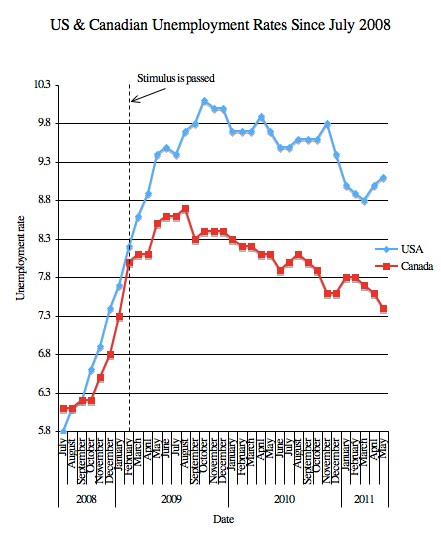
Look at their unemployment rate:
Canada and US unemployment rates
When we embraced “stimulus” spending, they went for the corporate tax cuts. Our unemployment rate used to be LOWER than theirs, before Pelosi and Reid took over Congress in January 2007. Now we are HIGHER than they are. That’s not rhetoric – that’s data. Even though Canada’s economy is linked to ours, and has suffered as a result of that, they have been signing free trade deals left, right and center. They did this in order to decouple themselves from our collapsing economy, massive debt and devalued currency. Barack Obama, of course, opposes free trade. He has to – he’s in the back pocket of the socialist labor unions.
Free trade empire: (click for larger image)
Canada: Free Trade Empire
What a contrast Canada’s energy policy makes with Obama’s politicized “Cash for Cronies” energy policy. But then again, Canada hired a conservative right-wing capitalist economist to run their country. We could have just done the same and put in economists like Thomas Sowell or Walter Williams to run our economy, but we put in an unqualified community organizer instead.