All posts by Wintery Knight

https://winteryknight.com/

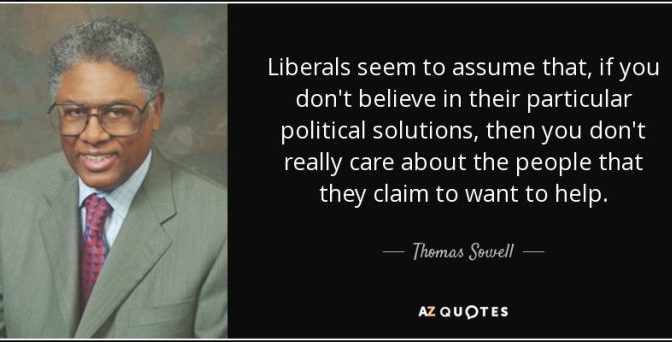
Economist Thomas Sowell explains the result of legislating price controls

My favorite economist is Thomas Sowell, who is famous for making the findings of academic economists accessible to ordinary people. I always joke to my friends that Thomas Sowell books are like Lay’s potato chips – you can’t read just one. Well, if you’ve read Dr. Sowell’s flagship book “Basic Economics”, you know that the early chapters are about how prices work in the economy.

So, I thought I would link to a VERY good article on price controls by Thomas Sowell. If you’ve never read him, I think you’ll really enjoy how me makes sense of the world for you. Learning how the world works is fun – now you see how to make good decisions.

This is “An Ancient Fallacy: Price Controls” from Capitalism Magazine.

He writes:

Those old enough to remember the gasoline crisis of 1979 may recall sitting in long lines of cars at filling stations, waiting — sometimes for hours — to reach the pump. This was one of the most common consequences of price control throughout history — a shortage. Yet how many Americans ever made the connection between the price controls of the 1970s and the gasoline shortages of the 1970s? How many have noticed that they haven’t been waiting in gasoline lines since Ronald Reagan got rid of the price controls on oil?

Why do price controls cause shortages? There are basically two reasons: supply and demand.

People will not supply as much at a lower price as they will at a higher price. Some oil wells that will repay their costs and earn a profit when the price of oil is $25 a barrel will not cover their costs when the price is $15 a barrel. Some people who will rent out a bungalow in their backyard when rents are high will not bother when rents are low. Some farmers will give up farming when food prices are kept below the point where they can earn a living.

On the demand side, people will demand more when the price is kept artificially low by price controls. Before rent control laws were passed in Sweden, less than one-fourth of unmarried adults there had their own separate housing units, but afterwards more than half did. People buy more of anything that is cheaper. With more being demanded and less being supplied, shortages are inevitable, whether with housing, food, medical care or whatever.

It is not just the quantity supplied that declines under price controls. Quality also declines.

When there are more people trying to rent apartments than there are apartments for rent, landlords no longer have to maintain the appearance of their buildings. They do not need to pay for painting, repairs or maintenance as often as they did when there was no housing shortage and they needed to attract tenants.

Sometimes quality deterioration takes the form of waiting — not just cars waiting in line at filling stations, but also sick people remaining on waiting lists for months to get surgery or other medical treatment they need. Cheap medical care is one of the most expensive things there is.

So, if you force producers to charge less for what they are making, you might see a shortage, you might see a decline in quality, or you might see waiting lists.

Now, one of the examples that Sowell uses in his books is the example of rent control. This is when the government responds to people complaining that “the rent is too damn high” by forcing landlords to charge less. If you’re paying attention, then you can predict what will happen next. There will be a shortage of housing, because people with capital invest it in other places, rather than building and renting out places to live. Why? Because there is no money to be made by investing in renting properties when the government is pushing prices down.

So, let’s look at a reverse case, where price controls are removed. What would you expect to see when a country that has had rent control laws for a long time repeals it?

Well, Argentina just elected a new free market capitalist government, and they repealed their rent control laws.

Newsweek reports on what happened next:

Argentina’s recent repeal of rent control by libertarian President Javier Milei has led to a surge in housing supply, with the freedom to negotiate contracts, previously restricted, directly causing a drop in rental prices.

Milei, a self-described “anarcho-capitalist” known for his free-market approach, repealed the 2020 Rental Law, enacted by former leftist President Alberto Fernández, which had imposed restrictions on landlords and led to a significant decline in rental availability.

[…]For many locals, finding a new apartment had become “mission impossible.” But after the repeal, Buenos Aires saw a doubling of available rental units, and rental prices have stabilized. Under the new rules, landlords and tenants have more freedom to agree on lease terms. If the duration isn’t specified, it defaults to two years.

“We’ve seen a significant increase in rental apartments, and in some cases, we had to lower prices in pesos because of fewer viewings,” Soledad Balayan, head of the real-estate agency Maure Inmobiliaria, told Argentine newspaper La Nación.

Since Millei’s repeal of rent control laws took effect on December 29, the supply of rental housing in Buenos Aires has jumped by 195.23%, according to the Statistical Observatory of the Real Estate Market of the Real Estate College (CI).

If you guessed that repealing price controls on rental properties would reverse the shortage and cause an abundance of high quality properties, then you guessed right. This is how the world works! Naturally, as supply increases, consumers have a lot more choice, and they get the benefit of better quality at a lower price, because of increased competition among suppliers of rental properties.

The article notes that Joe Biden has proposed rent control at the federal level, which is exactly the kind of policy that you would epect his successor, Kamala Harris, to push if she is elected President. If you know someone who rents, maybe you should tell them about the consequences of rent control laws?

Jay Richards: eight common myths about wealth, poverty and the free market

Have you read Jay Richards’ book “Money, Greed and God?” Because if you haven’t, he’s written a series of articles that summarize the main points of the book.

The index post is here.

Here are the posts in the series:

  • Part 1: The Eight Most Common Myths about Wealth, Poverty, and Free Enterprise
  • Part 2: Can’t We Build A Just Society?
  • Part 3: The Piety Myth
  • Part 4: The Myth of the Zero Sum Game
  • Part 5: Is Wealth Created or Transferred?
  • Part 6: Is Free Enterprise Based on Greed?
  • Part 7: Hasn’t Christianity Always Opposed Free Enterprise?
  • Part 8: Does Free Enterprise Lead to An Ugly Consumerist Culture?
  • Part 9: Will We Use Up All Our Resources?
  • Part 10: Are Markets An Example of Providence?

Parts 4 and 5 are my favorites. It’s so hard to choose one to excerpt, but I must. I will choose… Part 4.

Here’s the problem:

Myth #3: The Zero Sum Game Myth – believing that trade requires a winner and a loser. 

One reason people believe this myth is because they misunderstand how economic value is determined. Economic thinkers with views as diverse as Adam Smith and Karl Marx believed economic value was determined by the labor theory of value. This theory stipulates that the cost to produce an object determines its economic value.

According to this theory, if you build a house that costs you $500,000 to build, that house is worth $500,000. But what if no one can or wants to buy the house? Then what is it worth?

Medieval church scholars put forth a very different theory, one derived from human nature: economic value is in the eye of the beholder. The economic value of an object is determined by how much someone is willing to give up to get that object. This is the subjective theory of value.

And here’s an example of how to avoid the problem:

How you determine economic value affects whether you view free enterprise as a zero-sum game, or a win-win game in which both participants benefit.

Let’s return to the example of the $500,000 house. As the developer of the house, you hire workers to build the house. You then sell it for more than $500,000. According to the labor theory of value, you have taken more than the good is actually worth. You’ve exploited the buyer and your workers by taking this surplus value. You win, they lose.

Yet this situation looks different according to the subjective theory of value. Here, everybody wins. You market and sell the house for more than it cost to produce, but not more than customers will freely pay. The buyer is not forced to pay a cost he doesn’t agree to. You are rewarded for your entrepreneurial effort. Your workers benefit, because you paid them the wages they agreed to when you hired them.

This illustration brings up a couple important points about free enterprise that are often overlooked:

1. Free exchange is a win-win game.

In win-win games, some players may end up better off than others, but everyone ends up better off than they were at the beginning. As the developer, you might make more than your workers. Yet the workers determined they would be better off by freely exchanging their labor for wages, than if they didn’t have the job at all.

A free market doesn’t guarantee that everyone wins in every competition. Rather, it allows many more win-win encounters than any other alternative.

2. The game is win-win because of rules set-up beforehand. 

A free market is not a free-for-all in which everybody can do what they want. Any exchange must be free on both sides. Rule of law, contracts, and property rights are needed to ensure exchanges are conducted rightly. As the developer of the house, you’d be held accountable if you broke your contract and failed to pay workers what you promised.

An exchange that is free on both sides, in which no one is forced or tricked into participating, is a win-win game.

On this view, what you really need to fear as a consumer is government intervention that restricts your choices in the marketplace, or makes some choices more expensive than they need to be (tariffs).

If you care about poverty, it’s often tempting to think that it can only be solved one way – by transferring wealth from the rich to the poor. But that is a very mistaken view, as any economist will tell you. The right way to create prosperity is by creating laws and policies that unleash individual creativity. Letting individuals create innovative products and services, letting them keep what they earn, making sure that the law doesn’t punish entrepreneurs – that incentivizes wealth creation. Fixing poverty does not mean transferring wealth, it means giving people more freedom to create wealth on their own. Free trade between nations is an important way that we encourage people to create better products and services that what they have available in their own countries.

Economists agree on the benefits of free trade

Who could possibly disagree with free trade? Well, many people on the left do. But economists across the spectrum of ideology (university and private sector and public sector) agree on the benefits of free trade.

Harvard economist Greg Mankiw explains what most professional economists agree on.

Excerpt:

Here is the list, together with the percentage of economists who agree:

  1. A ceiling on rents reduces the quantity and quality of housing available. (93%)
  2. Tariffs and import quotas usually reduce general economic welfare. (93%)
  3. Flexible and floating exchange rates offer an effective international monetary arrangement. (90%)
  4. Fiscal policy (e.g., tax cut and/or government expenditure increase) has a significant stimulative impact on a less than fully employed economy. (90%)
  5. The United States should not restrict employers from outsourcing work to foreign countries. (90%)
  6. The United States should eliminate agricultural subsidies. (85%)
  7. Local and state governments should eliminate subsidies to professional sports franchises. (85%)
  8. If the federal budget is to be balanced, it should be done over the business cycle rather than yearly. (85%)
  9. The gap between Social Security funds and expenditures will become unsustainably large within the next fifty years if current policies remain unchanged. (85%)
  10. Cash payments increase the welfare of recipients to a greater degree than do transfers-in-kind of equal cash value. (84%)
  11. A large federal budget deficit has an adverse effect on the economy. (83%)
  12. A minimum wage increases unemployment among young and unskilled workers. (79%)
  13. The government should restructure the welfare system along the lines of a “negative income tax.” (79%)
  14. Effluent taxes and marketable pollution permits represent a better approach to pollution control than imposition of pollution ceilings. (78%)

Socialist economic policies don’t work because they are making policies that are based on economic myths. We know that these myths are myths because of economics is a mathematical science, and because we have tried good and bad policies in different times and places. We have calculations and we have experience to know what works and what doesn’t work. If you want to help the poor, you have to respect what economists know about how wealth is created. The solution is not to “spread the wealth around”, it’s to encourage people to create more wealth by inventing things that people freely choose to buy.

Frank Turek lectures on the case against same-sex marriage

About the speaker Frank Turek:

Frank Turek is one of my favorite speakers, and I admire him for being willing to take a public stand on controversial issues like gay marriage. He’s actually had to pay a price for that in his professional life, and I blogged about that before.

Here’s the lecture on gay marriage, featuring Christian apologist Frank Turek.

Outline:

Outline of Frank Turek's lecture on same sex marriage
Outline of Frank Turek’s lecture on same sex marriage

Introduction:

  • how to present your case against marriage safely
  • Christians are required to go beyond tolerance
  • loving another person can mean opposing the person when they want to do something wrong, even if they hate you
  • what did Jesus say about marriage? (see Matt 19:4-6)
  • what did Jesus say about sexual morality? (Matt 15, Matt 19)

Summary:

  • the same-sex marriage debate is about whether to compel people who disagree with the gay lifestyle to validate and normalize it
  • P1: the government has an interest in marriage because it perpetuates and stabilizes society – this is the purpose of marriage
  • P2-4: government can take 3 kinds of stances towards behaviors: promote, permit or prohibit
  • government promotes behaviors when it has an interest in them
  • same-sex relationships should be permitted, but not promoted
  • Q1: if same-sex marriage had serious negative consequences, would you reconsider their position?
  • Q2: are heterosexual relationships the same as homosexual relationships?
  • Q3: what would society be like if everyone married according to the natural marriage definition: one woman, one man, for life?
  • Q4: what would society be like if everyone married according to the same-sex marriage definition: man/man and woman/woman?
  • Should Christians care about law and politics? or should they just preach the gospel?
  • They should care because people often get their cues about what is moral and immoral based on what is legal and illegal
  • Many of the social problems we see today can be traced back to problems with marriage and family
  • Children do much better when they have a relationship with their mother and their father
  • Same-sex marriage necessarily destroys the relationship between a child and its mother or its father
  • When a country embraces same-sex marriage, it reinforces the idea that marriage is not about making and raising children
  • same-sex marriage shifts the focus away from the needs of the children to the feelings of desires of the selfish adults
  • does homosexuality impose any health and mental health risks?
  • what has the impact of legalizing same-sex marriage been in Massachusetts to individuals, schools, businesses and charities?
  • how same-sex marriage poses a threat to religious liberty
  • how should you respond to the view that homosexuality is genetic?

And at the very end, he shows this short video, which is only 5 minutes and explains the logic of opposing the redefinition of marriage:

My biggest concern is religious liberty, and we are seeing how same-sex marriage has proven to be incompatible with religious liberty. But I also care about children… I want them to have mothers and fathers who put their needs first. Marriage is about a commitment – it is the subjugation of feelings and desires to responsibilities and obligations. It is a promise. A promise to commit to love your spouse and children regardless of feelings and desires. It requires more self-denial, self-control and self-sacrifice. Not less.