
All posts by Wintery Knight

https://winteryknight.com/

Has feminism been good for women?

Radical feminists complain a lot about sexism, but damage is self-inflicted

One problem with feminism is that it produces the very outcomes that feminists then turn around and complain about. For example, consider the women’s studies major that is favored by feminists. Does it produce a good financial return on investment?

Here is an article from the Daily Signal to answer that.

Excerpt:

While only 23 percent of American women identify as feminists, 47 percent of millennial women do.

But unfortunately, the policies supported by modern feminists have been particularly bad for young women.

[…]Today, millennial women struggle with significant student loan debt and often have a hard time finding a job that will get them out of mom and dad’s basement. About 42 percent of women have more than $30,000 in student loan debt, compared than just 27 percent of men.

This could be a function of more women pursuing higher levels of learning. But significant student loan defaults among this group indicate that women may not be getting the return on investment they had hoped for.

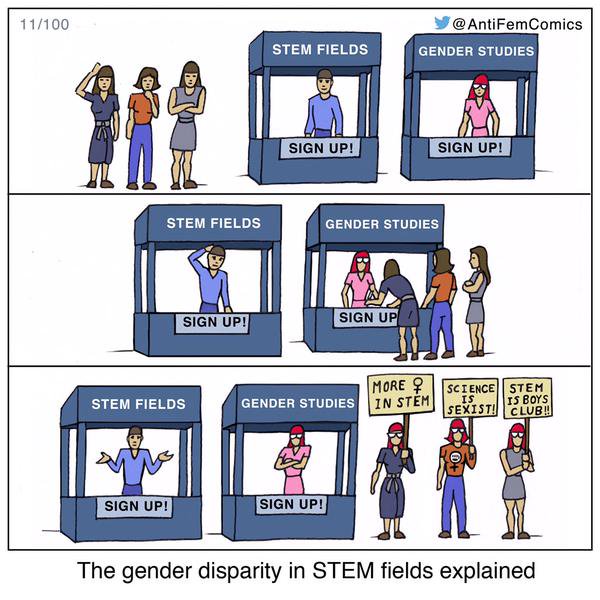
Women are vastly overrepresented in majors that are known to have low returns on investment, such as gender studies or social work. Yet the feminist movement encourages more young women to pursue these degrees.

Their solution is to advocate further government assistance through policies such as free public college, loan forgiveness, and income-based repayment policies that drag out the life of a loan while doing nothing to put pressure on colleges to keep prices in check.

Hmm. Perhaps instead of taxing working men to pay for the poor academic decisions of women, we can shame and blame women who prefer useless degrees in women’s studies to useful degrees in computer science?

Look at the numbers reported by USA Today:

According to the National Center for Education Statistics, the number of women’s and gender studies degrees in the United States has increased by more than 300% since 1990, and in 2015, there were more than 2,000 degrees conferred.

These days, women’s studies programs include gender and sexuality studies, and many of the programs explore and question the relationship of race, class, sexuality, ethnicity and more to encourage students to investigate in the broader field of gender.

THREE HUNDRED PERCENT. It would never occur to me – as a child of poor non-white immigrants – that I could spend tens of thousands of dollars, and even go into debt, for a degree that would not pay for itself. Whether I liked computer science or not, that’s what I had to study – or something like that.

What about the idea that women are paid less than men for the same work, because of discrimination?

Liberal feminist Hanna Rosin takes a look at this question in the far-left Slate, of all places.

Excerpt:

The official Bureau of Labor Department statistics show that the median earnings of full-time female workers is 77 percent of the median earnings of full-time male workers. But that is very different than “77 cents on the dollar for doing the same work as men.” The latter gives the impression that a man and a woman standing next to each other doing the same job for the same number of hours get paid different salaries. That’s not at all the case. “Full time” officially means 35 hours, but men work more hours than women. That’s the first problem: We could be comparing men working 40 hours to women working 35.

How to get a more accurate measure? First, instead of comparing annual wages, start by comparing average weekly wages. This is considered a slightly more accurate measure because it eliminates variables like time off during the year or annual bonuses (and yes, men get higher bonuses, but let’s shelve that for a moment in our quest for a pure wage gap number). By this measure, women earn 81 percent of what men earn, although it varies widely by race. African-American women, for example, earn 94 percent of what African-American men earn in a typical week. Then, when you restrict the comparison to men and women working 40 hours a week, the gap narrows to 87 percent.

But we’re still not close to measuring women “doing the same work as men.” For that, we’d have to adjust for many other factors that go into determining salary. Economists Francine Blau and Lawrence Kahn did that in a recent paper, “The Gender Pay Gap.”.”They first accounted for education and experience. That didn’t shift the gap very much, because women generally have at least as much and usually more education than men, and since the 1980s they have been gaining the experience. The fact that men are more likely to be in unions and have their salaries protected accounts for about 4 percent of the gap. The big differences are in occupation and industry. Women congregate in different professions than men do, and the largely male professions tend to be higher-paying. If you account for those differences, and then compare a woman and a man doing the same job, the pay gap narrows to 91 percent. So, you could accurately say in that Obama ad that, “women get paid 91 cents on the dollar for doing the same work as men.”

I believe that the remainder of the gap can be accounted for by looking at other voluntary factors that differentiate men and women.

The Heritage Foundation says that a recent study puts the number at 95 cents per dollar.

Excerpt:

Women are more likely than men to work in industries with more flexible schedules. Women are also more likely to spend time outside the labor force to care for children. These choices have benefits, but they also reduce pay—for both men and women. When economists control for such factors, they find the gender gap largely disappears.

A 2009 study commissioned by the Department of Labor found that after controlling for occupation, experience, and other choices, women earn 95 percent as much as men do. In 2005, June O’Neil, the former director of the Congressional Budget Office, found that “There is no gender gap in wages among men and women with similar family roles.” Different choices—not discrimination—account for different employment and wage outcomes.

If women choose to study women’s studies, why should they be surprised that they are paid less than men who study computer science?  I wish the people who teach women’s studies understood what it means to create something for a customer that they are willing to pay for. Then maybe they could tell women how to get paid more. People who learn hard things, create value for customers, and work longer hours make more money. Teaching young women useless prejudices against men does not help them to make more money.

Feminist explains how she chose to drink alcohol before recreational sex

College students puking in toilet

Guess where I’m linking today? To a radical feminist web site named Jezebel, to an article written by a radical feminist who writes for the radically leftist Slate.

No, I’m not crazy. Just read it:

Much of the conversation around alcohol and sex has focused on assault—the line at which intoxication becomes incapacitation, for instance—but what we fail to mention is how haunted people can be by the sex they actually, technically consented to.

[…]I wonder what my sex life would even look like if alcohol hadn’t been there. Alcohol gave me comfort in my own body, and it allowed me to turn my erotic curiosity and hunger for experience into an action plan. I was tired of being the stuttering girl sucking in her stomach after the lights went out. I wanted to be the woman who roamed wild and free.

Alcohol also helped me cut the girlish strings on my heart, an action my college years demanded. Three months into my freshman year, I split a six pack with a dashing sophomore, and we wound up partially clothed on his bed, my bare legs wrapped around his waist, my hands around his neck. I pulled back slightly and asked him the question, the naive question of a girl who does not yet understand her fate: “What does this mean?”

He looked past me, into his studio apartment, and then back into my eyes. “It means that I’m a 19-year-old boy, and we’re having fun.”

What is interesting is that she didn’t see this man’s using her for fun after getting her drunk as any disqualification for a serious relationship. On the contrary, she believes that a serious relationship built on self-sacrificial love and commitment that lasts through difficulties can be found in a man who uses her for fun sex:

I’m not saying I didn’t enjoy that night with the dashing sophomore. I’m saying the fun part for me might have been turning our physical intimacy into a sustained attachment.

Amazing. She wasn’t looking for men with good educations, good jobs, lots of savings, who were sober and chaste – they would have made her unhappy with their bossy leading, and strict plans about courting and marriage. Nope, she wanted the drunken slut who didn’t ask her any questions or have any plan for her to develop into a wife and mother. That’s who she wanted. He was hawt! And he was free, easy and fun.

She is 35 now, and still single. I’m sure if you ask her, she would like to be married “some day”, but who could look at 20 years of drunken sex and say that this is good preparation for the challenges of marriage? Marriage is about self-sacrificial love, and endurance. To prepare for it, you learn self-denial and self-control. You learn how to accept expectations, obligations and responsibilities.

Anyway, back to the article by the drunken, promiscuous feminist. The point that I wanted to make is that she chose the alcohol herself, and that she did it for a very specific reason:

I wanted to have fun, too. And alcohol evened the score. I cared less about everything when I was drinking: What you thought of me, what I looked like in this dress, whether that taco was warm or cold when I stuffed it in my mouth. I don’t want to make it sound like I drank in order to have sex. I drank for a million reasons.

[…]Booze downshifted my intense body consciousness, and it revved up my bravado. Sex was scary—but alcohol made me feel safe.

She drank in order to have sex. Got it? She chose to get drunk in order to have sex. This is the part that permissive parents and pious pastors need to understand about their darling daughters. Many young women think that recreational sex with hot guys is a pathway to marriage. They drink in order to make progress towards the marriage they want – the marriage to the man who is fun. Not the man who is serious. They don’t want the serious man who makes plans and expects them to behave responsibly and honor obligations. They want the fun, hot man – the bad boy – and they expect to change him into a faithful, sober, responsible provider through the magical power of vagina. And if that doesn’t work, by threatening him with divorce.

Why are millenials acting like children into adulthood?

This reminds me of the Institute for American Values study. Despite their name, it is not a conservative organization

Look at this citation from p. 15:

A number of students noted that being drunk could later serve as your excuse for the hook up.

A Yale University student said, “Some people like hook up because they’re drunk or use being drunk as an excuse to hook up.”

A New York University student observed, “[Alcohol is] just part of an excuse, so that you can say, oh, well, I was drinking.”

A Rutgers University student commented, “If you’re drinking a lot it’s easier to hook up with someone… [and] drugs, it’s kind of like a bonding thing… and then if you hook up with them and you don’t want to speak to them again, you can always blame it on the drinking or the drugs.”

[…]A University of Chicago junior observed, “One of my best friends… sometimes that’s her goal when we go out. Like she wants to get drunk so I guess she doesn’t have to feel guilty about [hooking up].”

I think at this point you should assume that if your daughter is not passionate about chastity, natural marriage and pro-life, then she is probably somewhere on this drinking – recreational sex – cohabitation – abortion – no-fault divorce path. The more fun-loving and emotional a woman is, the more likely she is to fall into it, and some of them just work it together with Christianity. Once woman I know was living with a non-Christian man and praying fervently for God to make her career take off. God is there for hope and comfort, not to impose any sort of moral boundaries. And parents and pastors are oblivious – they just want to let women do whatever they want, and then blame men for not making it “work out”. Parents and pastors are not doing the job of explaining to women what their lives will really be like from age 40 to 90, and urging women to make a plan that provides lasting love and and security even as they experience declining youth, declining beauty, and declining fertility.

I hope that many of the men out there who refuse to hold women accountable for their own desires start to understand that not everything a woman wants is good, and not every plan a woman makes will work. Sometimes, you need to calmly and constructively challenge them about their priorities, plans and actions. It’s for their own good.

The kalam cosmological argument defended in a peer-reviewed science journal

Here’s the peer-reviewed article. It appears in a scientific journal focused on astrophysics.

Here’s the abstract:

Both cosmology and philosophy trace their roots to the wonder felt by the ancient Greeks as they contemplated the universe. The ultimate question remains why the universe exists rather than nothing. This question led Leibniz to postulate the existence of a metaphysically necessary being, which he identified as God. Leibniz’s critics, however, disputed this identification, claiming that the space-time universe itself may be the metaphysically necessary being. The discovery during this century that the universe began to exist, however, calls into question the universe’s status as metaphysically necessary, since any necessary being must be eternal in its existence. Although various cosmogonic models claiming to avert the beginning of the universe predicted by the standard model have been and continue to be offered, no model involving an eternal universe has proved as plausible as the standard model. Unless we are to assert that the universe simply sprang into being uncaused out of nothing, we are thus led to Leibniz’s conclusion. Several objections to inferring a supernatural cause of the origin of the universe are considered and found to be unsound.

The whole text of the article is posted online here.

Here’s an excerpt in which the author, Dr. William Lane Craig, explains the Big Bang cosmology:

The monumental significance of the Friedman-Lemaitre model lay in its historization of the universe. As one commentator has remarked, up to this time the idea of the expansion of the universe “was absolutely beyond comprehension. Throughout all of human history the universe was regarded as fixed and immutable and the idea that it might actually be changing was inconceivable.”{8} But if the Friedman-Lemaitre model were correct, the universe could no longer be adequately treated as a static entity existing, in effect, timelessly. Rather the universe has a history, and time will not be matter of indifference for our investigation of the cosmos. In 1929 Edwin Hubble’s measurements of the red-shift in the optical spectra of light from distant galaxies,{9} which was taken to indicate a universal recessional motion of the light sources in the line of sight, provided a dramatic verification of the Friedman-Lemaitre model. Incredibly, what Hubble had discovered was the isotropic expansion of the universe predicted by Friedman and Lemaitre. It marked a veritable turning point in the history of science. “Of all the great predictions that science has ever made over the centuries,” exclaims John Wheeler, “was there ever one greater than this, to predict, and predict correctly, and predict against all expectation a phenomenon so fantastic as the expansion of the universe?”{10}

As a GTR-based theory, the Friedman-Lemaitre model does not describe the expansion of the material content of the universe into a pre-existing, empty, Newtonian space, but rather the expansion of space itself. This has the astonishing implication that as one reverses the expansion and extrapolates back in time, space-time curvature becomes progressively greater until one finally arrives at a singular state at which space-time curvature becomes infinite. This state therefore constitutes an edge or boundary to space-time itself. P. C. W. Davies comments,

An initial cosmological singularity . . . forms a past temporal extremity to the universe. We cannot continue physical reasoning, or even the concept of spacetime, through such an extremity. . . . On this view the big bang represents the creation event; the creation not only of all the matter and energy in the universe, but also of spacetime itself.{11}

The popular expression “Big Bang,” originally a derisive term coined by Fred Hoyle to characterize the beginning of the universe predicted by the Friedman-Lemaitre model, is thus potentially misleading, since the expansion cannot be visualized from the outside (there being no “outside,” just as there is no “before” with respect to the Big Bang).{12}

The standard Big Bang model thus describes a universe which is not eternal in the past, but which came into being a finite time ago. Moreover,–and this deserves underscoring–the origin it posits is an absolute origin ex nihilo. For not only all matter and energy, but space and time themselves come into being at the initial cosmological singularity. As Barrow and Tipler emphasize, “At this singularity, space and time came into existence; literally nothing existed before the singularity, so, if the Universe originated at such a singularity, we would truly have a creation ex nihilo.“{13}

[…]On such a model the universe originates ex nihilo in the sense that at the initial singularity it is true that There is no earlier space-time point or it is false that Something existed prior to the singularity.

Every theist should be able to understand and defend this argument. It is a scientific refutation of materialism, and it is supported by six lines of scientific evidence – all of which emerged as science has progressed.

Scientific evidence:

  1. Einstein’s theory of general relativity (GTR)
  2. the red-shifting of light from distant galaxies implies an expanding universe
  3. the cosmic background radiation (which also disproves the oscillating model of the universe)
  4. the second law of thermodynamics applied to star formation theory
  5. hydrogen-helium abundance predictions
  6. radioactive element abundance predictions

Those are the scientific discoveries that have led us to the beginning of the universe, which support’s Dr. Craig’s argument.

This is the kind of evidence I expect all Christian theists to be using when discussing the question of whether God exists. Scientific evidence. When talking to non-Christians, we first need to show that we understand science, because science is a reliable and respected way of getting knowledge about the universe. Non-Christians do not accept the Bible, but they do accept science, so we begin evangelism with science. Science (experimental, testable, repeatable science) should set limits on what anyone can believe – including non-Christians, who might otherwise not be inclined to listen to Bible verses and theology. Important: it’s not a good idea to discuss the resurrection of Jesus with a person who does not accept the scientific evidence for a Creator of the universe.

The Big Bang is not compatible with atheism

According to the Secular Humanist Manifesto, atheism is committed to an eternally existing universe, (See the first item: “Religious humanists regard the universe as self-existing and not created.”). If something non-material brought all existing matter into being, that would be a supernatural cause, and atheists deny that anything supernatural exists. The standard Big Bang theory requires that all the matter in the universe come into being out of nothing. This falsifies eternal models of the universe, which are required by the atheistic worldview.