
All posts by Wintery Knight

https://winteryknight.com/

Study: women who have fewer premarital sex partners have lower risk of divorce

Man helping a woman with proper handgun marksmanship

ConsiderĀ this article from Family Studies that talks about how the number of pre-marital sex partnersĀ that a woman has increases her risk of divorce.

It says:

American sexual behavior is much different than it used to be. Today, most Americans think premarital sex is okay,Ā and will have three or more sexual partners before marrying. What, if anything, does premarital sex have to do with marital stability?

This research brief shows that the relationship between divorce and the number of sexual partners women have prior to marriage is complex. I explore this relationship using data from the three most recent waves of the National Survey of Family Growth (NSFG) collected in 2002, 2006-2010, and 2011-2013. For women marrying since the start of the new millennium:

  • Women with 10 or more partners were the most likely to divorce, but this only became true in recent years;
  • Women with 3-9 partners were less likely to divorce than women with 2 partners; and,
  • Women with 0-1 partners were the least likely to divorce.

Earlier research found that having multiple sex partners prior to marriage could lead to less happy marriages, andĀ often increased the odds of divorce.

[…]Even more noteworthy has been the decline in the proportion of women who get married having had only one sex partner (in most cases, their future husbands). Forty-three percent of women had just one premarital sex partner in the 1970s.

[…]By the 2010s, only 5 percent of new brides were virgins. At the other end of the distribution, the number of future wives who had ten or more sex partners increased from 2 percent in the 1970s to 14 percent in the 2000s, and then to 18 percent in the 2010s. Overall, American women are far more likely to have had multiple premarital sex partners in recent years (unfortunately, the NSFG doesn’t have full data on men’s premarital sexual behavior, and in any event they recall their own marital histories less reliably than do women).

Here’s the change:

Women have freely chosen to dismiss the Bible and the moral law

And the problem with this, of course, is that more premarital sex partners means a higher risk of divorce:
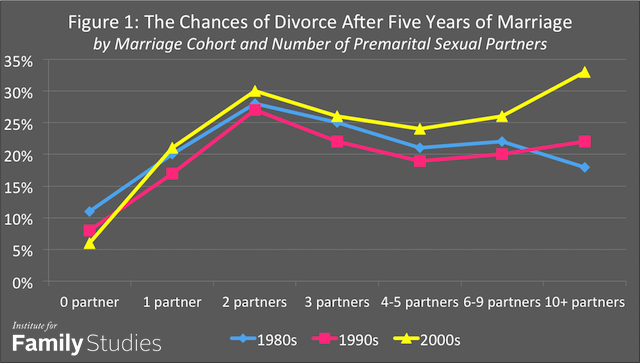
Even one non-husband premarital sex partner raises risk of divorce

Why is the 2-partner number so high?

In most cases, a woman’s two premarital sex partners include her future husband and one other man. That second sex partner is first-hand proof of a sexual alternative to one’s husband. These sexual experiences convince women that sex outside of wedlock is indeed a possibility. The man involved was likely to have become a partner in the course of a serious relationship—women inclined to hook up will have had more than two premarital partners—thereby emphasizing the seriousness of the alternative.

The Christian Post had an article about some recent numbers from the Centers for Disease Control about virgins.

Excerpt:

A new Centers for Disease Control study examines teenage health behaviors in connection to their self-reported sexual activity and shows those who remain abstinent are much healthier on many fronts than their sexually active peers.

The report, titled “Sexual Identity, Sexual Contacts, and Health-Related Behaviors Among Students in Grades 9-12, United States and Selected Sites,”Ā showcased the results from a 2015 survey that monitored several categories of health-related behaviors like tobacco usage, drug and alcohol use, sexual habits, unhealthy dietary behaviors, and behaviors that contribute to unintentional injuries and violence.

The report concludes “that students who had no sexual contact have a much lower prevalance of most health-risk behaviors compared with students” who had sexual contact.

The article quotes Dr. Jennifer Roback Morse, who I have featured on this blog many times:

In a Monday interview with The Christian Post, Jennifer Roback Morse, founder and president of the Ruth Institute, said,Ā “this study is remarkable because it asks questions and reports the answers, rather than avoiding questions or assuming answers.”

As Glenn Stanton noted last week inĀ The Federalist, the results from those questions and answers are remarkable.

With regard to smoking, teenage virgins are 3,300 percent less likely to smoke daily than their peers who are sexually involved with someone of the opposite sex, Stanton computed from the report’s data. Teen virgins are 9,500 percent less likely to smoke daily than their peers who are sexually involved with someone of the same sex or in a bisexual relationship, he added. Chaste young people are also extremely less likely to use indoor tanning beds, binge drink, smoke marijuana, ride in cars as passengers with a drunk driver, and get into physical fights than their sexually active peers. Abstinent youth are also more likely to get a solid eight hours of sleep every night and eat breakfast daily.

[…]The CDC report also included findings from 25 state surveys, and 19 large, urban school district surveys conducted among students in grades 9–12 which took place between December of 2014 and September of 2015.

Now, many pro traditional marriage people will tell young men “feminism and the sexual revolution change nothing about a woman’s suitability for marriage, so go out there and get married to these women anyway”. In my experience, no one is telling women NOT to follow their hearts, and explaining to them the harm that they do by allowing their feelings to determine who they will engage in relationships.

I would like to see womenĀ make better decisions with men before they marry, rather than be influenced by their peers and culture to give themselves to men who are not marriage-minded. Maybe a little skepticism should be shown to “follow your heart”? Women need to understand what they are losing when they choose to have premarital sex.

In my group of friends, theĀ men are aware of the Biblical prohibition on premarital sex. My friends know about theĀ research on marriage, and what it takes to make a marriage work. We don’t follow our hearts, because we do what we know will work to achieve the results we want. We don’t listen to the culture, and we don’t listen to radical feminists. Men generally take an engineering approach to marriage – we want to know what the best practices and tradeoffs are, and then weĀ plan and act to succeed.

How long are the days of Genesis? Hugh Ross and Jason Lisle debate

Two bears fight it out, and may the best bear win!

I found this radio debate about the age of the Earth on the Apologetics 315 Twitter feed.

Speakers:

Jason Lisle

Dr. Lisle graduated summa cum laude from Ohio Wesleyan University where he double-majored in physics and astronomy, and minored in mathematics. He did graduate work at the University of Colorado where he earned a Master’s degree and a Ph.D. in Astrophysics. While there, Dr Lisle used the SOHO spacecraft to investigate motions on the surface of the sun as well as solar magnetism and subsurface weather. His thesis was entitled ā€œProbing the Dynamics of Solar Supergranulation and its Interaction with Magnetism.ā€ Among other things, he discovered a previously unknown polar alignment of supergranules (solar convection cells), and discovered evidence of solar giant cells. He has also authored a number of papers in both secular and creation literature.

Hugh Ross

At age seventeen he became the youngest person ever to serve as director of observations for Vancouver’s Royal Astronomical Society. With the help of a provincial scholarship and a National Research Council (NRC) of Canada fellowship, he completed his undergraduate degree in physics (University of British Columbia) and graduate degrees in astronomy (University of Toronto). The NRC also sent him to the United States for postdoctoral studies. At Caltech he researched quasi-stellar objects, or “quasars,” some of the most distant and ancient objects in the universe.

So both have impeccable scientific credentials.

The MP3 file is here. (This is the updated version that Brian Auten fixed to remove the commercials!)

I don’t always agree with Frank Pastore, (only 95%), but he knows the topic of the debate back to front, and guides the discussion in an incredibly useful, accurate way. This is a fine debate to listen to! You will learn a lot. And you will have fun learning.

The Bible and the early church fathers

Jason Lisle

  • we take Genesis literally
  • the starting point of YEC is Scripture
  • the plain meaning of Scripture is that the earth was made in 6 24-hour days
  • science has to be interpreted in a way that fits a plain reading of Genesis 1
  • the evidence for an old universe and old Earth must be rejected a priori

Hugh Ross

  • we take Genesis literally
  • the Hebrew word for day (yom) can mean 24 hours or a long period of time
  • there are multiple creation accounts in the Bible
  • interpreting yom as long periods of time harmonizes all the accounts
  • the Bible says that the seventh day is not even ended
  • we believe in a literal Adam and Eve living thousands of years ago

Jason Lisle

  • there’s only 1 account of creation in the Bible: Genesis
  • the normal view in church history is 6 24-hour days
  • there are some early church fathers who that the days are long
  • the other places where creation is discussed are not real accounts

Hugh Ross

  • the early church did not spend a lot of time talking about the age of the Earth
  • there is not unanimous agreement about the age of the Earth
  • there is no definitive statement on the age of the Earth until Isaac Newton
  • Newton strongly favored an old earth, hundreds of years before Darwin
  • there are other creation accounts, Job 38-39
  • Pslam 104 is a creation account

Jason Lisle

  • a Psalm is not written in the genre of historical narrative
  • Psalm 104 is not a creation account – it talks about ships, etc
  • it’s talking about the modern era, not a creation account

The evidence from science

Hugh Ross

  • both of us believe in an absolute beginning of time, space and matter
  • both of us believe that space is expanding now
  • stars form as matter coalesces during the expansion of the universe
  • star formation requires a universe aged on the order of billions of years

Jason Lisle

  • if you pre-suppose my interpretation of Genesis, then the universe is young

Hugh Ross

  • the speed of the expansion of the universe proves an old universe
  • the light emitted from the oldest stars also proves an old universe

Jason Lisle

  • if you pre-suppose my interpretation of Genesis, then the universe is young

Was the universe made with the appearance of age

Jason Lisle

  • any evidence for an old universe is wrong
  • stars didn’t form gradually, they were created by God instantly
  • stars have the appearance of age, but they’re actually young

Hugh Ross

  • God doesn’t lie in the Bible or in the book of nature
  • Scientists can look back in time by looking further out into the universe
  • Because light takes a long time to travel to the Earth, we can see the past
  • we can see a time when there were no stars yet
  • stars formed slowly over time, not instantaneously
  • we have photos of the universe before stars and after stars
  • we can see a history of the universe by looking closer and further away

Does nature provide us with knowledge about creation?

They discuss Psalm 19 now, so here’s Psalm 19:1-5:

1 The heavens declare the glory of God; the skies proclaim the work of his hands.

2 Day after day they pour forth speech; night after night they display knowledge.

3 There is no speech or language where their voice is not heard.

4 Their voice goes out into all the earth, their words to the ends of the world.
In the heavens he has pitched a tent for the sun,

5 which is like a bridegroom coming forth from his pavilion, like a champion rejoicing to run his course.

Jason Lisle

  • nature isn’t a book
  • nature doesn’t provide knowledge about God
  • Psalm 19 doesn’t say that nature communicates to us
  • verse 3 says “There is no speech nor language”

Hugh Ross

  • If you read all of verse 3, it says the exact opposite of what you just said it says
  • Verse 1: “The heavens declare the glory of God; the skies proclaim the work of his hands”
  • Verse 2: “Day after day they pour forth speech; night after night they display knowledge.”
  • Verse 3: “There is no speech or language where their voice is not heard.“
  • Verse 4: “Their voice goes out into all the earth, their words to the ends of the world.”

Jason Lisle

  • You can’t take the Bible literally all the time

How important is the age of the Earth?

Hugh Ross

  • it’s a non-essential because it has nothing to do with salvation or inerrancy
  • both sides of the debate affirm the same views of salvation and inerrancy
  • professional scientists have multiple lines of evidence saying the universe is old
  • the only reason it matters is that young earth creationism is a barrier to faith
  • if you have to deny science to be a Christian, then it stops people from being saved
  • young earth opposition to science has been used by secularists to marginalize Christianity

Jason Lisle

  • there was no death in the Garden of Eden, animal or human, before the Fall
  • the Bible says that death was a consequence of Adam’s sin
  • so there was no death before the Fall, according to the Bible
  • old earth people believe in death before the Fall

Consider Romans 5:12:

12Therefore, just as sin entered the world through one man, and death through sin, and in this way death came to all men, because all sinned—

Hugh Ross

  • Romans 5:12 says that Adam’s sin caused death to come to all men
  • old earth people believe that only animal death existed before the Fall, not human death
  • plant and animal death existed before the Fall – Adam and Eve were eating!

Jason Lisle

  • I interpret the Bible to say that plants aren’t living creatures

What about dinosaurs, the Flood, and Noah’s ark?

Jason Lisle

  • dinosaurs were created on the 6th day
  • dinosaurs lived alongside humans and were vegetarians before the Fall
  • dinosaurs were on the Ark – they’re not that big – just take baby dinosaurs
  • it’s a global flood

Hugh Ross

  • dinosaurs were created on the 5th day
  • they were extinct before before humans ever appeared
  • nobody in history ever wrote about dinosaurs until 200 years ago
  • it’s a local flood

What do skeptical ancient historians think of the earliest Christian creed?

Sherlock Holmes and John Watson: let's take a look at the facts
Sherlock Holmes and John Watson: let’s take a look at the facts

Here is a post from my friend Eric Chabot. He writes about the earliest historical source for the minimal facts about the resurrection, which is the early creed recorded by Paul in 1 Corinthians: 3-7.

1 Cor 15:3-7:

3Ā For what I received I passed on to you as of first importance: that Christ died for our sins according to the Scriptures,

4Ā that he was buried, that he was raised on the third day according to the Scriptures,

5Ā and that he appeared to Cephas, and then to the Twelve.

6Ā After that, he appeared to more than five hundred of the brothers and sisters at the same time, most of whom are still living, though some have fallen asleep.

7Ā Then he appeared to James, then to all the apostles,

8 and last of all he appeared to me also, as to one abnormally born.

Just in case you didn’t know, Cephas is Peter, one of Jesus’ closest followers.

The general consensus among scholars is the that creed goes back to within 1-3 years after the death if Jesus, when almost all the eyewitnesses were still around.

The creed

In Eric’s post, he quotes very well-known skeptical historians who affirm each part of the creed.

First, the creed as a whole is respected, even by atheist scholars like John Dominic Crossan:

Paul wrote to the Corinthians from Ephesus in the early 50s C.E. But he says in 1 Corinthians 15:3 that ā€œI handed on to you as of first importance which I in turn received.ā€ The most likely source and time for his reception of that tradition would have been Jerusalem in the early 30s when, according to Galatians 1:18, he ā€œwent up to Jerusalem to visit Cephas [Peter] and stayed with him fifteen daysā€ (3).

And atheist scholarĀ Robert Funk:

The conviction that Jesus had risen from the dead had already taken root by the time Paul was converted about 33 C.E. On the assumption that Jesus died about 30 C.E., the time for development was thus two or three years at most.ā€ — Robert Funk co-founder of the Jesus Seminar.(5)

Let’s take a look at one of the parts of the creed that is respected by skeptical historians… namely, the early belief that Jesus was resurrected shortly after his death.

TheĀ early belief in the resurrection

Skeptical scholar E.P. Sanders:

That Jesus’ followers (and later Paul) had resurrection experiences is, in my judgment, a fact. What the reality was that gave rise to the experiences I do not know. ā€œI do not regard deliberate fraud as a worthwhile explanation. Many of the people in these lists were to spend the rest of their lives proclaiming that they had seen the risen Lord, and several of them would die for their cause. Moreover, a calculated deception should have produced great unanimity. Instead, there seem to have been competitors: ā€˜I saw him first!’ ā€˜No! I did.’ Paul’s tradition that 500 people saw Jesus at the same time has led some people to suggest that Jesus’ followers suffered mass hysteria. But mass hysteria does not explain the other traditions.ā€ ā€œFinally we know that after his death his followers experienced what they described as the ā€˜resurrection’: the appearance of a living but transformed person who had actually died. They believed this, they lived it, and they died for it. (14)

Skeptical scholar Bart Ehrman:

Historians, of course, have no difficulty whatsoever speaking about the belief in Jesus’ resurrection, since this is a matter of public record. (17)

Why, then, did some of the disciples claim to see Jesus alive after his crucifixion? I don’t doubt at all that some disciples claimed this. We don’t have any of their written testimony, but Paul, writing about twenty-five years later, indicates that this is what they claimed, and I don’t think he is making it up. And he knew are least a couple of them, whom he met just three years after the event (Galatians 1:18-19). (18)

You know, if all you did was give someone his post, I think that would be enough to show people that a more complete investigation of the historical Jesus was certainly a reasonable thing to do. It’s amazing to me that people who grow up at this time when access to the data is so easy do not take the opportunity to look into Christianity.

List of virtually undeniable facts

Finally,Ā below isĀ a list of facts about the historical Jesus that are accepted by ancient historians – Christian, non-Christian, atheist.

These are compiled by non-Christian scholar E.P. Sanders:

From his book “Jesus and Judaism” (1985):

  • Jesus was baptized by John the Baptist.
  • Jesus called disciples and spoke of there being twelve.
  • Jesus confined his activity to Israel.
  • Jesus was a Galilean who preached and healed.
  • Jesus engaged in a controversy about the temple.
  • Jesus was crucified outside Jerusalem by the Roman authorities.
  • After his death, his followers continued as an identifiable movement.
  • At least some Jews persecuted at least parts of the new movement.

From his book “The Historical Figure of Jesus” (1993):

  • Jesus was born c.4 BCE, near the time of the death of Herod the Great;
  • He spent his childhood and early adult years in Nazareth, a Galilean village;
  • He was baptized by John the Baptist;
  • He called disciples;
  • He taught in the towns, villages, and countryside of Galilee (apparently not the cities);
  • He preached “the kingdom of God”;
  • Around the year 30 he went to Jerusalem for Passover;
  • He created a disturbance in the temple area;
  • He had a final meal with the disciples;
  • He was arrested and interrogated by Jewish authorities, specifically the high priest;
  • He was executed on the orders of the Roman prefect, Pontius Pilate;
  • His disciples at first fled;
  • They saw him (in what sense is uncertain) after his death;
  • As a consequence they believed he would return to found the kingdom;
  • They formed a community to await his return and sought to win others to faith in him as God’s Messiah.

The way the resurrection of Jesus is presented on TV, you would think that mythical stories about Jesus emerged decades and even centuries after the fact in other parts of the world from where the events happened. But the trouble is that no ancient historian thinks that. Only Hollywood TV producers and movie makers think that. Now, if you are getting your view of the historical accuracyĀ of basic Christian beliefs from television and movies, then don’t be surprised if you are wrong. No one is saying that you have to go to Christian pastors and preachers for the facts, but you should go to the historians. They at least know the minimal facts.

The best way for a skeptic to tackle these issues is, I think, to watch a decent debate on the resurrection of Jesus between two respected scholars. My favorite debate on the resurrection is William Lane Craig versus atheist historian James Crossley. I have a video and a summary already ready made just waiting for you to check it out. Don’t worry, no one will be looking over your shoulder making you change everything your life should you be convinced. Just watch the debate and decide what you are going to do with it on your own. You don’t have to change your whole life overnight. Becoming a Christian is instantaneous and easy to do. Living like a Christian is a process, and it’s between you and God how fast you go. So just see what the facts are to start with and then take it from there.