
Fifth Third Bank gives employees raises and bonuses ahead of Trump’s tax cut bill

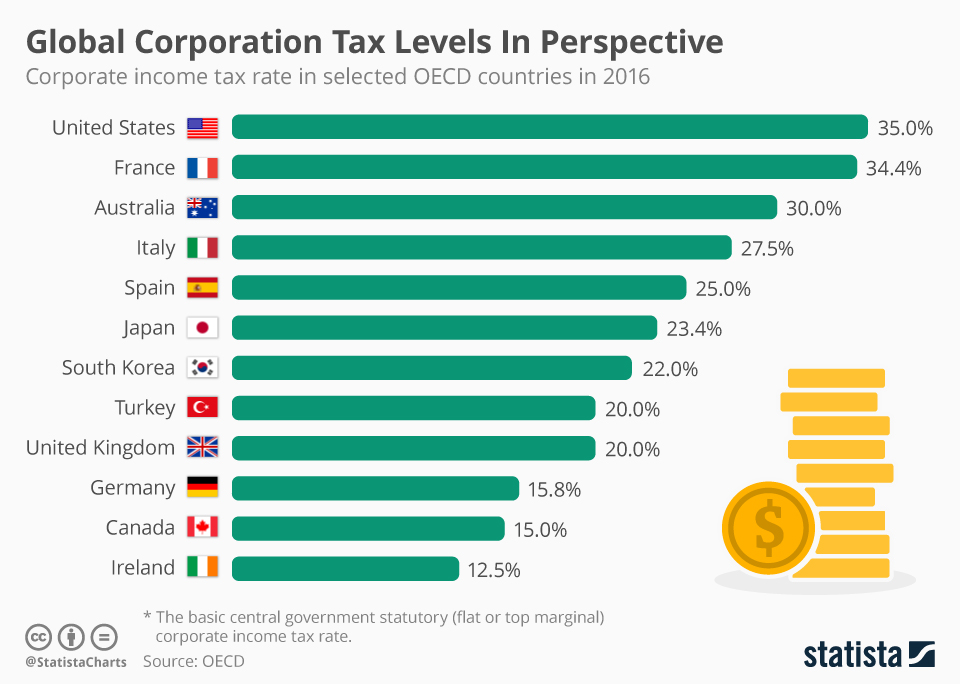
Why does the United States have the highest corporate tax rate in the world?

What happens when you cut the corporate tax? Well, government gets less of what businesses earn, which means less money for sugar subsidies and AMTRAK and settle Congressional sexual-harassment lawsuits. And what do businesses do with that extra money they get to keep? Well, they could create new products, make existing products cheaper, improve existing products, improve their existing products… lots of good things. In a competitive free market, business have to use their capital to develop better and cheaper products that customers will want to freely buy.

CNBC reports on one of my favorite corporations – Fifth Third Bank – reacting to news of an impending cut in the corporate tax rate.

Excerpt:

Fifth Third Bancorp will pay more than 13,500 employees a bonus and raise the minimum wage of its workforce to $15 an hour after the passage of the Republican tax plan that will cut the bank’s corporate tax rate.

[…]Cincinnati-based Fifth Third, the fifteenth largest U.S. bank by asset size, said the tax cut allowed it to re-evaluate its employee pay and pass along some of the windfall. Nearly 3,000 workers will see hourly wages rise to $15. The $1,000 one-time bonus is expected to be paid by the end of this year, the bank said, assuming President Donald Trump signs the bill into law by Christmas.

Senior managers and top executives are excluded from the special payments. “It is good for our communities, employees and Fifth Third Bank,” said CEO Greg Carmichael in a statement.

But, Fifth Third wasn’t the only company making decisions that favored their employees.

Fox Business reported on some others – and notice how the bonuses are going to non-management and non-executive workers:

AT&T

The telecom giant said Wednesday that more than 200,000 of its employees, including union-represented and non-management workers, will be eligible for a $1,000 bonus. The checks will be in the mail in time for the holidays if Trump finalizes the tax bill with his signature before Christmas. AT&T (T) also said it will invest $1 billion more than expected in the U.S. in 2018, once the cuts are final.

“Congress, working closely with the President, took a monumental step to bring taxes paid by U.S. businesses in line with the rest of the industrialized world,” AT&T Chairman and CEO Randall Stephenson said in a statement. “This tax reform will drive economic growth and create good-paying jobs.”

Boeing

The aerospace and defense company immediately announced $300 million in investments after the bill passed, with $100 million toward corporate giving including employee gift-match programs, $100 million toward workforce development, training and education and $100 million toward enhancing Boeing’s workplaces.

“On behalf of all of our stakeholders, we applaud and thank Congress and the administration for their leadership in seizing this opportunity to unleash economic energy in the United States,” Boeing (BA) President and CEO Dennis Muilenburg said in a statement. “It’s the single-most important thing we can do to drive innovation, support quality jobs and accelerate capital investment in our country.”

Comcast

The Philadelphia-based telecom corporation said it would award $1,000 bonuses to more than 100,000 non-executive employees. In addition, Comcast (CMCSA) NBC Universal Chairman and CEO Brian L. Roberts said the company plans to spend more than $50 billion in the next five years on infrastructure investments that are expected to create “thousands of new direct and indirect jobs.”

In a press release, Comcast said the initiatives were “based on the passage of tax reform and the FCC’s action on broadband.”

The way that economics works is that when you give tax cuts to the people who create products and services, they use that money to try to develop better products and services. We all benefit from having innovative products that make us more efficient and productive. Laptops, smartphones, wireless routers, GPS all give us the potential to be more productive. But the only way to develop and sell these products is to hire people who are focused on pleasing customers.

But when you give government money, they turn to the most dependent segments of the population (e.g. – non-English-speaking refugees from countries dominated by Islamic terrorism), and they offer to buy their votes by giving them free stuff. Free drug-injection clinics. Free contraceptives. Free abortions. Free sex changes. Free welfare for refugees and illegal immigrants. We need to let private sector job creators keep their own money because they pay workers who have to get up and go to work.

Should Christians expect to know God’s will by means of feelings and intuitions?

I have a key that will unlock a puzzling mystery

There are two views on the topic of decision making and the will of God. The view you learn in the church is called “the traditional view”. I call this view the feelings/intuition view. This view that elevates feelings / intuitions to the level of divine communications from God. The more practical view is called “the wisdom view”. I call this view the battlefield commander view. I am a proponent of the wisdom / commander view.

Let’s learn about the two different views:

[The traditional view is] that God has a plan for our lives and that we receive guidance through methods such as “open and closed doors”, “feeling led” and “the still, small, voice”.

[The wisdom view] holds that God does not have an “individual will” for our lives, but rather that all of God’s will can be summed up within two categories, God’s sovereign will and God’s moral will. Basically God’s sovereign will is all the things that god decrees will happen. It is hidden (mostly) from us, and does not play an active part in our decision, although some of it is revealed in the bible. God’s moral will is the part that we must concern ourselves with in making decisions. It is fully revealed in the bible and our decisions must be made within it. We may use wisdom in applying god’s moral will to our lives, or we may be in an area not covered by god’s moral will. We must finally submit in advance to God’s sovereign will, being prepared for him to sovereignty intervene and redirect us through whatever means he wills (see James).

Here’s a bit more from someone else:

Regarding the view that God has a personal will for us individually that we have to discern and find, J.I. Packer says, “The first thing to say is that the idea of guidance is actually a novelty among orthodox evangelicals. It does not go back farther than the last century. Second, it has led people to so much foolish action on the one hand, and so much foolish inaction on the other, as well as puzzlement and heartbreak when the ‘hotline’ to God seems to go silent, that it has to be discredited. Third, it must be said that Scripture gives us no more warrant constantly to expect personal ‘hotline,’ ‘voice-from-the-control-tower’ guidance than to expect new authoritative revelations to come our way for the guidance of the whole church.” (Hot Tub Religion, page 118).

As to the point of the question, how do I make decisions, I attempt to make decisions in light of three factors: God’s moral will, wisdom, and my personal desires. If something is opposed to God’s moral will, then I should obviously flee from it. If it’s not opposed, then I consider the wisdom of the choices. For example, would it be wise for me to marry a woman who loves Jesus, though we have nothing else in common? Probably not. If the options pass the criteria of wisdom, then I’m free to choose how I wish. If I’m offered two jobs, and both are honoring to God, and both would be wise to take, then I’m free to choose the job I would like more. I don’t need to put out a fleece or await some other confirmation from God. If it’s moral and wise, then the only question as to whether or not it will honor Him is my attitude.

Some examples of this model used in the Bible (in theological circles referred to as the Wisdom Model) are in Paul’s planning of a mission to Rome in Romans 1:9-15, 15:22-24, the Jerusalem Council (Acts 15:1-29), and Paul’s instructions for legal disputes (1 Cor 6:3-6).

The best book on this topic is Garry Friesen’s “Decision Making and the Will of God”. In it, you’ll find a full assessment about what the Bible teaches on this topic.

When I am trying to decide what will be effective, I look at Christian scholars, at their papers, books, and public debates. That’s effectiveness because it is addressed to a non-Christian audience in public with the force of reason and evidence. It is persuasion and it is addressed to rational minds. I want to change the minds of people who have a large influence on society on the whole. I don’t think that offering Christianity as life-enhancement or self-help is really “having an influence”. I think that offering Christianity as truth, with support, is “having an influence”.

So let me be clear about what I believe:

  • I don’t think that God normally talks to people directly
  • I don’t believe that life is an Easter egg hunt, filled with clues accessible only to emotion and intuition
  • I don’t believe that God expects people to discover a specific will for their lives using non-rational means
  • I think that people make up their own life plan that is consistent with the Bible
  • The goal of the life plan is to be effective, and there are no other considerations
  • I think that there are many good things a person can do, but that some are more effective than others
  • I think that with respect to the goal of serving God effectively, my happiness is expendable
  • I don’t think that the purpose of doing something for the Lord is to feel good about ourselves
  • I don’t think that people should choose ineffective things to do just because they like them
  • I don’t think that people should choose ineffective things to do just because they are good at them
  • I think people should do hard things that they don’t like – as long as it’s more effective
  • I don’t think that any course of action is as effective as any other – some plans accomplish more
  • I don’t think that life is totally unpredictable and irrational and subjective
  • I think that we can know what is or is not effective by studying and learning about the world
  • I think life is like a battlefield that must be surveyed, understood and acted upon deliberately

I think that every person is the commanding officer of his or her own life, and each person must study everything they can, make a plan that is consistent with the Bible’s moral prescriptions, execute the plan and achieve whatever they can achieve for the Lord. And the goal is not comfort or happy feelings, but real achievements. Not for the purpose of being saved, of course, because salvation is a free gift of God because of what Jesus did on the cross. Life is more like a battle than a vacation resort or a buffet or a shopping center. God’s will for us is not have happy feelings, but that we freely choose to sacrifice ourselves out of obedience and service to him. In my case, that means studying hard things, making money, saving money, and giving money away to good scholars, sponsoring good events and being persuasive to non-Christians. None of this necessarily makes me happy, but it does work to bring glory to God. I cried when I had to learn calculus, because it was so hard. But who cares? The main thing is that I have money now to sponsor Christian speakers or to give books to Christians to read, and God is happy with that.

I think that it is very important to realize that God is not impressed by our not being smart and not being effective. If we have the ability to be smart, then we should be smart, whether it makes us happy or not. If we have the ability to make money, then we should make money, whether it makes us happy or not. If we have the ability have a great influence, then we should have a great influence, whether it makes us happy or not. There will be plenty of time for happiness after we’re dead. But this life is a time of serving, and we should try to serve effectively, whether it makes us happy or not. With respect to God’s purposes in the world, my happiness is expendable.

Whenever someone questions my goals and plans by saying that I am asserting my will over God’s will, the first question I want to ask that person is this: “how do you know what God’s will is?” and “what is your basis for thinking that my plan to serve will not be effective?”. I want to know if I have misunderstood something about the way the world is, or miscalculated in some way. I want someone to look at my calculations and show where they are going to produce a less optimal result for the Lord. That’s the only concern I have – effectiveness for the Lord. Usually what I have found is that the other person wants to make the purpose of life their own happiness, and it makes them happier to choose what to do moment by moment, without having to study anything or make plans. It’s not that they have better goals (for God) or better plans (for God). It’s that they want their goals to be above God, and they don’t want to make plans other than to do whatever makes them happy.

This article by Greg Koukl may be helpful.

And I also found this summary of the Friesen book useful:

In nine parts.

Jay Richards: How to end poverty in 10 tough steps

I saw that Stand to Reason’s Amy Hall blogged about a lecture by Jay Richards, a Christian expert in economics. Amy linked to this post by Justin Taylor which summarizes the talk (above).

Summary:

  1. Establish and maintain the rule of law.
  2. Focus the jurisdiction of government on maintaining the rule of law, and limit its jurisdiction over the economy and the institutions of civil society.
  3. Implement a formal property system with consistent and accessible means for securing a clear title to property one owns.
  4. Encourage economic freedom: Allow people to trade goods and services unencumbered by tariffs, subsidies, price controls, undue regulation, and restrictive immigration policies.
  5. Encourage stable families and other important private institutions that mediate between the individual and the state.
  6. Encourage belief in the truth that the universe is purposeful and makes sense.
  7. Encourage the right cultural mores—orientation to the future and the belief that progress but not utopia is possible in this life; willingness to save and delay gratification; willingness to risk, to respect the rights and property of others, to be diligent, to be thrifty.
  8. Instill a proper understanding of the nature of wealth and poverty—that wealth is created, that free trade is win-win, that risk is essential to enterprise, that trade-offs are unavoidable, that the success of others need not come at your expense, and that you can pursue legitimate self-interest and the common good at the same time.
  9. Focus on your comparative advantage rather than protecting what used to be your competitive advantage.
  10. Work hard.

His book “Money, Greed and God” is a perfect introduction to economics and how it relates to the Christian worldview. I always encourage Christians to move beyond good intentions to good results by studying economics. We are supposed to be helping the poor, but how should we do it? Economics is the science that allows us to understand which policies we should support to do that.