What percentage of Muslims approve of radical Islam and terrorism?

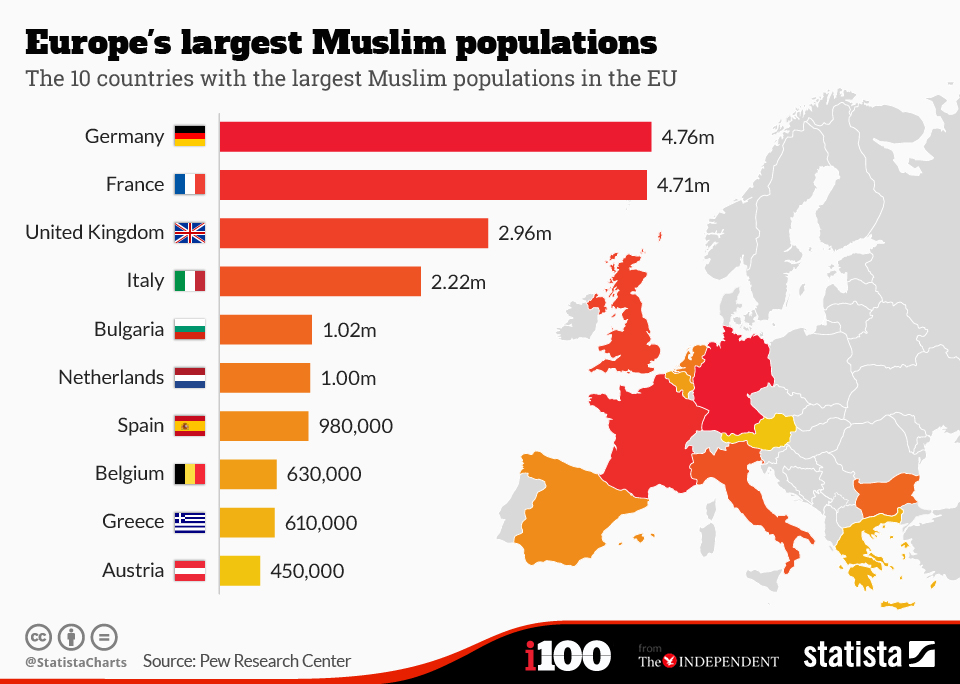
Muslim populations in Europe

Normally, when people ask me about this question, I go straight to the 2013 Pew Research survey which I blogged about before. But now I have something even better.

Here’s a post from Ben Shapiro at Breitbart News which looks at several polls from several different countries.

Shapiro writes: (links to polls removed)

So, here is the evidence that the enemy we face is not a “tiny minority” of Muslims, let alone a rootless philosophy unconnected to Islam entirely. It’s not just the thousands of westerners now attempting to join ISIS. It’s millions of Muslims who support their general goals, even if they don’t support the group itself.

France. A new, widely-covered poll shows that a full 16% of French people have positive attitudes toward ISIS. That includes 27% of French between the ages of 18-24. Anne-Elizabeth Moutet of Newsweek wrote, “This is the ideology of young French Muslims from immigrant backgrounds…these are the same people who torch synagogues.”

Britain. In 2006, a poll for the Sunday Telegraph found that 40% of British Muslims wanted shariah law in the United Kingdom, and that 20% backed the 7/7 bombers.Another poll from that year showed that 45% of British Muslims said that 9/11 was an American/Israeli conspiracy; that poll showed that one-quarter of British Muslims believed that the 7/7 bombings were justified.

Palestinian Areas. A poll in 2011 showed that 32% of Palestinians supported the brutal murder of five Israeli family members, including a three-month-old baby. In 2009, a poll showed that 78% of Palestinians had positive or mixed feelings about Osama Bin Laden. A 2013 poll showed 40% of Palestinians supporting suicide bombings and attacks against civilians. 89% favored sharia law. Currently, 89% of Palestinians support terror attacks on Israel.

Pakistan. After the killing of Osama Bin Laden, the Gilani Foundation did a poll of Pakistanis and found that 51% of them grieved for the terrorist mastermind, with 44% of them stating that he was a martyr. In 2009, 26% of Pakistanis approved of attacks on US troops in Iraq. That number was 29% for troops in Afghanistan. Overall, 76% of Pakistanis wanted strict shariah law in every Islamic country.

Morocco. A 2009 poll showed that 68% of Moroccans approved of terrorist attacks on US troops in Iraq; 61% backed attacks on American troops in Afghanistan as of 2006. 76% said they wanted strict sharia law in every Islamic country.

Jordan. 72% of Jordanians backed terror attacks against US troops in Iraq as of 2009. In 2010, the terrorist group Hezbollah had a 55% approval rating; Hamas had a 60% approval rating.

Indonesia: In 2009, a poll demonstrated that 26% of Indonesians approved of attacks on US troops in Iraq; 22% backed attacks on American troops in Afghanistan. 65% said they agreed with Al Qaeda on pushing US troops out of the Middle East. 49% said they supported strict sharia law in every Islamic country. 70% of Indonesians blamed 9/11 on the United States, Israel, someone else, or didn’t know. Just 30% said Al Qaeda was responsible.

Egypt. As of 2009, 87% of Egyptians said they agreed with the goals of Al Qaeda in forcing the US to withdraw forces from the Middle East. 65% said they wanted strict sharia law in every Islamic country. As of that same date, 69% of Egyptians said they had either positive or mixed feelings about Osama Bin Laden. In 2010, 95% of Egyptians said it was good that Islam is playing a major role in politics.

United States. A 2013 poll from Pew showed that 13% of American Muslims said that violence against civilians is often, sometimes or rarely justified to defend Islam. A 2011 poll from Pew showed that 21 percent of Muslims are concerned about extremism among Muslim Americans. 19 percent of American Muslims as of 2011 said they were either favorable toward Al Qaeda or didn’t know.

In short, tens of millions of Muslims all over the world sympathize with the goals or tactics of terrorist groups – or both. That support is stronger outside the West, but it is present even in the West. Islamist extremism is not a passing or fading phenomenon – it is shockingly consistent over time. And the West’s attempts to brush off the ideology of fanaticism has been an overwhelming failure.

A more recent poll says that 13% of Syrian refugees support Islamic State:

A first-of-its-kind survey of the hordes of Syrian refugees entering Europe found 13% support the Islamic State. The poll should raise alarms about the risks posed by the resettlement of 10,000 refugees in the U.S.

The poll of 900 Syrian refugees by the Arab Center for Research and Policy Studies also found that another 10% of the displaced Syrians have a lukewarm, but not entirely negative, view of the terror group. That means 23% — or almost 1 in 4 — could be susceptible to ISIS recruitment.

It also means as many 2,500 of the 10,000 Syrian refugees that the Obama administration is resettling inside American cities are potential terrorist threats.

Now contrast those facts with the views of Barack Obama and his allies in the mainstream media.

That video is from The Weekly Standard, here’s the text:

President Obama told CNN’s Fareed Zakaria that 99.9 percent of Muslims reject radical Islam. He made the comments in response to a question about the White House avoiding using the phrase “Islamic terrorists.”

“You know, I think that the way to understand this is there is an element growing out of Muslim communities in certain parts of the world that have perverted the religion, have embraced a nihilistic, violent, almost medieval interpretation of Islam, and they’re doing damage in a lot of countries around the world,” said Obama.

“But it is absolutely true that I reject a notion that somehow that creates a religious war because the overwhelming majority of Muslims reject that interpretation of Islam. They don’t even recognize it as being Islam, and I think that for us to be successful in fighting this scourge, it’s very important for us to align ourselves with the 99.9 percent of Muslims who are looking for the same thing we’re looking for–order, peace, prosperity.”

So Obama denies all of these surveys, and instead invents a view of the world that is consistent with his feelings. A true man of the secular left.

This gap between belief and reality explains why he is now bringing 200,000 Syrian Muslim refugees into America, keeping Syrian Christian refugees out of America, and generally underestimating Islamic State (ISIS / ISIL) because he cannot believe that radical Islam is anything for us to be concerned about.

Is the government capable of vetting Syrian refugees to find threats?

Not so much:

The administration argues that it’s conducting interviews with Syrians at camps in Turkey, Jordan and Lebanon. But without security forces on the ground in Syria who can verify details, there is no way to back-check a refugee’s story to see if he is telling the truth and is, in fact, not a security threat.

Even when we had people on the ground in Iraq to screen refugees, terrorists got through the safety net.

In 2011, for instance, two Kentucky immigrants who had been resettled as Iraqi refugees were busted for trying to buy stinger missiles for al-Qaida.

It turned out that their fingerprints matched those linked to roadside bombs in Iraq. It was a major red flag that should have barred their entry, but U.S. screeners failed to take note. And the terrorists slipped into the U.S.

The administration’s vetting process for the massive influx of Syrian refugees is completely unreliable, admits the FBI official in charge of such security background checks.

“It’s not even close to being under control,” warned assistant FBI director Michael Steinbach.

We should not be believing the man who promised us that we could keep our doctor, keep our health plans, and that our health insurance premiums would go down $2,500. He is either lying, or he likes to speak on matters where he is not competent to know the truth of the matter.

UPDATE: ECM sends me this video from Ben Shapiro:

Awesome!

Matt Dillahunty debates David Robertson on atheism, morality and evil

Two horses fight it out, may the best horse win!

OK. So I think it’s safe to say that of all the Christian apologists out there, David Robertson is my least favorite debater. Why? Many reasons, but mostly because he does not bring in evidence, especially scientific evidence. And he seems to make these clever quips like G. K. Chesterton. I like evidence. I would rather that he talk about scientific and historical evidence.

Dina asked me to listen to this debate a while back, between David Robertson and agnostic Matt Dillahunty (he’s not an atheist, he’s just an agnostic). I went in absolutely convinced that Robertson was going to have his ass handed to him by Matt Dillahunty. And I could not have been more wrong.

Here’s the debate posted on YouTube (audio only):

This snarky summary is just a paraphrase from certain parts of the debate, it is not designed for accuracy, but for fun – to make you listen to the debate. Listen to the debate to get the exact words in context.

Summary:

  • Matt Dillahunty: he’s an agnostic who calls himself an atheist
  • David Robertson: he’s from Scotland, could we not get someone better?
  • Robertson opening statement is incredibly weak, as you might expect, he only had two arguments embedded in a long list of nonsense: 1) origin and design of the universe 2) reality of evil requires objective morality

1) Creation/Design:

Robertson: The fact is that matter exists. There are 3 views that could account for this fact: 1) created, 2) eternal, 3) self-generated out of nothing. Option 3) is self-contradictory, 1) requires a Creator, and 2) is falsified by the Big Bang cosmology. So what’s your view?

Dillahunty: You’re trying to get me to say what my view is, but I can just say “I don’t know” and get out of having to take any position on how matter got here.  I can say “I don’t know” to all the scientific evidence for the Big Bang cosmology, too!

2) Evil requires objective morality, requires a moral lawgiver:

Robertson: evil exists, e.g. – the Holocaust. If atheism is true, objective morality is impossible. Richard Dawkins agrees. Therefore, theism is the best explanation for the existence of evil.

Dillahunty: In my opinion, morality means doing what helps people have well-being. And I think that the Holocaust is obviously bad, because it hurts the well-being of the victims.

Robertson: The problem is that on your view, different people decide what well-being is to them. If you were raised in the Social Darwinism of the Nazi regime, you would believe that the Holocaust was the best for the well-being of the society as a whole.

Dillahunty: Isn’t it obvious that killing people is bad for their well-being?

Robertson: Is it bad for the well-being of unborn children to kill them?

Dillahunty: Yes

Robertson: So you’re against abortion, then?

Dillahunty: No

Robertson: So you think that killing the child in the womb is against the well-being of the child, but you’re for that?

Dillahunty: I don’t know! I don’t know!

Then Dillahunty tried to claim Hitler was a Christian:

Dillahunty: here is a quote by Hitler saying that secular schools are bad, and religious schools are good – see, he’s a Christian!

Robertson: when was that said and to whom?

Dillahunty: I don’t know, I don’t know!

Robertson: It was said in 1933, during an election campaign, to Catholic authorities – he was a politician, looking for votes from Catholics so he could become Chancellor.

Good and evil on atheism:

Dillahunty: good actions results in states with more well-being, and evil actions result in states with less well-being.

Brierley: but when the Nazis slaughtered all those people, they believed they were increasing well-being

Dillahunty: But you could demonstrate to them that their action is not going to increase well-being. Survival of the fittest is descriptive of what happens, but it’s not prescriptive.

Robertson: Whose well-being will human beings think about most, if not their own? Do you really think that you can stop people like Charles Manson from being evil by sitting down and trying to prove to them that they are not helping their victim’s well-being?

(A BIT LATER)

Robertson (to Dillahunty): Is it a fact that Dachau (a concentration camp) was morally wrong?

Dillahunty: (literally, not a paraphrase) I DON’T KNOW

My thoughts:

When I listened to this debate, the overwhelming conviction that emerges is that Matt Dillahunty is not someone who forms his worldview based on evidence. His rejection of the Big Bang cosmology with “I don’t know” is just atrocious. His comments about slavery in the Bible and Hitler being a Christian show that his investigations of these issues is far below the level of a responsible adult. His dallying with the Jesus-never-existed view just shows him to be fundamentally anti-intellectual, as even atheist historian Bart Ehrman denies that view. His definition of faith has nothing to do with the Bible, or Christian authorities, or Christian scholars – he invented a definition of faith that allows him to mock Christians as morons. That’s just irresponsible – letting the desire to mock others cause you to distort the definition of a word. When asked to state his positions or respond to specific evidence, his response is very often “I don’t know”. It seems to me that atheism, to him, means not pursuing truth with the aim of grasping it. He wants to keep reality at a safe distance – that’s why he says “I don’t know” so often.

On morality, it’s even worse. It’s not surprising to me that he is pro-abortion and has no opinion about concentration camps being objectively evil. Most atheists are pro-abortion, by the way. When it comes to morality, Dillahunty only has his own personal opinions, and they refer to nothing outside his own mind. (His opinion of morality as related to well-being is utilitarianism – a very problematic view – but moreover, it is his subjective view – he isn’t offering it as any sort of objective moral system that would be prescriptive instead of descriptive. Without an after-life, there is no reason for anyone to care about the moral point of view when it goes against their self-interest, anyway. Atheists use moral language, but their statements are not referring to any objective, prescriptive moral reality. Atheism is materialistic and therefore deterministic – it does not even ground the free will that is needed to make moral choices. Their view is Darwinian survival of the fittest, that’s what emerges from their origins story – and it does not rationally ground morality. The strong kill the weak, if they can. I’ve written before about how difficult it is for atheists to rationally condemn things like slavery, and nothing in Dillahunty’s presentation led me to believe that he had solved that problem.

Anybody can be an intellectually-satisfied atheist with an empty head – it’s knowledge that causes people to conform their beliefs to reality. If one strives to keep one’s head as empty as possible, then of course one can believe anything one wants. I’m glad, speaking as a Christian theist, that I get to follow the evidence wherever it leads. It seems to me that we should do that, rather than decide how we want to live first, and then invent a worldview to justify our desires.

Positive arguments for theism

New study: vocational training graduates more likely to be employed

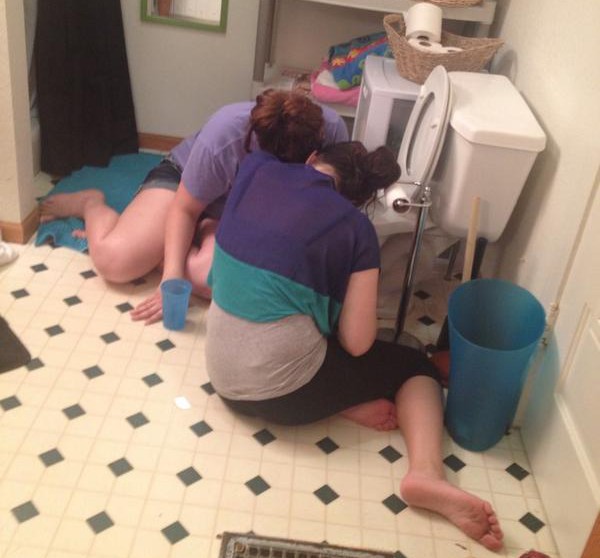
College students puking in toilet

The Stream reports on a new study of interest to young people who want to maximize the revenue from their future job, while minimizing the cost of their higher education.

Excerpt:

Conventional wisdom says that students need a four-year degree to make it in today’s economy. But do the numbers back that up?

According to a new study released by the Department of Education, students who pursue an occupational credential (an education that is career-centered) are more likely to be employed than those who get an academic credential.

[…]The study uses data from the Beginning Postsecondary Students Longitudinal Study (BPS), which tracked students who had enrolled in college for the first time.

Researchers surveyed students starting in 2003 and tracked their progress through 2009. By the end of that six-year period, the study found that a greater proportion of students who earned an occupational credential were employed.

Additionally, 74 percent of those employed students with an occupational credential were in jobs related to their field of study, compared to just 53 percent of employed students who earned an academic credential.

These data illustrate the need for change in the way policymakers think about higher education. With college tuition at an all-time high and with over 3.6 million students defaulting on their student loans, students need alternative options for upward mobility now more than ever.

The author Mary Clare Reim notes:

This suggests that recent efforts to encourage more individuals to pursue college (President Barack Obama said that all Americans should have at least some postsecondary education) may be misguided. The data also suggest that the administration’s antagonism toward more career-focused educational tracks — often provided by for-profit trade schools and community colleges — is misplaced.

On this career guide web site, I found the top 10 trades and technical careers ranked by median annual salary.

  1. Elevator Installers and Repairers $70,910
  2. Electrical and Electronics Repairers $65,230
  3. Boilermakers $54,640
  4. Construction and Building Inspectors $52,360
  5. Electricians $48,250
  6. Pile-Driver Operators $47,860
  7. Brickmasons and Blockmasons $46,930
  8. Plumbers $46,660
  9. Structural Iron and Steel Workers $44,540
  10. Sheet Metal Workers $41,710

Of course those are the median salaries, if you are clever and hard working, you can make much more.

Consider this story from the Wall Street Journal.

Excerpt:

Justin Friend ’s parents have doctoral degrees and have worked as university lecturers and researchers. So Mr. Friend might have been expected to head for a university after graduating from high school in Bryan, Texas, five years ago.

Instead, he attended Texas State Technical College in Waco, and received a two-year degree in welding. In 2013, his first full year as a welder, his income was about $130,000, more than triple the average annual wages for welders in the U.S. In 2014, Mr. Friend’s income rose to about $140,000.

[…]Mr. Friend, who is single, typically works 72 hours a week, usually including at least one day of the weekend, often on an overnight shift. His base pay is more than $25 an hour, up from about $22 when he started in 2012. He gets overtime after 40 hours a week. Pay is doubled on Sundays and tripled on holidays. He receives health insurance, a 401k retirement plan and paid vacation.

With little free time, expenses are low. He rents a one-bedroom apartment for $1,080 a month in a building with a pool and gym. To stay in shape for mountain-climbing trips, he sometimes runs up and down steps wearing a weighted backpack.

[…]The long hours mean “it’s hard to have a life,” Mr. Friend said. Eventually, he said he may pursue an advanced degree in metallurgy and research welding materials and techniques. For now, he’s building up his savings.

He’s debt-free, and probably didn’t even need student loans for this program. You couldn’t say that about most college students these days – and the ones in non-STEM fields will never be able to pay their loans back. What causes people to go into programs that don’t produce a return on investment? I think I know why. I think that many Americans have the idea that life should be about personal fulfillment, and not about doing things that don’t feel right to them. Hard work doesn’t “feel” right to many young Americans. They want work to make them famous, and to make them happy. Well, work isn’t supposed to be like that. Work is about making money, and very often the most difficult degrees and jobs are the least fame-making, and the least happiness-inducing.

Indoctrinate U

So why do people go to university and college to study non-STEM, non-trade, disciplines that produce lower employment and lower salaries?

I think that the Democrat Party has an interest in running up the national debt to $20 trillion in order to make college indoctrination cheaper, but as the debt grows, it gets harder and harder to provide public sector adult day care jobs to all the students who have no marketable skills. Government makes it easy for lazy students to spend 4 years drinking and having promiscuous sex at taxpayer expense. The combination of an immoral lifestyle with indoctrination and high student loans is usually enough to make a Democrat for life – or at least until the little brainwashed drones start to pay taxes (if ever).

Here is a quote from progressive president Woodrow Wilson about the purpose of higher education:

The purpose of a university should be to make a son as unlike his father as possible. By the time a man has grown old enough to have a son in college he has specialized. The university should generalize the treatment of its undergraduates, should struggle to put them in touch with every force of life.

That’s the real purpose of non-STEM degrees – to make a Democrat voter, and not to make a worker who can earn money and be independent of government programs. If all you have learned to do in college is roll your eyes like a jaded reptile and complain about “sexism” and “racism”, then you’re only qualified to sit in a safe space, not to provide a customer with anything of value. Welfare programs and government jobs (but I repeat myself) work while there is money to borrow, but when the debt hits a certain level, reality rises back to the surface.