

Awakening the “moral sense” of the public in the abortion debate


Young pro-life women protest Planned Parenthood

Scott Klusendorf linked to this article from the Public Discourse. The article talks about the need to augment logical arguments in other ways in order to awaken the moral sense of the public so that they will support the pro-life cause and vote to repeal pro-abortion laws.

Excerpt:

In a manner similar to the case of slavery as outlined by Douglass, there are two simple points that, once admitted, join to condemn clearly the practice of abortion: (1) the embryo is a human being from the moment of conception, and (2) all human beings have a natural right to life.

The second point, as in the case of the natural right to liberty, doesn’t require serious argument on the level of ordinary judgment, even though many pro-choice philosophers have tried to argue that only persons have a right to life, and the unborn, in their view, aren’t persons. To make such arguments, however, requires choosing an arbitrary cut-off point for personhood, as pro-life philosophers such as George, Tollefsen, and Lee have shown.

The first point is more often chosen as promising ground for challenges, but it too is plainly obvious to the unbiased mind.

Once conception occurs, the embryo is something other than the woman who carries it. The fact that the embryo requires the mother’s body to live is no argument against this—dependence does not exclude otherness, otherwise none of us would be distinguishable from everyone and everything else in the world upon which we depend in innumerable ways. The embryo is obviously something other than a part of the mother, but what is it?

This is where it gets easy, despite the messy, abstract philosophical arguments. The more appropriate version of the question is the following: What else could it be besides a human being? Is there a single example in natural history of sexual intercourse between two individuals of the same species resulting in something other than another individual of that species? Is it plausible to guess that sexual intercourse between two human beings might result in a fish, at least initially? Or maybe a frog? Such speculation is entirely fanciful and runs directly contrary to our experience of the world since the beginning of recorded history.

It should be obvious to anyone that the two points hold, and that the embryo is a human being possessing a natural right to life from the moment of its conception. The problem is that the younger and less developed the embryo is, the less it excites what some have called our “moral sense,” our sympathy with it as another human being like us. And as Hume correctly notes, human beings tend to be moved more by their passions and feelings, including the so-called “moral sense,” than by their intellectual understanding of the world when determining their actions. Even if our reason and common sense tell us clearly—as they undoubtedly do—that the embryo is a human being with the right to life, our moral sense or sympathy lets us off the hook.

So where does this leave pro-life advocates? How can we bridge the Humean—and human—gap between intellectual understanding and actual practice in our nation? The answer lies in the parallel between the issue of abortion and those of slavery and subsequent civil rights. The pro-life movement needs to model more closely in its organization and practices the antebellum abolition movement and the civil rights movement in order to achieve similar success in ending the evil of abortion. It needs to take up the mantle of these causes in a manner beyond rhetorical parallel or intellectual analogy and be prepared to undergo similar hardships before achieving its goals.

Both of these historical movements ultimately succeeded not by winning arguments, but by awakening the moral sense or conscience of a majority of the nation. Legislation relating to the provision of an ultrasound prior to an abortion, currently in place in some form in more than twenty states, is very well suited to this purpose. The dissemination of graphic images relating to abortion procedures, though controversial in pro-life circles, is also highly appropriate to this purpose.

The civil rights movement was driven forward significantly by television and photographic coverage of the inhuman treatment of protestors, as well as the publication of vivid written reports of racially motivated cruelties. Moral senses or sympathies are sparked most effectively by distasteful, unsettling, and shocking information; and when intellectual argument has had its day in trying to awaken consciences and has shown itself insufficient, recourse must be had to the level of moral sense and feeling.

There can be no doubt that pro-lifers are the abolitionists of this generation, urging the powerful not to take advantage of the powerless.

This reminds me about the story of Emmett Till. Have you heard of that? Here it is explained in a letter from Gregg Cunningham of CBR, a pro-life group.

Excerpt:

Many pro-lifers have heard about Emmett Till, the fourteen-year-old black boy from Chicago who, while visiting relatives in Mississippi, was tortured to death, allegedly for whistling at a white woman (or bidding her farewell with a flippant “bye baby” – accounts vary). But this tragic civil rights story offers more lessons for effective pro-life activism than is generally understood.

BlackPressUSA.com, August 27, 2001, reported in a story entitled “1955 – Emmett Till Killed in Mississippi” that Emmett’s mother “had insisted that the casket be opened when it arrived in Chicago, although it had been sealed when it left Mississippi.” There was a reason that authorities in Mississippi did not want the world to see the body of Emmett Till.

The Washington Post, August 28, 2005, published a story on the legacy of Emmett Till entitled “Dead End,” with a subhead which read “On the Trail of a Civil Rights Icon, Starting Where He Did”:

…Ahmed A. Rayner Sr., … prepared Emmett’s body for services after it was pulled from the Tallahatchie River – with a cotton-gin fan tied around his neck with barbed wire. Tortured and bruised, with most of his teeth missing, his remains were returned in a sealed box on a train to Chicago.

Ahmed Rayner is dead and the family-owned funeral home is run by his granddaughter [Pamela Rayner].

[…]‘I remember him saying that he had to do something because the way that he [Emmett] was brought up here, he looked so bad that it would probably scare most of the people,’ says Rayner. There was the eye that her grandfather had to put back into Till’s head and the fixing of his swollen tongue that hung out of his mouth – the stitching and patchwork to make the boy presentable in a glass-covered casket.

There was also a reason that Emmett’s mother demanded the unsealing of the crate in which the condition of her son’s body had been hidden:

‘After the body arrived I knew I had to look and see and make sure it was Emmett. That was when I decided that I wanted the whole world to see what I had seen. There was no way I could describe what was in that box. No way. And I just wanted the world to see.’ (BlackPressUSA.com, February 21, 2001, ‘A Disturbing Picture’)

Sounds a lot like abortion: no way it can be described; vital that we show the world how horrifying it looks.

I think the right approach is to give the arguments and the evidence first, and then to show the ultrasound images or the graphical images second (warning people to look away if they are squeamish, first). This is the way that moral people have always argued against injustices. If it worked to change minds then, then it will probably work to change minds now, too. For my own part, I’ve chose not to engage in sexual behavior at all until I am in a position where I can welcome a child into the world. I want to give my future children a safe environment with a committed mother and father. And if I have to give up short-term recreation in order to avoid putting myself in a situation where abortion might be a temptation, then that’s what I’m going to do. It’s called acting responsibly.

E-mails: Clinton Foundation donors lobbied Huma Abedin for diplomatic passports

Hillary Clinton look bored about the deaths of 4 Americans who asked for her help

From the Daily Caller, another setback for candidate Hillary.

Excerpt:

New emails released by Judicial Watch in connection with its probe of the Bill, Hillary, and Chelsea Clinton Foundation indicate Clinton Foundation donors lobbied senior Hillary Clinton aide Huma Abedin for diplomatic passports.

Abedin responded positively to the donor inquiries, according to the email.

The donors in question include Doug Band and Justin Cooper. The email indicates that Band reached out to Abedin in 2009, when she served as deputy chief of staff at the U.S. Department of State, and asked for her help in obtaining diplomatic passports for him, Cooper, and a third individual identified only by their initials.

“We had them years ago but they lapsed and we didn’t bother getting them,” Band wrote.

“Ok will figure it out,” Abedin replied.

[…]Band previously lobbied Department of State officials on behalf of Gilbert Chagoury, another Clinton Foundation donor who was eventually denied entry to the U.S. due to possible connections to Hamas, the Palestinian terror group.

Diplomatic passports are a prized asset, as significant benefits accrue to their holders. They are almost exclusively issued to government employees representing the United States in an official capacity. The Department of State requires applicants to present their official orders when procuring such documents.

Individuals with diplomatic passports enjoy easy passage at international borders, access to special lines at airports, no tax liability on certain sources of income, and relaxed visa restrictions.

The Clinton campaign has not yet responded to inquiries regarding this story.

Wow. So Clinton Foundation donors were contacting Clinton aides and getting access to diplomatic passports. The State Department exists to reward Clinton Foundation donors, apparently.

Robert Gagnon debates gay activist Jayne Ozanne on Bible vs homosexuality

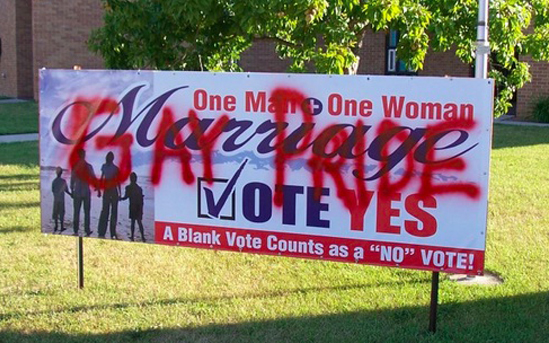
Gay activist vandalizes pro-marriage sign

I am tempted to say that this is the best podcast I have ever heard on the Unbelievable show. Do anything you have to do in order to listen to this podcast.

Details:

Prof Robert Gagnon has become a well-known voice advocating the traditional biblical view on sexuality. In a highly charged show he debates the scriptural issues on sexuality with Jayne Ozanne, the director of Accepting Evangelicals who came out as gay earlier this year.

The MP3 file is here.

If you can only listen for 15 minutes, then start at 49 minutes in and listen from there.

The following summary is rated MUP for made-up paraphrase. Reader discretion is advised.

Summary:
Intro:

  • Speaker introductions
  • Gagnon: scholars who support gay marriage agree that the Bible doesn’t support it
  • Gagnon: scholars who support gay marriage agree Jesus taught male-female marriage
  • Ozanne: I went to the hospital because I was sick from trying to suppress my gay desires
  • Ozanne: Doctors told me that I would die if I didn’t act on my gay desires
  • Ozanne: I decided to reinterpret the Bible to fit with my gay desires
  • Ozanne: According to my new interpretation, Jesus actually supports my gay desires

Segment 1: Genesis

  • Ozanne: In Genesis the Bible says that Adam needs a woman to complete him
  • Ozanne: I reinterpret this to mean that Adam needed a “complementarian human being”
  • Ozanne: Genesis doesn’t say whether Eve was complemented by Adam in that chapter
  • Ozanne: It’s not critical that men are complemented by women, a man could complement a man
  • Ozanne: Genesis 2 doesn’t talk about children, it’s all about adult needs from a relationship
  • Gagnon: Genesis 2 has never been interpreted that way in all of history
  • Gagnon: Genesis 2 language specifically implies a human being who is opposite/different
  • Gagnon: Genesis 2 language translates to complement or counterpart
  • Gagnon: Genesis as a whole teaches that the sexuality is for male and female natures
  • Gagnon: The extraction of something from the man that is given to the woman is complementarian
  • Ozanne: I think that people can be complementary outside of male-female Genesis language
  • Ozanne: I don’t want to discuss specific words and texts and Greek meanings
  • Gagnon: the text has always been read and interpreted to support male/female complementarity
  • Gagnon: the male-female nature argument is made because the two natures are complementary
  • Ozanne: the text was interpreted by patriarchal males who treated women like property, it’s biased
  • Ozanne: what is important to me is how Christ interprets Genesis (?? how does she know that?)
  • Ozanne: I am passionate about my interpretation of Scripture which supports my gay desires
  • Gagnon: just because a person is passionate about their interpretation it doesn’t make it right
  • Gagnon: I am not arguing for the male-female view based on passion, but on scholarship, evidence and history
  • Ozanne: both sides are equally passionate about their interpretations (?? so both are equally warranted?)
  • Ozanne: the real question is why God “allowed” two different interpretations of Scripture

Segment 2: Is homosexuality a sin?

  • Gagnon: Jesus affirmed traditional sexual morality, which forbids homosexuality
  • Gagnon: Jesus teaches that marriage is male-female, and limited to two people
  • Gagnon: No one in history has interpreted the Bible to say that homosexuality was not immoral
  • Ozanne: Jesus came to bring life, and that means he supports homosexuality
  • Ozanne: I was dying, and embracing my gay desires allowed me to live, so Jesus approves of me
  • Ozanne: God says “I am who I am” and that means he approves of me doing whatever I want
  • Ozanne: There is an imperative to be who I am, and that means embracing my gay desires
  • Gagnon: Jesus argued that the twoness of the sexual bond is based on the twoness of the sexes
  • Gagnon: Jesus did not come to gratify people’s innate desires, he called people to repent of sin
  • Gagnon: Jesus did reach out to sinners but he never condoned the sins they committed
  • Gagnon: Jesus’ outreach to tax collectors collecting too much and sexual sinners is the same: STOP SINNING
  • Ozanne: I don’t think that Romans 1 is talking about homosexuality
  • Ozanne: I think it’s talking about sexual addiction, not loving, committed gay relationships
  • Ozanne: Paul was condemning pederasty in Romans 1, not loving, long-term, consensual sexual relationships between gay adults
  • Gagnon: nothing in the passage limits the condemnation to pederasty
  • Gagnon: the passage was never interpreted to be limited to pederasty in history
  • Gagnon: rabbis and church fathers knew about committed two-adult same-sex relationships, and said they were wrong
  • Gagnon: the argument for marriage is based on the broad two-nature argument, with no exceptions
  • Gagnon: the condemnation is not limited to exploitative / coercive / lustful / uncommitted relationships
  • Gagnon: even pro-gay scholars agree the passage cannot be interpreted Ozanne’s way (he names two)

Segment 3: The showdown (49:00)

  • Ozanne: I don’t care how many pages people have written on this
  • Ozanne: God says that “the wisdom of the wise I will frustrate” so you can’t use scholars, even pro-gay scholars, to argue against my passionate interpretation
  • Ozanne: I am not interested in the text or history or scholarship or even pro-gay scholars who agree with you
  • Ozanne: what decides the issue for me is my mystical feelings about God’s love which makes my sexual desires moral
  • Ozanne: you are certain that this is wrong, but your view does not “give life” to people
  • Ozanne: your scholarship and historical analysis is “a message of death” that causes teenagers to commit suicide (= you are evil and a meany, Robert)
  • Ozanne: “I pray for you and your soul” (= opposing me will land you in Hell) and “I hope that listeners will listen with their hearts” (?? instead of their minds?)
  • Ozanne: you can prove anything you want with research, even two mutually exclusive conclusions, so you shouldn’t rely on scholarship and research since it could be used to prove my view as well
  • Ozanne: instead of relying on research, you should rely on your heart and your feelings about God’s love to decide what the Bible teaches about sexual morality
  • Gagnon: you are distorting the gospel in order to make your case
  • Gagnon: attacking my “certainty” is an ad hominem attack to cover your dismissmal of the scholarship and history
  • Gagnon: you distort the gospel to make it seem like Christ just wants us to get what we want, when we want it, with who we want it with
  • Gagnon: Christ calls us to take up our cross, to lose our lives and to deny ourselves
  • Gagnon: you have a notion of what “fullness of life” is, but it’s not reflective of the gospel
  • Gagnon: Paul’s life was much more troubling than yours, mine or anyone else around here
  • Gagnon: Paul was beaten, whipped, stoned, poorly sheltered, poorly clothed, poorly fed, shipwrecked, and anxious for his churches
  • Gagnon: on your view, he should have been miserable and angry with God all the time
  • Gagnon: but instead Paul was constantly thankful and rejoicing to be able to suffer with Jesus and look forward to the resurrection
  • Gagnon: I have suffered too, but the suffering we go through never provides us with a license to violate the commandments of God
  • Ozanne: “the ultimate thing is what people feel God has called them to”
  • Ozanne: My goal right now is to tell young people that homosexuality is fine so they don’t commit suicide
  • Ozanne: the view that homosexuality is wrong is “evil and misguided”
  • Gagnon: the greater rates of harm in the gay community are intrinsic to homosexual unions, not caused by external disapproval of homosexuality

Segment 4: Concluding statements

  • Gagnon: gay male relationships on average have more sex partners and more STDs
  • Gagnon: female relationships on average have shorter-length relationships and more mental issues
  • Gagnon: the greater rates of harm are because there is no complementarity / balance in the relationships
  • Gagnon: everyone has some disappointment or suffering in their lives that hurts them, and that they are tempted to break the rules to fix, but we should not break the rules in order to be happy
  • Ozanne: both sides are passionate, so no one can be right, and evidence proves nothing
  • Ozanne: only feelings about “what God is doing” can allow us to decide what counts as sin or not
  • Ozanne: the main thing that is at stake here is to make people like us, not to decide what the Bible says about sin
  • Ozanne: my message to people is to do whatever you want, and ignore mean people who don’t affirm you
  • Ozanne: we should be more opposed to mean people who make non-Christians feel unloved than about doing what the Bible says