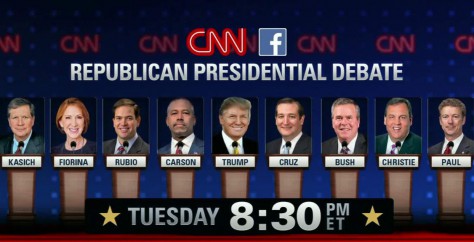
CNN Debate: Ted Cruz hammers Marco Rubio over support for amnesty and Libya disaster

The last GOP primary debate of 2015

Wow. If you missed tonight’s two CNN debates, you missed two great debates. Wolf Blitzer and Dana Bash show very little if any liberal bias, and the most biased moderator was actually the moderate RINO Hugh Hewitt. Substance, substance, substance.

Let’s look at the two biggest clashes of the night, both between Ted Cruz and Marco Rubio.

Cruz vs Rubio on amnesty and border security

The Washington Examiner was the most interesting exchange of the night between Cruz and Rubio, about Rubio’s past support for amnesty.

Excerpt:

Ted Cruz continued his fight with Marco Rubio over immigration and the Florida senator’s initial support of the Gang of Eight bill, which died in 2013.

The Texas senator told CNN’s Dana Bash that “border security is national security.”

“He has attempted to muddy the waters,” Cruz said of Rubio. “But I think that anyone who watched the battle that we had. … There was a time for choosing, as Reagan put it, where there was a battle over amnesty, and some chose to stand with Barack Obama and Chuck Schumer and support a massive amnesty plan. Others chose to stand with Jeff Sessions and Steve King and the American people and secure the border.”

Cruz then pivoted to tie the immigration issue to national security, arguing that the proposed immigration plan in 2013 had inadequate vetting, including the lack of mandated background checks for those entering the country.

“This issue is directly connected to what we’ve been talking about because he front line with ISIS isn’t just in Iraq and Syria, it’s in Kennedy Airport and the Rio Grande,” Cruz said. “Border security is national security, and one of the most troubling aspects of the Rubio-Schumer Gang of Eight bill is it gave President Obama blanket authority to admit refugees, including Syrian refugees, without mandating any background checks whatsoever. Now we have seen what happened in San Bernardino when you are letting people in and the FBI can’t vet them, it puts American citizens at risk.

“I tell you if i’m elected president, we will secure the border. We will triple the border patrol,” Cruz said. “We will build a wall that works and I’ll get Donald Trump to pay for it.”

I have the video clip (7 minutes):

You can hear Fiorina trying to jump in there, and I think she hurt herself quite a bit in the debate with her frequent interruptions. Yes, she is well-informed on foreign policy, but no, interruptions did not make her look presidential.

Now, Rubio did try to attack Cruz, claiming that he supported amnesty, and Cruz said that it was false. Who is right?

According to Andrew C. McCarthy in National Review, Cruz is right, and Rubio is lying:

Cruz has cast himself as the Republican field’s most consistent voice against “amnesty” for illegal aliens. Yet Rubio, with an assist from former Senator Rick Santorum, claims that Cruz has actually advocated granting legal status to illegal aliens.

Taken out of context, the charge seems colorable. But under the circumstances as they actually occurred, the proposal Cruz made was a case of intelligent legislating designed to expose the fraudulence of the pro-amnesty position. It was, in this way, reminiscent of smart legislating by Rubio (and, for that matter, by Cruz) that highlighted the folly of President Obama’s Iran deal.

He explains the whole story in the article, and concludes:

Cruz’s objective was to illustrate the fraudulence of the “out of the shadows” blather. Obviously, if the Gang of Eight had been sincere, a grant of limited legal status would have accomplished their purported humanitarian objective. But Cruz knew the Left would bitterly object, revealing that the true “comprehensive immigration reform” agenda was to mint new Democratic voters.

Indeed, Cruz made clear in proposing his amendment that the Gang of Eight would betray millions of legal immigrants who sought U.S. citizenship properly and that it therefore undermined the rule of law. And as the amnesty-friendly Huffington Post reported at the time, the point of Cruz’s amendment was to “take away one of [the Gang of Eight bill’s] central purposes: giving a pathway to citizenship to 11 million undocumented immigrants.”

It is thus remarkable to find Rubio, of all people, depicting Cruz as an amnesty supporter because of Cruz’s attempt to expose the Democratic agenda that Rubio, whether out of naïveté or opportunism, was then promoting.

The troubling thing is that Rubio is lying about this in televised ads, which I think justifies my decision to drop him off my list of acceptable candidates for me. He is conservative on many other things, but when you take his liberal policies and add it to these lies about Cruz, he should not be elected President.

Cruz vs Rubio on the Obama-Clinton invasion of Libya

And here is is Cruz attacking Rubio on his support for the Obama administration’s interventions in Libya:

I supported a boots-on-the-ground invasion and occupation of Syria to remove Assad when he crossed the red line. But Libya was a huge mistake that did more harm than good, and Rubio should not have supported the Obama-Clinton plan to invade Libya. I like projecting American military power and punishing evil, but not in Libya and not in Egypt. I disagree with Cruz on Syria, as he did not want to topple Assad. That would have been a huge win for us against Iran, which is the real power behind Syria – and Hezbollah, too. But that’s a minor disagreement compared to the foul-up in Libya.

Cruz vs Rubio on defense spending

I could not find the video clip for Rubio’s charge that Cruz did not vote for some defense spending bills, but this piece by Stephen Hayes in the Weekly Standard has more details about it. Those charges are damaging, but it turns out that Cruz is innocent of Rubio’s charges. First of all, both Cruz and Rubio voted against those bills, according to Yahoo News. Lindsay, who I often link to on this blog, is a huge Cruz supporter, and she found an article in the Washington Free Beacon that clears Cruz of the charge of being an isolationist:

Rubio said that Cruz’s votes against the National Defense Authorization Act (NDAA) would defund programs vital to the security of the U.S. and its allies. Cruz was one of only two senators, along with libertarian Sen. Rand Paul (R., Ky.), to oppose that defense bill in October.

“Three times he voted against the National Defense Authorization Act, which is a bill that funds the troops. It also, by the way, funds Iron Dome and other important programs,” Rubio said, referring to Israel’s air defense platform, which is supported with financial aid from the U.S.

Cruz responded that he opposed the NDAA to fulfill a campaign promise about indefinite detention.

“I voted against the National Defense Authorization Act because when I campaigned in Texas, I told voters in Texas that I would oppose the federal government having the authority to detain U.S. citizens permanently with no due process,” Cruz said.

Rubio responded that individuals who wage war against the U.S. forfeit the constitutional protections of civilians.

“If you’re an American citizen and you decide to join up with ISIS, we’re not going to read you your Miranda rights. You’re going to be treated as an enemy combatant—a member of an army attacking this country,” Rubio said.

While the candidates feuded over civil liberties, both expressed willingness to project power abroad.

“Radical Islamic terrorism will face no more determined foe than I will be,” Cruz said.

“We are the most powerful nation in the world. We need to begin to act like it again,” Rubio said.

However, Cruz introduced an amendment to the NDAA defense spending bill to remove the part about indefinite detention, so that he could go ahead and vote for the rest of the bill:

Sens. Ted Cruz (R-Texas) and Rand Paul (R-Ky.), both of whom are running for president, have joined up with other senators to introduce an amendment to the National Defense Authorization Act (NDAA), currently before the Senate, that would ban indefinite detention of U.S. citizens or legal permanent residents, without being charged or given a trial, unless authorized by Congress.

Sens. Mike Lee (R-Utah), Susan Collins (R-Maine) and Dianne Feinstein (D-Calif.) also put their names on the provision.

“The Constitution does not allow President Obama, or any President, to apprehend an American citizen, arrested on U.S. soil, and detain these citizens indefinitely without a trial,” Cruz said in a statement. “While we must vigorously protect national security by pursuing violent terrorists and preventing acts of terror, we must also ensure our most basic rights as American citizens are protected.”

The amendment had bi-partisan support, but it did not pass – that’s why Cruz voted against the bill. At least he tried to fix it so that he could vote for it while respecting the wishes of his constituents. I thought he came across as informed and hawkish in the debate on Tuesday night, which works for me, although I am all for the Patriot Act and collection of bulk data.

So it turns out that Cruz’s attitude towards Rubio’s dishonest attacks was warranted, and it falls to me to do the investigating that shows who was right and who was wrong. Cruz comes out of the debate squeaky clean, and Rubio comes out looking dirty.

Is the definition of atheism “a lack of belief in God”?

I have a key that will unlock a puzzling mystery

First, let’s see check with the Stanford University Encyclopedia of Philosophy:

‘Atheism’ means the negation of theism, the denial of the existence of God.

Stanford University is one of the top 5 universities in the United States, so that’s a solid definition. To be an atheist is to be a person who makes the claim that, as a matter of FACT, there is no intelligent agent who created the universe. Atheists think that there is no God, and theists think that there is a God. Both claims are objective claims about the way the world is out there, and so both sides must furnish forth arguments and evidence as to how they are able to know what they are each claiming.

Philosopher William Lane Craig has some thoughts on atheism, atheists and lacking belief in God in this reply to a questioner.

Question:

In my discussions with atheists, they  are using the term that they “lack belief in God”. They claim that this is different from not believing in God or from saying that God does not exist. I’m not sure how to respond to this. It seems to me that its a silly word-play and is logically the same as saying that you do not believe in God.
What would be a good response to this?
Thank you for your time,

Steven

And here is Dr. Craig’s full response:

Your atheist friends are right that there is an important logical difference between believing that there is no God and not believing that there is a God.  Compare my saying, “I believe that there is no gold on Mars” with my saying “I do not believe that there is gold on Mars.”   If I have no opinion on the matter, then I do not believe that there is gold on Mars, and I do not believe that there is no gold on Mars.  There’s a difference between saying, “I do not believe (p)” and “I believe (not-p).”   Logically where you place the negation makes a world of difference.

But where your atheist friends err is in claiming that atheism involves only not believing that there is a God rather than believing that there is no God.

There’s a history behind this.  Certain atheists in the mid-twentieth century were promoting the so-called “presumption of atheism.” At face value, this would appear to be the claim that in the absence of evidence for the existence of God, we should presume that God does not exist.  Atheism is a sort of default position, and the theist bears a special burden of proof with regard to his belief that God exists.

So understood, such an alleged presumption is clearly mistaken.  For the assertion that “There is no God” is just as much a claim to knowledge as is the assertion that “There is a God.”  Therefore, the former assertion requires justification just as the latter does.  It is the agnostic who makes no knowledge claim at all with respect to God’s existence.  He confesses that he doesn’t know whether there is a God or whether there is no God.

But when you look more closely at how protagonists of the presumption of atheism used the term “atheist,” you discover that they were defining the word in a non-standard way, synonymous with “non-theist.”  So understood the term would encompass agnostics and traditional atheists, along with those who think the question meaningless (verificationists).  As Antony Flew confesses,

the word ‘atheist’ has in the present context to be construed in an unusual way.  Nowadays it is normally taken to mean someone who explicitly denies the existence . . . of God . . . But here it has to be understood not positively but negatively, with the originally Greek prefix ‘a-’ being read in this same way in ‘atheist’ as it customarily is in . . . words as ‘amoral’ . . . . In this interpretation an atheist becomes not someone who positively asserts the non-existence of God, but someone who is simply not a theist. (A Companion to Philosophy of Religion, ed. Philip Quinn and Charles Taliaferro [Oxford:  Blackwell, 1997], s.v. “The Presumption of Atheism,” by Antony Flew)

Such a re-definition of the word “atheist” trivializes the claim of the presumption of atheism, for on this definition, atheism ceases to be a view.  It is merely a psychological state which is shared by people who hold various views or no view at all.  On this re-definition, even babies, who hold no opinion at all on the matter, count as atheists!  In fact, our cat Muff counts as an atheist on this definition, since she has (to my knowledge) no belief in God.

One would still require justification in order to know either that God exists or that He does not exist, which is the question we’re really interested in.

So why, you might wonder, would atheists be anxious to so trivialize their position?  Here I agree with you that a deceptive game is being played by many atheists.  If atheism is taken to be a view, namely the view that there is no God, then atheists must shoulder their share of the burden of proof to support this view.  But many atheists admit freely that they cannot sustain such a burden of proof.  So they try to shirk their epistemic responsibility by re-defining atheism so that it is no longer a view but just a psychological condition which as such makes no assertions.  They are really closet agnostics who want to claim the mantle of atheism without shouldering its responsibilities.

This is disingenuous and still leaves us asking, “So is there a God or not?”

So there you have it. We are interested in what both sides know and what reasons and evidence they have to justify their claim to know. We are interested in talking to people who make claims about objective reality, not about themselves, and who then go on to give reasons and evidence to support their claims about objective reality. There are atheists out there that do make an objective claim that God does not exist, and then support that claim with arguments and evidence. Those are good atheists, and we should engage in rational conversations with them. But clearly there are some atheists who are not like that. How should we deal with these “subjective atheists”?

Dealing with subjective atheists

How should theists respond to people who just want to talk about their psychological state? Well, my advice is to avoid them. They are approaching religion irrationally and non-cognitively – like the person who enters a physics class and says “I lack a belief in the gravitational force!”.  When you engage in serious discussions with people about God’s existence, you only care about what people know and what they can show to be true. We don’t care about a person’s psychology.

Dealing with persistent subjective atheists

What happens when you explain all of that to a subjective atheist who continues to insist that you listen to them repeat over and over “I lack a belief in God, I lack a belief in God”? What if you tell them to make the claim that God does not exist, and then support it with arguments and evidence, but instead they keep leaving comments on your blog telling you again and again about their subjective state of mind: “I lack a belief in cupcakes! I lack a belief in icebergs!” What if they keep e-mailing you and threatening to expose you on Twitter for refusing to listen to them, or denounce you via skywriting: “Wintery Knight won’t listen to me! I lack a belief in crickets!”. I think at this point you have to give up and stop talking to such a person.

And that’s why I moderate and filter comments on this blog. There are uneducated people out there with access to the Internet who want attention, but I am not obligated to give it to them. And neither are you. We are not obligated to listen to abusive people who don’t know what they are talking about. I do post comments from objective atheists who make factual claims about the objective world, and who support those claims with arguments and evidence. I am not obligated to post comments from people who refuse to make objective claims or who refuse to support objective claims with arguments and evidence. And I’m not obligated to engage in discussions with them, either.

Related posts

Thomas Sowell: does affirmative action help minorities to get ahead?

Economist Thomas Sowell
Economist Thomas Sowell – the best economist in the world

My favorite economist, Thomas Sowell has an article in Investors Business Daily that explains what affirmative action really does to minorities.

Excerpt:

Affirmative action is supposed to benefit black and other minority students admitted with lower academic qualifications than some white students who are rejected.

[…]Despite much media spin, the issue is not whether blacks in general should be admitted to higher-ranked or lower-ranked institutions.

The issue is whether a given black student, with given academic qualifications, should be admitted to a college or university where he would not be admitted if he were white.

Much research over the years has confirmed… that admitting black students to institutions for which their academic preparation is not sufficient can be making them worse off instead of better off.

I became painfully aware of this problem more than 40 years ago when I was teaching at Cornell University and discovered that half the black students there were on some form of academic probation.

These students were not stupid or uneducable. On the contrary, the average black student at Cornell at that time scored at the 75th percentile on scholastic tests. Their academic qualifications were better than those of three-quarters of all American students who took those tests.

Why were they in trouble at Cornell, then? Because the average Cornell student in the liberal arts college at that time scored at the 99th percentile. The classes taught there — including mine — moved at a speed geared to the verbal and mathematical level of the top one percent of American students.

The average white student would have been wiped out at Cornell. But the average white student was unlikely to be admitted to Cornell in the first place. Nor was a white student who scored at the 75th percentile.

That was a “favor” reserved for black students. This “favor” turned black students who would have been successful at most American colleges and universities into failures at Cornell.

None of this was peculiar to Cornell. Black students who scored at the 90th percentile in math had serious problems trying to keep up at MIT, where other students scored somewhere within the top 99th percentile.

Nearly one-fourth of these black students with stellar qualifications in math failed to graduate from MIT, and those who did graduate were concentrated in the bottom tenth of the class.

There were other fine engineering schools around the country where those same students could have learned more, when taught at a normal pace, than at a breakneck speed geared to students with extremely rare abilities in math.

[…]Mismatching students with educational institutions is a formula for needless failures.

The book “Mismatch” by Sander and Taylor is a first-rate study of the hard facts. It shows, for example, that the academic performances of black and Hispanic students rose substantially after affirmative action admissions policies were banned in the University of California system.

Instead of failing at Berkeley or UCLA, these minority students were now graduating from other UC campuses. They were graduating at a higher rate, with higher grades, and now more often in challenging fields like math, science and technology.

[…]Does the actual fate of minority students not matter to the left as much as their symbolic presence on a campus?

Now, you might ask yourself on what basis Sowell makes all these assertions, so here are a few of his academic publications about affirmative action, which are state-of-the-art:

Now, I was recently talking to a friend who has empirically false views on a number of topics. He is opposed to capital punishment, opposed to gun ownership, supports affirmative action, and so on. When I ask him why he believes these things, he doesn’t point to any evidence. I offered to give him studies showing that capital punishment has a deterrent effect on crime, that concealed carry laws reduce violent crime rates, that affirmative action laws harm minorities, etc.

If we really want to help minorities, we have to do what makes sense according the evidence. We have to aim to do good, not just feel good.