Wayne Grudem debates Richard Glover on economics and the Bible

A great episode of the Unbelievable podcast. This is a great debate. I really enjoyed it. All three speakers were excellent putting forward their points. It’s nice to hear an American voice, a British voice and an Australian voice debating an important issue. HIGHLY RECOMMENDED.

Details:

Wayne Grudem is a theologian known for his conservative approach to both doctrine and economics. His new book “The Poverty of Nations: A Sustainable Solution” (co-authored with economist Barry Asmus) makes the case that pouring aid into developing countries is a failed strategy. Grudem debates whether the Bible supports free market, capitalist economics with Australian economist and theologian Richard Glover who wrote a critique of the book for the Australian Bible Society.

 The MP3 file is here.

Summary:

Grudem:

  • The Bible speaks to all of life, including economics, stewardship, government
  • The study of economics helps us to understand how to take care of the poor
  • My job is to apply the teachings of the Bible to all of life

Brierley:

  • What’s your thesis in the book?

Grudem:

  • A good system is one where the poor have the opportunity to earn and save from their labor
  • Book is a response to a Kenyan couple Grudem met at a London conference on business and Christianity
  • Book is not concerned with how individuals and groups can do charity to help the poor
  • Our church already does that and we support individuals and groups doing charity
  • The book is concerned with how should nations be transformed in order to grow economically
  • What should the laws, policies and cultural beliefs of a nation be in order for it to not be poor?
  • The book lists factors that have moved nations from poverty to prosperity in different times and places
  • The thesis of the book is this: government should set their people free to be able to produce more
  • We advocate freedom in economics: freedom to work, freedom to save, freedom to start businesses
  • We believe that this free enterprise view is consistent with the Bible in a number of places
  • E.g. – private property is good for prosperity (thou shall not steal) but forbidden by communism

Brierley:

  • What about the church sharing in communities in Acts 2 and Acts 4?

Grudem:

  • That is not redistribution of wealth among individuals and businesses by a secular government
  • Those passages showed that there was voluntary sharing among Christians, which is not communism

Brierley:

  • What’s wrong with Grudem’s book?

Glover:

  • The book emphasizes the Bible and the goal is to help the poor in poor countries
  • Criticism 1: the book doesn’t engage with non-free-market perspectives on economics
  • Criticism 2: the book doesn’t survey all that the Bible says about economics

Brierly:

  • For 1) what is one of the views that is not considered?

Glover:

  • Jeffrey Sachs says that nations need a leg up before they can grow economically
  • Ha-Joon Chang says that free enterprise was not how the wealthy nations became wealthy

Grudem:

  • We do engage with other points of view, especially Jeffrey Sachs in the book
  • The trouble with leftist views on economic development is that it does not work in practice
  • NO COUNTRY has even been lifted out of poverty by foreign aid
  • He says we don’t cite enough from the wisdom literature: we have 64 citations in the index
  • He says we don’t cite enough from the gospels: we have 42 citations in the index
  • He says we don’t cite enough from the epistles: we cite 22 of 27 epistles in the index
  • Some economists won’t criticize cultural and moral values that hurt prosperity
  • As Christians, we think that moral and cultural values are part of the problem that needs solving

Brierley:

  • What about foreign aid?

Grudem:

  • Foreign aid doesn’t help: a lot of the money goes into government and rulers can be corrupt
  • Instead of encouraging people to start businesses, it tells people to go into government to get aid money
  • Economists (lists 3) are saying that foreign aid entrenches corrupt government in power, does no good

Brierley:

  • If it’s not working, should we keep doing it?

Glover:

  • When there is an immediate need, we should do it, even if it is not a long-term solution: we need both

Brierley:

  • Should we stop foreign aid completely?

Grudem:

  • Voluntary charitable giving from individuals and churches to help poor countries is good
  • Me and my co-author are both active on our church board that helps poor countries with urgent needs
  • Food and doctors are urgent needs, and we should help, but it doesn’t lift countries out of poverty
  • We need a long-term solution that helps poor countries produce their own food and doctors
  • We are criticizing 1) government to government aid and 2) IMF/World bank to government aid
  • We have had pushback because 500,000 people make a living from this foreign aid industry
  • No country has ever been lifted out of poverty into sustainable prosperity
  • That’s the definition of insanity: continuing to do the same thing that has never worked

Brierley:

  • Does the Bible support free enterprise as a way of creating sustainable prosperity?

Glover:

  • When I said the Bible was absent from his book, absent was a bad choice of words
  • But the hundreds of references he listed were not dealth with *in depth*
  • In the Scriptures, God is the one who provides (e.g. – in Ephesians, Sermon on the Mount)
  • The Bible is less focused on his people making money, and more focus on sharing basics, like food
  • Secular governments should just take it from people who have food and give it to hungry people
  • In 2 Cor 8-9, Paul talks about voluntary sharing so everyone will be equal

Brierley:

  • Does 2 Cor 8-9 undermine the free enterprise system you champion in the book?

Grudem:

  • The sharing in the Bible solves cases of urgent need, it does not lift countries from poverty to sustainable prosperity
  • Some older translations say “equality” in 2 Cor 8:13-14, but newer translations (e.g. – ESV) say “fairness”
  • The Greek word is translated as “fairly” the only other place it appears in the NT (Col 4:1), in every translation
  • God uses the means of human work and productivity to provide (daily bread is baked, doesn’t just fall from Heaven)
  • In general, there’s no provision in Scripture for a person to be dependent on donations for their entire lives
  • God promises Israel fields and mountains to tend and mine, but prosperity is from work, not depending on others

Brierley:

  • Does the Bible support this focus on work?

Grudem:

  • Working is highly praised in Scripture, (lists Bible passages that favor work over dependency)
  • Countries that were exposed to this notion of work and productivity have been more prosperous

Glover:

  • Jeffrey Sachs and other development economists don’t say you can be prosperous through dependence
  • They say that it is a necessary part of leading to nations out of poverty into poverty

Grudem:

  • It’s never worked. What nation has become prosperous through foreign aid?

Glover:

  • There are lots of nations, especially in Africa, where foreign aid has helped lift them out of poverty

Grudem:

  • Name one country in Africa where foreign aud has lifted them out of poverty into sustainable prosperity

Glover:

  • I can’t think of one right now.

Grudem:

  • Our book contains a map of Africa and we looked at every nation’s per capita income
  • No nation has been able to rise out of poverty through dependence on foreign aid
  • The only close one is Botswana, but they have abundant freedoms, Christian morals, less corrupt government
  • So Botswana is the best case and they became prosperous through becoming productive, not foreign aid

Brierley:

  • Is he right to say that charity is a short-term solution, but that it’s not good long-term for prosperity?

Glover:

  • Yes, and work is a very important focus in the Scriptures as he says.
  • But since the Fall work has been much harder, and may not have the outcomes that we would like

Grudem:

  • I also believe in emergency aid for when catastrophies happen, like floods and famines
  • But dependence on foreign aid enriches corrupt rulers and does not create the productivity that leads to sustained prosperity

Brierley:

  • Can foreign aid be used to give poor nations a leg up on becoming prosperous?

Grudem:

  • Dambisa Moyo, Oxford-educated economist from Zambia, says stop the aid, it’s doing more harm than good
  • Jeffrey Sachs’ view is that foreign aid hasn’t worked yet, but just keep trying a bit more
  • What works: limited government, rule of law, fair courts, documented property rights, low taxes, stable currency
  • People are creative and want to work, we just have to get government out of the way and let people work, earn and save

Brierley:

  • Is this free enterprise system supported by the Bible?

Glover:

  • The wealthy nations of the world did not become wealthy through productive work and free enterprise policies
  • Ha-Joon Chang: free enterprise policies have never brought a country from poverty to wealth
  • E.g. – wealth is created through tariffs (not by innovating and by economic freedom?)

Grudem:

  • I’ve read Ha-Joon Chang’s book, and his examples are very selective and limited
  • Index of Economic Freedom: the freest countries are the most prosperous, the least free countries are the most poor
  • When you look at macro data, instead of very selective examples, the free enterprise system is best for prosperity

Glover:

  • The book doesn’t do enough to engage with leftist economists (he doesn’t say which ones)
  • Just because nations who are free are rich, doesn’t mean freedom causes productivity
  • There are parts of the Bible that doesn’t support the free enterprise system (he names none)

Grudem:

  • The Bible is focused on work not dependency, and charity not government redistribution
  • The best way to help the poor in other countries is by encouraging work and productivity

Are you ready for marriage? 10 questions to find out how prepared you are

Marriage and family
Marriage and family

Would you like your marriage to be long-lasting and fulfilling? Well, check out the questions below and see if you are ready for life-long wedded bliss.

1. Are you opposed to no-fault divorce laws?

No-fault divorce laws allow one spouse to leave the marriage at any time, for any reason, or for no reason at all. If you support no-fault divorce, then your view of marriage is that it’s something to be entered into lightly, because it can be exited easily. You’ll be walking down the aisle thinking “oh well, if it doesn’t work out, I can always get a divorce”. If you oppose no-fault divorce laws, then your view of marriage is that there is no escape hatch. You’ll probably be a lot more careful about getting married. Since you are convinced that marriage is built to last forever, you’ll have a courtship of at least 6 months, and involve both sets of parents in the process. If you put commitment above happiness, you’re ready for marriage.

2. Are you opposed to abortion laws?

Abortion laws basically make it easy for two people to have recreational sex, and then get rid of any complications that result quickly and easily. This way, both the people that created the effect can escape the responsibility for what they did, and keep right on pursuing their goals and dreams. If you support abortion laws, you’re really saying that you can engage in recreational sex with people who are unwilling to accept responsibility for any children that result. If you are pro-life, then you’re saying that people should be careful about having sex, and be ready to take responsibility for a child, should one appear. Being responsible is good preparation for marriage.

3. Are you supportive of daycare for young kids?

Daycare services are essential for couples who need both the father and the mother to be working. The advantage of both parents working is that you can afford lots of shiny new stuff – like vacations, boats, shoes and handbags. Studies show that children don’t die during daycare, although if you put a child in daycare, there will be effects on the child’s behavior, such as higher anxiety and aggression. If you oppose daycare, you’re putting the needs of your children above your need for shiny stuff. Putting the needs of children first is a sign that you are ready for the self-sacrifice that marriage requires.

4. Are you in favor of smaller government?

If you’re in favor of smaller government, then you would rather keep taxes low so that more money stays in the family. If you support bigger government, then you think that government knows how to spend your money better than you and your spouse do. Additionally, government usually likes to spend more money than they take in. For example, in the last 8 years, we’ve added $10 trillion dollars to the debt, which is now $18.5 trillion. If you oppose higher taxes and bigger government, then you want government to pass on less debt to your children. Putting your kids’ financial well-being over your own is pro-marriage.

5. Are you in favor of school choice?

If you’re opposed to school choice, then you think that government should decide which schools your children will attend. School choice laws allow parents to give money to the schools they think are best for the children. If a school has excellent teachers and teaches students skills that they can use in their professional lives, then parents can choose that school. Schools have to compete to provide higher quality to parents, for lower cost. If you support giving parents more choice, then you put the needs of children – especially poor, minority children – above the needs of education administrators and teacher unions. Putting kids fist is pro-marriage.

6. Are you in favor of premarital sex?

Premarital sex is really fun (so I’m told). You can have sex with people who are just really attractive, even if these people have lousy character. Your friends will be impressed, and you’ll feel more attractive – like you were climbing a ladder of attractiveness with each new partner. If you combine sex with being drunk, then you can’t remember anything after. And you can’t feel guilty if the booze made you do it, right? On the other hand, if you present yourself to your spouse as a virgin, you are telling them that you have self-control, that you take sex as communication rather than recreation, and that they can trust you to be faithful by keeping sex inside the marriage. Trust is important for a good marriage.

7. Are you in favor of welfare for single mothers?

Sometimes, women find themselves pregnant before they are married. If you think that giving taxpayer money to women who have babies before they have husbands is a good idea, then you are rewarding behavior that creates fatherless children. Raising a child without a father causes serious behavioral problems. Boys tend to become more violent, and are more likely to commit crimes. Girls tend to engage in sex at earlier ages. If you oppose encouraging fatherlessness with welfare, you want women to get married before they have kids. Taking the needs of children seriously is pro-marriage.

8. Are you in favor of same-sex marriage?

When a man and a man get married and acquire children, those children will not be raised with their birth mother. Similarly with lesbians, the children will not grow up with their birth father. Studies show that children suffer from not being raised by their biological parents. For example, children of same-sex parents have lower graduation rates than children raised by heterosexual couples. If you think that children have a right to a stable relationship with their biological mother and father, then you place a higher value on the needs of children as opposed to the needs of adults. That’s a good sign you’re ready for marriage.

9. Are you in favor of radical feminism?

Feminism shows that you think the purpose of marriage is to make women happy, and not to work as a team to serve God and raise good children. Indeed. Marriage doesn’t work if the woman approaches it as an accessory. Marriage is about a man and a woman sacrificing their own interests and compromising in order to work together as a team. Husbands and children have needs that women should care about. Feminism teaches women that husbands and children are less important than their careers, hobbies and interests. Feminism is anti-marriage.

10. Are you responsible with earning, budgeting and saving money?

This one comes to us from Bob P. He says that marriages work better when both spouses are “committed to financial planning, budgeting and a renunciation of debt to support a lifestyle. Disagreement about financial issues is one of the greatest causes of marital stress.” If you’re able to choose a college major or a trade that you don’t like, but that pays well, that’s a positive. If you’re able to string together jobs so that your resume is gap-less, that’s a positive. If you’re able to save money even though it means you’re having less fun, that’s a positive. If you’re able to give away money to others to support them, that means you’re able to sacrifice your interests for the benefit of others. That’s pro-marriage.

Well, how did you do? Leave your ideas for more policies and points of view that are marriage-friendly in the comments.

UVA retracts rape story after Columbia University calls it “journalistic failure”

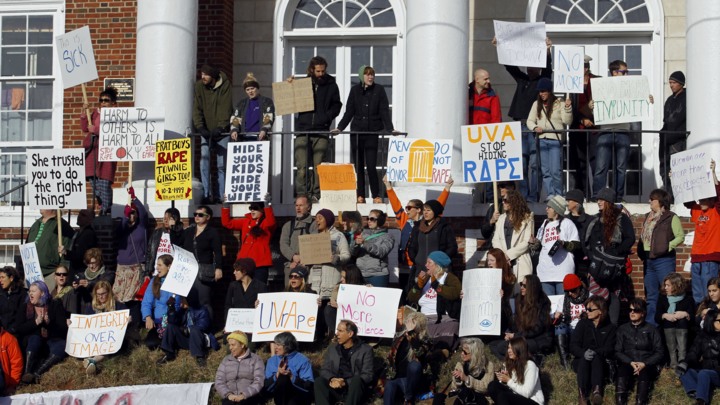
UVA students following their leftist masters
UVA students blindly following their leftist masters

The Wall Street Journal reports on the conclusion to this radical-feminist scandal. I’ll explain later why I am writing about this, too.

Excerpt:

Rolling Stone retracted an explosive article detailing an alleged gang rape at a University of Virginia fraternity after Columbia University’s Graduate School of Journalism concluded that the story was a “journalistic failure that was avoidable.”

The Rolling Stone story was written by Sabrina Rubin Erdely and published last November under the headline “A Rape on Campus.” It sparked a national uproar over sexual misconduct at college campuses. At UVA, President Teresa Sullivan suspended all Greek activities for six weeks and students marched in protest.

But before long, other media reports raised serious doubts about the veracity of the article and the reporting and editing process behind it.

[…]The “most consequential” decision, the report found, was Rolling Stone’s acquiescence to the fact that Ms. Erdely “had not contacted the three friends who spoke with Jackie on the night she said she was raped.” If Rolling Stone had done so, it said, it “would have almost certainly led the magazine’s editors to change plans.”

[…]The Charlottesville, Va., police concluded in March after a four-month investigation that “there is no substantive basis to support the account alleged in the Rolling Stone article,” the Columbia report notes. Police said at the time they were unable to interview the woman featured in the story and their investigation remains suspended until she decides she “wishes to cooperate.”

Jackie was later discovered to be a radical feminist. The author of the retracted rape story is also a radical feminist. And she is presenting herself as a victim:

Ms. Erdely, in a statement, said the past few months have been among the most painful in her life, and reading the Columbia report detailing her mistakes was “a brutal and humbling experience.”

[…]The report said that Rolling Stone’s editors, as well as Ms. Erdely, “concluded that their main fault was to be too accommodating of Jackie because she described herself as the survivor of a terrible sexual assault.”

Columbia, however, disagreed with that conclusion, noting that editors made decisions about “attribution, fact-checking and verification that greatly increased their risks of error but had little or nothing to do with protecting Jackie’s position.”

Newsbusters quotes the report, which shows that Erdely’s story was agenda-driven from the start:

Last July 8, Sabrina Rubin Erdely, a writer for Rolling Stone, telephoned Emily Renda, a rape survivor working on sexual assault issues as a staff member at the University of Virginia. Erdely said she was searching for a single, emblematic college rape case that would show “what it’s like to be on campus now … where not only is rape so prevalent but also that there’s this pervasive culture of sexual harassment/rape culture,” according to Erdely’s notes of the conversation.

Reason.com quotes this part of the report to show her editors were complicit:

Jackie proved to be a challenging source. At times, she did not respond to Erdely’s calls, texts and emails. At two points, the reporter feared Jackie might withdraw her cooperation. Also, Jackie refused to provide Erdely the name of the lifeguard who had organized the attack on her. She said she was still afraid of him. That led to tense exchanges between Erdely and Jackie, but the confrontation ended when Rolling Stone’s editors decided to go ahead without knowing the lifeguard’s name or verifying his existence. After that concession, Jackie cooperated fully until publication.

Reason also comments:

It’s actually even worse than that. When Erdely told Jackie that she really did need to know the name of Jackie’s date (the lifeguard who supposedly masterminded the attack), Jackie stopped answering her phone calls and texts for about two weeks. Eventually, Erdely left Jackie another voicemail in which the writer agreed to stop trying to contact the lifeguard and instead use a pseudonym, Drew. After that, Jackie magically reappeared, calling Erdely back “quickly,” according to the report.

Jackie, in fact, displayed impressive levels of self-preservation and rational behavior—at least, from the perspective of a highly disturbed person whose goal was to spread an incredible lie without exposing it as such. She was highly detailed in her account of the crime, gave descriptions, and recalled (wholly invented) conversations with great accuracy. And she studiously avoided any line of questioning that would have exposed the lie. If a particular question posed a threat, she either invented a reason why it couldn’t be answered, or simply stopped responding.

No one at Rolling Stone has been fired, much less charged with crimes. The woman who made the false rape charge has also not been charged with anything. So there is no deterrent there to prevent this from happening again – either to the women who make the charges, or to the radical feminists who “report” on them. Let’s hope that when the lawsuits shake out that both Erdely and her Rolling Stone cheerleaders find themselves bankrupted.

How often are rape claims false?

National Review explains:

Specifically, in their analysis of sexual-assault cases at a large university, the authors found that 5.9 percent of cases were provably false. However, 44.9 percent cases “did not proceed” – meaning there was insufficient evidence, the accuser was uncooperative, or the incident did not meet the legal standard of assault. An additional 13.9 percent of cases could not be categorized due to lack of information. That leaves 35.3 percent of cases that led to formal charges or discipline against the accused.

“35.3 percent of cases that led to formal charges or discipline against the accused”. That’s a lot of Jackie-scenarios.

The trouble is when people don’t do the homework and just come to have a general mistrust of men based on their intuitions and emotions from stories they hear about from the news media – stories like this one. And yet they become so sure that they have an educated and informed opinion, just from hearing news reports. They never hear about the retractions.

My take

So why did I cover this story in past blog posts, and why am I bringing up the retraction now? Well, it’s because of the feminist agenda. I want to point out how the feminist left uses stories like this in order to push a wedge between men and women. Women who are indoctrinated for four years in misandry are less likely to look to men as protectors, providers and moral/spiritual leaders. Marriage, with its traditional gender roles of men working and woman raising the kids, will be out.

If men are all rapists, then how could a woman give up her own dreams and career to stay home and raise kids? If men are all rapists, how could a woman trust a man to be faithful to her? If men are all rapists, then how could a man be trusted to provide for a family. If men are all rapists, then how could a woman trust a man to stick around when she is old and wrinkly? And of course, this lousy impression of men is all reinforced by the binge-drinking, hooking-up, and serial cohabitation that is so popular in university campuses.

There is a reason why Rolling Stone ran with this story, despite all the warning signs – it made the point that they wanted to make. Women who think that they can’t depend on men will naturally turn to bigger government to provide for them, and that’s what people on the left want women to do. Marriage is subversive to their plan. Having a lot of children is subversive to their plan. Homeschooling is subversive to their plan.