Thomas Aquinas on law, economics and government

I found three posts at the AEI Values and Capitalism blog authored by a recent graduate of Grove City College.

Here the 3 posts:

I’m going to snip the most interesting parts from each of the 3 posts.

First post talks about the Bible and private property:

What, if any, role does government play in defining, bestowing and taking private property? This question underlies many modern-day political debates, but it’s actually an issue scholars have debated for centuries. At the heart of this debate is the tension between private property and government confiscation: Does private property exist? If so, does government have the authority to take it from the citizens it governs?

[…]“It is false to say that human beings are not permitted to possess their own property,” he writes, implying that individual human beings have a right to the external goods they own and no one else may possess ownership over their goods. The eighth commandment—”Thou Shalt Not Steal”—assumes the principle of private property. God, by commanding man to refrain from stealing from his neighbor, assumes that man can and does own material goods.

[…]In his book “Foundations of Economics: A Christian View,” Dr. Shawn Ritenour of Grove City College puts it quite simply: “Our property is God’s gift.” The socialist idea that property rights come from government is false. Property rights come from our Creator.

So that’s the first thing to get clear. The Bible assumes the concept of private property.

Second post talks about when the government is justified in taking the property of citizens:

Theft is not justified on an individual level or a state level. Stealing is stealing. But if this is true, does government commit theft when it taxes its citizens? According to Aquinas, not quite. “If rulers exact from their subjects what is due them in justice in order to maintain the common good,” he writes, “there is no robbery” (emphasis mine). Government may justly take from its citizens their God-given property only if it promotes justice for the common good of society.

But this criterion is vague. The common good may be defined in a variety of ways. But Aquinas does not leave the reader without qualifying his statement:

But public authority is committed to rulers in order that they may safeguard justice. And so they are permitted to use force and coercion only in the course of justice, whether in wars against enemies or in punishing civilian criminals. (emphasis mine)

Government may take from its citizens, i.e. taxes, for the two-fold purpose of defended them from foreign enemies and convicting domestic criminals.

So the government can take money from citizens for defending them from external threats and internal threats. But what about helping the poor? Who is going to help the poor, if it’s not government’s job?

Third post talks about whose job it is to help the poor:

We must help those in need directly, through private institutions and through the church, not allowing government to become a substitute for our individual responsibility of loving our neighbor. Aquinas writes:

But because many persons are in need, and the same things cannot assist everybody, the dispensing of one’s own goods is committed to each individual, so that each may out of them assist those in need. (emphasis mine)

Because of the magnitude and specificity of each individual’s needs, the government cannot adequately provide for every one of its citizens. As Christians, we must work to provide for our neighbors in accordance with the command in Scripture to love our neighbor as ourselves.

Property is a gift from God—not government—to his people for the purposes of self-preservation and assisting those in need. When private institutions, churches and individuals fulfill their mandate to love our neighbors as ourselves, no need for government involvement exists.

Just a helpful reminder to everyone about what one of the pillars of the Christian faith thought about fiscal policy and the role of government. By the way, if you’re thinking about studying economics and you’re a Christian, I recommend Grove City College.

Christianity and economics

Here’s an interview with Dr. Shawn Ritenour, economics professor at Grove City College. The interview is conducted by Dr. Paul Kengor.

Excerpt:

Kengor: …it seems that the very foundation of economics, not to mention the American republic in some respects, is the right to private property. Do you agree? If so, is that Scriptural?

Ritenour: The foundation of economic activity and policy is private property. All action requires the use of property and all economic policy is about how people can legally use their property. To benefit from the division of labor, we must be able to exchange our products, which requires private property. Private property is definitely Scriptural. The Bible explicitly prohibits theft, fraud, moving property barriers, debasing money, violating labor contracts, as well as coveting. These prohibitions apply to both citizens and rulers. In my text, I apply this conclusion to issues such as confiscatory taxation, government subsidies, business regulation, and monetary inflation.

Kengor: I find it very telling that Karl Marx was first and foremost against private property, not to mention against God as well. In the “Communist Manifesto,” he wrote plainly: “the theory of the Communists may be summed up in a single sentence: Abolition of private property.” And yet, there are some religious left Christians who claim that the Bible, especially in certain Old Testament passages, preaches a form of socialism and even communism. A student of mine had a teacher at a private Christian school in Ohio who instructed the class that as Christians they should be communists. Can you address this argument?

Ritenour: Communism can be condemned strictly on the basis of the Christian ethic of property (among other reasons). Nothing in Scripture either commands or implies that the means of production should be controlled by the state. There are passages in the early chapters of Acts that are often cited as promoting “Christian communism,” but, in fact, actually illustrate Christian sharing. The various Christians still owned their property, but were generous in sharing whenever they saw a need. When Peter rebukes Ananias in Acts 5, he explicitly says that both the property that Ananias and Sapphira sold and the monetary proceeds from selling it were theirs to do with what they wanted. That is not the gospel according to Marx.

Kengor: I like the way you turn the religious left’s thinking on private property on its head. You note that “God prohibits our coveting the property of others.” With that being the case, isn’t it wrong for the government to use the mighty arm of the state to forcibly remove property from one person to give it to another?

Ritenour: I see no other way around that conclusion, especially when we realize that, in our day of mass democracy, the state usually accomplishes policies of wealth redistribution by inciting envy and covetousness among the populace.

Kengor: What about profits? Reconcile the profit motive with the God of Scripture. We have people in this society who portray profits as greedy or unjust.

Ritenour: Profit is the reward entrepreneurs receive for more successfully producing what people want. This is no easy thing to do. Entrepreneurs must invest in present production of goods they sell in the future. Neither entrepreneurs nor government bureaucrats know exactly what future demand will be. Therefore, production necessitates bearing risk. If the entrepreneur forecasts future demand incorrectly, he will waste resources and reap losses. If he forecasts the future correctly, he serves his fellow man by producing goods people want. It seems only right that such producers are rewarded with profit. In a free market, the only way entrepreneurs earn profits is to serve customers better than anyone else.

If you would like to learn more about the relationship between Christianity and economics, then I recommend “Money, Greed and God” and “Indivisible” by Jay Richards. The former is about what the Bible says about economics, the latter is about developing a Christian worldview of fiscal and social issues. If you really want a comprehensive assessment of the Bible and politics, then I recommend Wayne Grudem’s “Politics According to the Bible“.

Further study
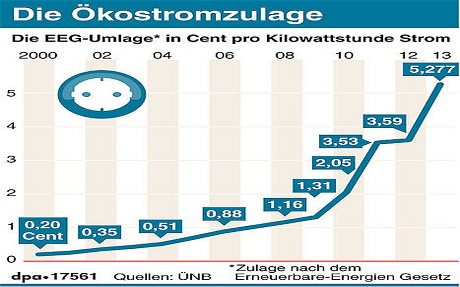
How well is government promotion wind and solar power working out in Germany?

Surcharge paid by German households and SMEs

First, let’s hear from the ultra-leftist New York Times. (H/T Dennis Prager)

Excerpt:

It is an audacious undertaking with wide and deep support in Germany: shut down the nation’s nuclear power plants, wean the country from coal and promote a wholesale shift to renewable energy sources.

But the plan, backed by Chancellor Angela Merkel and opposition parties alike, is running into problems in execution that are forcing Germans to come face to face with the costs and complexities of sticking to their principles.

German families are being hit by rapidly increasing electricity rates, to the point where growing numbers of them can no longer afford to pay the bill. Businesses are more and more worried that their energy costs will put them at a disadvantage to competitors in nations with lower energy costs, and some energy-intensive industries have begun to shun the country because they fear steeper costs ahead.

Newly constructed offshore wind farms churn unconnected to an energy grid still in need of expansion. And despite all the costs, carbon emissions actually rose last year as reserve coal-burning plants were fired up to close gaps in energy supplies.

A new phrase, “energy poverty,” has entered the lexicon.

“Often, I don’t go into my living room in order to save electricity,” said Olaf Taeuber, 55, who manages a fleet of vehicles for a social services provider in Berlin. “You feel the pain in your pocketbook.”

Mr. Taeuber relies on just a single five-watt bulb that gives off what he calls a “cozy” glow to light his kitchen when he comes home at night. If in real need, he switches on a neon tube, which uses all of 25 watts.

Even so, with his bill growing rapidly, he found himself seeking help last week to fend off a threat from Berlin’s main power company to cut off his electricity. He is one of a growing number of Germans confronting the realities of trying to carry out Ms. Merkel’s most ambitious domestic project and one of the most sweeping energy transformation efforts undertaken by an industrialized country.

[…]The cost of the plan is expected to be about $735 billion, according to government estimates, and may eventually surpass even that of the euro zone bailouts that have received far more attention during Ms. Merkel’s tenure. Yet as the transition’s unknowns have grown, so have costs for the state, major companies and consumers.

[…]With consumers having to pay about $270 each in surcharges this year to subsidize new operators of renewable power, the hardest hit are low-wage earners, retirees and people on welfare, Mr. Gärtner said. Government subsidies for the plan amounted to $22.7 billion in 2012 and could reach $40.5 billion by 2020, according to John Musk, a power analyst at RBC Capital Markets.

[…]Part of the reason consumer prices have risen so sharply is that, for now, the government has shielded about 700 companies from increased energy costs, to protect their competitive position in the global economy.

Industrial users still pay substantially more for electricity here than do their counterparts in Britain or France, and almost three times as much as those in the United States, according to a study by the German industrial giant Siemens. The Cologne Institute for Economic Research said there had been a marked decline in the willingness of industrial companies to invest in Germany since 2000.

Note that German industry has been EXEMPT from paying the green energy surcharge. Households and small-to-medium-size enterprises are paying it.

The key part of the article, I think, is this:

One of the first obstacles encountered involves the vagaries of electrical power generation that is dependent on sources as inconsistent and unpredictable as the wind and the sun.

And no one has invented a means of storing that energy for very long, which means overwhelming gluts on some days and crippling shortages on others that require firing up old oil- and coal-burning power plants. That, in turn, undercuts the goal of reducing fossil-fuel emissions that have been linked to climate change.

Last year, wind, solar and other nonfossil-fuel sources provided 22 percent of the power for Germany, but the country increased its carbon emissions over 2011 as oil- and coal-burning power plants had to close gaps in the evolving system, according to the German electricity association BDEW.

Didn’t anyone think of that problem before starting out this crazy plan? No. Because they important thing was feelings – politicians had to feel good about solving a made-up crisis.

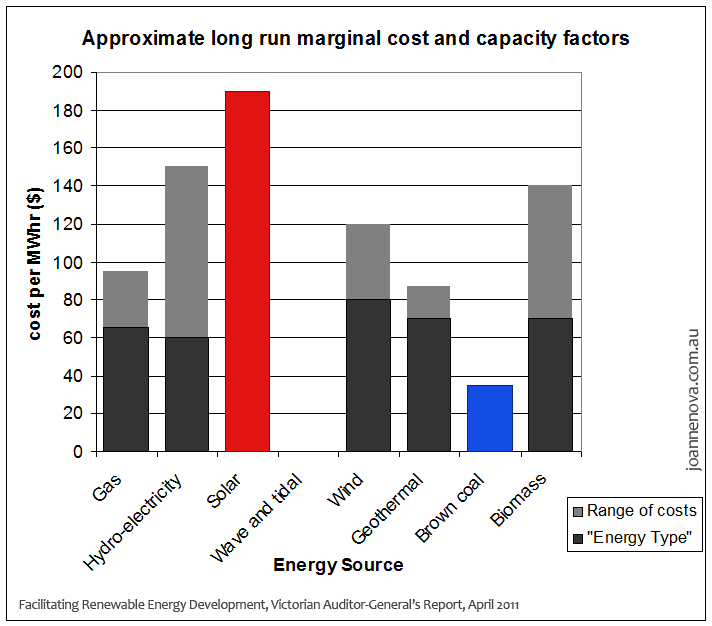
Cost of renewable wind and solar energy

Why can’t leftists learn from the failed experiments of others?

Government-subsidized green energy scams have been tried before in Spain and Denmark. Did they work?

Well, we know that in Spain, the green jobs programs failed. (H/T ECM)

Excerpt:

Subsidizing renewable energy in the U.S. may destroy two jobs for every one created if Spain’s experience with windmills and solar farms is any guide.

For every new position that depends on energy price supports, at least 2.2 jobs in other industries will disappear, according to a study from King Juan Carlos University in Madrid.

U.S. President Barack Obama’s 2010 budget proposal contains about $20 billion in tax incentives for clean-energy programs. In Spain, where wind turbines provided 11 percent of power demand last year, generators earn rates as much as 11 times more for renewable energy compared with burning fossil fuels.

The premiums paid for solar, biomass, wave and wind power – – which are charged to consumers in their bills — translated into a $774,000 cost for each Spanish “green job” created since 2000, said Gabriel Calzada, an economics professor at the university and author of the report.

“The loss of jobs could be greater if you account for the amount of lost industry that moves out of the country due to higher energy prices,” he said in an interview.

The Heritage Foundation cites a study from Denmark, which shows that wind power has also failed.

Excerpt:

But according to a new study from the Danish Centre for Political Studies (CEPOS), commissioned by the Institute for Energy Research, the road to increased wind power is less traveled for a reason. The study refutes the claim that Denmark generates 20 percent of its power from wind stating that its high intermittency not only leads to new challenges to balance the supply and demand of electricity, but also provides less electricity consumption than assumed. The new study says, “wind power has recently (2006) met as little as 5% of Denmark’s annual electricity consumption with an average over the last five years of 9.7%.” Furthermore, the wind energy Denmark exports to its northern neighbors, Sweden and Norway, does little to reduce carbon dioxide emissions because the energy it replaces is carbon neutral.

The study goes on to say that the only reason wind power exists in Denmark is “through substantial subsidies supporting the wind turbine owners. Exactly how the subsidies have been shared between land, wind turbine owners, labor, capital and its shareholders is opaque, but it is fair to assess that no Danish wind industry to speak of would exist if it had to compete on market terms.”

But there’s a cost involved. When government spends more money, it necessarily diverts labor, capital and materials from the private sector. Just like promises are made in the United States about green jobs creation, the heavily subsidized Danish program created 28,400 jobs. But “this does not, however, constitute the net employment effect of the wind mill subsidy. In the long run, creating additional employment in one sector through subsidies will detract labor from other sectors, resulting in no increase in net employment but only in a shift from the non-subsidized sectors to the subsidized sector.”

And because these resources are being diverted away from more productive uses (in terms of value added, the energy technology underperforms compared to industrial average), “Danish GDP is approximately $270 million lower than it would have been if the wind sector work force was employed elsewhere.”

Why do people keep voting in leaders who don’t know what they are doing? Why are people surprised when emotional craziness and moral preening doesn’t work out financially?

Previously, I blogged about how Obama was causing our electricity prices to skyrocket by effectively banning coal power. Not to mention blocking the Keystone XL pipeline. Keep that in mind when you are lighting your house with 5 Watt light bulbs. This doesn’t happen by accident – you need politicians to wage war on the free market system in order for this to happen. And that’s what we’ve been voting for in the last two elections.

Related Posts

William Lane Craig posts full Vilenkin e-mail misrepresented by Krauss in their debate

First, Dr. Craig posted the e-mail from Vilenkin to Krauss, which Krauss used in his debate with Craig, with the parts Krauss omitted in bold:

Hi Lawrence,

Any theorem is only as good as its assumptions. The BGV theorem says that if the universe is on average expanding along a given worldline, this worldline cannot be infinite to the past.

A possible loophole is that there might be an epoch of contraction prior to the expansion. Models of this sort have been discussed by Aguirre & Gratton and by Carroll & Chen. They had to assume though that the minimum of entropy was reached at the bounce and offered no mechanism to enforce this condition. It seems to me that it is essentially equivalent to a beginning.

On the other hand, Jaume Garriga and I are now exploring a picture of the multiverse where the BGV theorem may not apply. In bubbles of negative vacuum energy, expansion is followed by cocntraction, and it is usually assumed that this ends in a big crunch singularity. However, it is conceivable (and many people think likely) that singularities will be resolved in the theory of quantum gravity, so the internal collapse of the bubbles will be followed by an expansion. In this scenario, a typical worldline will go through a succession of expanding and contracting regions, and it is not at all clear that the BGV assumption (expansion on average) will be satisfied.

I suspect that the theorem can be extended to this case, maybe with some additional assumptions. But of course there is no such thing as absolute certainty in science, especially in matters like the creation of the universe. Note for example that the BGV theorem uses a classical picture of spacetime. In the regime where gravity becomes essentially quantum, we may not even know the right questions to ask.

Alex

Now recall that Krauss excuses the selective editing of the e-mail in the debate by saying that it was “too technical” to include. Judge for yourself if the omitted lines are “too technical” or whether they were omitted in order to mislead people about the evidence for the beginning of the universe.

Dr. Craig comments:

Whoa! That puts a very different face on the matter, doesn’t it? Why didn’t Krauss read the sentence, “It seems to me that it is essentially equivalent to a beginning”? Because it was too technical? Is this the transparency, honesty, and forthrightness that Krauss extols? (By the way, Vilenkin’s criticism of these models is the same one that Vilenkin makes in his Cambridge paper: far from showing an eternal past, these models actually feature a universe with a common beginning point for two arrows of time.)

And why did Krauss delete Vilenkin’s caveat that the BGV theorem can, in his estimation, be extended to cover the case of an expanding and contracting model such as Garriga and Vilenkin are exploring? And why delete the remark that such a model is usually assumed to be incorrect? It’s evident that Vilenkin’s email was selectively edited to give it the spin Krauss wanted.

Some people told me that they thought that Dr. Craig needed to be a little less gracious with Krauss in the debate, but that comment takes Krauss on directly. Too bad most of the people who watch the debate will never know unless they see the original e-mail from Vilenkin that Craig posted.

Dr. Craig then wrote to Dr. Vilenkin about this misrepresentation and here is part of the reply:

The Aguirre-Gratton model can avoide singularities by postulating a small “initial” closed universe and then allowing it to evolve in both directions of time. I put “initial” in quotation marks, because Aguirre and Gratton do not think of it that way. But this model requires that a very special condition is enforced at some moment in the history of the universe. At that moment, the universe should be very small and have very low entropy. Aguirre and Gratton do not specify a physical mechanism that could enforce such a condition.

Carroll and Chen claim that the universe did not have to be small at that special moment. But in my recent paper I show that in this case singularities are unavoidable.

[…]I think you represented what I wrote about the BGV theorem in my papers and to you personally very accurately.

Now I don’t want anyone to get the idea that all atheists are like Krauss. I distinctly remember another atheist named Anthony Flew debating Dr. Craig and a questioner from the audience asked him why not prefer speculative cosmologies like the eternally oscillating model. Dr. Flew (unlike Dr. Krauss) was honest – he said that we have to accept the science we have today based on the evidence we have today. Dr. Krauss is not willing to accept the science we have today and the evidence we have today. That’s the difference. This is a failing of Dr. Krauss’ will and intellect. He simply cannot bring himself to accept what science has shown, if it impacts his autonomy in any way. He would rather mislead himself and others with speculations rather than face reality.

Watch the whole debate – see for yourself

I’ll re-state the relevant part of my Craig-Krauss debate summary below. The summary has the full video.

The segment from 52:18 to 57:12 about the Vilenkin e-mail on the BVG theorem is a must-see. Krauss is standing up and gesticulating while Craig is calmly trying to quote a paper by Vilenkin that shows that Krauss is misrepresenting Vilenkin. Krauss constantly interrupts him. After a while, when Craig exposes him as having misrepresented Vilenkin and gets him to admit that all current eternal models of the universe are probably wrong, he quietens down and can’t even look at Craig in the face.

Cosmological argument:

  • Craig: The e-mail says any universe that is expanding, on average, requires a beginning
  • Craig: There are two models – Aguirre & Gratton and Carroll & Chen – where there is a period of contraction before the expansion
  • Craig: The two models are the ones cited in the e-mail that Dr. Krauss showed
  • Craig: In the very paper by Vilenkin that I cited, he says that both of those models don’t work
  • Krauss: (agitated and interrupting) Vilenkin said that they have to make an assumption about entropy that they have no rationale for
  • (as Craig starts to talk Krauss makes an exaggerated, disrespectful gesture and sits down in a huff)
  • Craig: Yes, an unwarranted assumption means that they don’t have EVIDENCE for their theories being correct
  • Krauss: (agitated and interrupting) “All the evidence suggests that the universe had a beginning but WE DON’T KNOW!!!!!!!” (raising his voice)
  • Craig: I’m not saying that we know that the universe had a beginning with certainty
  • Craig: I am saying that the beginning of the universe is more probably true than false based on the evidence we have
  • Craig: And you  agree with me about that – you think the universe had a beginning
  • Krauss: (agitated and interrupting) (Unintelligible)
  • Moderator: One at a time
  • Craig: In your Vilenkin e-mail slide, at the end of the paragraph where the two models are mentioned that Vilenkin specifically shows…
  • (I am guessing that Craig is going to ask why so much of what Vilenkin wrote has been cut out of the e-mail that Krauss showed)
  • Krauss: (agitated and interrupting) Because it was technical…
  • Moderator: Lawrence! Hang on a sec!
  • Craig: He specifically shows that these models are not past eternal, and that they require a beginning just like the others…
  • Krauss: (agitated and interrupting) We can do the math if you want
  • Craig: Now wait. I couldn’t help notice that there on your slide there was a series of ellipsis points indicating missing text…
  • Krauss: (agitated and interrupting) “Yeah, because it was technical!”
  • Craig: “I wonder what you deleted from the original letter”
  • Krauss: (agitated and interrupting) “I just told you!”
  • Craig: “Now wait. Could it have been something like this:  (reads a quote from Vilenkin) ‘You can evade the theorem by postulating that the universe was contracting prior to some time. This sounds as if there is nothing wrong with having contraction prior to expansion. But the problem is that a contracting universe is highly unstable. Small perturbations would cause it to develop all sorts of messy singularities, so it would never make it to the expanding phase.’
  • Craig: “That’s Vilenkin.”
  • Krauss: “In this paper, that’s absolutely right”
  • Krauss: But it’s ok for theories to assume things that we know are wrong – they are still good theories – it’s unknown
  • (Craig turns away and looks through his papers)
  • Craig: “Isn’t it true that the only viable quantum gravity models on order today involve a beginning – have a finite past?”
  • Krauss: “No”
  • Craig: “Well, can you give us one then”
  • Krauss: (talks about a variety of possible eternal models) “In my experience in science, all of them are probably wrong”
  • Krauss: “You know most theories are wrong, which is why, you know, it’s hard”
  • Craig: “Right”

Krauss accused Dr. Craig of misrepresenting science many times in his three Australia debates, but now we know the truth about who misrepresented science.

UPDATE: This whole episode made me think of a lecture by famous physicist Richard Feynman.

Excerpt:

The first principle is that you must not fool yourself–and you are the easiest person to fool. So you have to be very careful about that. After you’ve not fooled yourself, it’s easy not to fool other scientists. You just have to be honest in a conventional way after that.

I would like to add something that’s not essential to the science, but something I kind of believe, which is that you should not fool the layman when you’re talking as a scientist. I am not trying to tell you what to do about cheating on your wife, or fooling your girlfriend, or something like that, when you’re not trying to be a scientist, but just trying to be an ordinary human being. We’ll leave those problems up to you and your rabbi.  I’m talking about a specific, extra type of integrity that is not lying, but bending over backwards to show how you are maybe wrong, that you ought to have when acting as a scientist. And this is our responsibility as scientists, certainly to other scientists, and I think to laymen.

Now given what Krauss did in the debate, it seems to me that he is not in agreement with Feynman.

UPDATE: Dr. Craig reports that Dr. Krauss refused to let the organizers live-stream the three Australia debates, as well as refusing to let the Australian Broadcasting Corporation live-broadcast the three debates.