
Tag Archives: Youth

Should Christians divorce their faith from public square issues?

I have had major problems with IVCF and Campus Crusade as an undergraduate student (IVCF) then as a graduate student (Crusade). Basically, they are totally driven by numbers and refuse to say or do anything that isn’t centered on privatized fideism. They refused to learn apologetics, take positions on economics or politics, or even to discuss the moral questions being discussed in the broader society – for fear of “offending” people. They do this because they think that being saved can be divorced from personal morality as well as engagement with society as a whole. Their focus is on “belief”, not on study, growth or practice. Whatever you believe about abortion, gay rights, environmentalism and socialism is totally fine with them, because Christianity has nothing to say about those kinds of issues.

Scott Klusendorf at the Life Training Institute assesses Campus Crusade for Christ’s decision to rename themselves “CRU”.

Excerpt:

Well, at Cal Poly SLO in May of 2008, the response of Christians to the abortion controversy did in fact turn-off at least one non-Christian, but not for reasons campus fellowship groups might expect. The ASB student leader responsible for organizing an abortion debate at that campus expressed her dismay that Campus Crusade would not attend the event or get behind promoting it with its members.

She asked me directly why I thought that was so. She thought for sure the Christians would show up and she was puzzled that they didn’t. Their refusal to get involved turned her off.

I didn’t know what to tell her. Perhaps CC had good reasons for not attending and I hold out hope it did, though it’s hard for me to imagine what those reasons might be. I suspect she is not the only secular student puzzled by CC’s non-involvement.

Indeed, according to a 2005 TIME Magazine piece, the overall trend is not encouraging. Instead of equipping students to confront the thought structures that determine culture in the first place, many of these groups help students nurture a very private and personal faith, a faith separate from the intellectual climate of the university. The TIME article states:

“But all the groups tend to go about their business quietly. “They kind of operate under the surface,” McKaig says. Josh Sanburn, editor in chief of the Indiana Daily Student, notes that the number of students in the fellowships is roughly the same as the school’s African-American student population, but unlike the Christians, “the black students on this campus are very good about making sure they’re heard.” Evangelical students, however, see their spiritual mission differently. Says sophomore CSF member Emily Hoefling: “We usually believe what affects people more than a newspaper article is to see people living Christian lives.”

Question: Since when does “living Christian lives” mean checking out of the real action on campus?

I fear that the message to Christian students and the campus at large couldn’t be clearer: Christianity is not relevant to the most pressing issues of our day. It’s fine as a personal life enhancement, but irrelevant to the real world of ideas, politics, morality, and law where the rest of the world lives.

Again, is that a good witness for Christ? As Charles Malik pointed out half a century ago, “If you win the whole world [for Christ] and lose the mind of the world, you will soon discover that you have not won the world.”

As I’ve said before, Christian leaders have it all wrong. My own experience suggests that far from turning people off, a persuasive pro-life case, graciously communicated, suggests to non-believers that maybe, just maybe, the Christian worldview has something relevant to say to the key issues of our day. But when we fail to even put in an appearance at key debates, the message to non-Christians is that we simply don’t care about the big stuff.

Including the biggest issue of all, “Christ?”

This reminds me of an article I found on Life News about Michele Bachmann.

Excerpt:

Congresswoman Michele Bachmann is one of the several pro-life advocates seeking the Republican nomination to face pro-abortion President Barack Obama and she cites Christian writer Francis Schaeffer as an influence on her pro-life views.

In a campaign stop to speak to local residents at a church in Cedar Rapids, Iowa, Bachmann shared her testimony and talked about the Christian faith she and her husband share. That faith, which has matured thanks to the writings of Schaeffer, has led Bachman to a pro-life view that has seen her compile a 100% pro-life voting record in Congress and adopt dozens of foster children.

“One thing that Dr. Schaeffer said is that [God is] not just the God of theology. He’s not just the God of the Bible,” Bachmann said, according to the Des Moines Register. “Since he is the Creator God, he’s the father of biology, sociology, of political science, of you name the subject. … And that altered our way of thinking, that God had something to say about our career.”

“Francis Schaeffer also said that life is the watershed issue of our time, and how we come down on how we view human life will impact all other issues,” she said. “And so Marcus and I decided we didn’t want to be pro-life only, just as speaking… We wanted to live a life of being about pro-life.”

The Register indicates Bachmann told the audience that, upon the encouragement to put her pro-life views into action, she and her husband began counseling and praying with single mothers and helping them get to pregnancy and adoption centers to provide further practical support instead of abortion.

One of the reasons why I started this blog is because of my experiences with the campus clubs when I was a student. In many cases, you would not find a dime’s worth of difference between the worldviews of secular leftists and these campus club organizations, at least in my experience. The ones I belonged to were thoroughly compromised by postmodernism, relativism, leftism and anti-intellectualism. They blocked me from introducing apologetics and debates every step of the way, for fear of “offending” people. I will never forget the empty-headed people who proclaimed themselves “Christian communists” or the ones who explained to me how blind faith was more genuine than rational faith, or the science student who told me that Christianity and science were completely separate, etc. Every week it was another testimony or a prayer walk. Never would they even let a scholar come in to talk about the evidence for the resurrection.
Is a college degree worth what you pay for it?

Michael Barone writing in Human Events.

Excerpt:

We are still suffering from the bursting of the housing bubble created by low interest rates, lowered mortgage standards, and subsidies to Fannie Mae and Freddie Mac. Those policies encouraged the granting of mortgages to people who should never have gotten them — and when they defaulted, the whole financial sector nearly collapsed.

Now some people see signs that another bubble is bursting. They call it the higher-education bubble.

For years, government has assumed it’s a good thing to go to college. College graduates tend to earn more money than non-college graduates.

Politicians of both parties have called for giving everybody a chance to go to college, just as they called for giving everybody a chance to buy a home.

So government has been subsidizing higher education with low-interest college loans, Pell grants, and cheap tuitions at state colleges and universities.

The predictable result is that higher education costs have risen much faster than inflation, much faster than personal incomes, much faster than the economy over the past 40 years.

Moreover, you can’t get out of paying off those college loans, even by going through bankruptcy. At least with a home mortgage, you can walk away and let the bank foreclose and not owe any more money.

Peter Thiel, the co-founder of PayPal, is adept at spotting bubbles. He sold out for $500 million in March 2000, at the peak of the tech bubble, when his partners wanted to hold out for more. He refused to buy a house until the housing bubble burst.

“A true bubble is when something is overvalued and intensely believed,” he has said. “Education may still be the only thing people still believe in in the United States.”

But the combination of rising costs and dubious quality may be undermining that belief.

For what have institutions of higher learning done with their vast increases in revenues? The answer in all too many cases is administrative bloat.

Take the California State University system, the second tier in that state’s public higher education. Between 1975 and 2008, the number of faculty rose by 3 percent, to 12,019 positions. During those same years, the number of administrators rose 221 percent, to 12,183. That’s right: There are more administrators than teachers at Cal State now.

These people get paid to “liaise” and “facilitate” and produce reports on diversity. How that benefits Cal State students or California taxpayers is unclear.

It is often said that American colleges and universities are the best in the world. That’s undoubtedly true in the hard sciences.

But in the humanities and to a lesser extent in the social sciences, there’s a lot of garbage. Is a degree in religious and women’s studies worth $100,000 in student loan debt? Probably not.

As economist Richard Vedder points out, 45 percent of those who enter four-year colleges don’t get a degree within six years. Given the low achievement level of most high school graduates, it’s hard to avoid the conclusion that many of them shouldn’t have bothered in the first place.

I think college is a good idea if you you don’t spend too much on it, and if you can make back the investment by getting a job in a good field. In general, no subject that is easy is worth spending $100,000 on, though. Engineering, science, medicine, law, etc. are worth it.

How Obama’s plan to raise the minimum wage will hurt young black men

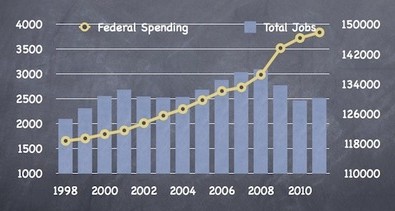
Government Spending Vs Jobs

From Investors Business Daily.

Excerpt:

How amusing to watch Democrats wring their hands over what they can do to get businesses to create jobs, when one of the biggest job killers is the minimum wage they keep hiking.

Recall that it was Democrats who raised the federal wage floor a whopping $2.10 an hour in the middle of the recession. The record 41% increase has led to record unemployment among young people, especially black teens.

Congress started ratcheting up the minimum wage from $5.15 an hour in mid-2007, arguing it would help abate poverty. But retailers looking to slash costs eliminated low-skilled, entry-level jobs rather than pay the mandated increases.

Now 1.5 million fewer teens are working. Last year’s unemployment rate for workers ages 16 to 19 shot up to 26% from 2007’s 15%.

As for black teens, their joblessness soared to a record 43% after the final raise to $7.25 took effect in mid-2009. It helped put more than half of young black men out of work — a first.

The president proposes cranking the minimum wage even higher to $9.50. Then he wants to raise it every year thereafter as a “living wage” indexed to inflation.

Yes, this is the problem that happens when you elect someone who knows nothing whatsoever about economics. And when I say nothing, I mean he is in disagreement with virtually all economists across the ideological spectrum.

Moderate economist Gregory Mankiw of Harvard University lists the policies that are accepted by virtually all economists.

Here’s Greg’s list, together with the percentage of economists who agree:

  1. A ceiling on rents reduces the quantity and quality of housing available. (93%)
  2. Tariffs and import quotas usually reduce general economic welfare. (93%)
  3. Flexible and floating exchange rates offer an effective international monetary arrangement. (90%)
  4. Fiscal policy (e.g., tax cut and/or government expenditure increase) has a significant stimulative impact on a less than fully employed economy. (90%)
  5. The United States should not restrict employers from outsourcing work to foreign countries. (90%)
  6. The United States should eliminate agricultural subsidies. (85%)
  7. Local and state governments should eliminate subsidies to professional sports franchises. (85%)
  8. If the federal budget is to be balanced, it should be done over the business cycle rather than yearly. (85%)
  9. The gap between Social Security funds and expenditures will become unsustainably large within the next fifty years if current policies remain unchanged. (85%)
  10. Cash payments increase the welfare of recipients to a greater degree than do transfers-in-kind of equal cash value. (84%)
  11. A large federal budget deficit has an adverse effect on the economy. (83%)
  12. A minimum wage increases unemployment among young and unskilled workers. (79%)
  13. The government should restructure the welfare system along the lines of a “negative income tax.” (79%)
  14. Effluent taxes and marketable pollution permits represent a better approach to pollution control than imposition of pollution ceilings. (78%)

From CNBC, we get this article showing that any increase in the minimum wage will raise the unemployment rate for young people.

Excerpt:

A quarter of teenagers were jobless in March, representing a surprising increase from February, even as the unemployment rate for the rest of the population decreased.

This figure may only get worse if budget-strapped states raise the minimum wage, and it could also be a sign of greater structural damage underlying our economy, analysts said.

The unemployment rate for 16- to 19-year olds jumped back up to 24.5 percent in March, up from 23.9 percent the prior month, according to the latest jobs data from the Labor Department.

[…]“Even when comprehending that teen employment is volatile in nature, the data that exists serves up some shock and awe,” said Brian Sozzi, a retail research analyst with Wall Street Strategies, in a note Wednesday. “If these (wage) increases do go through, the prospect for teen employment will remain grim as employers search for workers with advanced skills to fill positions.”

Twelve states, including Illinois and Pennsylvania, are considering a hike in the minimum wage. While this has been the subject of a long-running debate, many economists and analysts say raising this pay bar may cause more teen layoffs, even as it helps teens who manage to stay employed make more.

“Minimum wage increases over the past few years has definitely made it worse,” said Peter Boockvar, chief equities strategist at Miller Tabak. “In fact, there should be zero minimum wage for teenagers, or at most, something much less than the current rate.”

Teens typically are the first to be fired and the last to be hired back in a normal economic cycle, so this rate can be considered a kind of leading indicator of employment.

A new study shows that only 25% of teens will be able to find jobs this summer. And Obama thinks that this number is apparently too high. He wants to lower it by raising the price that must be paid by employers who would like to hire younger workers.

You can find out more about how raising the minimum wage increases unemployment from this comprehensive, 50-year, government study.

Excerpt:

Summary of Research on the Minimum Wage

* The minimum wage reduces employment.

Currie and Fallick (1993), Gallasch (1975), Gardner (1981), Peterson (1957), Peterson and Stewart (1969).

* The minimum wage reduces employment more among teenagers than adults.

Adie (1973); Brown, Gilroy and Kohen (1981a, 1981b); Fleisher (1981); Hammermesh (1982); Meyer and Wise (1981, 1983a); Minimum Wage Study Commission (1981); Neumark and Wascher (1992); Ragan (1977); Vandenbrink (1987); Welch (1974, 1978); Welch and Cunningham (1978).

* The minimum wage reduces employment most among black teenage males.

Al-Salam, Quester, and Welch (1981), Iden (1980), Mincer (1976), Moore (1971), Ragan (1977), Williams (1977a, 1977b).

* The minimum wage helped South African whites at the expense of blacks.

Bauer (1959).

* The minimum wage hurts blacks generally.

Behrman, Sickles and Taubman (1983); Linneman (1982).

* The minimum wage hurts the unskilled.

Krumm (1981).

* The minimum wage hurts low wage workers.

Brozen (1962), Cox and Oaxaca (1986), Gordon (1981).

* The minimum wage hurts low wage workers particularly during cyclical downturns.

Kosters and Welch (1972), Welch (1974).

* The minimum wage reduces average earnings of young workers.Meyer and Wise (1983b).

* The minimum wage reduces employment in low-wage industries, such as retailing.Cotterman (1981), Douty (1960), Fleisher (1981), Hammermesh (1981), Peterson (1981).

* The minimum wage causes employers to cut back on training.Hashimoto (1981, 1982), Leighton and Mincer (1981), Ragan (1981).

* The minimum wage encourages employers to install labor-saving devices.Trapani and Moroney (1981).

* The minimum wage increases the number of people on welfare.Brandon (1995), Leffler (1978).

* The minimum wage hurts the poor generally.

Stigler (1946).

* The minimum wage does little to reduce poverty.

Bonilla (1992), Brown (1988), Johnson and Browning (1983), Kohen and Gilroy (1981), Parsons (1980), Smith and Vavrichek (1987).

* The minimum wage helps unions.Linneman (1982), Cox and Oaxaca (1982).

* The minimum wage increases teenage crime rates.Hashimoto (1987), Phillips (1981).

* The minimum wage encourages employers to hire illegal aliens.

Beranek (1982).

* Few workers are permanently stuck at the minimum wage.

Brozen (1969), Smith and Vavrichek (1992).

* The minimum wage has reduced employment in foreign countries.Canada: Forrest (1982); Chile: Corbo (1981); Costa Rica: Gregory (1981); France: Rosa (1981).

This is why it is important for voters to understand economics. When you raise the price of labor, fewer employers will purchase labor. Supply and demand.