Tag Archives: Work

How hard work and business ownership makes people conservative

Well, here’s the story of one from the Washington Times.

Excerpt:

High school freshman Tim Scott could not afford Chick-fil-A sandwiches back in 1981, but the French fries were good and inexpensive. Eating those fries made him a success, a conservative and an odds-on favorite to be the next congressman from Charleston, S.C.

Mr. Scott has been garnering attention because he is a black Republican who won a primary over the son of the late one-time segregationist Sen. Strom Thurmond. South Carolina acquaintances, though, are coming out of the woodwork to say Mr. Scott bears watching not because he is black but because he’s the real deal: industrious, principled, consistent, thoughtful. In a word, authentic.

But to hear him tell it, it all began with the fries.

Mr. Scott’s parents were split – his father was in the Air Force in Colorado – and his mother, he said, worked two eight-hour shifts daily. “She was a nurse’s assistant cleaning up other people’s feces,” he said. “That’s nobody’s definition of fun.” Despite her example of hard work, though, his own schoolwork showed no signs of similar dedication. “I literally failed four subjects at once: world geography, civics, Spanish and English. Those last two subjects showed I wasn’t bilingual, I was bi-ignorant.”

Young Mr. Scott did, however, hold down a part-time job taking tickets at a movie theater. The Chick-fil-A was next door. He bought fries there regularly. The restaurant’s proprietor, a guy named John Moniz – a “Christian conservative white Republican, although I didn’t know it at the time,” Mr. Scott said – “just started recognizing me, and one day he came up and sat down next to me and started talking.”

I love this story. I’m a colored evangelical Protestant man. I was the only evangelical Christian and the only political conservative in my entire family. My Dad used to bring me to work ALL the time, even on weekends – and I would meet all his co-workers, drink coffee and play with his office supplies. My conversion started when I got my first paying job – programming UNIX shell scripts for a high-tech corporation while I was still a teenager – and that was my lowest paying job ever. One look at my pay check and I was through with the government and their lousy payroll taxes. I didn’t see them in my office helping me to debug and test –  so why did they deserve any of my money? I let my grades slide to keep working right through college (until grad school). I always valued working and saving and investing more than education. It’s the pattern you learn from watching your father work – the dignity of labor – the joy of independence – the ability to share with those in need. Work makes you a conservative.

You can friend Tim here on Facebook.

BONUS:

Marco Rubio responds to Democrat Harry Reid’s comments that no Hispanic person can be a Republican.

Marco Rubio is a Hispanic Republican who is about to win a federal Senate seat. I have been following him since his election announcement.

WORLD magazine’s book of the year is “The Battle”

The article from WORLD magazine is here. (H/T Muddling Towards Maturity)

The book is called “The Battle: How the Fight Between Free Enterprise and Big Government Will Shape America’s Future”.

Excerpt:

The Battle then goes beyond money to note that, “The main issue in the new American culture struggle between free enterprise and statism is not material riches—it is human flourishing.” Brooks notes that “the 30 percent coalition charges the majority with money-grubbing selfishness” but is itself “fundamentally materialistic.” Leftists “believe that it should make no difference whether income comes from redistribution and government edict or from enterprise and excellence as judged by the free market. This is an ideology driven by raw materialism.”

Brooks emphasizes the differences in worldview: “In contrast, the 70 percent majority maintains a worldview that is primarily nonmaterialistic. It understands money as just a proxy measure of true prosperity and personal fulfillment. It emphasizes creativity, meaning, optimism, and control in one’s own life and seeks to escape from under the heavy hand of the state. . . . When we reduce the idea of work to nothing more than a means of economic support, we strip it of its transcendental meaning in our lives.” Brooks argues that productive work is crucial to happiness: “Americans prefer to find meaning in their jobs rather than through their after-work pursuits.”

[…]That leads to a political plank for the present: Since the 30 percenters “have concealed the central pillar of their ideology—income equality—under a misleading definition of fairness,” the rest of us should “expose this fact and reclaim the language of fairness for the free enterprise system.” It’s vital to make distinctions: “Legal equality, political equality, religious equality—almost all Americans would agree that these values are vital to our nation. But equality of income? That’s a fundamentally different kind of equality.” We want fair trials but not a right to be declared innocent. We want all people to have the right to vote but not “the right to see their chosen candidate elected to office.”

Brooks notes that the 30 percent coalition’s use of the word “fairness” is duplicitous: “It implies that equality of outcome is a core American principle, when in fact what Americans believe in is equality of opportunity and the potential to earn success.” He is right to insist that the 70 percent coalition cannot cede to the minority the fairness issue and merely argue for free enterprise on the basis of economic efficiency: “Fairness should not be a 30 percent trump card but rather their Achilles’ heel. Equality of income is not fair.” A fair system rewards hard work and excellent performance, and gives people on the bottom a chance to rise not by bringing down the top but by striving for excellence.

I heard Arthur Brooks being interviewed about the book on Dennis Prager’s show. And I read a chapter by Brooks in that “Indivisible” booklet put out by the Heritage Foundation. So he is a recognized conservative.

Muddling linked to some must-read and must-listen interviews that I will be looking at tonight (Monday). If they are good, I’ll link to them for Tuesday.

If government is paying the piper, then government is calling the tune

Veronique de Rugy

Check out this post from GMU economist Veronica de Rugy on Big Government. (H/T ECM)

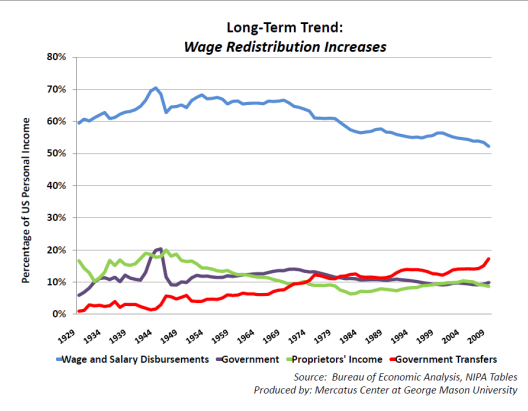
First, she puts up this chart.

Veronique writes:

On this chart we can see the changes over time in the composition of personal income in the United States since 1929. The most notable trend is the increase in the portion of personal income coming from government transfers (mainly social Security payments, unemployment benefits, food stamps, and personal and business tax credits.)  And the increase isn’t minor: the proportion of total personal income constituted by government money has grown from 0.9% to 17.2%.

Complementary decreases of wage earnings as percentages of total personal income (from 59.5% to 52.3%) are also going on.

The problem with government giving people money is that it creates a culture of dependency, as with Greece. Politicians take money from job-creating business-owners, or from productive individual workers, and they redistribute it to whiny unproductive, immature victim groups like unions, in order to buy their votes. Eventually, the government goes too far making promises and the productive people just stop or slow their working or they move away, since they keep less and less of their own money for the same amount of work and risk-taking.

And that’s when welfare checks of the losers dry up, and they have no choice but to riot and kill people. Why do they riot? Well, if they were earning their own money by working, then they would know that they are responsible for themselves, not government. They would understand that something might go wrong, and they would know that they had to cut their spending and save for a rainy day. So when things do go bad, they would have known how to live cheaply off of their savings while they find another job.

But people who take welfare don’t save – they think the money will always be there. What do they do when the taxpayers slow or stop production? They have no skills, and they have no savings. They can’t just find a new government because a new government isn’t going to find any more money from somewhere – there isn’t any left. So the only way to get their welfare back is to revolt – which is exactly what the socialists in Greece are doing right now. They’ve been spoiled rotten and they want their welfare back, like little babies crying for their mommies.

It’s sick. And this is what Obama and the Democrats idolize, because that’s how they grew up – begging their rich parents for money and bailouts for their own irresponsible behaviors. Their policies aren’t thought through – it’s just reliving their silver spoon childhoods of never having to work for anything.

Would you like to know what Republicans are like? Consider Michele Bachmann.

At 13, Bachmann was forced to become almost financially independent after her parents divorced. She used her babysitting money to buy her own clothes and lunches at school and saved up enough to purchase her first pair of contact lenses. Between college semesters at Winona State University, she took her hardworking streak to Alaska where on one memorable day she cleaned 280 salmon.

She also quit her job as a tax litigation attorney to homeschool her five kids, because she didn’t like the job the public schools were doing. Her business runs a small business, and she helped him to start it. That’s what Republicans do. We work. And we give.

We need to stop increasing the size of government so they can “take care” of all our needs. We need to take care of all our needs, and to take care of our neighbor’s needs, too. That’s capitalism. Having something to share from what you can make from your own industry and labor.