Why are we in a recession? Maybe it’s because the people running the country believe that unemployment checks and welfare are better than earned paychecks for “stimulating” the economy.
Here’s CNS News to explain what Democrats are trying to achieve:
House Minority Whip Steny Hoyer (D-Md.) said Tuesday that food stamps and unemployment insurance are the two “most stimulative” things you can do for the economy.
During a pen and pad briefing with reporters on Capitol Hill, Hoyer was asked if any Democrats are “reconsidering the wisdom” of letting the Bush tax cuts expire at year’s end for the top income earners given the still struggling U.S. economy.
“I haven’t talked to any who are of that mind,” said Hoyer. “If you talk to economists, they will tell you there are two things that are the most stimulative that you can do — one’s unemployment insurance, the other’s food stamps, okay?”
“Why is that?” he said. “Because those folks who receive those resources must spend them. And they’ll spend them almost upon receipt. Most economists with whom I talk believe that those with significant discretionary income, that that’s not the case.”
Unless action is taken by Congress, the Bush tax cuts will expire on Jan. 1, 2013. Originally enacted in 2001 and 2003, President Barack Obama and Congress renewed the cuts for all income-brackets for two years in 2010.
[…]The Congressional Budget Office (CBO has projected that if the Bush tax cuts are allowed to expire at the end of 2012, coupled with the defense cut sequester, it will lead to a 1.3 percent contraction in GDP after Jan. 1, 2013.
If the Bush tax cuts are allowed to expire, it is expected that 710,000 people will lose their jobs. This will achieve the Democrats goal of “stimulating the economy” with higher unemployment and more food stamps. This continues the Democrat plan of increasing the record number of people on welfare and food stamps. They will pay for this “stimulus” by adding more debt to the $8 trillion they have already run up since January 2007. The debt will be paid by young people and children. The real plan behind making millions of people dependent on government is, of course, to be able to buy their votes and to control them. Democrats are the anti-freedom party. You have too much freedom when you have a job. It leads to “inequality”. If everyone received their daily bread from the government, and rode on mass transit to labor camps instead of driving in cars, and slept in identical apartments with identical furniture and identical television programs to watch, then the world would be more equal. And equality is what Democrats want most.
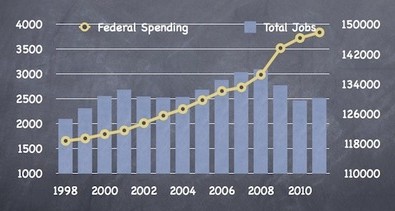
So what is the Republican alternative plan for the economy? To let job creating businesses keep their own money and hire people to do work. Republicans want to stop taxing and regulating job creating businesses so that people can be put back to work, and have the confidence to spend money. That’s how you stimulate the economy – we know this because it has worked for Reagan and Bush before. Obama’s approach has never worked. The Democrats have been running the show since January 2007. And that’s why we are down 5 million jobs since Steny Hoyer became the House Whip in January of 2007. This is not going to end until the Democrats are voted out.
From the Heritage Foundation explains the 1996 Welfare Reform Act and its detractors.
Excerpt:
Last Thursday, the Obama Administration quietly issued new bureaucratic rules that overturned the popular welfare reform law of 1996. This was an illegal move, and it completely undoes years of progress that helped millions of Americans.
The 1996 reform replaced the old Aid to Families with Dependent Children (AFDC) program with a new program called Temporary Assistance to Needy Families (TANF). At the core of the TANF program were new federal work standards that required able-bodied welfare recipients to work, prepare for work, or at least look for work as a condition for receiving aid. Welfare reform turned “welfare” into “workfare.”
Under the old, pre-reform AFDC program, welfare was a one-way handout: Government mailed checks to recipients who did nothing in return. Reform changed that. The new TANF program was based on fairness and reciprocal responsibility: Taxpayers continued to provide aid, but beneficiaries were required, in exchange, to engage in constructive behavior to increase self-sufficiency and reduce dependence.
The TANF work requirements were not onerous. Under the law, some 40 percent of adult TANF recipients in a state were required to engage in “work activities,” which is defined as unsubsidized employment, subsidized employment, on-the-job training, attending high school or a GED program, vocational education, community service work, job search, or job readiness training. Participation was part-time, 20 hours per week for mothers with children under six and 30 hours for mothers with older children.
[…]As welfare dependence fell and employment increased,child poverty among the affected groups fell dramatically. For a quarter century before the reform, poverty among black children and single mothers had remained frozen at high levels. Immediately after the reform, poverty for both groups experienced dramatic and unprecedented drops, quickly reaching all-time lows.
None of this reduced the left’s antipathy for welfare reform. The left had strongly opposed work requirements in welfare in 1996. When TANF faced reauthorization in 2001, they again aggressively sought to repeal federal work standards; they repeated the attack in 2006. For the most part, they lost those battles. But they were not done.
[…]Having lost repeated legislative battles to abolish workfare, the left has now gone backdoor, using an arcane bureaucratic device called a section 1115 waiver to declare the actual work standards written in the TANF law null and void and grant federal bureaucrats carte blanche authority to devise new replacement standards.
Now that we are in an election year, I expect to see a lot of promises by the Democrats of more and more handouts, bailouts and rewards to all of their various constituencies. And all paid for by the job creators in the private sector, and their hard-working employees. After all, “the private sector is fine” and “if you’ve got a business — you didn’t build that. Somebody else made that happen”.
How amusing to watch Democrats wring their hands over what they can do to get businesses to create jobs, when one of the biggest job killers is the minimum wage they keep hiking.
Recall that it was Democrats who raised the federal wage floor a whopping $2.10 an hour in the middle of the recession. The record 41% increase has led to record unemployment among young people, especially black teens.
Congress started ratcheting up the minimum wage from $5.15 an hour in mid-2007, arguing it would help abate poverty. But retailers looking to slash costs eliminated low-skilled, entry-level jobs rather than pay the mandated increases.
Now 1.5 million fewer teens are working. Last year’s unemployment rate for workers ages 16 to 19 shot up to 26% from 2007’s 15%.
As for black teens, their joblessness soared to a record 43% after the final raise to $7.25 took effect in mid-2009. It helped put more than half of young black men out of work — a first.
The president proposes cranking the minimum wage even higher to $9.50. Then he wants to raise it every year thereafter as a “living wage” indexed to inflation.
Yes, this is the problem that happens when you elect someone who knows nothing whatsoever about economics. And when I say nothing, I mean he is in disagreement with virtually all economists across the ideological spectrum.
Here’s Greg’s list, together with the percentage of economists who agree:
A ceiling on rents reduces the quantity and quality of housing available. (93%)
Tariffs and import quotas usually reduce general economic welfare. (93%)
Flexible and floating exchange rates offer an effective international monetary arrangement. (90%)
Fiscal policy (e.g., tax cut and/or government expenditure increase) has a significant stimulative impact on a less than fully employed economy. (90%)
The United States should not restrict employers from outsourcing work to foreign countries. (90%)
The United States should eliminate agricultural subsidies. (85%)
Local and state governments should eliminate subsidies to professional sports franchises. (85%)
If the federal budget is to be balanced, it should be done over the business cycle rather than yearly. (85%)
The gap between Social Security funds and expenditures will become unsustainably large within the next fifty years if current policies remain unchanged. (85%)
Cash payments increase the welfare of recipients to a greater degree than do transfers-in-kind of equal cash value. (84%)
A large federal budget deficit has an adverse effect on the economy. (83%)
A minimum wage increases unemployment among young and unskilled workers. (79%)
The government should restructure the welfare system along the lines of a “negative income tax.” (79%)
Effluent taxes and marketable pollution permits represent a better approach to pollution control than imposition of pollution ceilings. (78%)
From CNBC, we get this article showing that any increase in the minimum wage will raise the unemployment rate for young people.
Excerpt:
A quarter of teenagers were jobless in March, representing a surprising increase from February, even as the unemployment rate for the rest of the population decreased.
This figure may only get worse if budget-strapped states raise the minimum wage, and it could also be a sign of greater structural damage underlying our economy, analysts said.
The unemployment rate for 16- to 19-year olds jumped back up to 24.5 percent in March, up from 23.9 percent the prior month, according to the latest jobs data from the Labor Department.
[…]“Even when comprehending that teen employment is volatile in nature, the data that exists serves up some shock and awe,” said Brian Sozzi, a retail research analyst with Wall Street Strategies, in a note Wednesday. “If these (wage) increases do go through, the prospect for teen employment will remain grim as employers search for workers with advanced skills to fill positions.”
Twelve states, including Illinois and Pennsylvania, are considering a hike in the minimum wage. While this has been the subject of a long-running debate, many economists and analysts say raising this pay bar may cause more teen layoffs, even as it helps teens who manage to stay employed make more.
“Minimum wage increases over the past few years has definitely made it worse,” said Peter Boockvar, chief equities strategist at Miller Tabak. “In fact, there should be zero minimum wage for teenagers, or at most, something much less than the current rate.”
Teens typically are the first to be fired and the last to be hired back in a normal economic cycle, so this rate can be considered a kind of leading indicator of employment.
* The minimum wage encourages employers to hire illegal aliens.
Beranek (1982).
* Few workers are permanently stuck at the minimum wage.
Brozen (1969), Smith and Vavrichek (1992).
* The minimum wage has reduced employment in foreign countries.Canada: Forrest (1982); Chile: Corbo (1981); Costa Rica: Gregory (1981); France: Rosa (1981).
This is why it is important for voters to understand economics. When you raise the price of labor, fewer employers will purchase labor. Supply and demand.

 WINTERY KNIGHT