Tag Archives: Wonder

New study: how the hummingbird performs stunning feats of aerobatics

Hummingbird in flight

New study reported by Science Daily.

Excerpt:

The sight of a tiny hummingbird hovering in front of a flower and then darting to another with lightning speed amazes and delights. But it also leaves watchers with a persistent question: How do they do it?

Now, the most detailed, three-dimensional aerodynamic simulation of hummingbird flight conducted to date has definitively demonstrated that the hummingbird achieves its nimble aerobatic abilities through a unique set of aerodynamic forces that are more closely aligned to those found in flying insects than to other birds.

The new supercomputer simulation was produced by a pair of mechanical engineers at Vanderbilt University who teamed up with a biologist at the University of North Carolina at Chapel Hill. It is described in the article “Three-dimensional flow and lift characteristics of a hovering ruby-throated hummingbird” published this fall in the Journal of the Royal Society Interface.

For some time researchers have been aware of the similarities between hummingbird and insect flight, but some experts have supported an alternate model which proposed that hummingbird’s wings have aerodynamic properties similar to helicopter blades. However, the new realistic simulation demonstrates that the tiny birds make use of unsteady airflow mechanisms, generating invisible vortices of air that produce the lift they need to hover and flit from flower to flower.

You might think that if the hummingbird simply beats its wings fast enough and hard enough it can push enough air downward to keep its small body afloat. But, according to the simulation, lift production is much trickier than that.

For example, as the bird pulls its wings forward and down, tiny vortices form over the leading and trailing edges and then merge into a single large vortex, forming a low-pressure area that provides lift. In addition, the tiny birds further enhance the amount of lift they produce by pitching up their wings (rotate them along the long axis) as they flap.

Hummingbirds perform another neat aerodynamic trick — one that sets them apart from their larger feathered relatives. They not only generate positive lift on the downstroke, but they also generate lift on the upstroke by inverting their wings. As the leading edge begins moving backwards, the wing beneath it rotates around so the top of the wing becomes the bottom and bottom becomes the top. This allows the wing to form a leading edge vortex as it moves backward generating positive lift.

According to the simulation, the downstroke produces most of the thrust but that is only because the hummingbird puts more energy into it. The upstroke produces only 30 percent as much lift but it takes only 30 percent as much energy, making the upstroke equally as aerodynamically efficient as the more powerful downstroke.

Large birds, by contrast, generate almost all of their lift on the downstroke. They pull in their wings toward their bodies to reduce the amount of negative lift they produce while flapping upward.

Awesome design in nature!

So the question I have from reading the article is this. Do birds and flying insects have a recent common ancestor? I don’t have too many friends who can answer this for me, but I asked one of them and they both said there is no recent common ancestor for hummingbirds and flying insects. So this looks like another example of convergence – common design in two animals that don’t share a recent common ancestor.
The best explanation for the design of bird wings is intelligent design

A great post from Evolution News about my favorite animals in the whole world – BIRDS!

Excerpt:

How hard can it be to make a flexible wing flap for an airplane? Almost all aircraft today use rigid wings with rigid landing flaps. They work, but they waste fuel. German engineers embarked on a mission to reduce kerosene consumption by 6%: “integrating flexible landing devices into aircraft wings is one step towards that target,” a news item from Fraunhofer says. They’ve named the project SARISTU, for Smart Intelligent Aircraft Structures.

Birds are way ahead of them:

While birds are able to position their feathers to suit the airflow, aircraft wing components have so far only been rigid. As the name suggests, landing flaps at the trailing edge of the wing are extended for landing. This flap, too, is rigid, its movement being limited to rotation around an axis. This is set to change in the SARISTU project. “Landing flaps should one day be able to adjust to the air flow and so enhance the aerodynamics of the aircraft,” explains Martin Schüller, researcher at the Fraunhofer Institute for Electronic Nano Systems ENAS in Chemnitz. (Emphasis added.)

What are some of the challenges in building a flexible wing?

  1. Knowing where to flex: The flap can’t be flexible all over, or it would be hard to control. The designers made “five hard and three soft zones, enclosed within a silicon skin cover extending over the top.”
  2. Finding stretchy skin: When the soft zone moves, the skin of the aircraft has to stretch with it. “The mechanism that allows the landing flap to change shape can only function if the skin of the landing flap can be stretched as it moves, a problem tackled by researchers from the Fraunhofer Institute for Manufacturing Technology and Advanced MaterialsIFAM in Bremen.”
  3. Covering the air gap: “Any gap between the flap and the fixed aircraft wingwould cancel out any positive effect,” the article notes. “This led us to develop an elastic connecting element, and this work already covers everything from the chemical makeup to the process technology andmanufacture of the component,” an engineer says.
  4. Designing the material to tolerances: “The mechanism sits underneath the soft zones, the areas that are most distended. While the novel design is noteworthy, it is the material itself that stands out, since the flexible parts are made of elastomeric foam that retain their elasticity even attemperatures ranging from minus 55 to 80 degrees Celsius.”

No feathers, but it’s a start. The team showed off their prototype at the ILA Berlin Air Show in May. Apparently it was not quite ready for takeoff:

When the prototype takes off for the first time it will benefit from a development known as SARISTU, a deformable wing which is currently the subject of intensive research by Fraunhofer Gesellschaft. In future the landing flaps will be designed to adapt in flight to the air flow conditions, thereby always ensuring the best possible aerodynamics.

We celebrate this advance, but you know where we’re going. Birds had it all figured out long ago: the right shape, the right material, the control of airflow, and much more. As Dr. Timothy Standish says in the film Flight: The Genius of Birds, “Feathers do a number of jobs remarkably well.” They are individually controllable, they flex, they insulate, they save on weight, and they can handle the temperature requirements of avian flight. That’s just a partial list achievements in powered flight that surpass anything man has yet designed.

If you want to get hold of that DVD on “Flight” that they mentioned, it’s right here on Amazon.com. I highly recommend it.

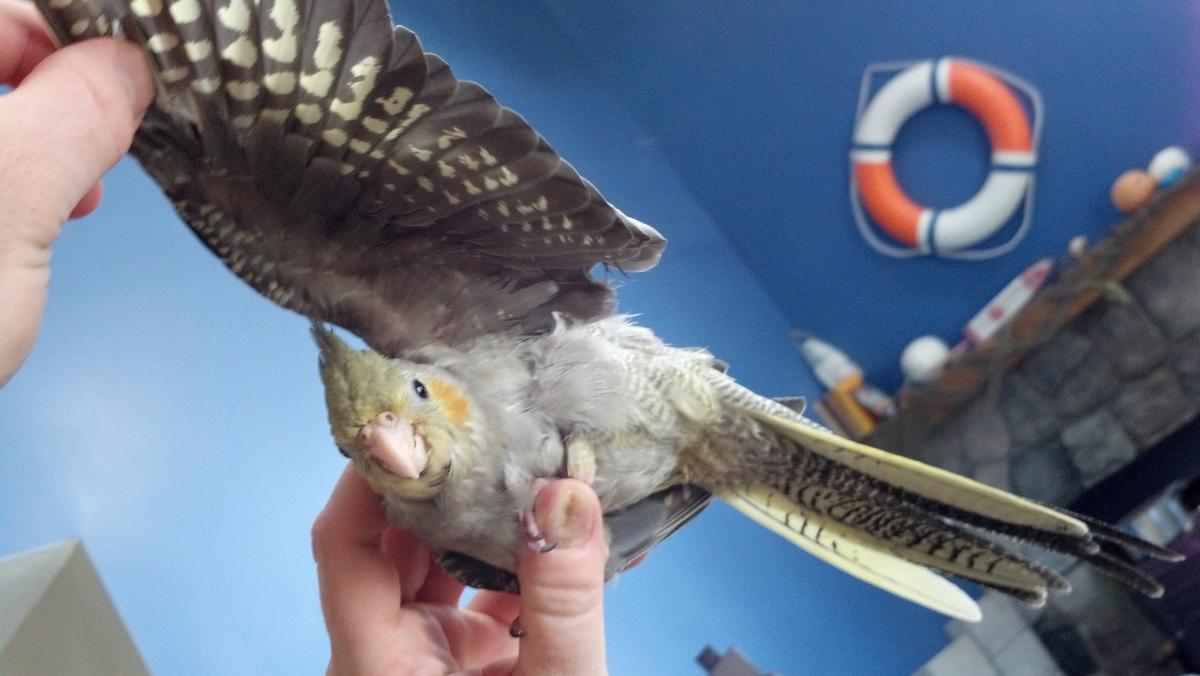
I also highly recommend owning birds – because if you work really hard at caring for one for a long time, they might grow to trust you. There is nothing quite like a tiny little bird trusting you enough to let you gently pull open his or her wing for a closer look at how it works:

Cockatiel lets a trusted friend see her wing
Awww! Cockatiel lets a trusted friend see under her wing

There’s more to birds than just well-designed wings. There’s a well-designed heart in there, too! That might even be more amazing than the design of the wing. It is to me.

Note: although this post does not provide a rigorous case for intelligent design, that can be found by looking at the work of Stephen C. Meyer on the origin of life and on the Cambrian explosion. The books that demonstrate the superiority of the intelligent design hypothesis are “Signature in the Cell” and “Darwin’s Doubt“. If you’d like to see a good popular-level presentation of intelligent design related to the origin of life, click here for a lecture.