
Tag Archives: Women’s Studies

We need to teach women to not make false accusations of rape

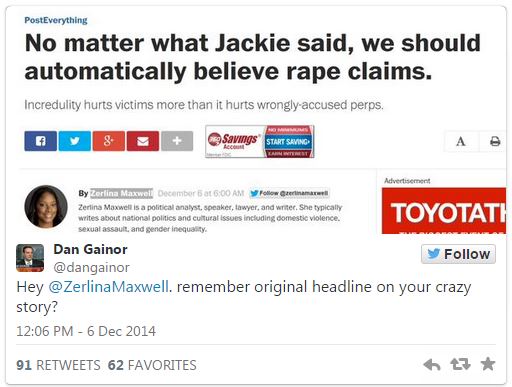
Zerlina Maxwell writes in the Washington Post: “we should automatically believe rape claims”

Here’s the news story that is prompting this post, from the Washington Free Beacon.

Excerpt:

Rolling Stone settled the defamation lawsuit filed by a University of Virginia fraternity over a false story about a rape on campus, agreeing to pay $1.65 million on Tuesday.

The lawsuit stemmed from the 2014 story “A Rape on Campus,” published in Rolling Stone by Sabrina Rubin Erdely. The story detailed the sexual assault of a woman identified only as “Jackie” at the Virginia Alpha Chapter of the Phi Kappa Psi fraternity.

The story was officially retracted in 2015 after a police investigation did not find any evidence to back up the story. News outlets also began to question Jackie’s story, and once again did not find any evidence to confirm her account.

The fraternity sought $25 million and settled for $1.65 million. Phi Kappa Psi plans to donate a “significant portion” to groups that provide sexual assault awareness education, prevention training, and victim counseling services, according to the Associated Press.

Rolling Stone and Erdely had an agenda, and they were recklessly oblivious to the harm they would cause innocent victims in their ruthless pursuit of that agenda,” the fraternity’s lawsuit said.

Rolling Stone settled another defamation lawsuit against university administrator Nicole Eramo for $3 million.

Naturally, the liberal mainstream media – which anxiously reported on the hoax – is not nearly as interested in reporting on the correction. Because they have their agenda of blaming men for the free choices that women make. But it’s not just liberal mainstream media that pushes the rape culture myth. At the time this Rolling Stone story came out, I remember that traditional pro-marriage advocates like Brad Wilcox gleefully tweeted the false rape accusation story, and then had to take it back later. So this was by no means seen through at the beginning, except by men’s rights activists who were familiar with the nature of false rape hoax stories. “Pro-marriage” people are anxious to prove that they can fit in with liberals, and if they have to denigrate men to do it, they will.

So why do some women lie about rape? Let’s look at a study.

Studies show about 40% of rape accusations are false

False accusations of rape or sexual assault are commonly used by women to get attention and sympathy, or to get an alibi when they’ve done something wrong, or to get revenge on someone who has rejected them.

Here’s a Fox News article from a prominent equity feminist, Wendy McElroy.

Excerpt:

“Forty-one percent of all reports are false.”

This claim comes from a study conducted by Eugene J. Kanin of Purdue University. Kanin examined 109 rape complaints registered in a Midwestern city from 1978 to 1987.

Of these, 45 were ultimately classified by the police as “false.” Also based on police records, Kanin determined that 50 percent of the rapes reported at two major universities were “false.”

Although Kanin offers solid research, I would need to see more studies with different populations before accepting the figure of 50 percent as prevalent; to me, the figure seems high.

But even a skeptic like me must credit a DNA exclusion rate of 20 percent that remained constant over several years when conducted by FBI labs. This is especially true when 20 percent more were found to be questionable.

False accusations are not rare. They are common.

If you would like to get an idea of how false rape accusations are handled by the police, here is an example. Usually no charges are filed against the women, or if charges are filed, then they get off without jail time. Meanwhile, men falsely accused of rape spend years in jail, until the women finally admits she made the whole thing up. The presumption is that women always tell the truth, and that evidence isn’t needed to prove her charges.

False accusations in divorce trials

False accusations of domestic violence and sexual abuse are also commonly made during divorce settlements in order to get custody of the children, and the attendant benefits.

Consider this article from Touchstone magazine, by Stephen Baskerville.

Excerpt:

Today it is not clear that we have learned anything from these miscarriages of justice. If anything, the hysteria has been institutionalized in the divorce courts, where false allegations have become routine.

What is ironic about these witch-hunts is the fact that it is easily demonstrable that the child abuse epidemic—which is very real—is almost entirely the creation of feminism and the welfare bureaucracies themselves. It is well established by scholars that an intact family is the safest place for women and children and that very little abuse takes place in married families. Child abuse overwhelmingly occurs in single-parent homes, homes from which the father has been removed. Domestic violence, too, is far more likely during or after the breakup of a marriage than among married couples.

Yet patently false accusations of both child abuse and domestic violence are rampant in divorce courts, almost always for purposes of breaking up families, securing child custody, and eliminating fathers. “With child abuse and spouse abuse you don’t have to prove anything,” the leader of a legal seminar tells divorcing mothers, according to the Chicago Tribune. “You just have to accuse.”

Among scholars and legal practitioners it is common knowledge that patently trumped-up accusations are routinely used, and virtually never punished, in divorce and custody proceedings. Elaine Epstein, president of the Massachusetts Women’s Bar Association, writes that “allegations of abuse are now used for tactical advantage” in custody cases. The Illinois Bar Journal describes how abuse accusations readily “become part of the gamesmanship of divorce.” The UMKC Law Reviewreports on a survey of judges and attorneys revealing that disregard for due process and allegations of domestic violence are used as a “litigation strategy.” In the Yale Law Review, Jeannie Suk calls domestic violence accusations a system of “state-imposed de facto divorce” and documents how courts use unsupported accusations to justify evicting Americans from their homes and children.

I often hear men, especially men in the church, complaining that young men won’t get married because they are too busy watching porn and playing video games. But maybe the real reason is that they don’t want to be exposed to domestic violence laws and divorced courts that are waiting to separate them from their earnings.

If the church isn’t speaking out against premarital sex (to women) and against no-fault divorce (to women) and against biased domestic violence laws (to women), then they have no one to blame for the so-called “marriage strike” but themselves. Unfortunately, it seems that no one who advocates for marriage has the courage to attack the root cause of the marriage decline: women’s own irresponsible choices. When women choose immoral men and then choose to have sex with them before marriage, they have no one to blame but themselves for the damage that results.

Domestic violence rates

Here’s a recent article in the radically leftist UK Guardian that summarizes the evidence that women commit domestic violence at the same rates as men.

Excerpt:

Domestic violence has traditionally been understood as a crime perpetrated by domineering men against defenceless women. Research spanning over 40 years has, however, consistently found that men and women self-report perpetrating domestic violence at similar rates. Professor John Archer from the University of Central Lancashire has conducted a number of meta-analytic reviews of these studies and found that women are as likely to use domestic violence as men, but women are twice as likely as men to be injured or killed during a domestic assault. Men still represent a substantial proportion of people who are assaulted, injured or killed by an intimate partner (50%, 30% and 25% respectively).

If the empirical research is correct in suggesting that between a quarter and half of all domestic violence victims are men, a question follows: why has women’s domestic violence towards men been unreported for so long, and what has changed in the last five years to make it more visible?

One reason may be the feminist movement. Feminism took up the cause of domestic abuse of women in the 1970s, with the world’s first women’s refuge being opened by Erin Pizzey in 1971. Feminism understood domestic violence as the natural extension of men’s patriarchal attitudes towards women, leading men to feel they had the right to control their partners, using violence if necessary. Feminists campaigned successfully to bring the issue into the public arena, thereby securing resources to establish services to help victims. This activism and advocacy led to governmental and public acceptance that “domestic violence” was synonymous with violence against women.

[…]The dual stereotypes of the violent man and passive woman have undoubtedly obscured the existence of male victims of domestic violence in the past. Men were also unlikely to view their own victimisation as either domestic violence or a criminal assault, and so were unlikely to seek help.

More domestic violence studies from multiple countries are discussed here. They confirm the study discussed above – the rates are similar for men and women. But all the taxing and spending is for women, not men. It’s a huge difference in how women and men are treated, just like there is a difference in concern and spending with breast cancer vs prostate cancer.

I’ve only met one unmarried woman in my entire life who was aware of all of these injustices against men. And yet so many women want to get married, and think they are qualified for marriage. What kind of friend could a woman be to a man, when she only knows about the trendy problems that concern leftists (global warming, rape culture, transgenders in bathrooms, etc.) but nothing about the problems that face unmarried men – especially if they take on the challenges of marriage and fatherhood? The typical young, unmarried woman today (Christian and non-Christian) is pro-abortion, pro-no-fault-divorce, pro-big-government,  a radical feminist and anti-male. Why do they think that marriage is something they deserve? What exactly is it that they offer a man?
Has feminism been good for women?

Radical feminists complain a lot about sexism, but damage is self-inflicted

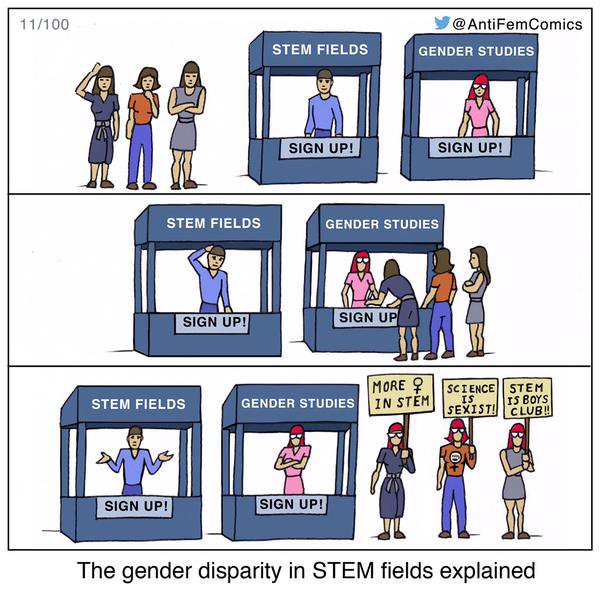
One problem with feminism is that it produces the very outcomes that feminists then turn around and complain about. For example, consider the women’s studies major that is favored by feminists. Does it produce a good financial return on investment?

Here is an article from the Daily Signal to answer that.

Excerpt:

While only 23 percent of American women identify as feminists, 47 percent of millennial women do.

But unfortunately, the policies supported by modern feminists have been particularly bad for young women.

[…]Today, millennial women struggle with significant student loan debt and often have a hard time finding a job that will get them out of mom and dad’s basement. About 42 percent of women have more than $30,000 in student loan debt, compared than just 27 percent of men.

This could be a function of more women pursuing higher levels of learning. But significant student loan defaults among this group indicate that women may not be getting the return on investment they had hoped for.

Women are vastly overrepresented in majors that are known to have low returns on investment, such as gender studies or social work. Yet the feminist movement encourages more young women to pursue these degrees.

Their solution is to advocate further government assistance through policies such as free public college, loan forgiveness, and income-based repayment policies that drag out the life of a loan while doing nothing to put pressure on colleges to keep prices in check.

Hmm. Perhaps instead of taxing working men to pay for the poor academic decisions of women, we can shame and blame women who prefer useless degrees in women’s studies to useful degrees in computer science?

Look at the numbers reported by USA Today:

According to the National Center for Education Statistics, the number of women’s and gender studies degrees in the United States has increased by more than 300% since 1990, and in 2015, there were more than 2,000 degrees conferred.

These days, women’s studies programs include gender and sexuality studies, and many of the programs explore and question the relationship of race, class, sexuality, ethnicity and more to encourage students to investigate in the broader field of gender.

THREE HUNDRED PERCENT. It would never occur to me – as a child of poor non-white immigrants – that I could spend tens of thousands of dollars, and even go into debt, for a degree that would not pay for itself. Whether I liked computer science or not, that’s what I had to study – or something like that.

What about the idea that women are paid less than men for the same work, because of discrimination?

Liberal feminist Hanna Rosin takes a look at this question in the far-left Slate, of all places.

Excerpt:

The official Bureau of Labor Department statistics show that the median earnings of full-time female workers is 77 percent of the median earnings of full-time male workers. But that is very different than “77 cents on the dollar for doing the same work as men.” The latter gives the impression that a man and a woman standing next to each other doing the same job for the same number of hours get paid different salaries. That’s not at all the case. “Full time” officially means 35 hours, but men work more hours than women. That’s the first problem: We could be comparing men working 40 hours to women working 35.

How to get a more accurate measure? First, instead of comparing annual wages, start by comparing average weekly wages. This is considered a slightly more accurate measure because it eliminates variables like time off during the year or annual bonuses (and yes, men get higher bonuses, but let’s shelve that for a moment in our quest for a pure wage gap number). By this measure, women earn 81 percent of what men earn, although it varies widely by race. African-American women, for example, earn 94 percent of what African-American men earn in a typical week. Then, when you restrict the comparison to men and women working 40 hours a week, the gap narrows to 87 percent.

But we’re still not close to measuring women “doing the same work as men.” For that, we’d have to adjust for many other factors that go into determining salary. Economists Francine Blau and Lawrence Kahn did that in a recent paper, “The Gender Pay Gap.”.”They first accounted for education and experience. That didn’t shift the gap very much, because women generally have at least as much and usually more education than men, and since the 1980s they have been gaining the experience. The fact that men are more likely to be in unions and have their salaries protected accounts for about 4 percent of the gap. The big differences are in occupation and industry. Women congregate in different professions than men do, and the largely male professions tend to be higher-paying. If you account for those differences, and then compare a woman and a man doing the same job, the pay gap narrows to 91 percent. So, you could accurately say in that Obama ad that, “women get paid 91 cents on the dollar for doing the same work as men.”

I believe that the remainder of the gap can be accounted for by looking at other voluntary factors that differentiate men and women.

The Heritage Foundation says that a recent study puts the number at 95 cents per dollar.

Excerpt:

Women are more likely than men to work in industries with more flexible schedules. Women are also more likely to spend time outside the labor force to care for children. These choices have benefits, but they also reduce pay—for both men and women. When economists control for such factors, they find the gender gap largely disappears.

A 2009 study commissioned by the Department of Labor found that after controlling for occupation, experience, and other choices, women earn 95 percent as much as men do. In 2005, June O’Neil, the former director of the Congressional Budget Office, found that “There is no gender gap in wages among men and women with similar family roles.” Different choices—not discrimination—account for different employment and wage outcomes.

If women choose to study women’s studies, why should they be surprised that they are paid less than men who study computer science?  I wish the people who teach women’s studies understood what it means to create something for a customer that they are willing to pay for. Then maybe they could tell women how to get paid more. People who learn hard things, create value for customers, and work longer hours make more money. Teaching young women useless prejudices against men does not help them to make more money.

Are young, unmarried women sincere about wanting to be married “some day”?

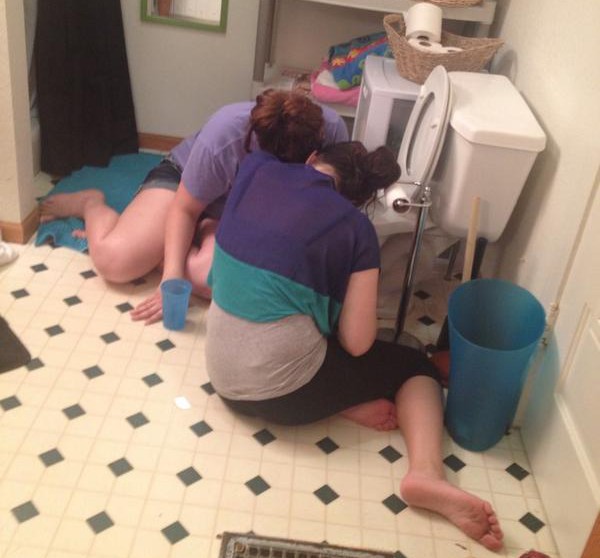
College students puking in toilet

Here’s a useful video for learning about what men think of marriage now that radical feminism has redefined it:

This comment about the video by Gaza on the Elusive Wapiti blog deserves a post of it’s own, so here it is:

One thing that Helen seems to miss is how women value and prioritize marriage and what role this plays vis a vis the male corollary. 

The “story” isn’t just about men being “on strike” or even (to Helen’s credit) rationally choosing to delay and/or avoid; it must also include how women treat marriage WRT their own valuation and prioritization and life decisions (NOT merely stated desires). 

There are not swarms of 25 y/o female college-grads looking for a husband with no willing men within sight. There are, however, swarms of 25 y/o/ female college-grads looking to have fun, travel, chase dreams, build careers, and explore their options. 

I’ve “dated” a few of these women; most (and their social circles included) are so focused on the self-indulgence (“experience”) and the status associated with sexual conquest/power that any mention of marriage is usually as a joke (enter the “boyfriends/husbands are boring/stupid/lazy” meme); marriage is merely some distant thing to be acquired at some seemingly distant age. 

Sure, over time (cue: the wall), the distant thing becomes a stated desire, but the transition from stated-desire to behavioral change and actual prioritization often takes years. I meet women well into their 30’s who still can’t alter their behaviors to demonstrate congruence with their stated desires. 

But that is when we start to hear how important marriage is, how men are avoiding commitment, why men should value marriage. All bacon-wrapped in various shaming mechanisms. The women singing the “Man-up and marry me” tune are not the 25 y/o versions; they are too busy singing the “you go girl” showtunes, exactly as prescribed by the Sandberg, lean-in, [binge drinking, continuous alpha male hookups, alpha male cohabitation], [and later, jump off the carousel into a marriage to a beta provider that makes her perpetually feel that she married down compared to the alphas that she used to hookup with while drunk].

So we can plainly see how something is valued based on the prioritization of one’s choices. Most young women value marriage as an idea, as a capstone to her personal journey; an indicator of status and achievement but not as a goal in-of-itself and not as a life decision that supersedes the accumulation of personal experience, the flexing her sexual and relationship power, or the kindling her optionality. 

These women desire to “hang-out” with the most attractive men they can, under any number of relationship approximations while pursuing their personal journeys and then suddenly desire to elevate commitment and marriage as something paramount, right around the same time their ability to define and opt-in/out of those indulgent relationship approximations wanes. Hmm.

After 10+ years of treating men and relationships as consumable commodities, marriage is now so valuable? So sacred that it will magically be more robust in the face of challenges, requiring more giving and less taking than those previous marital approximations, and yet because it is now a “Marriage”, it won’t be treated as merely a vehicle for the pursuit of her apparently perpetually fleeting “happiness”? Convince me.

There is a false premise at work that assumes that it is men who are devaluing marriage. Sure, there is some truth to this, but woman are messaging their own valuation of marriage as well; in real-time, often in very overt means and often at the expense of men who are still clinging to some idealistic view of marriage. 

And likely those are the very men who are willing and able to be husbands at 25. The very same men who will grow to become self-sufficient 35 y/o men feeling their own blossoming optionality, harvesting their own “experiences” with the 25 y/o versions of the suddenly-marriage-minded women, while a decade of observational and experiential evidence of what women truly value buries what remains of their marital idealism.

Tl:dr
I’d consider marriage to a woman who has demonstrated through her choices, prioritization, sacrifice and delayed gratification that marriage is valuable to her and who can articulate how it would be valuable to me. [not holding breath]

What do you think? Is that something that you are seeing more of in the current generation of young, unmarried women? I have to confess, I see a lot of emphasis among Christian women on short-term missions trips and on careers, but not much planning on how to be prepared for marriage. In my experience, there is not much preparation work going on, and marriage is put off later and later. This is despite the fact that a woman’s fertility declines starting at age 27 and is pretty much dead at 35. IVF is very expensive, but has a higher risk of birth defects and and can often lead to too many embryos, some of which will then need to be aborted. Men respond to incentives, and they have certain things they are looking for out of a wife and marriage.

It would be nice if there were some wisdom being transferred from older, married women to young, unmarried women, but I don’t see it happening. What I see happening is young women, including ones raised in Christian homes, going off to college to binge drink and hookup and cohabitate, and always expressing the desire for marriage “some day”. But marriage is something you prepare for early with every decision. Some decisions are not good preparation for marriage. I get the impression that young, unmarried women think that marriage is “boring” and not the way to “make a difference”, and so in practice, they are trying other things.

Remember, the offer that a woman such as Gaza describes to a man is not the same as the offer of marriage that was made by 20-year-old women in the 1950s.

Marriage used to mean:

  • Being the legally and socially recognized head of the household.
  • An expectation of regular sex.
  • Legal rights to children.
  • Lifetime commitment.
  • That you are guaranteed a chaste bride on your wedding night.

Men liked the original version of marriage without the modern debasements. Should they feel obligated to settle for the new version of marriage which is influenced by radical feminism? I would have to be convinced. Women are kidding themselves if they think that they can do anything they want and wait as long as they want and still be as attractive to men.