Tag Archives: Will

New paper: paralyzed man uses thoughts to control robotic arm

This is from Science Daily. (H/T The Best Schools)

Excerpt:

Researchers at the University of Pittsburgh School of Medicine and UPMC describe in PLoS ONE how an electrode array sitting on top of the brain enabled a 30-year-old paralyzed man to control the movement of a character on a computer screen in three dimensions with just his thoughts. It also enabled him to move a robot arm to touch a friend’s hand for the first time in the seven years since he was injured in a motorcycle accident.

With brain-computer interface (BCI) technology, the thoughts of Tim Hemmes, who sustained a spinal cord injury that left him unable to move his body below the shoulders, were interpreted by computer algorithms and translated into intended movement of a computer cursor and, later, a robot arm, explained lead investigator Wei Wang, Ph.D., assistant professor, Department of Physical Medicine and Rehabilitation, Pitt School of Medicine.

“When Tim reached out to high-five me with the robotic arm, we knew this technology had the potential to help people who cannot move their own arms achieve greater independence,” said Dr. Wang, reflecting on a memorable scene from September 2011 that was re-told in stories around the world. “It’s very important that we continue this effort to fulfill the promise we saw that day.”

Six weeks before the implantation surgery, the team conducted functional magnetic resonance imaging (fMRI) of Mr. Hemmes’ brain while he watched videos of arm movement. They used that information to place a postage stamp-size electrocortigraphy (ECoG) grid of 28 recording electrodes on the surface of the brain region that fMRI showed controlled right arm and hand movement. Wires from the device were tunneled under the skin of his neck to emerge from his chest where they could be connected to computer cables as necessary.

For 12 days at his home and nine days in the research lab, Mr. Hemmes began the testing protocol by watching a virtual arm move, which triggered neural signals that were sensed by the electrodes. Distinct signal patterns for particular observed movements were used to guide the up and down motion of a ball on a computer screen. Soon after mastering movement of the ball in two dimensions, namely up/down and right/left, he was able to also move it in/out with accuracy on a 3-dimensional display.

“During the learning process, the computer helped Tim hit his target smoothly by restricting how far off course the ball could wander,” Dr. Wang said. “We gradually took off the ‘training wheels,’ as we called it, and he was soon doing the tasks by himself with 100 percent brain control.”

I think that this is relevant to the physicalism vs immaterial mind/soul debate. Here’s a person using mental effort to control matter.
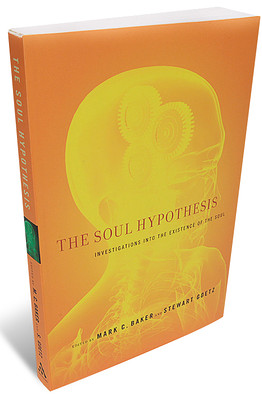
New collection of essays published to defend mind-body dualism

Here’s the new book on J.P. Moreland’s web site.

Full text:

In the Soul Hypothesis: Investigations into the Existence of the Soul (Continuum), co-editors Mark C. Baker and Stewart Goetz have assembled an impressive interdisciplinary team of scholars to address questions about the existence and nature of the soul.

“The Soul of the Matter” – Charles Taliaferro
“Minds, Brains and Brains in Vats” – Daniel N. Robinson
“Brains and Souls; Grammar and Speaking” – Mark Baker
“Making Things Happen: Souls in Action” – Stewart Goetz
“Energy of the Soul” – Robin Collins
“The Measure of All Things: Quantum Mechanics and the Soul” – Dean Zimmerman
“From Seeing to Seer” – Hans Halvorson
“Souls Beastly and Human” – William Hasker
“A Scientific Case for the Soul” – Robin Collins

You can preview the book here.

The book is unique is combining philosophical and scientific arguments for dualism, and the result is a rigorous, exciting, persuasive presentation of the issues and a stimulating challenge to so much of the reductionism that reigns in the sciences. As was noted in a recent review of the book in the WSJ,

Sooner or later, the contributors to “The Soul Hypothesis” warn, scientists will pinpoint the exact three neurons whose firing accompanies the thought of our deciding to make a phone call or, if you prefer, deciding to get up and get a beer from the refrigerator. As ever more such micro-couplings are observed, we will—so scientists tell us with unseemly glee— gradually come to see that our cherished conscious life is nothing but a long series of electrical impulses, not an autonomous realm of free will and free thought. Co-editor Mark C. Baker cites the psychologist Steven Pinker, who finds it plausible to say that neural “activity in the brain” simply “is the mind.”

The book’s contributors set out this scientific challenge fully and engagingly, but they also expose its fallacies. They note, for instance, that even if two things differ in their essential nature, as do mental thoughts and physical actions—or legislatures and laws—there is no reason why the one can’t cause the other. As David Hume argued, what establishes our idea of cause and effect is the regular “conjunction” of two events. That a physical act regularly follows a mental decision suggests, as co-editor Stewart Goetz writes, that the one is “causing” the other and that voluntary human action exists.

The Soul Hypothesis is an excellent text that is sure to provoke a vigorous dialog about its content. I highly recommend it.

I really would like to be able to use this argument more – I just need a good book. I’m a big admirer of Charles Taliaferro. I even met him once at a conference!

Frank Turek asks atheists: would you follow Jesus if Christianity were true?

His latest radio show is awesome as usual. We need to get used to talking to atheists, and this will help you because he’s taking calls on that question – “if Christianity were true, would you become a Christian?”.

The MP3 file is here. (54 minutes, not ad-free – skip ahead 3 minutes at breaks)

Topics from opening monologue and then callers:

  • if Christianity were true, would atheists necessarily become Christians?
  • does God force people to believe in him against their will?
  • how important is evidence to persuading someone?
  • what are some reasons to believe that God exists?
  • what are some reasons to accept the resurrection of Jesus?
  • what does the Bible mean by the word “faith”?
  • what should you do with someone who needs reasons to believe?
  • what should you do with someone who wouldn’t believe even with reasons?
  • what about Christians who think the Earth is only thousands of years old?
  • was their death and suffering before the Fall?
  • what about evolution? haven’t we been able to observe evolution in action?
  • what about the origin of life – the origin of biological information?
  • what about the fossil record – especially the hominid fossil record?
  • what about theistic evolution?

This is a great podcast, especially for beginners.

Frank Turek is a former naval aviator. He flew military aircraft. If you’ve seen the movie Top Gun, he’s Maverick. And he’s talking to you about apologetics, with all the benefit of his experience debating and conducting open forums on college campuses. Fun, fun, fun! (And not the bad kind of fun that Mary likes) Sometimes I wonder why I have to sit at a keyboard all day and slave over a hot computer*, when I would much rather be doing what Frank Turek is doing. Oh well. At least I get to listen and tell you about it, too.

By the way, the right answer to his question for an atheist is “yes, but where is the evidence?”. That’s what atheists should say in response to the question, and then they should listen to the evidence. Also, they should have reasons for believing that there is no God, or they are just exercising blind faith. And if they ask you, “would believe there were no God if atheism were true?” then you have to answer yes, because if atheism is true then you are rationally obligated to believe it. But then, they have to have evidence before you actually have to believe it! Being open to being proved wrong means a lot to people who don’t agree with you. For example, I used to be a young-earther and I changed my mind.

By the way – that question he’s asking? – “if Christianity were true, would you become a follower of Jesus?” – he stole that from my 13-question quiz for atheists. But I won’t be bitter if you go to this page, print out my 13 questions, find an atheist of your very own, and ask them the questions yourself. Don’t let them know why you are asking or what the right answers are. Just ask your atheist the questions and then report back to me here.

Frank’s web site is called Cross Examined.

* I stole this from Brian Auten.