CNS News reports on a new study by the Congressional Budget Office (CBO).
Excerpt:
The top 40 percent of households by before-tax income actually paid 106.2 percent of the nation’s net income taxes in 2010, according to a new study by the Congressional Budget Office.
At the same time, households in the bottom 40 percent took in an average of $18,950 in what the CBO called “government transfers” in 2010.
Taxpayers in the top 40 percent of households were able to pay more than 100 percent of net federal income taxes in 2010 because Americans in the bottom 40 percent actually paid negative income taxes, according to the CBO study entitled, “The Distribution of Household Income and Federal Taxes, 2010.”
[…]When the the negative 9.1 percent in federal income taxes paid by those in the bottom 40 percent is subtracted from the 109.1 percent paid by those in the top 60 percent, federal tax revenues net out to an even 100 percent.
[…]The households in the bottom 40 percent of income—which on average paid negative federal income taxes—were on average receiving many thousands of dollars in what the report calls “government transfers.” These transfers included, among other things, benefits from unemployment insurance, Medicare and Social Security, as well as from means-tested programs such as the Supplemental Nutrition Assistance Program (food stamps), and Medicaid.
“Government transfers increase income in all groups, but those increases, both in dollars and as a percentage of market income, are larger for groups with lower market income,” says the report.
According to the CBO, households in the bottom quintile received an average of $22,700 in government transfers in 2010 (including $14,300 in payments from Medicare and Social Security and $8,500 in payments from other government programs); and households in the second quintile received an average of $15,200 in government transfers (including $10,300 in payments from Medicare and Social Security and $4,900 from other government programs).
Now I have been reading articles like this one in National Review by James Pethokoukis, which talk about Obama’s rhetoric about “income inequality”. And I think that when the President goes on a rant about how much he wants to fix “income inequality”, you have to keep in mind what he is actually fixing. He thinks the people who earn the most need to be taxed more and he thinks that the people who earn the least need to be given more benefits. That’s what he is trying to fix.
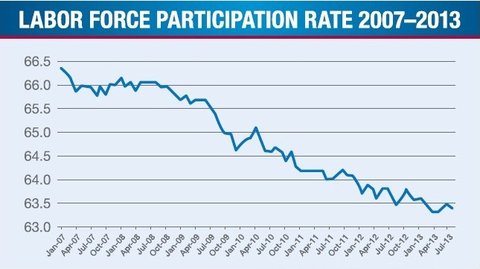
Labor Force Participation Rate from 2007 (Pelosi/Reid) to 2013
Three data points explain what happens when government gets bigger, and job creators get smaller.
First from Investors Business Daily, Obama’s failure to reduce health insurance premiums with his big government takeover of health care.
Excerpt:
The average employer-provided family health insurance premiums have climbed $2,976 since 2009, according to an annual Kaiser Family Foundation survey released this week. They’re up $3,671 compared with the year before President Obama took office. That’s despite Obama’s repeated promises that the health care reform law he championed would cut premiums by $2,500 in his first term.
And while annual premium increases have moderated over the past two years, that’s due to trends in the insurance market largely unrelated to ObamaCare, and trends the law could actually reverse.
The Kaiser survey found that the average family premium this year is $16,351, up 4% over last year, and up 22% since 2009. After adjusting for inflation, premiums climbed an average 3.2% a year in Obama’s first term, higher than the 2.7% average during President Bush’s last four years in office.
During his first campaign for president, Obama repeatedly claimed that his health reform plan would, as he said at a Virginia rally in 2008 “lower premiums by up to $2,500 for a typical family per year.”
Now, let’s take a look the second failure, as reported by the Weekly Standard.
Excerpt:
President Obama likes to talk about income inequality, but what matters far more is the actual income of the typical American. And how has the typical American household income fared on Obama’s watch? Well, the economic “recovery” has now spanned an Olympiad, and during that time the typical American household income has not only dropped—it has dropped more than twice as much as it did during the recession.
New estimates derived from the Census Bureau’s Current Population Survey by Sentier Research indicate that the real (inflation-adjusted) median annual household income in America has fallen by 4.4 percent during the “recovery,” after having fallen by 1.8 during the recession. During the recession, the median American household income fell by $1,002 (from $55,480 to $54,478). During the recovery—that is, from the officially defined end of the recession (in June 2009) to the most recent month for which figures are available (June 2013)—the median American household income has fallen by $2,380 (from $54,478 to $52,098). So the typical American household is making almost $2,400 less per year (in constant 2013 dollars) than it was four years ago, when the Obama “recovery” began.
Importantly, these income tallies include government payouts such as unemployment compensation and cash welfare. So Obama’s method of funneling ever-more money and power to Washington, and then selectively divvying some of it back out, clearly isn’t working for the typical American family.
In 35 states, welfare benefits pay more than a minimum wage job, according to a new study by the libertarian Cato Institute, and in 13 states welfare pays more than $15 per hour.
“One of the single best ways to climb out of poverty is taking a job, but as long as welfare provides a better standard of living than an entry-level job, recipients will continue to choose it over work,” said Michael Tanner, senior policy analyst and co-author of the study.
The study is an updated version of one Tanner put out in 1995 that estimated the full value of welfare benefits packages across the states. The 1995 study found that such tax-free welfare benefits greatly exceeded the poverty level and “their dollar value was greater than the amount of take-home income a worker would receive from an entry-level job.”
Despite efforts to curb welfare spending, many welfare programs and benefits have continued to outpace the income that many workers can receive for working an entry-level job, which disincentivizes work, according to the study.
“The current welfare system provides such a high level of benefits that it acts as a disincentive for work,” reads the study. “Welfare currently pays more than a minimum-wage job in 35 states, even after accounting for the Earned Income Tax Credit, and in 13 states it pays more than $15 per hour.”
According to the study, the federal government funds 126 separate programs designed to support low-income earners. Seventy-two of these programs provide cash or in-kind benefits to recipients. This is on top of additional welfare programs operated by state and local governments.
Welfare recipients in Hawaii get the most benefits, according to Tanner, at $29.13 per hour — or $60,590 pre-tax income annually. However, the state’s minimum wage is only $7.25 per hour, according to the Labor Department. Hawaiians on welfare also earn 167 percent of the median salary in the state, which is only $36,275.
What if a fireman showed up in front of your house on your birthday and claimed that he wanted to put out the candles on your birthday cake because they were a fire hazard? What if he read out a long, passionate, prepared speech about how much he wanted to put out fires? What if he then dumped a bucket of gasoline on your cake? What if your house caught fire and he claimed that you should let him keep throwing gas on the fire to put it out? What if you found out that this person was a lawyer and a community organizer, and knew nothing at all about putting fires out? Obama was not prepared to run the economy, and, as expected, he spent a ton of money without getting the results he said he was going to get. He gave speeches about jobs and poverty and everything he’s done has been to increase unemployment and increase poverty – and now we are $17 trillion dollars in debt. Speeches about achieving objective X during a campaign don’t necessarily translate into achieving objective X. You actually have to know what you are doing in order to achieve objectives, preferably because you’ve done it before in real life.
Here is a news story from Yahoo News that explains the problem and the cause of the problem. (H/T Dad)
Excerpt:
Large U.S. companies boosted their offshore earnings by 15 percent last year to a record $1.9 trillion, avoiding hefty tax bills by keeping the profits abroad, according to a new report.
The overseas earnings stockpile has climbed by 70 percent over the past five years, said research firm Audit Analytics. Data in its report covers the Russell 3000 index of the largest U.S. corporations.
U.S.-based multinationals do not have to pay U.S. corporate income tax on foreign earnings as long as the earnings do not enter the United States. Accounting rules also let the companies avoid recognizing a tax expense if management intends to keep the earnings indefinitely reinvested overseas.
“It would probably be nice to have this money in our country being used in our economy, but at the moment we see it growing elsewhere,” said Don Whalen, general counsel and director of research at Audit Analytics.
Conglomerate General Electric Co (GE.N), had the most indefinitely reinvested overseas earnings, at about $108 billion, while drugmaker Pfizer Inc (PFE.N) was next with $73 billion, according to Audit Analytics.
The simple answer is that Americans believe that corporations need to pay high taxes and operate under burdensome regulations. This eats into their profits, making it harder for them to grow and expand. The plain truth is that it is easier for corporations to expand and hire in countries with lower taxes and fewer regulations. Besides, who wants to be wiped out by a nuisance lawsuit just because someone spills coffee on themselves and then refuses to take responsibility? The smart play is to just opt out completely, and that’s what many corporations do – earning higher profits in more business-friendly countries.


 WINTERY KNIGHT