Tag Archives: Water

Can naturalism account for the origin of the 20 amino acids in living systems?

Do the Miller-Urey experiments simulate the early Earth?

The origin of life

There are two problems related to the origin of the first living cell, on naturalism:

  1. The problem of getting the building blocks needed to create life – i.e. the amino acids
  2. The problem of creating the functional sequences of amino acids and proteins that can support the minimal operations of a simple living cell

Normally, I concede the first problem and grant the naturalist all the building blocks he needs. This is because step 2 is impossible. There is no way, on naturalism, to form the sequences of amino acids that will fold up into proteins, and then to form the sequences of proteins that can be used to form everything else in the cell, including the DNA itself. But that’s a topic for a separate post.

Today, let’s take a look at the problems with step 1.

The problem of getting the building blocks of life

Now you may have heard that some scientists managed to spark some gasses to generate most of the 20 amino acids found in living systems. These experiments are called the “Miller-Urey” experiments.

The IDEA center has a nice summary of origin-of-life research that explains a few of the main problems with step 1.

Miler and Urey used the wrong gasses:

Miller’s experiment requires a reducing methane and ammonia atmosphere,11, 12 however geochemical evidence says the atmosphere was hydrogen, water, and carbon dioxide (non-reducing).15, 16 The only amino acid produced in a such an atmosphere is glycine (and only when the hydrogen content is unreasonably high), and could not form the necessary building blocks of life.11

Miller and Urey didn’t account for UV of molecular instability:

Not only would UV radiation destroy any molecules that were made, but their own short lifespans would also greatly limit their numbers. For example, at 100ºC (boiling point of water), the half lives of the nucleic acids Adenine and Guanine are 1 year, uracil is 12 years, and cytozine is 19 days20 (nucleic acids and other important proteins such as chlorophyll and hemoglobin have never been synthesized in origin-of-life type experiments19).

Miller and Urey didn’t account for molecular oxygen:

We all have know ozone in the upper atmosphere protects life from harmful UV radiation. However, ozone is composed of oxygen which is the very gas that Stanley Miller-type experiments avoided, for it prevents the synthesis of organic molecules like the ones obtained from the experiments! Pre-biotic synthesis is in a “damned if you do, damned if you don’t” scenario. The chemistry does not work if there is oxygen because the atmosphere would be non-reducing, but if there is no UV-light-blocking oxygen (i.e. ozone – O3) in the atmosphere, the amino acids would be quickly destroyed by extremely high amounts of UV light (which would have been 100 times stronger than today on the early earth).20, 21, 22 This radiation could destroy methane within a few tens of years,23 and atmospheric ammonia within 30,000 years.15

And there were three other problems too:

At best the processes would likely create a dilute “thin soup,”24 destroyed by meteorite impacts every 10 million years.20, 25 This severely limits the time available to create pre-biotic chemicals and allow for the OOL.

Chemically speaking, life uses only “left-handed” (“L”) amino acids and “right-handed” (“R)” genetic molecules. This is called “chirality,” and any account of the origin of life must somehow explain the origin of chirality. Nearly all chemical reactions produce “racemic” mixtures–mixtures with products that are 50% L and 50% R.

Two more problems are not mentioned in the article. A non-peptide bond anywhere in the chain will ruin the chain. You need around 200 amino acids to make a protein. If any of the bonds is not a peptide bond, the chain will not work in a living system. Additionally, the article does not mention the need for the experimenter to intervene in order to prevent interfering cross-reactions that would prevent the amino acids from forming.

Usually when you hear the origin of life debated, they sort of skirt about the problem of where the amino acids come from, but there is no reason not to make that an issue. The naturalist has to explain how the first living cell could come about naturalistically.

Positive arguments for Christian theism


New study: fracking does not contaminate drinking water

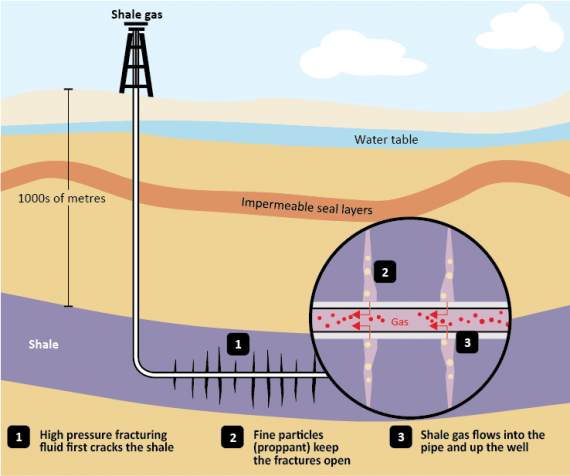
Hydraulic fracturing also known as "fracking"
Hydraulic fracturing also known as “fracking”

The study comes out of Yale University, and was published in PNAS. Pretty good school, pretty good peer-reviewed journal.

Here’s the introduction:

Organic compounds found in drinking water aquifers above the Marcellus Shale and other shale plays could reflect natural geologic transport processes or contamination from anthropogenic activities, including enhanced natural gas production. Using analyses of organic compounds coupled with inorganic geochemical fingerprinting, estimates of groundwater residence time, and geospatial analyses of shale gas wells and disclosed safety violations, we determined that the dominant source of organic compounds to shallow aquifers was consistent with surface spills of disclosed chemical additives. There was no evidence of association with deeper brines or long-range migration of these compounds to the shallow aquifers. Encouragingly, drinking water sources affected by disclosed surface spills could be targeted for treatment and monitoring to protect public health.

So, the fracking – which happens deep below the earth – didn’t introduce any new chemical additives into the water. Basically, fracking involves fracturing rocks using high pressure water, sand and chemicals. The question is whether chemicals and/or the fracking fluid contaminate the water supply used by humans. The answer, according to this study, is no. The distance between the water supply and the shale is simple far, far, far too great for the cracks to traverse. The minor contamination from surface spills is easy to detect and cleanup. This is not what you see on far left web sites and Hollywood movies, but it is what you see in studies down by Yale University scientists published in prestigious peer-reviewed science journals.

Anyway, this study is consistent with a report from the far-left radically environmentalist Environmental Protection Agency.

This is reported in the radically leftist National Public Radio, of all places.

Excerpt:

The Environmental Protection Agency says it finds no evidence that hydraulic fracturing — better known as fracking — has led to widespread pollution of drinking water. The oil industry and its backers welcome the long-awaited study while environmental groups criticize it.

“We found the hydraulic fracturing activities in the United States are carried out in a way that has not led to widespread systemic impacts on drinking water resources,” says Tom Burke, Science Advisor and Deputy Assistant Administrator of EPA’s Office of Research and Development. “In fact, the number of documented impacts to drinking water resources is relatively low when compared to the number of fractured wells,” he adds.

The EPA’s draft assessment was conducted at the request of Congress. “It is the most complete compilation of scientific data to date,” says Burke, “including over 950 sources of information, published papers, numerous technical reports, information from stakeholders and peer-reviewed EPA scientific reports.”

Fracking has allowed drillers to tap oil and natural gas reserves once thought off-limits deep underground. That has led to drilling booms across the country and boosted the country’s oil and natural gas production significantly. But environmental groups have long argued fracking comes with a cost to the environment, especially to water. Those groups have called for stronger regulations and even bans on fracking altogether.

[…]The American Petroleum Institute says the conclusions echo what the oil industry has argued all along. “Hydraulic fracturing is being done safely under the strong environmental stewardship of state regulators and industry best practices,” says Erik Milito, API upstream group director.

Acknowledging the potential vulnerabilities outlined in the EPA report, Milito says, “Continuous safety improvements have been an ongoing part of hydraulic fracturing for 65 years.”

Indeed. This is not the first time that the radically leftist EPA has cleared the fracking industry, either. I blogged about the last one for Dimock, Pennsylvania.

Here’s an excerpt from the EPA press release that exonerates fracking:

 The U.S. Environmental Protection Agency announced today that it has completed its sampling of private drinking water wells in Dimock, Pa. Data previously supplied to the agency by residents, the Pennsylvania Department of Environmental Protection and Cabot Oil and Gas Exploration had indicated the potential for elevated levels of water contaminants in wells, and following requests by residents EPA took steps to sample water in the area to ensure there were not elevated levels of contaminants. Based on the outcome of that sampling, EPA has determined that there are not levels of contaminants present that would require additional action by the Agency.

[…]Overall during the sampling in Dimock, EPA found hazardous substances, specifically arsenic, barium or manganese, all of which are also naturally occurring substances, in well water at five homes at levels that could present a health concern. In all cases the residents have now or will have their own treatment systems that can reduce concentrations of those hazardous substances to acceptable levels at the tap. EPA has provided the residents with all of their sampling results and has no further plans to conduct additional drinking water sampling in Dimock.

So, if you want to worry about fracking, it will have to be because of something other than facts. We have facts piled on facts piled on facts, and they all say that fracking is a great way for us to get cheap, clean energy that doesn’t pollute the environment or contaminate our water supply. You have to be anti-science to doubt this data. Democrats do oppose fracking. They don’t know about the science, they just oppose it because that’s what’s in the popular culture, in Hollywood movies, etc. We have to fight them with the science. Democrats are the anti-science party, so don’t expect this to alter their rhetoric.

New study: Saturn’s orbit keeps Earth in the circumstellar habitable zone

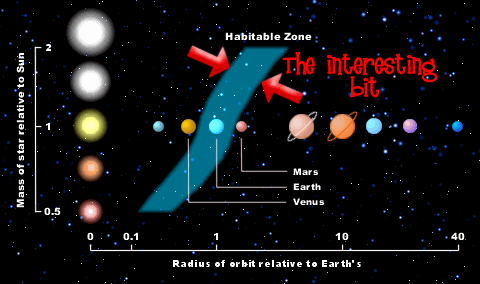
Circumstellar Habitable Zone

What do you need in order to have a planet that supports complex life? First, you need liquid water at the surface of the planet. But there is only a narrow range of temperatures that can support liquid water. It turns out that the size of the star that your planet orbits around has a lot to do with whether you get liquid water or not.

A heavy, metal-rich star allows you to have a habitable planet far enough from the star so  the planet can support liquid water on the planet’s surface while still being able to spin on its axis. The zone where a planet can have liquid water at the surface is called the circumstellar habitable zone (CHZ). A metal-rich star like our Sun is very massive, which moves the habitable zone out further away from the star.

If our star were smaller, we would have to orbit much closer to the star in order to have liquid water at the surface. Unfortunately, if you go too close to the star, then your planet becomes tidally locked, like the moon is tidally locked to Earth. Tidally locked planets are inhospitable to life. So we need a star massive enough to give us a nice wide habitable zone far away from the Sun itself.

But even with the right size star, which we have in our solar sytem, we still have CHZ problems. Just because a planet starts off in the circumstellar habitable zone, it doesn’t mean that it will stay there.

Jay Richards tweeted about this new article from the New Scientist, which talks about that very problem.

Excerpt: (links removed)

Earth’s comfortable temperatures may be thanks to Saturn’s good behaviour. If the ringed giant’s orbit had been slightly different, Earth’s orbit could have been wildly elongated, like that of a long-period comet.

Our solar system is a tidy sort of place: planetary orbits here tend to be circular and lie in the same plane, unlike the highly eccentric orbits of many exoplanets. Elke Pilat-Lohinger of the University of Vienna, Austria, was interested in the idea that the combined influence of Jupiter and Saturn – the solar system’s heavyweights – could have shaped other planets’ orbits. She used computer models to study how changing the orbits of these two giant planets might affect the Earth.

Earth’s orbit is so nearly circular that its distance from the sun only varies between 147 and 152 million kilometres, or around 2 per cent about the average. Moving Saturn’s orbit just 10 percent closer in would disrupt that by creating a resonance – essentially a periodic tug – that would stretch out the Earth’s orbit by tens of millions of kilometres. That would result in the Earth spending part of each year outside the habitable zone, the ring around the sun where temperatures are right for liquid water.

Tilting Saturn’s orbit would also stretch out Earth’s orbit. According to a simple model that did not include other inner planets, the greater the tilt, the more the elongation increased. Adding Venus and Mars to the model stabilised the orbits of all three planets, but the elongation nonetheless rose as Saturn’s orbit got more tilted. Pilat-Lohinger says a 20-degree tilt would bring the innermost part of Earth’s orbit closer to the sun than Venus.

So the evidence for a our solar system being fine-tuned for life keeps piling up. It’s just another factor that has to be just right so that complex, embodied life could exist here. All of these factors need to be just right, not just the orbits of any other massive planets. And you need at least one massive planet to attract comets and other such unwelcome intruders away from the life-permitting planets.

Here’s a good clip explaining the circumstellar habitable zone:

The factor I blogged about today is just one of the things you need in order to get a planet that supports life.

Here are a few of the more well-known ones:

  • a solar system with a single massive Sun than can serve as a long-lived, stable source of energy
  • a terrestrial planet (non-gaseous)
  • the planet must be the right distance from the sun in order to preserve liquid water at the surface – if it’s too close, the water is burnt off in a runaway greenhouse effect, if it’s too far, the water is permanently frozen in a runaway glaciation
  • the solar system must be placed at the right place in the galaxy – not too near dangerous radiation, but close enough to other stars to be able to absorb heavy elements after neighboring stars die
  • a moon of sufficient mass to stabilize the tilt of the planet’s rotation
  • plate tectonics
  • an oxygen-rich atmosphere
  • a sweeper planet to deflect comets, etc.
  • planetary neighbors must have non-eccentric orbits

Here is a study that I wrote about recently about galactic habitable zones.