Tag Archives: Washington

Supreme Court narrowly sides with private schools against government

From the Wall Street Journal.

Excerpt:

The Supreme Court’s big school choice decision yesterday is notable mainly for its insight into the progressive mind. To wit, no fewer than four Justices seem to believe that all wealth belongs to the government, and then government allows citizens to keep some of it by declining to tax it.

At issue in Arizona Christian School Tuition Organization v. Winn was a state tax credit for donations to organizations that offer scholarships for private schools, including (but not exclusively) religious schools. A group of taxpayers sued, claiming that religion was being subsidized on their dime, in violation of the First Amendment’s establishment clause.

The district court tossed out this novel church-state theory, only to have it revived by the Ninth Circuit Court of Appeals. Yesterday’s 5-4 decision was another well-deserved rebuke to the nation’s leading judicial activists who dominate that appellate court.

[…]And what do you know, four Justices assume precisely that. Both of President Obama’s nominees joined the four dissenters, and newcomer Elena Kagan delivered a fiery 24-page apologia for that position, claiming that “the distinction” between appropriations and tax credits “is one in search of a difference.” There’s a good debate to be had about tax credits (see below), but one question for Justice Kagan: Is the government also establishing religion by not imposing a 100% tax rate on churches, mosques and synagogues?With one more vote, the current Court’s liberal minority would surely ban school choice involving any religious schools. The Arizona decision shows again that the Court is only a single vote away from many decisions not all that far removed from those of the Ninth Circuit.

You can also listen to a 5-minute podcast on the decision from the Hugh Hewitt show right here.

Note that Obama’s two new appointees sided against Christian schools and private schools. Yet some brain-damaged Christians actually vote for Democrats, and claim to be Christians. (And they claim to want to get married and to raise children who will presumably be Christians, too!). School choice is as central an issue to informed Christians as is opposition to no-fault divorce, same-sex marriage and abortion.

Must-see videos on education policy

Related posts

Republicans introduce national right-to-work legislation

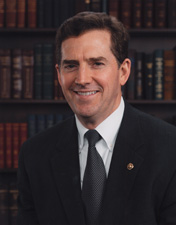
Sen. James Demint

From the Hill.

Excerpt:

Eight Republican Senators introduced a bill Tuesday giving workers a choice as to whether to join labor unions, which they argue will boost the nation’s economy and provide an increase in wages.

Sen. Jim DeMint (R-S.C.), introduced the National Right to Work Act to “reduce workplace discrimination by protecting the free choice of individuals to form, join, or assist labor organizations, or to refrain from such activities,” according to a statement.

Seven other Republicans signed onto the effort: Sens. Tom Coburn (Okla.), Orrin Hatch (Utah), Mike Lee (Utah), Rand Paul (Ky.), James Risch (Idaho), Pat Toomey (Pa.) and David Vitter (La.).

“Facing a steady decline in membership, unions have turned to strong-arm political tactics to make forced unionization the default position of every American worker, even if they don’t want it,” Hatch said. “This is simply unacceptable. At the very least, it should be the policy of the U.S. government to ensure that no employee will be forced to join a union in order to get or keep their job.

“Republicans cited a recent poll they said shows that 80 percent of union members support having their policy and that “Right to Work” states outperform “forced-union” states in factors that affect worker well being.

From 2000 to 2008, about 4.7 million Americans moved from forced-union to right to work states and a recent study found that there is “a very strong and highly statistically significant relationship between right-to-work laws and economic growth,” and that from 1977 to 2007, right-to-work states experienced a 23 percent faster growth in per capita income than states with forced unionization.

“To see the negative impacts of forced unionization, look no further than the struggling businesses in states whose laws allow it,” Vitter said. “It can’t be a coincidence that right-to-work states have on balance grown in population over the last 10 years, arguably at the expense of heavy union-favoring states.”

DeMint blamed the problems faced by U.S. automakers on the unions.

“Forced-unionism helped lead to GM and Chrysler’s near bankruptcy and their requests for government bailouts as they struggled to compete in a global marketplace,” he said. “When American businesses suffer because of these anti-worker laws, jobs and investment are driven overseas.”

If you want to attract businesses, then you need to have pro-business laws. That’s where jobs come from – businesses.

Here’s an article about states who are trying to pass these laws to attract more employers.

Excerpt:

Currently 14 states beyond Indiana and Wisconsin are considering legislation that would limit union benefits and/or collective bargaining power. They are: Alaska, Hawaii, Maine, Michigan, Minnesota, Missouri, Montana, New Hampshire, New Mexico, Ohio, Pennsylvania, Virginia, Washington (state) and West Virginia. In any number of these states, supporters have planned or held rallies against the measures. But public support might be less than deep. According to a Rasmussen Poll conducted late last week and released Monday, 48 percent of likely U.S. voters sided with Wisconsin Governor Walker whereas only 38 percent sided with his union opponents; the other 14 percent were undecided. And 50 percent of the respondents favored reducing their home state’s government payroll by one percent a year for 10 years either by reducing the work force or reducing their pay. Only 28 percent opposed such action.

This is how we are going to turn the recession around. Cut off the spending on left-wing special interests – NPR, PBS, ACORN, Planned Parenthood, Unions. They all will have to pay their own way, just like the grown-ups do.

Republicans in Florida, Indiana and Pennsylvania push school choice

First, education reform in Florida.

Excerpt:

Michelle Rhee, who gained national attention as the chancellor of schools in Washington, D.C., called Monday for giving students government-funded vouchers to attend private schools, rating principals based on student achievement and getting rid of teacher tenure.

The release of the blueprint was the first formal action of Ms. Rhee’s new advocacy group, StudentsFirst, which she launched in December, after leaving her job heading D.C. schools in October. Ms. Rhee said she was in discussions with the governors of Florida, New Mexico, New Jersey, Tennessee, Nevada and Indiana to adopt part, if not all, of the agenda.

[…]The nation’s two largest teachers’ unions criticized Ms. Rhee’s agenda.[…]The detailed plan Ms. Rhee released Monday focuses on overhauling teacher pay and evaluation plans, giving parents more say in their child’s education and spending tax dollars more wisely.

In addition to doing away with tenure, it calls for ending the practice of paying teachers based on years of service and on the master’s degrees they collect. Ms. Rhee said pay should be based on whether teachers boost student achievement.

She also is calling for districts to get parental consent before placing children in the classrooms of low-performing teachers. Ms. Rhee said firing ineffective teachers can be time-consuming and expensive.

“Too many districts hide the fact that they have ineffective teachers and we are saying, ‘If you can’t change the laws, then you have to give parents the information,’ ” she said.

The blueprint also prods states and districts to adopt “parent trigger” laws that let parents force a major overhaul of a school if more than half of them sign a petition. They could vote to turn the school into a charter school or force the district to get rid of most of the teaching staff.A similar policy was used in Compton, Calif., last year.

Ms. Rhee’s document also calls for an end to what she calls ineffective policies that waste taxpayer money, such as class size reduction policies in the higher grade levels. Her plan, she said, wouldn’t increase spending but would ensure taxpayer money was spent more wisely.

StudentsFirst’s initial foray into policy could be in Florida, where Republican Gov. Rick Scott, who was elected to office in November, appointed Ms. Rhee to his transition team. In a news release, Mr. Scott praised Ms. Rhee’s agenda and said he supported her call to eliminate tenure and expand the number of charter schools, public schools run by independent groups.

And education reform from Indiana. (H/T Heritage Foundation)

Excerpt:

Gov. Mitch Daniels urged the state legislature to finally act on significant reforms to public education and local government in his annual State of the State speech Tuesday, repeating a call for the expansion of charter schools, merit pay for teachers and the elimination of township government.

[…]Now empowered by a Republican majority in both legislative chambers, Daniels said “it’s going to be a session to remember.” He was escorted to the podium by several lawmakers of both parties, including Sen. Earline Rogers, D-Gary.

He said Indiana should let students finish their high school studies a year early and be given scholarships for college studies. Teachers should be rewarded based on student performance, he said, adding that one in three Hoosier children can pass the national math or reading exam.

Meanwhile, he said 99 percent of Indiana teachers are rated “effective.”

“If that were true 99 percent, not one-third, of our students would be passing those national tests,” Daniels said.

Families who can’t find the right public or charter public school, he said, should be able to apply state dollars toward “the non-government school of their choice.”

And finally, education reform in Pennsylvania. (H/T Heritage Foundation)

Excerpt:

Political momentum is building for taxpayer-funded school tuition vouchers, as hundreds of people clogged the Capitol rotunda Tuesday to support the idea of “school choice.”

[…]During the recent campaign, Lt. Gov. Jim Cawley told the boisterous crowd, Gov. Tom Corbett “repeatedly said that things would change in education. Today we start that process of putting children first. State government should be open to and promote charter schools, home schools, private schools and cyber schools” as well as traditional public schools, he said.”I’m more excited and encouraged about the possibility of educational change than I’ve ever been,” said Sen. Jeffrey Piccola, R-Dauphin, who has been advocating state-funded tuition vouchers for 15 years.

[…]His bill, Senate Bill 1, would create a three-phase program for making state-funded vouchers available to low-income students who now have no choice but to go to public schools that consistently score poorly on state proficiency tests.

[…]The Senate Education Committee will hold a hearing on the bill in mid-February, and it could get a Senate vote in March. Since Republicans control both the Senate and House, and since Gov. Tom Corbett supports the school choice idea, the bill is likely to be enacted. But opponents could file a court challenge.

Last week was “School Choice Week“, and there were a lot of events promoting school choice. Republicans noticed these events and participated in them. And now Republicans are making a push to sign bills that help poor students to get better educations. Democrats are opposed to school choice because they are supported by teacher unions who want guaranteed jobs for teachers regardless of performance.

I like that the Republicans are making pushes to cut spending, ban taxpayer funding of abortions, and introduce school choice. These are all issues that I strongly agree with, because they are all pro-child. Children shouldn’t have to pay for the debts their parents run up, children shouldn’t be killed in the womb, and children shouldn’t get a crappy education just so that badly performing schools can stay open. These policies make sense to me. Next, they should introduce a federal law for charter marriages, and introduce a federal voucher program for pre-marital counseling.

Must-see videos on education policy

Related posts