An amnesty advocate that President Barack Obama’s White House publicly promoted as part of its “Champion of Change” series has been indicted in federal court on charges of fraud.
Bonnie M. Youn, who Obama’s White House touts on its website as “a recognized Asian American & Pacific Islander (AAPI) community leader in Georgia,” was indicted on three criminal charge counts in the U.S. District Court for the Northern District of Georgia Atlanta Division on April 1, according to publicly filed court documents.
The first indictment count alleges Youn committed perjury with regard to an alien illegally in the United States. The second indictment count alleges that Youn violated a federal immigration law that prohibits bringing illegal aliens into the United States and harboring them, alleging she did so “for the purpose of commercial advantage and private financial gain.” The third indictment count alleges Youn illegally tampered with witness testimony, specifically alleging she influenced the illegal alien—whose identity is kept anonymous in the indictment—to provide false information about employment in the United States to federal agents.
The indictment, signed by U.S. Attorney Sally Quillian Yates and two Assistant U.S. Attorneys, indicates that Youn’s alleged illegal activity began “on or about February 9, 2009,” just as President Obama took office at the beginning of his first term and before she was honored by the White House. The third indictment count says that the alleged witness tampering began on or about August 15, 2011.
An arrest warrant was filed for Youn Tuesday.
[…]According to a press release from the National Asian Pacific American Bar Association (NAPABA), Youn received the White House honor from President Obama in late March 2013. “Today, the White House honored 10 individuals with the Cesar Chavez Champions of Change Award,” the press release, dated March 26, 2013, reads. “Among the 10 honorees is Bonnie M. Youn, who is a member of the National Asian Pacific American Bar Association (NAPABA).”
One of the things that really bothers me about the Obama administration’s fascination with amnesty is that people think that they are for immigrants. As far as I can tell, the Obama administration has done nothing to streamline the legal immigration process for immigrants who pay taxes and stay out of trouble with the law. Concern for skilled immigrants is typically something that Republicans champion. Skilled immigrants are not a concern for Democrats, because they pay taxes, and are therefore more likely to favor lower taxes and limited and government than illegal immigrants.
Buried deep in a section of President Obama’s budget, released this week, is an eye-opening fact: This year, 70% of all the money the federal government spends will be in the form of direct payments to individuals, an all-time high.
In effect, the government has become primarily a massive money-transfer machine, taking $2.6 trillion from some and handing it back out to others. These government transfers now account for 15% of GDP, another all-time high. In 1991, direct payments accounted for less than half the budget and 10% of GDP.
What’s more, the cost of these direct payments is exploding. Even after adjusting for inflation, they’ve shot up 29% under Obama.
Where do these checks go? The biggest chunk, 38.6%, goes to pay health bills, either through Medicare, Medicaid or ObamaCare. A third goes out in the form of Social Security checks. Only 21% goes toward poverty programs — or “income security” as it’s labeled in the budget — and a mere 5% ends up in the hands of veterans.
So a lot of the money is not even going for poverty! More:
Instead, a surprisingly large amount of federal money is handed out to wealthy Americans through Social Security, Medicare, farm subsidies, unemployment benefits, conservation programs, disaster payments and other programs.
An IBD analysis found that the richest 1% of Americans, in fact, receive roughly $10 billion each year in federal checks.
Outgoing Sen. Tom Coburn, R-Okla., who exposed these vast payment programs available to the rich, said “this reverse Robin Hood-style of wealth distribution is an intentional effort to get all Americans bought into a system where everyone appears to benefit.”
Why is this bad? It’s because government only spends the money that it collects from other individuals and businesses. They should be spending that money on government responsibilities like roads, the military and foreign policy. Not redistributing wealth to particular people. That just makes a certain segment of the population dependent on government and makes them more likely to vote for bigger government. Government is notoriously terrible at knowing who is really in need of help. Plus, private charities are more likely to push poor people in the direction of independence and responsibility. Government basically says, “here’s the money, and keep doing whatever you’re doing because we don’t have a plan for you to get out of poverty”.
We don’t want to be the kind of country that punishes people for working or for starting businesses, but it seems like that is the direction we are heading in.
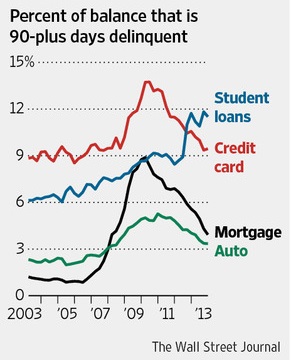
Some Americans caught in the weak job market are lining up for federal student aid, not for education that boosts their employment prospects but for the chance to take out low-cost loans, sometimes with little intention of getting a degree.
[…]A number of factors are behind the growth in student debt. The soft jobs recovery and the emphasis on education have driven people to attain more schooling. But borrowing thousands in low-rate student loans—which cover tuition, textbooks and a vague category known as living expenses, a figure determined by each individual school—also can be easier than getting a bank loan. The government performs no credit checks for most student loans.
College officials and federal watchdogs can’t say exactly how much of the U.S.’s swelling $1.1 trillion in student-loan debt has gone to living expenses. But data and government reports indicate the phenomenon is real. The Education Department’s inspector general warned last month that the rise of online education has led more students to borrow excessively for personal expenses. Its report said that among online programs at eight universities and colleges, non-education expenses such as rent, transportation and “miscellaneous” items made up more than half the costs covered by student aid.
The report also found the schools disbursed an average of $5,285 in loans each to more than 42,000 students who didn’t log any credits at the time. The report pointed to possible factors such as fraud in addition to cases of people enrolling without serious intentions of getting a degree.
Capella Education Co., which runs online schools, examined student costs and debt at institutions public and private in Minnesota and concluded that between a quarter and three-quarters of loans taken out by students were for non-education expenses. At one of Capella’s master’s programs, the typical graduate left with about $30,200 in student debt even though tuition, fees and book costs totaled roughly $18,800. Borrowers are prohibited under federal law, except in rare instances, from discharging student debt through bankruptcy.
The share of student borrowers taking out the maximum amount of loans—$12,500 a year for undergraduates—has risen since the recession. In the 2011-12 academic year, federal Education Department data show, 68% of all undergraduate borrowers hit the annual loan ceiling, up from 60% in 2008.
Research suggests a fair chunk of that is going to non-education expenses. In 2011-12, about a quarter of student borrowers took out loans that exceeded their tuition, after grants, by $2,500, according to research by Mark Kantrowitz, a higher-education analyst and publisher of the education site Edvisors.com.
Some students say they intend to get a degree but must borrow as much as possible because they can’t find decent-paying jobs to cover day-to-day expenses.
Here are some examples of how this is working out:
Tommie Matherne, a 32-year-old married father of five in Billings, Mont., has been going to school since 2010, when he realized the $10 an hour he was making as a mall security guard wasn’t covering his family’s expenses. He uses roughly $2,000 in student loans each year to stock his fridge and catch up on bills.His wife is a stay-at-home mother who also gets loans to take online courses.
“We’ve been taking whatever we can for student loans every year, taking whatever we have left over and using it to stock up the freezer just so we have a couple extra months where we don’t have to worry about food,” says Mr. Matherne, who owes $51,600 in federal loans.
Some students end up going deeper into debt. Early last year, when Denna Merritt lost her long-term unemployment benefits, the 49-year-old Indianapolis woman enrolled part-time at the Art Institute of Pittsburgh’s online program, aiming for a degree in graphic design. She took out $15,000 in federal loans, $2,800 of which went to catch up on unpaid bills, including utilities, health-insurance premiums and cable.
Mr. Selent, of Fort Lauderdale, knows he is getting himself deeper in a hole but prefers that to the alternative of making minimum wage. In his 20s, he earned a bachelor’s degree in communications from a local for-profit school but couldn’t find a job in the field after graduating and began falling behind on his student-loan bills. He is now taking courses for a degree in theater so he can become an actor.
Meanwhile, federal loans allow him to cover any needs that arise during the semester. Says Mr. Selent: “It keeps me from falling apart.”
Wow. Communications and Theatre. Do you think a private bank would have given him money to do a degree in theater? I don’t think so. A private banker might give a loan to someone trying to get a STEM degree, like computer science or nursing, but not for theater. So how did the theater major get the loan, then, if no sane private sector banker would give it to him?
This article from the Heritage Foundation think tank explains how he got the money.
Excerpt:
The Obama Administration’s overreach into the student loan industry has been wide-sweeping. In what The Wall Street Journal deemed “that other government takeover,” a provision buried deep in Obamacare effectively nationalized the student loan industry by ending government subsidies to private lenders and putting the federal government in charge of originating and servicing federally backed student loans.
The Obamacare provision came in addition to the Administration’s decision in 2011—made through executive order—to forgive student loan debt after 20 years. And it comes in addition to the Administration’s gainful employment regulations restricting access to student loans for students attending for-profit institutions.
But the current debate’s origins are in separate legislation passed in 2007 whereby the federal government set interest rates on student loans artificially low, cutting the rates in half temporarily for four years. Now that the interest rates are set to increase, President Obama is pressing Congress to keep rates low.
So the Democrats are repeating the mortgage lending recession they caused in 2008 by again transferring risk away from private banks and onto the backs of the taxpayers. Anybody can get a loan for anything, whether it be basket-weaving or women’s studies or… theater.
It’s just more vote-buying from the Democrat party
The government is giving away these loans to students, no questions asked, in order to buy their votes. These are the students who cheered when Obama promised that they could stay on their parents’ insurance plans until they were 26. The Democrats get the moocher vote, and the students get their loans forgiven in 20 years. Everybody wins – except that the next generation of Americans gets stuck with the bill for this vote buying scheme.


 WINTERY KNIGHT