An anti-Syrian coalition defeated Hezbollah in Lebanon’s parliamentary election on Sunday in a blow to Syria and Iran and a boost to the United States.
…Lebanon’s rival camps are at odds over Hezbollah’s guerrilla force, which outguns the Lebanese army, and ties with Syria, which dominated Lebanon for three decades until 2005.
…The United States, which lists Hezbollah as a terrorist group, has linked future aid to Lebanon to the shape and policies of the next government. Hezbollah, which says it must keep its arms to deter Israel, is part of the outgoing cabinet.
The anti-Syrian coalition has enjoyed firm backing from many Western countries since the 2005 assassination of Hariri’s father Rafik al-Hariri.
The coalition took power in an election following Hariri’s killing, but struggled to govern in the face of a sometimes violent conflict with Hezbollah and its allies.
It also ignited a trade war with Canada. In response to vague “buy American” provisions in the stimulus package, “A number of Ontario towns, with a collective population of nearly 500,000, retaliated with measures effectively barring U.S. companies from their municipal contracts — the first shot in a larger campaign that could shut U.S. companies out of billions of dollars worth of Canadian projects.”
Yet, Obama had the audacity to claim that only passing the stimulus package would save us from “irreversible decline” and economic ““disaster”.
Remember how Democrats used to complain about Bush and his “tax cuts for the rich”? Yeah, it’s strange how only people who pay taxes (59% of the public) can actually get tax cuts, isn’t it. But Obama has an even better idea: “tax hikes for the poor”.
A senior administration official said the new standards would raise the cost of an average car by $1,300, $600 of which could be attributed to the rules being announced today.
On the other hand, let’s take a look at Canada in relation to the United States, courtesy of the Cato Institute. (H/T Heritage Foundation)
The Cato Institute writes:
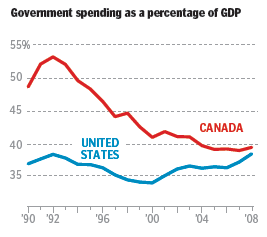
Spending: Spending by all levels of the Canadian government peaked at 53 percent of the country’s GDP in the early 1990s, then plunged to 40 percent in 2008. U.S. government spending has risen, reaching 39 percent of GDP in 2008. And with the stimulus package, that number is likely to jump even higher.
Government spending as % of GDP
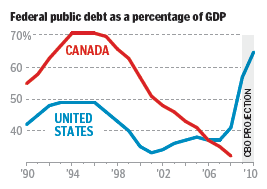
Debt: The Canadian government cut its debt from 71 percent of GDP in 1995 to 32 percent in 2008. Under President Obama’s budget plan, U.S. federal public debt will jump from 41 percent of GDP in 2008 to more than 60 percent next year.
Federal debt as % of GDP
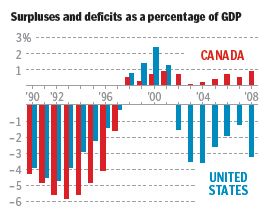
Deficits: Canada has balanced its budget every year since 1998 — not by raising taxes, but by cutting spending. The United States balanced its budget for four years in the late 1990s, but now deficits are so large that it’s difficult to imagine that ever happening again.
Surplus / Deficit as % of GDP
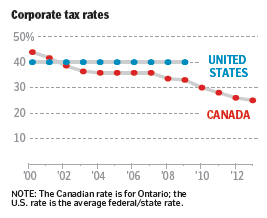
Corporate Taxes: Canada has cut the corporate tax rate from 28 percent to just 15 percent, and most provinces have trimmed corporate taxes as well. The U.S. federalstate rate stands at about 40 percent, and the Obama administration is planning to increase corporate taxes.
Corporate tax rates
It’s important to note that the Liberal party in Canada is socially progressive, but moderate on fiscal issues. Of course, now that the Conservatives have been running things, it’s gotten even better. It would be great if they could win a majority. The biggest problem in Canada right now is the fascist Human Rights Commissions, but there are candidates from the Conservative Party who intend to abolish the HRCs in BC and Ontario.

 WINTERY KNIGHT