Tag Archives: University

Making a difference as a Christian: advice on fundraising, ministry, and missions

Ratio Christi event at Ohio State University featuring Frank Turek
Ratio Christi event at Ohio State University featuring Frank Turek (10/12/2015)

What’s the ideal balance between work and missions? In this post, I will argue against going abroad to do full-time missions.

Do apologetics ministry in your spare time, and work full-time

A full-time job and part-time ministry makes the most sense from a cost-benefit point of view. I have friends who are software engineers who studied enough science, history, and philosophy part-time, who are able to do public debates with atheists, which influence many more people than one-on-one interactions. One of my friends has several Masters degrees, and is in a PhD program, but his full-time career is in software and network management. He is 100% self-funded. He has worked in a successful apologetics career with a full-time career in technology, and he is debt-free. This is the best option . Your debts get paid off. Your resume stays gap-free. You bring a nest egg to your future spouse. You can afford to have children. You can afford a stay-at-home mom. You can afford either homeschooling or private schools, should you decide to go that route.

You have to start saving and investing early if you want to be independent in your old age. With full-time work and part-time ministry, you still make a difference for Christ and His Kingdom over time, while avoiding a financial crisis that could cost you your family, your friends, and even your faith. This is an especially wise way to proceed, given the economic struggles we are likely to face from housing bubbles, student loan bubbles, rising interest rates, entitlement crises, state pension underfunding, environmental regulations, the ever increasing national debt, demographic crisis, etc. Read the culture and be cautious about the future.

Use the Internet to make a difference in other countries for free

One cost-effective way to make a difference is by using the Internet to reach other countries. You can work full-time, and then use your spare time to blog. This blog gets an average of 24,000 page views per week. About 45% of that traffic comes from NON-USA countries. If you keep working full-time and just start a blog for free, then you can maintain your gap-free resume and have a much easier time marrying and raising children.

The university next door is a great place to have an influence

I do think full-time ministry is OK in two cases: if you don’t go abroad, or if you go abroad with a full-time job or full-ride scholarship. My friend Eric Chabot was able to host Frank Turek at Ohio State University last night (see photo above), for example. He got a great crowd. He is donation-driven, but he runs a lean operation since he lives near the campus where he serves. When it comes to having an impact, the American university is the place to make a difference. We have enough trouble in our own country, especially in the universities, where so many young people lose the faith of their childhood – there’s no need to travel and incur heavy expenses.  I think it also makes sense financially to go abroad for missions, if you get a scholarship that pays your way or if you have a job offer where you can work full-time and do missions part-time. What does not make sense is sending an unskilled missionary to a foreign country at the cost of tens of thousands of dollars that could be used much more efficiently in smaller, effective Eric-Chabot-style operations.

Your feelings and desires are not God speaking to you

Now some people who want to go into overseas missions will tell me that they feel led to go. This method of decision making is not Biblical, as I explained in one of my previous posts. If you believe the Bible, then feelings are a pretty poor way of determining what God wants from you. In fact, left to themselves, humans typically choose what feels best for them, not what does best for God. If God really calls you to do something, like he called Jonah, then you probably won’t feel like doing it. Missionary work is especially suspect when God is supposedly calling you to go to a country that you always dreamed of traveling to while you were a non-Christian. Normally, conversion causes you to have different desires – not the same desires you had as a non-Christian. Unless you hear an audible voice, like an Old Testament prophet would, then it’s best not to think that God is speaking through your feelings and desires. A good book to read on this is “Decision Making and the Will of God“, by Garry Friesen.

Don’t go into missions in order to have fun or go on an adventure

I am suspicious of people who try to turn Christianity into a mechanism for achieving the same goals that non-Christians want to achieve. These days, it seems as if everyone wants to travel to exotic places. If there is evidence of hedonistic, fun-pursuing, thrill-seeking behavior in your past, then consider that you may just want an “adventure”. I have a friend who went to Russia for a year just after graduating college, and she admitted to me that she just went “to have an adventure”. To me, that’s not a good reason to spend thousands of dollars, and put gaps in your resume. It’s not a cost-effective way to make a difference, given the other alternatives. Your goal should be to make yourself defensible so that you can put out a sustained effort that lasts, not burn out and then be ineffective for the rest of your life. Think about what J. Warner Wallace says about living wisely and prudently so you position yourself to make a steady contribution in the second half of your life. Don’t wreck your long-term impact for short-term fun. God will not honor that.

Don’t go into missions to make up for an immoral past

Anyway, if you look in your past and see lots of wild behavior – drinking, drugs, premarital sex, cohabitation, abortions, gambling, divorces, etc., then consider that you may be interested in missions for the wrong reasons. You don’t need to go on a missions trip to dramatically declare to everyone that you are now completely reformed from your wild party days. I actually managed to talk a friend out of a short-term missions trip who felt that it was a good way to do something meaningful to “make up” for her past. By being responsible with her job and saving money, she’s managed to avoid burning out, and to instead put out a steady stream of effective activities. And she was financially stable enough to get married and have children, as well – another excellent way to make a difference.

Do not go into missions if your resume and balance sheet do not demonstrate maturity

We already talked about the need for sound planning in the Bible study we did with Wayne Grudem.  The Bible praises hard work, stewardship, prudence and wisdom. And this is especially true for people who are getting older and need to be thinking about marriage, children and retirement. It’s not a good witness for Christians to be financially unstable. When you are able to stand on your own two feet financially, and help others from your earnings, you gain credibility with non-Christians. We don’t want people to think that we are doing this for the money. The best option is to be self-funded, like Paul and his tent-making-funded ministry.

By the way, if you’d like to read a related post by Eric Chabot, this one is a good one.
Asian-Americans being discriminated against by the secular left in academia

Now for some of you, this post is going to be a surprise. Most of you will have learned in school that whites are racist against blacks, and that’s why blacks underperform in education. What you probably didn’t know is that Asians outperform in education, so that “racism” cannot possibly be what is holding back blacks. However, there is real racism and discrimination in education. It comes from the university admissions people, who want to punish Asian-Americans for their academic success. They want to keep them out of the best universities, because there are too many of them, and it threatens “diversity”.

According to this very popular article in ultra-leftist The Economist, the Asian-Americans are pushing back against the progressive racists in academia.

The article says:

MICHAEL WANG, a young Californian, came second in his class of 1,002 students; his ACT score was 36, the maximum possible; he sang at Barack Obama’s inauguration; he got third place in a national piano contest; he was in the top 150 of a national maths competition; he was in several national debating-competition finals. But when it came to his university application he faced a serious disappointment for the first time in his glittering career. He was rejected by six of the seven Ivy League colleges to which he applied.

“I saw people less qualified than me get better offers,” says Mr Wang. “At first I was just angry. Then I decided to turn that anger to productive use.” He wrote to the universities concerned. “I asked: what more could I have done to get into your college? Was it based on race, or what was it based on?” He got vague responses—or none. So he complained to the Department of Education. Nothing came of it. “The department said they needed a smoking gun.”

In May this year Mr Wang joined a group of 64 Asian-American organisations that made a joint complaint to the Department of Education against Harvard, alleging racial discrimination. That follows a lawsuit filed last year against Harvard and the University of North Carolina by a group of Asian-American students making similar charges. The department rejected the claim in July, but another two complaints have since been filed by Asian-Americans, one against Harvard and one against nine other universities.

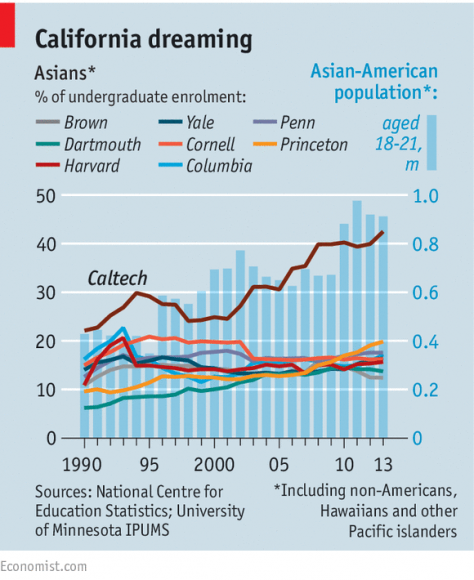
The article points out that Ivy League universities are allowed to discriminate against Asians by race. So Asian admissions are flat. But at the California Institute of Technology (Caltech), which is the top experimental science university in the United States, Asian admissions have been soaring. Why? California does not allow discrimination by race in admissions.

Here’s the graph:

Admissions of Asian-Americans at Caltech compared to Ivy League

Read this:

Some Asians allege that the Ivy Leagues have put an implicit limit on the number of Asians they will admit. They point to Asians’ soaring academic achievements and to the work of Thomas Espenshade and Alexandria Walton Radford of Princeton, who looked at the data on admissions and concluded that Asian-Americans need 140 SAT points out of 1,600 more than whites to get a place at a private university, and that blacks need 310 fewer points. Yet in California, where public universities are allowed to use economic but not racial criteria in admissions, 41% of Berkeley’s enrolments in 2014 were Asian-Americans and at the California Institute of Technology 44% were (see chart).

[…]For the moment the court has taken the view that universities may take race into account, but racial quotas are not on. The Ivies deny running a racial quota. But in its comment on the Asian groups’ complaint, Harvard defends the use of race as a criterion in admission—“a class that is diverse on multiple dimensions, including on race, transforms the educational experience of students from every background and prepares our graduates for an increasingly pluralistic world”—and describes its admissions process as “holistic”, meaning it takes into account considerations wider than mere test scores.

Many Asian parents think this is wrong. They woke up a long time ago to the need to counter the stereotype of the maths-nerd Asian who does nothing but work, and encouraged their children to diversify—into music, debating, charity work, sports, everything that is supposed to increase students’ chances of admission. But many who have excelled in those areas, including Mr Wang and Irene Liu, a student from Massachusetts with a similarly stellar CV, were rejected by the Ivy League. Ms Liu’s mother, Tricia, says, “I feel angry about it. We came for the American dream: you work hard, you do well. This just doesn’t add up.” Irene has accepted a place at a top Canadian university, and is happy about it. Her mother isn’t: “It breaks my heart that she’s going abroad. If she had gone to Harvard, I could have brought her dumplings.”

I often blog about depressing and negative things on this blog because there is so much going wrong in a world run by the secular left, especially because church pastors and Christian parents seem to be so committed to the idea that Christianity has nothing to do with anything outside of the church walls. But this topic is a big win for us. We should be open to presenting conservative ideas and values to Asian-Americans. We have BOTH of the Asian-American governors (Bobby Jindal and Nikki Haley) as conservative Republicans. We also favor more choice and competition in education. There is an opportunity for new alliances here. I am hopeful.

UPDATE: Asian friend writes this to me:

I sounded the alarm on this years ago. But what has come of it? The lesson I have learned is that Asians don’t count. Asians don’t count as a minority, even though we are the smallest minority. Asians don’t count as non-whites, even though liberals in particular are sexually aroused by the fantasy of the exotic in Asian culture, particularly women. Asians don’t count as a governmentally oppressed group, even though the first racially specific legislation passed in Congress was the Chinese Exclusion act of 1882 and were targeted for internment camps during WWII. Asians don’t count, because despite all hardships, Asians do not waste time trying to rectify the past but make a better lives for themselves. And in so doing, they make a better lives for their children and their community. The successes of Asians in America is a big negative pull on the narrative of the Left, but it has no effect. Why not? Because flouting the narrative renders Asians as a people group irrelevant, to be ignored over #blacklivesmatter or whatever.

Asian woes have been more recent than slavery, yet they seem to be doing fine. Maybe their strong views of marriage and family have something to do with it?

Darrell Bock and Eric Chabot discuss the challenges of campus ministry

A conflict of worldviews

My good friend Eric Chabot did an episode of the The Table podcast, which is the culture podcast of Dallas Theological Seminary. Eric does campus ministry at Ohio State University, one of the largest universities in the United States. He has a frontline view of the challenges that Christians face on campus, which is a battle I am so passionate about.

Here’s the podcast:

The MP3 file is here.

Summary:

  • 00:15  What does a typical RC meeting look like at Ohio State?
  • 02:44  Key social issues facing Ohio students
  • 05:30  How do you engage with the same-sex issue on campus?
  • 11:01  How do you engage with political issues on campus?
  • 13:08  How do you engage with social justice issues on campus?
  • 16:19  How would you describe the Christian environment on campus?
  • 18:33  Advice for parents considering Ohio State for their child

I give this podcast and the discussion my highest recommendation. It’s so practical, and so different from what you hear in church from pastors who seem to be totally unaware of how worldviews conflict on the university campus. This podcast is practical and hands-on.

There is also a transcript (PDF).

I just want to excerpt a few questions to get you interested enough to listen:

Dr. Darrell Bock:

Ok. Well, that’s the intellectual background. Let’s move on to the other questions I told you we were going to discuss. The social pressures of campus? This, and I’ve done a handful of these interviews, in fact I think you’re the 5th or 6th campus that we’ve done.

We’ve done UCLA, UC Irvine, California, San Diego, A&M and Princeton, and the interesting thing is that as we move from campus to campus and I go to social issues, that – those kind of are more varied than the intellectual stuff. The intellectual stuff seems to be pretty consistent from campus to campus.

But the social challenges really are a reflection of the environment of the campus itself and certain emphasis are tied to certain campuses. So, what are the social challenges that students face in terms of their walk at Ohio State?

And:

Dr. Darrell Bock:

Ok. Well, let’s turn our attention to the final two questions that I want to be sure and get through, and that is you’re giving advice – let’s start with parents – you’re giving advice to parents. They’re thinking about, you know, sending their kid to Ohio State.

What do you regard as the, as keys for the preparation of that student that a parent should be thinking about? Perhaps in particular, thinking about their junior and senior years, they’re getting ready to think about college and the way you prepare a student for college and the choices and the freedom that they’re gonna fall into. How do you, what advice would you give to parents?

And:

Dr. Darrell Bock:

Ok. This may seem like a related question, but I do think the demands are slightly different and that is what advice do you give to youth leaders and to pastors as they are preparing kids who are going through their church programs for university?
And here, I sorta have in mind what kinds of things would you hope a youth leader who’s dealing with high school students, what kinds of issues do you hope that they’re dealing with and treating so that the student is prepared for the campus experience?

That’s why I focus so much on same-sex marriage and politics on this blog. We really have to explain to young people why natural marriage is best, and why the free enterprise system is best. We are seeing now the challenge that the combination of same-sex marriage and big secular government (socialism) poses for religious liberty.