Tag Archives: Unions

Obama pleases environmental lobby by killing 20,000-job Keystone XL pipeline

Obama Economic Record November 2011

From the Daily Caller.

Excerpt:

Roughly 20,000 oil industry construction jobs are being thrown under Obama’s 2012 campaign bus, largely because the president needs to pump up his sagging support among the environmentalists.

The pitch came Thursday when President Barack Obama put his leadership behind a State Department plan to study alternative routes for the pipeline, which is intended to bring oil from Alberta in Canada to oil refineries along the Gulf Coast.

“We should take the time to ensure that all questions are properly addressed and all the potential impacts are properly understood,” said Obama’s afternoon statement.

The construction jobs, and the revenue from operating the Keystone XL pipeline, may now go to Canadian workers.

That’s because Canadian government officials are already planning to help build a competing pipeline from Alberta’s oil fields to new West Coast ports near Vancouver. The likely destination point is the port of Kitimat in British Columbia.

The U.S. Department of State will begun studying an alternative route for the Keystone pipeline, even though an earlier department study had concluded the proposed route is the best of several alternatives. The new study will delay any final approval until after the 2012 election, allowing Obama to boost his support among environmentalist groups, activists and voters.

But the delay may kill the U.S. segment of any pipeline, because the decision increases the environmentalist movement’s clout during any future round of approval disputes, and also spurs the development of a pipeline through Canada.

The job-killing decision was panned by GOP legislators and business groups.

“More than 20,000 new American jobs have just been sacrificed in the name of political expediency,” said a statement from Ohio Rep. John Boehner, the Speaker of the House of Representatives.

“This is clearly a political decision and everyone knows it… Politics has trumped jobs in this decision and we can only wonder if the Administration’s delay will cause Canada to turn their pipeline west and ship their energy and American jobs elsewhere,” said  statement from the U.S. Chamber of Commerce.

But the decision helps the Democratic-allied green-energy industry, which is now reliant on government subsidies to compete against the oil energy industry.

The oil that would be pumped through the Keystone XL pipeline would make gas cheaper for drivers, and worsen the competitiveness of the green-tech companies.

The stock value of green-energy companies, and their supply of commercial investment, has already dropped in the last several months because investment analysts believe an Obama loss in 2012 will prompt GOP legislators to cut federal subsidies.

Before his 2008 election, Obama predicted he would raise oil-energy prices to spur the green-energy industry.

The Wall Street Journal explains more.

Excerpt:

In April 2010 and again this August, State produced multivolume environmental impact statements that concluded the pipeline would have “no significant impacts” on the environment. That should have ended the matter.

But the President’s environmentalist friends have decided to make Keystone a test of his green virtue. “We’ll see if [Mr. Obama] is an oil guy or a people guy,” eco-agitator Bill McKibben recently warned at an Occupy Wall Street event, and the Sierra Club has threatened that it won’t “mobilize the environmental base” in 2012 if he approves the project. Various Hollywood worthies have marched in front of the White House in protest.

[…]We’re guessing this decision to abdicate was really made by President Plouffe, as in David Plouffe, the White House political aide who seems to be running most of the executive branch these days. The Keystone cop-out couldn’t be a clearer expression that this Administration puts its anticarbon obsessions—and Big Green campaign donors—above job creation and blue-collar construction workers. He’s President of the 1%.

This reminds me of the way that Obama hurt the economy by delaying three free trade deals for three years, in order to appease his union supporters.

When Obama tries to create jobs, he ends up doing thinks like giving $535 million taxpayer dollars to Solyndra – to repay his Democrat fundraisers. And then they go bankrupt, because green energy is a hoax. The right way to create jobs is by letting businesses keep the money they earn, and keeping government out of their operations. Unfortunately, Obama doesn’t like it when people earn money by selling services and products, and he thinks that government needs to regulate businesses. So, we are stuck with high unemployment.

Related posts

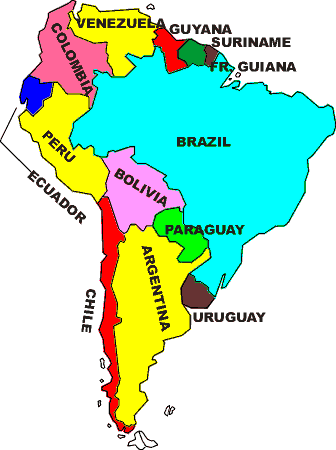
FARC terrorist leader Alfonso Cano killed by Colombian armed forces

Map of South America

From the Heritage Foundation.

Excerpt:

The armed forces of Colombia have scored a major battlefield victory. They finally hunted down, confronted, and killed the leader of the narco-terrorist Revolutionary Armed Forces of Colombia (FARC), Guillermo Leon Saenz, widely known by his alias Alfonso Cano.

A guerrilla for decades, Cano assumed the top leadership of the FARC following the natural death of founder Manuel Marulanda (2008) and the elimination of senior figures Raul Reyes (2008) and Jorge Briceno (aka Mono Jojoy, 2010).

Seen by some as a modern-day version of the “good revolutionary,” Cano—a life-long advocate of armed violence and terrorism—fell in combat with the Colombian armed forces as they rappelled their way into his secret jungle hideout. Cano was also indicted in a U.S. court for drug trafficking along with dozens of other FARC leaders and had a $5 million price on his head.

FARC is a Marxist terrorist group.

The Economist reports that the Colombian economy is also doing well.

Excerpt:

WHEN the figures are finally tallied, Colombia may prove to have weathered the world recession better than any other of the larger Latin American countries. After a slight contraction at the end of 2008, the economy has been growing modestly this year. This resilience stems from continued foreign investment, an increase in government spending on public works and easier money: since December the central bank has cut interest rates by six percentage points, to 4%, a steeper drop than anywhere in the region outside Chile.

[…]President Álvaro Uribe’s security policies have helped to restore confidence. Investment soared, from 15% of GDP in 2002 to 26% last year, says Mr Zuluaga. Private business has retooled. After many delays, the government has issued licences to expand several ports; this month it hopes to award a contract for the first of four big road schemes, costing a total of $7.5 billion over four years. It hopes for investment of up to $50 billion in mining and oil over the next decade.

And liberal MSNBC has more on the booming Colombian economy.

Excerpt:

…Colombia’s revival is benefiting U.S. economic and political rivals as much as or more than the U.S. itself.

The long delay in signing the treaty allowed Latin America’s fourth-largest economy to strengthen ties with China. It also damaged U.S. credibility in the region, says Eric Farnsworth, vice-president of the Council of the Americas in Washington. “The delay in passing this called into question the United States’ reliability as a partner,” Farnsworth says. “There’s a strategic component to this. It’s not just about economics and trade.”

[…]As talks between the U.S. and Colombia dragged on, Colombia and China forged plans for a rail link between the Pacific and Caribbean that could draw freight away from the Panama Canal. Colombian President Juan Manuel Santos aims for a trade deal with South Korea. To tighten his connections to high-growth Asia, he’s also seeking membership in the Asia-Pacific Economic Cooperation group. “While Washington was debating whether the accord with Colombia was opportune, we advanced in our foreign policy strategy,” says Trade Minister Sergio Diaz-Granados.

Santos has cooperated more with his South American neighbors, organizing a meeting of finance ministers to discuss ways to protect their currencies and economies from the debt crisis in the U.S. and Europe. He supports a stock trading platform with Colombia, Chile, and Peru and wants to bring Mexico and Panama on board. Exports to Brazil have surged tenfold. While the U.S. remains Colombia’s biggest export market, with $16.8 billion in 2010 sales, up 30 percent from a year earlier, sales to China more than doubled last year, to $1.2 billion. Sales to the European Union are also rising, to $5.4 billion this year through August, more than in all of 2010. An EU trade accord could come next year.

The government has reduced cocaine cultivation 37 percent and halved the number of insurgents to about 8,000. Improved security has spurred enough growth to win an investment-grade credit rating from Standard & Poor’s as well as investment from billionaires. Colombia’s victories over the guerrillas opened up swathes of countryside to exploration for oil, gold, and coal. Mexican billionaire Carlos Slim’s push into crude has helped fuel foreign investment that the government says may reach a record $12 billion this year. The economy grew 5.2 percent in the second quarter.

The U.S. faces more competition from Colombia’s neighbors and Canada. In 2010, U.S. agricultural exports to Colombia fell more than 50 percent from 2008, to $827 million, as Argentina’s more than doubled, to $1 billion, according to a report by Senator Richard Lugar’s staff. Diaz-Granados attributes the U.S. setback to the delay in the free-trade agreement.

An August accord reduces or ends Colombian tariffs on Canadian wheat, paper, and machinery. Bank of Nova Scotia, Canada’s third-largest lender, agreed in October to buy 51 percent of Banco Colpatria Red Multibanca Colpatria for about $1 billion—Scotiabank’s largest international takeover. “This is not the Colombia of old,” says Brian J. Porter, group head of international banking for Scotiabank. “The more we looked at Colombia, the more excited we got about the economic potential.”

We really should have signed that trade deal 3 years ago – it would have helped out economy a lot.  But unions got Obama elected, and the unions decided that the trade deal needed to be held up for 3 years. And that’s one of the reasons why we’ve had over 9% unemployment. Our economic policy is being set by unions, not by economists. But in Colombia, economic policy is set by economists, not unions.

Obamacare contains billions of dollars in pork for Obama’s union allies

From Investors Business Daily. (H/T Jan)

Excerpt:

According to a new Government Accountability Office report, the federal government has so far handed out $2.7 billion out of a $5 billion program squirreled away in ObamaCare.

The Early Retiree Reinsurance Program is advertized as a way to “stabilize the availability of employer-sponsored coverage for early retirees,” according to a Health and Human Services memo.

The argument goes that companies are increasingly dropping retiree health benefits, leaving those who retire before becoming eligible for Medicare in a jam — either they face exorbitant rates for insurance or expose themselves to potentially catastrophic health costs.

[…]According to figures obtained by IBD, 10 of the top 12 recipients are either unions or public employee groups. In fact, the biggest single recipient was the UAW Retiree Medical Benefits Trust, which alone grabbed more than 8% of all the funds handed out so far. Other union beneficiaries include the United Food and Commercial Workers, the United Mine Workers and the Teamsters.

Meanwhile, almost half of the money doled out has gone to state and local governments, the GAO found.

[…]The problem is that these groups are the least likely to drop their retiree health benefits, calling the lie to the Obama administration’s whole “stabilizing” excuse.

In fact, over the past 10 years, the share of state and local governments offering retiree benefits increased — climbing to 83% from 80% in 2001, according to an annual Kaiser Family Foundation health benefits survey.

That’s at a time when private companies have been dropping retiree health plans to cut costs, with the share of large firms offering such benefits falling to 26% this year from 37% in 2001, the Kaiser survey shows.

So this ObamaCare money is really being used mainly to pay off unions and governments that would have provided these benefits anyway.

While the law forbids employers from using the funds for anything other than retiree health costs, money is fungible, freeing up union and government resources for other uses like, say, helping Obama get re-elected.

And what will the unions do with that money? IBD explains.

Excerpt:

United Steelworkers President Leo Gerard, speaking on radio host Ed Schultz’s show last Monday, declared, “What we need is more militancy.” Asked to clarify, Gerard said: “I think we’ve got to start a resistance movement. If Wall Street Occupation doesn’t get the message, I think we’ve got to start blocking bridges and doing that kind of stuff.”

The Canadian union leader then denounced Americans’ 2008 election of Tea Party representatives to the House as “nut jobs,” and called for more force and illegality: “We ought to be doing more than occupying parks. We ought to start occupying bridges. We ought to start occupying the banks’ places themselves.”

[…]Two months ago another White House ally, Teamsters chief Jimmy Hoffa, openly called for his members to “take these sons of bitches out” in Congress, as Obama stood silently at his side. “They got a war with us and there’s only going to be one winner,” he growled.

Hoffa’s Teamsters, it should be noted, have the most violent record of all labor unions, clocking in 454 incidents of violence since 1991, according to the National Institute for Labor Relations Research in Washington.

Then there’s the SEIU-linked Acorn, which has made OWS its latest cause. The Obama-tied group had supposedly disbanded, but now operates as New York Communities for Change (NYCC), using the strong-arm political tactics of community organizer Saul Alinsky.

Since it was discovered that NYCC was a prime funder and director of the Occupy movement, Fox News reports that the group has been shredding documents, firing staff, offering up alibis and surveilling Fox News personnel.

One starts to wonder: Is Occupy Wall Street a grass-roots movement, or a corrupt, violent organization whose real center is the Obama administration itself? One thing’s for sure: It isn’t interested in democracy.

You can see the full list of Occupy Wall Street crimes here – it’s up to 167 crimes right now, including rape. The unions are heavily involved in the Occupy Wall Street protests.

I’m concerned that the government is getting too closely involved with groups of people who are not peaceful and law-abiding.