
Tag Archives: Unions

Environmentalists and protectionists block economic growth in Puerto Rico

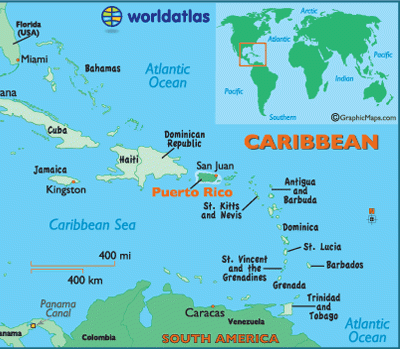
Puerto Rico Map
Puerto Rico Map

Here’s a story from Mary Anastasia O’Grady at the Wall Street Journal. She interviewed Puerto Rican Gov. Luis Fortuño and learned about his plan to boost the island’s economic growth.

Excerpt:

If [Luis Fortuño’s] plan to boost the island’s competitiveness by switching electricity generation from oil to natural gas is to succeed, he’s going to need relief from the pernicious 1920 Jones Act. It prohibits any ship not made in the U.S. from carrying cargo between U.S. ports. There are no liquefied-natural-gas (LNG) tankers made in the U.S. Unless Puerto Rico gets a Jones Act exemption, it cannot take advantage of the U.S. natural gas bonanza to make itself more competitive.

The Jones Act is good if you are a union shipbuilder who doesn’t like competition, or a member of Congress who takes political contributions from the maritime lobby. But it’s bad if you are a low-income Puerto Rican who needs a job. And there are plenty of those.

Puerto Ricans are American citizens but they are significantly poorer than the rest of the country. Per capita income on the island in 2010 was roughly $16,300 compared to just over $47,000 for the nation as a whole.

Life on the island is also expensive, in part because of the high price of electricity, 68% of which is produced using imported oil. The governor’s office says that the price of electricity here went up 100% from 2001 to 2011.

[…][B]ringing down high energy costs remains a fundamental challenge, and one that is exacerbated by new costly federal regulations on emissions that would require the installation of scrubbers on oil-fired electricity plants. To meet those regulations affordably, Mr. Fortuño wants to convert the island’s oil-fired plants to cheaper, cleaner natural gas. To that end, he proposes a pipeline from the southern LNG terminal at Punta Guayanilla across the island to San Juan. The U.S. Army Corps of Engineers has assessed the proposal and said it would produce no significant environmental impact.

It sounds like a plan to help the poor and unemployed. There are only two problems. First, the Sierra Club and local environmentalists have ginned up fears about the project and promised to sue to stop construction. Second, the Jones Act is still in the way.

The governor admits that his administration could have done a better job communicating the pipeline plan to Puerto Ricans, but he also points out that “some of the same groups that have opposed the pipeline have also opposed wind-power and solar projects. They are opposing everything, including waste-to-energy” projects which he maintains are less polluting than landfills.

Mr. Fortuño says that he expects Washington to give him a carve-out for LNG tankers, but he doesn’t have it yet. He also says that a large part of the environmentalist push-back is political, suggesting to me that he ought to be more worried than he is. This kind of politics needs to preserve the status quo of the welfare state. And that implies blocking Mr. Fortuño’s development agenda no matter what it means to the poor.

I thought this article was a neat little way to see how groups of people who understand economics try to pull themselves up out of messes, and who stands in their way. It’s something to think about when you think about poverty – what will really work to lift people out of poverty? And what is the real effect of labor unions and environmentalists on economies?

Indiana passes right-to-work law and is now open for business – and jobs

Central United States

From GOP USA.

Excerpt:

Indiana is poised to become the first right-to-work state in more than a decade after the Republican-controlled House passed legislation on Wednesday banning unions from collecting mandatory fees from workers.

It is yet another blow to organized labor in the heavily unionized Midwest, which is home to many of the country’s manufacturing jobs. Wisconsin last year stripped unions of collective bargaining rights.

The vote came after weeks of protest by minority Democrats who tried various tactics to stop the bill. They refused to show up to debate despite the threat of fines that totaled $1,000 per day and introduced dozens of amendments aimed at delaying a vote. But conceding their tactics could not last forever because they were outnumbered, they finally agreed to allow the vote to take place.

The House voted 54-44 Wednesday to make Indiana the nation’s 23rd right-to-work state. The measure is expected to face little opposition in Indiana’s Republican-controlled Senate and could reach Republican Gov. Mitch Daniels’ desk shortly before the Feb. 5 Super Bowl in Indianapolis.

“This announces especially in the Rust Belt, that we are open for business here,” Republican House Speaker Brian Bosma said of the right-to-work proposal that would ban unions from collecting mandatory representation fees from workers.

Republicans recently attempted similar anti-union measures in other Rust-Belt states like Wisconsin and Ohio where they have faced massive backlash. Ohio voters overturned Gov. John Kasich’s labor measures last November and union activists delivered roughly 1 million petitions last week in an effort to recall Wisconsin Gov. Scott Walker.

Indiana would mark the first win in 10 years for national right-to-work advocates who have pushed unsuccessfully for the measure in other states following a Republican sweep of statehouses in 2010. But few right-work states boast Indiana’s union clout, borne of a long manufacturing legacy.

Every time one state enacts a right-to-work law, it puts competitive pressure on other states. The reason why is because businesses are attracted to right-to-work states, and they will prefer to expand there, rather than in union-friendly states. In fact, some companies will just up and move to right-to-work states, leaving the union-friendly states with no employers at all.

How Barack Obama used taxpayer dollars to outsource green energy jobs

This is from Hans Bader at GlobalWarming.org.

He links to this ABC News story.

Excerpt:

Despite all the talk of green jobs, the overwhelming majority of stimulus money spent on wind power has gone to foreign companies, according to a new report by the Investigative Reporting Workshop at the American University’s School of Communication in Washington, D.C.

Nearly $2 billion in money from the American Recovery and Reinvestment Act has been spent on wind power, funding the creation of enough new wind farms to power 2.4 million homes over the past year. But the study found that nearly 80 percent of that money has gone to foreign manufacturers of wind turbines.

“Most of the jobs are going overseas,” said Russ Choma at the Investigative Reporting Workshop. He analyzed which foreign firms had accepted the most stimulus money. “According to our estimates, about 6,000 jobs have been created overseas, and maybe a couple hundred have been created in the U.S.” Even with the infusion of so much stimulus money, a recent report by American Wind Energy Association showed a drop in U.S. wind manufacturing jobs last year.

[…]Iberdrola, one of the largest operators of renewable energy worldwide, is based in Spain and has received the most U.S. stimulus dollars — $577 million. It buys some of its turbines from another Spanish manufacturer, Gamesa, which has a U.S. connection. Gamesa has two facilities to manufacture turbine blades in Pennsylvania, but the company said the market forced it to temporarily lay off nearly 100 workers.

[…]A Chinese company called A-power is helping to build a massive $1.5 billion wind farm in West Texas. The consortium behind the project expects to get $450 million in stimulus money.

Walt Hornaday, an American partner on the project, said it would create some American jobs. “Our estimation,” he said, “is that we are going to have on the order of 300 construction jobs just within the fence of the project.”

But that’s in addition to 2,000 manufacturing jobs — many of them in China.

And this News Max story.

Excerpt:

Gulf Oil CEO Joe Petrowski says President Barack Obama’s weekend comments in Brazil that the United States looks forward to purchasing oil drilled for offshore by that nation “is rather puzzling,” and “hypocritical” as his administration has imposed a virtual moratorium on domestic drilling. The signal to purchase more foreign oil comes after the U.S. Export-Import Bank invested more than $2 billion with Brazil’s state-owned oil company, Petrobras, to finance exploration.

“Any drilling, or any new production, especially production outside the Mideast – that is inherently unstable and probably is going to become more unstable as we move forward – is a positive,” Petrowski said Tuesday on Fox News.

“But why Brazil, when we could have the jobs and foreign exchange in this country, is rather puzzling – and I’d say somewhat humorous,” Petrowski told Fox News’ Neal Cavuto. “What is it about Brazil that they have that we don’t have?

Read the rest here – there’s a lot more Obama outsourcing to read about.