
Tag Archives: Union

Why is America so much more prosperous than other nations?

It occurred to me that young people are being taught in government-run schools that central planning of the economy by the federal government works better than allowing states to decide policy for themselves. Naturally, the students – lacking life experience and at the mercy of the unionized teacher’s grading pen – have no choice except to be indoctrinated. But what are the facts?

The genius of America is that the Founding Fathers allowed the federal government to only have power in certain areas of life. Other areas of policy were delegated to the states. This allows states to try different policies to see what works best, or even just what works best for them. Then the other states have the option to emulate that success, or continue doing what doesn’t work. States that do what works will see more success, with more businesses and people migrating to their states. States that persist in doing what doesn’t work will see business and taxpayers flee. That is the genius of America’s design.

Federalism encourages states to operate according to the “principle of subsidiarity”, which is an economic principle that states that problems are best solved at the lowest level possible (individual -> family -> church – > business -> community -> local government -> state government -> federal government). This is because the people at the lowest level have the most KNOWLEDGE about how to solve the problem.

Case study: right-to-work laws

Let’s look at an example – unions and right to work laws. Starting after world war 2, some states decided to pass right to work laws. These laws allowed workers to decide for themselves whether to join a union or not. Since workers had the choice about whether to join the union, the union had to care about the workers and advocate for them, instead of enriching themselves at the expense of the workers via corruption and thuggery.

Here is how different states adopted right to work laws at different times:

Map of states showing adoption of right-to-work laws

What happened in these states? Well job creating businesses started to move from forced-union-membership states to right-to-work states. Why? Because unions were stopping them from innovating. Companies would figure out new ways to improve productivity, such as using machines and computers. But the unions would step in and insist that the old ways were best. The unions wanted their union members to just be able to do the same job, e.g. – pulling a lever over and over, for the entire 35 years of their career. And the unions wanted their members to be paid like a software engineer or a doctor for pulling a lever over and over. The unions also wanted to make sure that underperforming workers could never be fired, or replaced. And so on. Companies realized that they couldn’t compete in a global market like this, so they got up and left for right-to-work states.

Here’s what happened next:
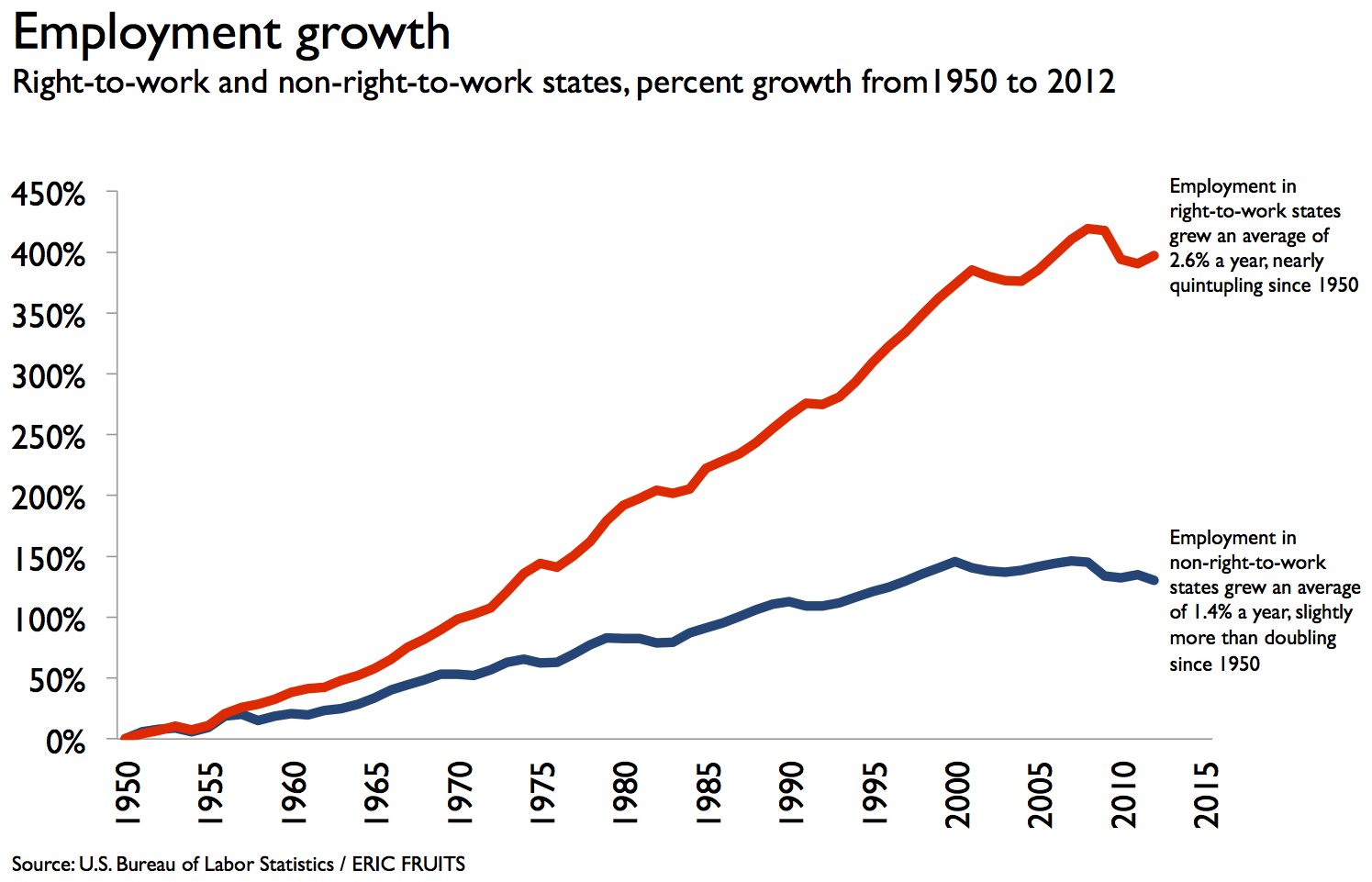
Rates of employment in forced union states vs right to work states

States with right-to-work laws never said that there couldn’t be unions, only that workers wouldn’t have to join a union to work. And in right-to-work states, not only did workers not join unions, they voted not to unionize at all. This resulted in a massive decline in private sector unions in America:
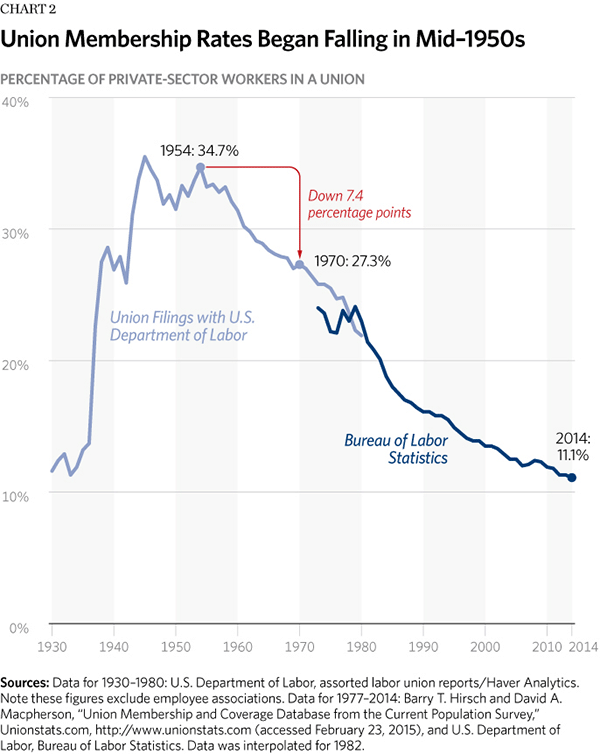
Decline in private sector union membership

As a result of job creating businesses not being hampered by union corruption and thuggery, American businesses quickly outpaced their rivals in forced union membership states in productivity, as measured by GDP. They also outpaced the productivity per worker in other economically illiterate countries. Why? Because allowing companies to innovate meant that workers were using more machinery and computers to do their jobs. They learned new skills. Underperforming workers could be replaced with workers who were willing to grow and adapt. Non-union workers higher productivity allowed them to find other jobs if they were laid off.
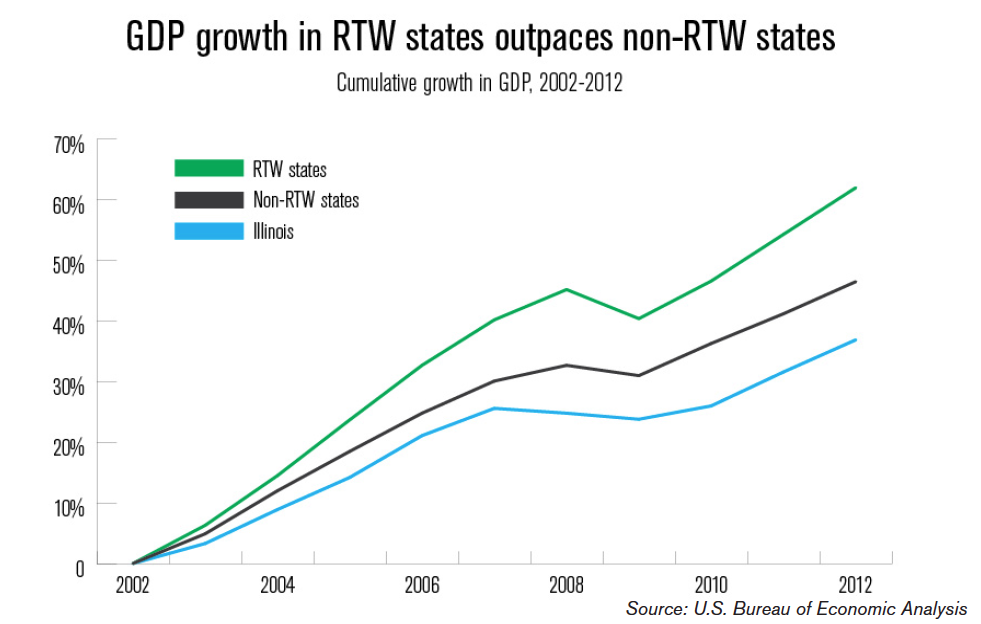
Right to work states innovate, creating more skilled workers

The job security of the American worker comes from his improved worker productivity – not from the union. Not only did unemployment go down in right to work states (more jobs!) but salaries and benefits also increases, as companies had to compete with each other for workers. However, companies were ok with paying more for workers, because they would rather pay ONLY the workers who deserved it, rather than pay one rate for all union workers, regardless of performance.

This article from the far-left New York Times explains how slaries and benefits rise when job creators move to right-to-work states: Income Rises When Right-to-Work Laws Are Passed because job creators must offer workers a lot in order to get them to sign. Not just salaries and benefits, but realistic development plans to grow the workers skills, making them even more resistant to layoffs and economic downturns.

Quote:

While some persons may favor right-to-work laws largely on philosophical grounds (people should have the freedom to decide whether they want to belong to a union or not), the major reason I support such laws is that they seem to promote prosperity — specifically, higher incomes. Real personal income in the right-to-work states rose nearly twice as much as in other states from 1970 and 2013.

To be sure, most of that reflected higher population growth in right-to-work states — there was massive in-migration to these states from the states denying workers the right to not join a union. Yet even after correcting for population growth, income per person on average rose somewhat more in the right to work jurisdictions. Capital moves to right-to-work states with a more stable labor environment, and that increases labor demand and, ultimately, income and wages.

Although unions mostly died out in the private sector, the ones that remained actually functioned well as unions – focusing on their workers instead of enriching union bosses. They had to, because if they didn’t, then the workers would just opt out of them. The only places where unions still survive is in the public sector, i.e. – government. This is because government is (by law) a monopoly, where consumers have no choice except to accept the garbage that they are offered. They can’t go anywhere else for a lower price, or a better product, or a better service. Public sector unions are immune to innovation, because they lobby the government to prevent any improvement or accountability.

Here is an example of a public sector union’s effort to “help the customer”:
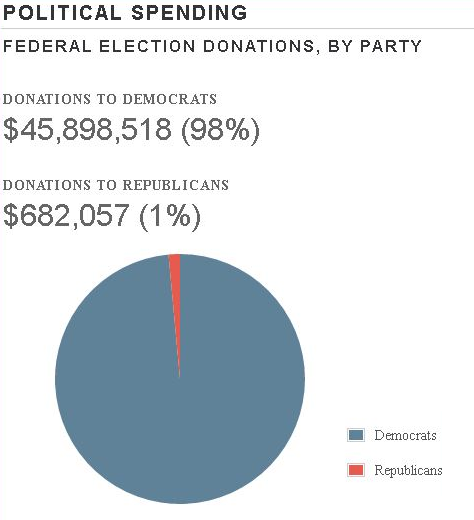
Political contributions by the American Federation of Teachers union

And here’s what those efforts to “help the customer” produced for the customer:

Education spending has tripled since 1970

They aren’t really helping the customer, are they? What they do is collect dues, enrich their union leaders, intimidate their opponents with threats and force, and then give money to secular left politicians to prevent their customers from opting out of a system that doesn’t produce higher quality and lower prices for the customer. The secular left politicians pass laws that prevent the customers (parents) from being able to get a better product (education for their children) for a lower price. We should abolish public sector unions in order to get the benefits for the customer that we see in the private sector.
Five liberal Democrat policies that hurt minorities

Marriage and Poverty

The five policies are:

  • higher minimum wage rates
  • opposition to school voucher programs
  • releasing criminals from jail
  • affirmative action
  • single mother welfare

This article is by Jason L. Riley, and it appeared in the Wall Street Journal.

Excerpt:

At the urging of labor unions, President Obama has pushed for higher minimum wages that price a disproportionate percentage of blacks out of the labor force. At the urging of teachers unions, he has fought voucher programs that give ghetto children access to better schools.

Both policies have a lengthy track record of keeping millions of blacks ill-educated and unemployed. Since the 1970s, when the federal government began tracking the racial achievement gap, black test scores in math, reading and science have on average trailed far behind those of their white classmates. And minimum-wage mandates have been so effective for so long at keeping blacks out of work that 1930, the last year in which there was no federal minimum-wage law, was also the last year that the black unemployment rate was lower than the white rate. For the past half-century, black joblessness on average has been double that of whites.

Last week the Justice Department said it would release some 6,000 inmates from federal prison starting later this month. The goal, according to the White House, is to ease overcrowding and roll back tough sentencing rules implemented in the 1980s and ’90s.

But why are the administration’s sympathies with the lawbreakers instead of their usual victims—the mostly law-abiding residents in low-income communities where many of these inmates eventually are headed? In dozens of large U.S. cities, violent crime, including murder, has climbed over the past year, and it is hard to see how these changes are in the interest of public safety.

The administration assures skeptics that only “nonviolent” drug offenders will be released, but who pays the price if we guess wrong, as officials have so often done in the past?

When Los Angeles asked the Rand Corp. in the 1990s to identify inmates suitable for early release, the researchers concluded that “almost no one housed in the Los Angeles jails could be considered non-serious or simply troublesome to their local communities” and that “jail capacity should be expanded so as to allow lengthier incarceration of the more dangerous.”

A 2002 federal report tracked the recidivism rate of some 91,000 supposedly nonviolent offenders in 15 states over a three-year period. More than 21% wound up rearrested for violent crimes, including more than 700 murders and more than 600 rapes. The report also noted the difficulty of identifying low-risk inmates. Auto thieves were rearrested for committing more than a third of the homicides and a disproportionate share of other violent offenses.

Keep in mind that when criminals are release, they don’t go move into wealthy progressive neighborhoods. It’s not the wealthy leftists elites who have to deal with the released inmates. It’s the poor, low-income minority neighborhoods that have to deal with them.

By the way, I covered the minimum wage argument here, and I covered the school choice argument here.

That covers the first 3 policies. This article from The College Fix covers the fourth policy, affirmative action.

It says:

A UCLA law professor critiques affirmative action as detrimental to the very people it strives to aid: minority students.

Professor Richard Sander, though liberal-leaning, has deemed affirmative action practices as harmful, a notion that contradicts a liberal view in college admissions, said Stuart Taylor, a nonresident senior fellow at the Brookings Institution.

[…]Sander began teaching law at UCLA in 1989. After a few years he garnered an interest in academic support and asked permission to analyze which strategies most effectively assist struggling students.

After reviewing statistics on performance, especially those of students with lower academic merit, he noticed correlations between race and academic success.

“I was struck by both the degree to which it correlated with having weak academic entering credentials and its correlation with race,” Sander said in a recent interview with The College Fix. “And as I looked into our admissions process I realized that we were giving really a large admissions preference.”

Sander noticed that students admitted into the law school with lower academic credentials than their peers had significantly lower percentages of passing the Multistate Bar Examination, Sander said. This especially pertained to minority students who were given special consideration in the admittance process due to their race rather than their academic preparedness.

He then began thinking about whether or not these students would have better chances of succeeding if they went to a less elite university, he said.

He called this discrepancy a mismatch; when minority students with lower credentials than their peers are accepted into more challenging universities and then suffer academically as a result.

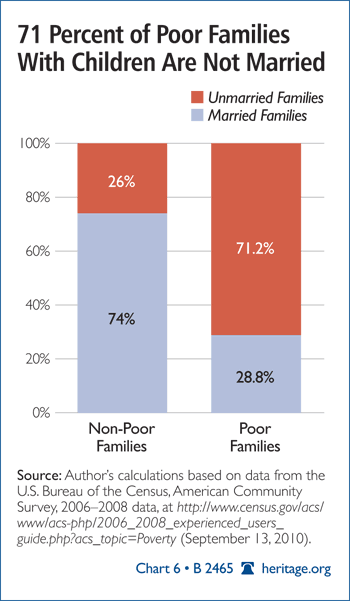
And the fifth policy is welfare. Welfare encourages women to not marry the men that they have sex with, since they will lose their single mother benefits if they do. Children who are raised fatherless are more likely to struggle in a number of areas, and they are especially likely to be poor. What we should be doing (if we really want to help the poor) is paying people to get married and stay married. But Democrats are opposed to that. The connection between welfare, fatherlessness, poverty and crime is explained in a previous post.

Five liberal Democrat policies that hurt minorities

Marriage and Poverty

The five policies are:

  • higher minimum wage rates
  • opposition to school voucher programs
  • releasing criminals from jail
  • affirmative action
  • single mother welfare

This article is by Jason L. Riley, and it appeared in the Wall Street Journal.

Excerpt:

At the urging of labor unions, President Obama has pushed for higher minimum wages that price a disproportionate percentage of blacks out of the labor force. At the urging of teachers unions, he has fought voucher programs that give ghetto children access to better schools.

Both policies have a lengthy track record of keeping millions of blacks ill-educated and unemployed. Since the 1970s, when the federal government began tracking the racial achievement gap, black test scores in math, reading and science have on average trailed far behind those of their white classmates. And minimum-wage mandates have been so effective for so long at keeping blacks out of work that 1930, the last year in which there was no federal minimum-wage law, was also the last year that the black unemployment rate was lower than the white rate. For the past half-century, black joblessness on average has been double that of whites.

Last week the Justice Department said it would release some 6,000 inmates from federal prison starting later this month. The goal, according to the White House, is to ease overcrowding and roll back tough sentencing rules implemented in the 1980s and ’90s.

But why are the administration’s sympathies with the lawbreakers instead of their usual victims—the mostly law-abiding residents in low-income communities where many of these inmates eventually are headed? In dozens of large U.S. cities, violent crime, including murder, has climbed over the past year, and it is hard to see how these changes are in the interest of public safety.

The administration assures skeptics that only “nonviolent” drug offenders will be released, but who pays the price if we guess wrong, as officials have so often done in the past?

When Los Angeles asked the Rand Corp. in the 1990s to identify inmates suitable for early release, the researchers concluded that “almost no one housed in the Los Angeles jails could be considered non-serious or simply troublesome to their local communities” and that “jail capacity should be expanded so as to allow lengthier incarceration of the more dangerous.”

A 2002 federal report tracked the recidivism rate of some 91,000 supposedly nonviolent offenders in 15 states over a three-year period. More than 21% wound up rearrested for violent crimes, including more than 700 murders and more than 600 rapes. The report also noted the difficulty of identifying low-risk inmates. Auto thieves were rearrested for committing more than a third of the homicides and a disproportionate share of other violent offenses.

Keep in mind that when criminals are release, they don’t go move into wealthy progressive neighborhoods. It’s not the wealthy leftists elites who have to deal with the released inmates. It’s the poor, low-income minority neighborhoods that have to deal with them.

By the way, I covered the minimum wage argument here, and I covered the school choice argument here.

That covers the first 3 policies. This article from The College Fix covers the fourth policy, affirmative action.

It says:

A UCLA law professor critiques affirmative action as detrimental to the very people it strives to aid: minority students.

Professor Richard Sander, though liberal-leaning, has deemed affirmative action practices as harmful, a notion that contradicts a liberal view in college admissions, said Stuart Taylor, a nonresident senior fellow at the Brookings Institution.

[…]Sander began teaching law at UCLA in 1989. After a few years he garnered an interest in academic support and asked permission to analyze which strategies most effectively assist struggling students.

After reviewing statistics on performance, especially those of students with lower academic merit, he noticed correlations between race and academic success.

“I was struck by both the degree to which it correlated with having weak academic entering credentials and its correlation with race,” Sander said in a recent interview with The College Fix. “And as I looked into our admissions process I realized that we were giving really a large admissions preference.”

Sander noticed that students admitted into the law school with lower academic credentials than their peers had significantly lower percentages of passing the Multistate Bar Examination, Sander said. This especially pertained to minority students who were given special consideration in the admittance process due to their race rather than their academic preparedness.

He then began thinking about whether or not these students would have better chances of succeeding if they went to a less elite university, he said.

He called this discrepancy a mismatch; when minority students with lower credentials than their peers are accepted into more challenging universities and then suffer academically as a result.

And the fifth policy is welfare. Welfare encourages women to not marry the men that they have sex with, since they will lose their single mother benefits if they do. Children who are raised fatherless are more likely to struggle in a number of areas, and they are especially likely to be poor. What we should be doing (if we really want to help the poor) is paying people to get married and stay married. But Democrats are opposed to that. The connection between welfare, fatherlessness, poverty and crime is explained in a previous post.