Investors Business Daily does the math on the GM bailout.
Excerpt:
Sale of the U.S. government’s stake in General Motors Corp. ends a sorry saga. Not only were Americans lied to about the costs, but the bailout underscores why replacing market forces with federal bailouts doesn’t work.
The Obama administration says it will unload 200 million shares — or about 40% of its holdings — back to GM right away. The rest, 300 million shares, are to be sold by March 2014.
[…]Well, GM on Wednesday said it will buy back the 200 million share government stake for $5.5 billion, or $27.50 a share.
The break-even point on the government’s total holdings was $53 a share. But now, with $20.9 billion in taxpayer funds left to pay off from 300 million shares, the break-even point has risen to $69.72 a share.
In other words, at current prices, taxpayers are sitting with a loss of 61%, or nearly $15 billion, on their investment.
So where did the money go, then?
According to a study last summer by the Heritage Foundation, the $80 billion auto bailout gave the UAW and its members nearly $27 billion due to the fact that GM couldn’t shed its outrageously expensive labor contracts, something it could have done in a normal bankruptcy.
As such, Obama didn’t bail out the auto industry; he bailed out the unions. Without the unions’ added costs, taxpayers would have owed nothing.
It’s not hard to see how this happened. The UAW and its affiliates give tens of millions of dollars each election cycle, almost entirely to Democrats.
This union influence explains why Obama’s auto czars, Steve Rattner and Ron Bloom, arranged a government bankruptcy for GM that flew in the face of hundreds of years of bankruptcy law and violated investor rights.
Bondholders took huge losses, while unions got a big chunk of ownership in GM stock that they weren’t legally entitled to.
In a shocking display of favoritism and blatant unfairness, GM’s union workers kept their pensions, while nonunion workers at GM spin-off Delphi lost theirs.
Those unions paid Obama back by working hard to get him re-elected. That’s how socialism works.
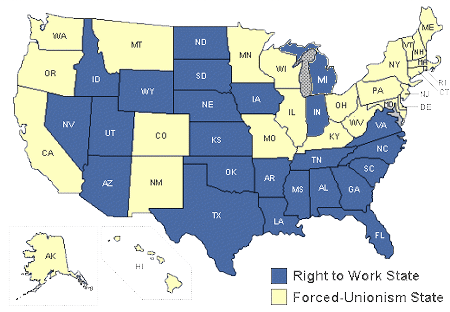
Previously, we saw that unemployment rates in right-to-work states were MUCH lower than in states that force workers to join unions and pay union dues in order to work.
Curtis sent me this article from Investors Business Daily, which looks at whether wages are lower in states that have right-to-work laws.
Excerpt:
The president says right-to-work laws mean “the right to work for less money.” So how does he explain the fact that incomes are up in RTW states while forced unionism is a proven job killer?
Campaigning Monday in Michigan as it stood poised to become the nation’s 24th right-to-work state, President Obama spoke the exact opposite of the truth to union workers at a Daimler Detroit Diesel plant in the birthplace of organized labor.
Is Obama telling the truth?
Let’s see:
According to Michigan’s Mackinac Center, using data taken from the Bureau of Economic Analysis and Bureau of Labor Statistics, private-sector, inflation-adjusted employee compensation in right-to-work states increased by 12% between 2001 and 2011 compared with just 3% over the same period in forced-unionization states.
These good wages came from good jobs. Employment in right-to-work states expanded 2.4% over the same stretch vs. a 3.4% decline in non-right-to-work states. Ironically, Obama is taking credit for jobs created in RTW states.
According to the National Institute for Labor Relations Research, right-to-work states (excluding Indiana, which passed a RTW law in early 2012) “were responsible for 72% of all net household job growth across the U.S. from June 2009 through September 2012.”
This is why people vote with their feet and move to these states. RTW states experienced large population gains of 15.3% from 2000 to 2010, compared to 5.9% in non-RTW states.
Obama did get one thing right, though, when he said the bills that passed both houses of the Michigan legislature “don’t have to do with economics. They have everything to do with politics.”
The president who fought Boeing’s expansion in RTW South Carolina knows it’s all about his keeping union dues flowing into Democratic coffers and maintaining the plush lifestyles of the union leaders who support him.
The right thing for Republicans to do when they get elected is to cut off all sources of funding for the Democrat Party. Right-to-work laws and school choice promote freedom and diminish the amount of power that left-wing, pro-abortion, pro-gay-marriage labor unions can exert. They will have less money, and with less money, they will have less influence on elections. Let the people decide, not the powerful, corrupt labor unions.
It’s official – Michigan has enacted a new right-to-work law that will create more jobs and free workers from having to violate their consciences by forcibly supporting pro-abortion, pro-gay marriage policies via their mandatory union dues.
Republicans say the move would not only give current workers the freedom to choose whether to join a union and pay dues but would, more importantly, bring many, many new jobs to Michigan. Rep. Gov. Rick Snyder, who supports the bill, points out that Indiana enacted (after a long and bitter fight) the same kind of law earlier this year. “We’ve carefully watched what’s gone on in Indiana since they passed similar legislation back in February,” Snyder told Fox News’ Greta van Susteren last week, “and they’ve seen a significant increase in the number of companies talking about [bringing] thousands of jobs to their state.”
Of course, the move is not just economic. It’s political, too. Democrats depend on millions — actually, billions — of dollars in support from the forced dues of union members. If that money supply were to dry up, or even just decrease, the Democratic Party would be in serious trouble.
De-funding the unions is the first step to education reform. And Michigan students need education reform very badly. Even 40% of the union workers – who are much more sensible and patriotic than the union bosses – agree with the new law:
Regardless of news reports, the people of Michigan are behind this. A recent poll showed that 51 percent of Michigan voters support right-to-work. Only 41 percent are opposed. In fact, 40 percent of union households supported it. In November, Michigan voters rejected a ballot proposal that would have amended the state constitution to prevent the legislature from passing a right-to-work law and elevated union contracts above state law. The New York Times called it “a test case on enshrining the rights of unions,” and unions spent more than $23 million campaigning for the initiative. It lost by 15 points.
[…][M]aking union dues voluntary makes union organizers less aggressive—they get less financial benefit from organizing new firms, because they cannot force workers to pay them. Union organizing attempts drop 40 percent to 50 percent after states pass a right-to-work law. That in turn attracts business investment. Employers want to know unions will leave them alone if they treat their workers well. As a result, right-to-work states have lower unemployment rates—and more manufacturing jobs.
In the public schools in Detroit, Mich., according to the U.S. Department of Education, only 7 percent of the eighth graders are grade-level proficient or better in reading.
Some public school teachers in the City of Detroit and around the state of Michigan are reportedly taking a vacation or a sick day today to protest right-to-work legislation likely to be approved by the state legislature. Under current law, Michigan public school teachers must pay dues to the teachers’ union. If the right-to-work law is enacted, Michigan public-school teachers will be free to join the union and pay dues to it if they wish, but they will also be free not to join the union and not to pay it dues.
Detroit public-school eighth graders do even worse in math than they do in reading, according to the Department of Education. While only 7 percent scored highly enough on the department’s National Assessment of Educational Progress test in 2011 to be rated “proficient” or better in reading, only 4 percent scored highly enough to be rated “proficient” or better in math.
Statewide in Michigan, only 32 percent of public-school eighth graders scored grade-level proficient or better in reading, and only 31 percent scored grade-level proficient or better in math.
According to this report, over 26,000 students missed school because of the “sick day” protest by the teachers.
The actual unemployment rate of right-to-work states is 6.7%. Compare that with the 8.7% unemployment rate of forced-unionism states. Jobs are the number one priority right now, and right-to-work means more jobs.

 WINTERY KNIGHT