
Tag Archives: Unborn Child

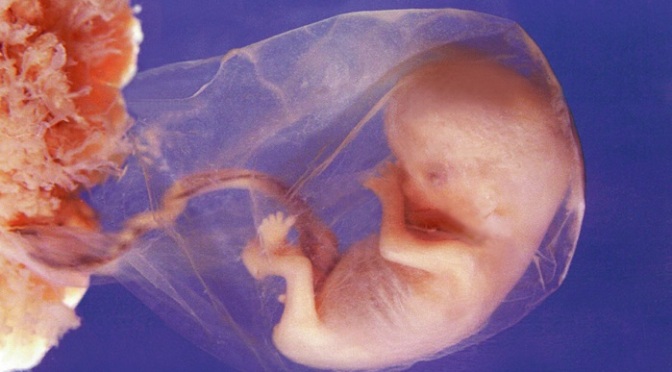
Which side of the abortion rights debate is backed by scientific evidence?

Once upon a time I didn’t know much about the case for abortion rights or the case for the right to life of unborn children. My reason for not reading much about it is that I thought that it was kind of a subjective issue. But, I started a project to read 1-2 books on every conceivable topic, including one on abortion. Lo and behold, it turned out that one side did have the backing of science.

This article from The Public Discourse explains: (links removed)

The following are typical examples—only three of the many, many we could cite. These are from standard texts by embryologists, developmental biologists, and microbiologists:

“Human life begins at fertilization, the process during which a male gamete or sperm unites with a female gamete or oocyte (ovum) to form a single cell called a zygote. This highly specialized, totipotent cell marked the beginning of each of us as a unique individual.” “A zygote is the beginning of a new human being (i.e., an embryo).” Keith L. Moore, The Developing Human: Clinically Oriented Embryology, 7th edition.

“Fertilization is the process by which male and female haploid gametes (sperm and egg) unite to produce a genetically distinct individual.” Signorelli et al., Kinases, phosphatases and proteases during sperm capacitation, Cell Tissue Research.

“Although life is a continuous process, fertilization (which, incidentally, is not a ‘moment’) is a critical landmark because, under ordinary circumstances, a new, genetically distinct human organism is formed when the chromosomes of the male and female pronuclei blend in the oocyte” (emphasis added; Ronan O’Rahilly and Fabiola Mueller, Human Embryology and Teratology, 3rd edition.

The genetically distinct part is key – this unborn child is has a different DNA signature (a human signature) than either the mother or the father. Nothing will be added or taken away from this new signature as the unborn child grows. It never changes.

More:

These authorities all agree because the underlying science is clear. At fertilization—or, more precisely, when the sperm (a male sex cell) fuses with the oocyte (a female sex cell, more commonly referred to as an egg)—each of them ceases to be, and a new entity, one that is both genetically and functionally distinct from either parent, is generated. This new entity, initially a single totipotent cell, then divides into two cells, then (asynchronously) three, then four, eight, and so on, enclosed all the while by a membrane inherited from the oocyte (the zona pellucida), which then dissolves during implantation, allowing for continued growth in the direction of maturity as a member of the species. Even prior to implantation, however, these cells and membrane function as parts of a whole that regularly and predictably develops into the more mature stages of a complex human body.

How do we know that the result of sperm-oocyte fusion is a new entity, rather than a continuation of the oocyte? We know that a new entity exists because, once the sperm penetrates the oocyte, a completely new trajectory of biological development commences. The biological activity of an oocyte is directed toward successful fertilization; the biological activity of sperm is directed toward penetration of an oocyte. The biological activity of the new entity that results when sperm and oocyte fuse, however, is directed toward nothing less than the development of a mature human organism, distinct from either parent. Further, this new entity’s activities are directed not by instructions from the mother’s body, as some people wrongly suppose, but by its own unique set of instructions, especially the blueprint for development contained in its unique genetic material. The mother’s body recognizes the zygote and then the embryo as an entity distinct from itself. In fact, the embryo must send out chemical signals to prevent the mother’s immune system from attacking it. The embryo also emits chemical signals that induce changes in the lining of the mother’s uterus to enable successful implantation.

If this embryo is provided a suitable environment, nutrition, and protection from deliberate attack, serious injury, or disease, it will develop to the mature stage of a human organism. Thus, from the zygote stage onward this distinct, new organism has all of the internal resources—in its genetic and epigenetic structure—needed to develop itself (or, rather, himself or herself, since in the human sex is determined from the very beginning) to the mature stage of a human organism. At no point after fertilization—implantation, gastrulation, birth, puberty, etc.—does a fundamental change in biological trajectory occur. These subsequent stages of development are simply the unfolding of the zygote’s inherent dynamism toward human organismal maturity. This shows that the zygote already is a human organism—a member of the species Homo sapiens—albeit at an early stage of his or her development.

So, since I like to win arguments with science, I just took the side of the debate that was backed by science. I really hate to lose debates, you know. I really like to cite scientific evidence when I’m debating.

The crime of abortion, it seems to me, is that you are depriving a human being of his or her future, because of your convenience right now. Human beings don’t have the right to take away the futures of other human beings because they want to be unburdened by the results of their own actions. We shouldn’t resort to violence in order to escape responsibility for our own actions. In almost every case, (except to save the life of the mother), killing the unborn child isn’t justified. It’s actually very scary to me that anyone would think that hurting other people was a reasonable response to one’s own diminished happiness. How did we ever get to a place in society when people don’t think that taking responsibility to care for the unborn child is morally better than killing the unborn child? It’s a baby for goodness sake. We ought to be serious about setting up our lives and controlling ourselves so that we never hurt an unborn child.
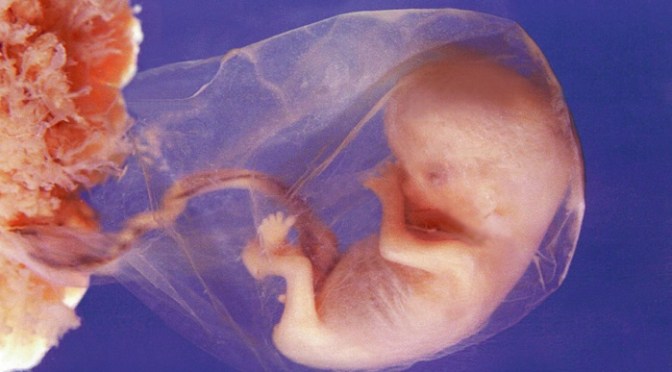
Which side of the abortion rights debate is backed by scientific evidence?

Once upon a time I didn’t know much about the case for abortion rights or the case for the right to life of unborn children. My reason for not reading much about it is that I thought that it was kind of a subjective issue. But, I started a project to read 1-2 books on every conceivable topic, including one on abortion. Lo and behold, it turned out that one side did have the backing of science.

This article from The Public Discourse explains: (links removed)

The following are typical examples—only three of the many, many we could cite. These are from standard texts by embryologists, developmental biologists, and microbiologists:

“Human life begins at fertilization, the process during which a male gamete or sperm unites with a female gamete or oocyte (ovum) to form a single cell called a zygote. This highly specialized, totipotent cell marked the beginning of each of us as a unique individual.” “A zygote is the beginning of a new human being (i.e., an embryo).” Keith L. Moore, The Developing Human: Clinically Oriented Embryology, 7th edition.

“Fertilization is the process by which male and female haploid gametes (sperm and egg) unite to produce a genetically distinct individual.” Signorelli et al., Kinases, phosphatases and proteases during sperm capacitation, Cell Tissue Research.

“Although life is a continuous process, fertilization (which, incidentally, is not a ‘moment’) is a critical landmark because, under ordinary circumstances, a new, genetically distinct human organism is formed when the chromosomes of the male and female pronuclei blend in the oocyte” (emphasis added; Ronan O’Rahilly and Fabiola Mueller, Human Embryology and Teratology, 3rd edition.

The genetically distinct part is key – this unborn child is has a different DNA signature (a human signature) than either the mother or the father. Nothing will be added or taken away from this new signature as the unborn child grows. It never changes.

More:

These authorities all agree because the underlying science is clear. At fertilization—or, more precisely, when the sperm (a male sex cell) fuses with the oocyte (a female sex cell, more commonly referred to as an egg)—each of them ceases to be, and a new entity, one that is both genetically and functionally distinct from either parent, is generated. This new entity, initially a single totipotent cell, then divides into two cells, then (asynchronously) three, then four, eight, and so on, enclosed all the while by a membrane inherited from the oocyte (the zona pellucida), which then dissolves during implantation, allowing for continued growth in the direction of maturity as a member of the species. Even prior to implantation, however, these cells and membrane function as parts of a whole that regularly and predictably develops into the more mature stages of a complex human body.

How do we know that the result of sperm-oocyte fusion is a new entity, rather than a continuation of the oocyte? We know that a new entity exists because, once the sperm penetrates the oocyte, a completely new trajectory of biological development commences. The biological activity of an oocyte is directed toward successful fertilization; the biological activity of sperm is directed toward penetration of an oocyte. The biological activity of the new entity that results when sperm and oocyte fuse, however, is directed toward nothing less than the development of a mature human organism, distinct from either parent. Further, this new entity’s activities are directed not by instructions from the mother’s body, as some people wrongly suppose, but by its own unique set of instructions, especially the blueprint for development contained in its unique genetic material. The mother’s body recognizes the zygote and then the embryo as an entity distinct from itself. In fact, the embryo must send out chemical signals to prevent the mother’s immune system from attacking it. The embryo also emits chemical signals that induce changes in the lining of the mother’s uterus to enable successful implantation.

If this embryo is provided a suitable environment, nutrition, and protection from deliberate attack, serious injury, or disease, it will develop to the mature stage of a human organism. Thus, from the zygote stage onward this distinct, new organism has all of the internal resources—in its genetic and epigenetic structure—needed to develop itself (or, rather, himself or herself, since in the human sex is determined from the very beginning) to the mature stage of a human organism. At no point after fertilization—implantation, gastrulation, birth, puberty, etc.—does a fundamental change in biological trajectory occur. These subsequent stages of development are simply the unfolding of the zygote’s inherent dynamism toward human organismal maturity. This shows that the zygote already is a human organism—a member of the species Homo sapiens—albeit at an early stage of his or her development.

So, since I like to win arguments with science, I just took the side of the debate that was backed by science. I really hate to lose debates, you know. I really like to cite scientific evidence when I’m debating.

The crime of abortion, it seems to me, is that you are depriving a human being of his or her future, because of your convenience right now. Human beings don’t have the right to take away the futures of other human beings because they want to be unburdened by the results of their own actions. We shouldn’t resort to violence in order to escape responsibility for our own actions. In almost every case, (except to save the life of the mother), killing the unborn child isn’t justified. It’s actually very scary to me that anyone would think that hurting other people was a reasonable response to one’s own diminished happiness. How did we ever get to a place in society when people don’t think that taking responsibility to care for the unborn child is morally better than killing the unborn child? It’s a baby for goodness sake. We ought to be serious about setting up our lives and controlling ourselves so that we never hurt an unborn child.

If unborn babies don’t have consciousness or don’t feel pain, may we kill them?

Was having a conversation by e-mail yesterday with a pro-abortion atheist, and he gave two reasons why he supported abortion in the first and second trimester. First, he said that unborn babies can’t feel pain, so it’s OK to kill them. Second, he said that unborn babies don’t have consciousness, so it’s OK to kill them. I thought it might be useful to link to something that answers both of these objections.

Frank Beckwith is the author of “Defending Life: A Moral and Legal Case Against Abortion Choice“, which was published by Cambridge University Press, a top academic press. But before Cambridge University Press, Beckwith wrote four easy-to-understand essays for the Christian Research Journal. Part IV is the one that has the response to the two questions raised by my atheist friend.

Part I. The Appeal to Pity

Part II. Arguments from Pity, Tolerance, and Ad Hominem

Part III. Is The Unborn Human Less Than Human?

Part IV. When Does a Human Become a Person?

Excerpt:

Some ethicists argue that the unborn becomes fully human sometime after brain development has begun, when it becomes sentient: capable of experiencing sensations such as pain. The reason for choosing sentience as the criterion is that a being that cannot experience anything (i.e., a presentient unborn entity) cannot be harmed. Of course, if this position is correct, then the unborn becomes fully human probably during the second trimester and at least by the third trimester. Therefore, one does not violate anyone’s rights when one aborts a nonsentient unborn entity. [13]

There are several problems with this argument. First, it confuses harm with hurt and the experience of harm with the reality of harm. [14] One can be harmed without experiencing the hurt that sometimes follows from that harm, and which we often mistake for the harm itself. For example, a temporarily comatose person who is suffocated to death “experiences no harm,” but he is nevertheless harmed. Hence, one does not have to experience harm, which is sometimes manifested in hurt, in order to be truly harmed.

Second, if sentience is the criterion of full humanness, then the reversibly comatose, the momentarily unconscious, and the sleeping would all have to be declared nonpersons. Like the presentient unborn, these individuals are all at the moment nonsentient though they have the natural inherent capacity to be sentient. Yet to countenance their executions would be morally reprehensible. Therefore, one cannot countenance the execution of some unborn entities simply because they are not currently sentient.

Someone may reply that while these objections make important points, there is a problem of false analogy in the second objection: the reversibly comatose, the momentarily unconscious, and the sleeping once functioned as sentient beings, though they are now in a temporary state of nonsentience. The presentient unborn, on the other hand, were never sentient. Hence, one is fully human if one was sentient “in the past” and will probably become sentient again in the future, but this cannot be said of the presentient unborn.

There are at least three problems with this response. First, to claim that a person can be sentient, become nonsentient, and then return to sentience is to assume there is some underlying personal unity to this individual that enables us to say that the person who has returned to sentience is the same person who was sentient prior to becoming nonsentient. But this would mean that sentience is not a necessary condition for personhood. (Neither is it a sufficient condition, for that matter, since nonhuman animals are sentient.) Consequently, it does not make sense to say that a person comes into existence when sentience arises, but it does make sense to say that a fully human entity is a person who has the natural inherent capacity to give rise to sentience. A presentient unborn human entity does have this capacity. Therefore, an ordinary unborn human entity is a person, and hence, fully human.

Second, Ray points out that this attempt to exclude many of the unborn from the class of the fully human is “ad hoc and counterintuitive.” He asks us to “consider the treatment of comatose patients. We would not discriminate against one merely for rarely or never having been sentient in the past while another otherwise comparable patient had been sentient….In such cases, potential counts for everything.” [15]

Third, why should sentience “in the past” be the decisive factor in deciding whether an entity is fully human when the presentient human being “is one with a natural, inherent capacity for performing personal acts?” [16] Since we have already seen that one does not have to experience harm in order to be harmed, it seems more consistent with our moral sensibilities to assert that what makes it wrong to kill the reversibly comatose, the sleeping, the momentarily unconscious, and the presentient unborn is that they all possess the natural inherent capacity to perform personal acts. And what makes it morally right to kill plants and to pull the plug on the respirator-dependent brain dead, who were sentient “in the past,” is that their deaths cannot deprive them of their natural inherent capacity to function as persons, since they do not possess such a capacity.

These four essays are a very good introduction to common responses to pro-abortion arguments. I recommend that people get familiar with this, as once you look into it, you will see that the abortion issue can be debated with as much confidence as William Lane Craig defends Christian theism. You will have the same access to scientific evidence and rational arguments on this topic, and so you will have the upper hand. And that’s fun.

The best introductory book on the abortion / right to life issue is “The Case for Life” by pro-life debater Scott Klusendorf. The best comprehensive book is a tie between “The Ethics of Abortion” by Christopher Kaczor, and Frank Beckwith’s “Defending Life: A Moral and Legal Case Against Abortion Choice“.