
Tag Archives: Trillion

Obama says that adding 4 trillion to the debt is unpatriotic… then does it

Here’s the speech from July 3, 2008:

Ha! That looks like Obama giving that speech. Oh, it is Obama. Ha ha.

In that clip, Obama says:

The problem is, is that the way Bush has done it over the last eight years is to take out a credit card from the Bank of China in the name of our children, driving up our national debt from $5 trillion for the first 42 presidents – #43 added $4 trillion by his lonesome, so that we now have over $9 trillion of debt that we are going to have to pay back — $30,000 for every man, woman and child. That’s irresponsible. It’s unpatriotic.

Obama liked to talk about the credit card from the bank of China during the campaign. And many people who watch Jon Stewart and Stephen Colbert and Rachel Maddow believed him. They believed him because the comedians told them to believe him. They did not want to stop laughing long enough to look at Obama’s voting record to see that he was consistently getting F ratings on spending and government waste and pork in all of his years as a legislator.

So Obama said that spending 4 trillion is “unpatriotic”. But then Obama did a funny thing. CBS News reports.

The latest posting by the Treasury Department shows the national debt has now increased $4 trillion on President Obama’s watch.

The debt was $10.626 trillion on the day Mr. Obama took office. The latest calculation from Treasury shows the debt has now hit $14.639 trillion.

It’s the most rapid increase in the debt under any U.S. president.

The national debt increased $4.9 trillion during the eight-year presidency of George W. Bush. The debt now is rising at a pace to surpass that amount during Mr. Obama’s four-year term.

Mr. Obama blames policies inherited from his predecessor’s administration for the soaring debt. He singles out:

“two wars we didn’t pay for”
“a prescription drug program for seniors…we didn’t pay for.”
“tax cuts in 2001 and 2003 that were not paid for.”

He goes on to blame the recession, and its resulting decrease in tax revenue on businesses, for making fewer sales, and more employees being laid off. He says the recession also resulted in more government spending due to increased unemployment insurance payments, subsidies to farms and funding of infrastructure programs that were part of his stimulus program.

Obama’s explanation for the deficits doesn’t wash, since the deficit was only $162 billion in 2007, the last year the Republicans had control of the House and Senate.

The Washington Times explains.

Excerpt:

A favorite liberal narrative is that President George W. Bush squan- dered the Clinton-era budget surpluses and piled up deficits with expensive wars and tax cuts for the rich. Candidate Barack Obama used this tale to great effect, and President Obama tells it still. Take his State of the Union address last week, when Mr. Obama attributed the Bush-era deficits to “paying for two wars, two tax cuts, and an expensive prescription drug program.”

The truth is that Mr. Bush’s deficits were the product of spending, not tax cuts. In fact, Mr. Obama could learn an important lesson for his own economic plan by studying Mr. Bush’s two very different attempts at tax-cutting.

As the Wall Street Journal’s Stephen Moore illuminates in his 2008 book “The End of Prosperity” (Threshold Editions), Mr. Bush’s 2001 tax cuts failed to revive an economy still staggering from the bursting of the dot-com bubble. Mr. Bush’s strategy had been to adopt a demand-side, Keynesian stimulus, hoping that putting a few extra dollars in Americans’ pockets would jump-start the economy through increased consumption. This approach faltered, not just because Americans opted to save their rebates, but because it neglected the importance of business investment to overall growth. Predictably, the economy lagged and government revenues stagnated. What the United States needed then (and needs now) was to stimulate investment, not consumption.

By 2003, Mr. Bush grasped this lesson. In that year, he cut the dividend and capital gains rates to 15 percent each, and the economy responded. In two years, stocks rose 20 percent. In three years, $15 trillion of new wealth was created. The U.S. economy added 8 million new jobs from mid-2003 to early 2007, and the median household increased its wealth by $20,000 in real terms.

But the real jolt for tax-cutting opponents was that the 03 Bush tax cuts also generated a massive increase in federal tax receipts. From 2004 to 2007, federal tax revenues increased by $785 billion, the largest four-year increase in American history. According to the Treasury Department, individual and corporate income tax receipts were up 40 percent in the three years following the Bush tax cuts. And (bonus) the rich paid an even higher percentage of the total tax burden than they had at any time in at least the previous 40 years. This was news to theNew York Times, whose astonished editorial board could only describe the gains as a “surprise windfall.”

Unfortunately, Mr. Bush allowed Congress to spend away those additional tax revenues. The fact is that the increase in tax revenues that flowed from the ‘03 tax cuts could have paid for the wars in Afghanistan and Iraq and then some but for rampant discretionary domestic spending.

So, Bush passed his tax cuts in 2001 and 2003, but revenue went up:
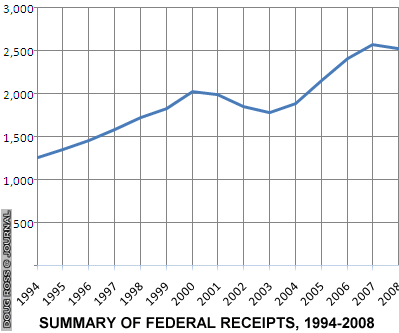
Federal receipts after Bush tax cuts

And the deficits went down from 2004 to 2007:

Obama Budget Deficit 2011

Bush was on track to balance the budget, then Nancy Pelosi came along and added 5.34 trillion to the debt in her 4 years as Speaker.

Economist Paul Ryan disgusted with Obama’s childish emotional bloviating

Republican economist Paul Ryan responds to the community-organizer/teleprompter-reader.

Here’s the transcript. (H/T Lonely Conservative)

Excerpt:

I’m very disappointed in the president. I was excited when we got invited to attend his speech today. I thought the president’s invitation to Mr. Camp, Mr. Hensarling and myself was an olive branch. Instead, what we got was a speech that was excessively partisan, dramatically inaccurate, and hopelessly inadequate to addressing our countries pressing fiscal challenges.

What we heard today was not fiscal leadership from our commander-in-chief. What we heard today was a political broadside from our campaigner-in chief.

I guess it’s no coincidence that last week when the president launched his billion dollar re-election campaign was the week we launched our effort to try and get this debt and deficit under control and get our economy growing.

Last year, in the absence of a serious budget, the president created a fiscal commission. Then with his budget he disavowed his fiscal commission. He ignored all of its recommendations. Now he wants to delegate leadership yet again to a new commission. How are we to expect different results? And the measurements of results of this new commission are lower than the measurements of success of the last commission that ended a few months ago.

We need leadership. We don’t need a doubling down on the failed politics of the past.

[…]Exploiting people’s emotions of fear, envy, and anxiety is not hope; it’s not change. It’s partisanship. We don’t need partisanship. We don’t need demagoguery. We need solutions. And we don’t need to keep punting to other people to make tough decisions. If we don’t make those decisions today, our children will have to make much, much tougher decisions tomorrow.

Paul Ryan and Jeb Hensarling are the two best-known Republican budget wonks.

You can read more about Paul Ryan in this Business Week interview.

Excerpt:

President Obama called your plan “a vision that says if our roads crumble and our bridges collapse, we can’t afford to fix them … but we can somehow afford more than $1 trillion in new tax breaks for the wealthy.” How do you respond?
I don’t even know what to say about that. First of all, we’re not even talking about cutting taxes. We’re talking about keeping tax revenues where they are [by making the Bush tax cuts permanent] and cleaning up all the junk in the tax code for a flatter, fair, simpler tax system. So we’re not talking about cutting taxes. We want to keep the tax revenues where they are and fix the tax code. And with respect to all the spending—you know, that partisan-spending rhetoric—if you don’t fix entitlements, Charlie, if you don’t get spending under control, there’s not going to be any money left for those other things, for roads, for bridges, for education, for the environment. So I’m amazed that he would use that kind of hyperbolic, hyperventilating rhetoric to describe our plan.

I find it interesting that last week we heard William Lane Craig chastise the child Sam Harris for making “stupid and insulting” remarks about Christians, we are now getting Paul Ryan making similar assessments of our naive, childish President. Have Christians and conservatives finally reached their limit of tolerating stupidity and incompetence?

More about Paul Ryan and his budget proposal in my previous post.

What’s wrong with the American economy and how Paul Ryan would fix it

This is a pretty long, but very educational, article from National Review.

Here’s the intro:

There’s been an avalanche of commentary on Paul Ryan’s “Path to Prosperity,” and rightly so. Ryan’s proposal, which would reform entitlement spending, balance the budget, and begin paying off the debt, is the most important legislative proposal of my lifetime. It may not pass in its current form. But there is a much better chance than you’d think that it will pass in modified form, perhaps under another president. Either way, it will change the way we talk about the deficit and the debt for a very long time.

The plan is quite comprehensive, encompassing discretionary spending, defense spending, financial regulation, Fannie and Freddie, tax reform, welfare programs, and Medicare and Medicaid. (As David Brooks puts it, PTP “dodges Social Security,” which is acceptable, given Social Security’s lesser impact on our long-term fiscal problems.)

As for getting debt under control, here’s what the Congressional Budget Office had to say about the “Path to Prosperity”:

The resulting budget deficits under the proposal would be around 2 percent of GDP in the 2020s [down from 9 percent in 2010] and would decline during the 2030s. The budget would be in surplus by 2040 and show growing surpluses in the following decade. Federal debt would equal about 48 percent of GDP by 2040 and 10 percent by 2050.

And Yuval Levin has put together some nice charts, based on the CBO numbers, that show how dramatically PTP changes our country’s fiscal trajectory, relative to both current law and the Obama budget.

[…]So let’s sift through the most controversial aspects of the plan: those related to health-care entitlements. It’s going to be a rather wonky exercise, though I’ve done my best to make it readable by breaking it up into bite-sized chunks.

Here’s a summary of his nine points:

  1. It reduces the growth of Medicare and Medicaid spending so that it is similar to countries like France, Germany and Switzerland
  2. It reduces the costs of health care by letting individuals control how their own money is being spent – reducing demand naturally
  3. It lets individuals decide what medical insurance coverages they want – just like they do with auto insurance
  4. It mandates that seniors have to pay appropriate premiums for any extra medical insurance coverage they choose
  5. It encourages states to save money and to prevent fraud by giving them financial rewards for doing so
  6. It requires the rich to pay more for Medicare than the poor -by means-testing service provision
  7. It introduces a voucher system where the government gives each person money (e.g. – $15,000) to choose a plan they like
  8. The Democrat alternative to the “Path to Prosperity” plan is tax increases and rationing health care
  9. The CBO agrees that if we do nothing about entitlement spending, we will bankrupt the country

I really encourage my Christian readers to take a shot at reading this article. It is very important for us to be seen as being informed about policies down to the details, so that we can discuss things other than Christianity intelligently. No one is going to trust you to discuss spiritual things unless they can see that you have some familiarity with material things. The reason why Bill Craig can back atheists into an auditorium is because he understands things about cosmology, physics, history and philosophy. People trust him, because he knows what he is talking about. You have a plan for a Christian life too, and you need to be able to do a good job of making decisions. You need to understand your country’s economy in order to make good decisions. And not just voting decisions, but spending decisions, educational decisions, career decisions and investing decisions. And then when you talk about your faith to others in public, you can link it to all kinds of different public areas of knowledge. So that Christianity will come up naturally, no matter what the topic is.

Related posts