Tag Archives: Theism

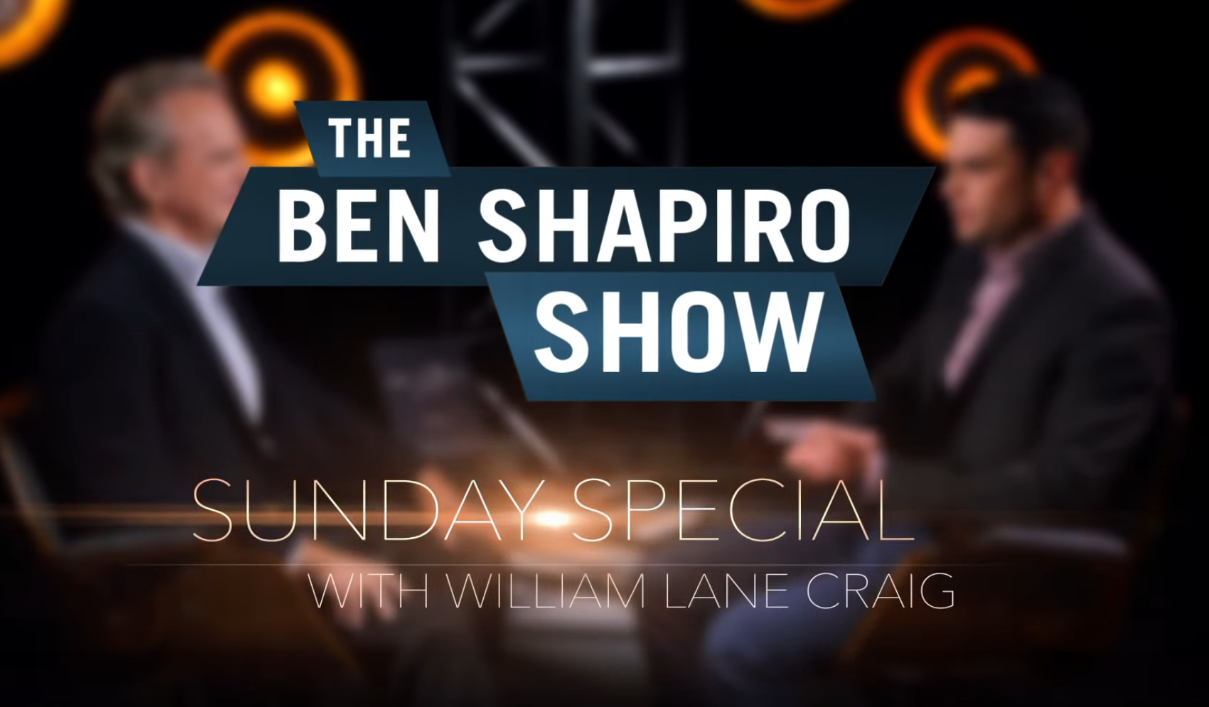
Dr. William Lane Craig interviewed on the Ben Shapiro Show Sunday Special

Dr. William Lane Craig on the Ben Shapiro Sunday special

The episode of the Ben Shapiro show that we’ve all been waiting for is here! They discuss arguments for God’s existence in the first 25 minutes. The spend the first 26 minutes on arguments for God,and  the next 16 minutes on Christian distinctives. They spend a bunch more time responding to common arguments for atheism, and finally Ben asks Dr. Craig how he became a Christian.

Summary:

William Lane Craig, philosopher, theologian, and best selling author of numerous books including “On Guard: Defending Your Faith With Reason And Precision,” joins Ben to discuss the hard sciences vs. philosophy, the cosmological and ontological arguments, Jesus, slavery, gay marriage, and much more.

Video:

The MP3 file is here.

Topics:

  • Why are we seeing such a decline in religious belief in America?
  • Why are mainline denominations in Christianity and Judaism emptying out?
  • What was the driver behind the move away from religion starting in the 1960s?
  • Why is their a gap in the university and in the broader culture between reason and religious belief?
  • What is the strongest argument for God’s existence?
  • What is the most compelling argument for God’s existence for this culture?
  • Respond to Richard Dawkins’ challenge that God needs a cause.
  • Why does the universe have to have a cause?
  • Does Darwinian evolution provide grounds for our awareness of objective moral values and duties?
  • What is the strongest objection to the cosmological argument?
  • What is the strongest objection to the moral argument?
  • What about the objection that the existence of the universe is just a “brute fact” and doesn’t need an explanation for it’s existence?
  • What about David Hume’s objection to the law of causality?
  • What about objections to the cause of the universe from apparently uncaused events in quantum mechanics?
  • What is the ontological argument, and why is it frequently dismissed?
  • How do we get from an unmoved mover to a moral God?
  • Which arguments show that God is a mind?
  • How do you show that God is present and active in time now?
  • How do you move from God as Creator, Designer and moral lawgiver to a God who has revealed himself to human beings?
  • Who does Jesus claim to be in the gospels, and what is the evidence that his claims were correct?
  • From the Jewish perspective, this narrative has some  problems. First, merely declaring yourself as the Messiah is not seen as a punishable offense.
  • Second, the real problem is that Jesus vision of himself as the Messiah is completely different than how Jews have understood the Messiah. The Messiah in Judaism has always been a political figure who is destined to restore the Kingdom of Israel, bringing more Jews back to Israel, etc.  Claiming to be God, though would be blasphemy and a punishable offense.
  • Why is resurrection proof of divinity? Wasn’t Lazarus also raised from the dead?
  • The gospels were written decades after the events they claim to describe. Should we still see them as reliable enough to infer that the resurrection really happened?
  • Couldn’t legends have been introduced in the gap between the events and the time that the events were recorded?
  • Is it enough for us to have a Creator God, or is there a reason for God to reveal himself to us?
  • Tell us about your experience debating atheist scholars on university campuses.
  • Has any an atheist ever caused you to doubt your arguments?
  • The problem of human evil is easy to respond to, but how do you respond to the problem of natural evil, i.e. – suffering from events in the natural world, such as birth defects or natural disasters.
  • Atheists like to bring up specific disagreements they have with the Bible, e.g. – same-sex marriage, abortion, slavery, genocide. How would you respond to those?
  • Regarding slavery in the Bible, isn’t it the case that people sometimes do things that are not prescribed by God, and the Bible merely records that?
  • How would you respond then to people who push for same-sex marriage by arguing that this is a case where God wanted same-sex marriage, but couldn’t press for it because the people were not capable at that time and in that culture?
  • When discussing specific issues of morality, do you try to argue from a natural law perspective or from the morality in the Bible?
  • How would you respond to someone like Jordan Peterson who approaches religion teachings pragmatically, focusing on behaviors rather than the rational grounding of those behaviors?
  • How do you speak to young people about God without them losing interest?
  • How did you become a Christian?
  • As the influence of Judeo-Christian religion recedes, what do you see filling the void, and how do you see that affecting Western civilization going forward?
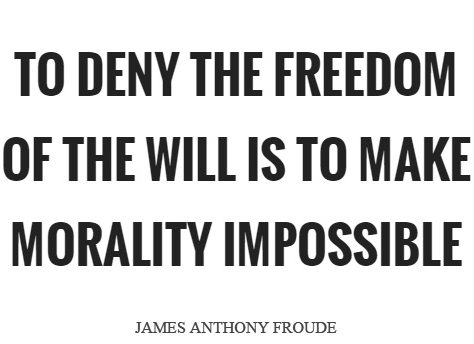
New study: belief in free will linked to ability to behave morally and to help others

Is it possible to choose to be moral if we are machines made out of meat?

A while back I finished reading “God’s Crime Scene”, the new book by J. Warner Wallace. I wanted to post something about some studies he mentioned in Chapter 6, on free will. This is one of the places where he found evidence in a surprising area.

Wallace says that free will makes more sense if theism is true, because we have non-material souls that interact with our bodies, but are not causally determined by them. On atheism, only matter exists, and you can’t get free will (or consciousness) from matter. So atheists like Sam Harris and Alex Rosenberg, for example, deny free will, because they are materialists and atheists.

Anyway, here’s what he writes on p. 256:

In 2008, researchers from the University of Minnesota and the University of British Columbia conducted experiments highlighting the relationship between a belief in determinism and immoral behavior. They found students who were exposed to deterministic literature prior to taking a test were more likely to cheat on the test than students who were not exposed to literature advocating determinism. The researchers concluded those who deny free will are more inclined to believe their efforts to act morally are futile and are, therefore, less likely to do so.

In addition, a study conducted by researchers from Florida State University and the University of Kentucky found participants who were exposed to deterministic literature were more likely to act aggressively and less likely to be helpful toward others.” Even determinist Michael Gazzaniga conceded: “It seems that not only do we believe we control our actions, but it is good for everyone to believe it.”” The existence of free will is a common characteristic of our experience, and when we deny we have this sort of free agency, there are detrimental consequences.

I decided to look up these studies.

Here’s the abstract for first study: (2008)

Does moral behavior draw on a belief in free will? Two experiments examined whether inducing participants to believe that human behavior is predetermined would encourage cheating. In Experiment 1, participants read either text that encouraged a belief in determinism (i.e., that portrayed behavior as the consequence of environmental and genetic factors) or neutral text. Exposure to the deterministic message increased cheating on a task in which participants could passively allow a flawed computer program to reveal answers to mathematical problems that they had been instructed to solve themselves. Moreover, increased cheating behavior was mediated by decreased belief in free will. In Experiment 2, participants who read deterministic statements cheated by overpaying themselves for performance on a cognitive task; participants who read statements endorsing free will did not. These findings suggest that the debate over free will has societal, as well as scientific and theoretical, implications.

And the abstract for the second study: (2009)

Laypersons’ belief in free will may foster a sense of thoughtful reflection and willingness to exert energy, thereby promoting helpfulness and reducing aggression, and so disbelief in free will may make behavior more reliant on selfish, automatic impulses and therefore less socially desirable. Three studies tested the hypothesis that disbelief in free will would be linked with decreased helping and increased aggression. In Experiment 1, induced disbelief in free will reduced willingness to help others. Experiment 2 showed that chronic disbelief in free will was associated with reduced helping behavior. In Experiment 3, participants induced disbelief in free will caused participants to act more aggressively than others. Although the findings do not speak to the existence of free will, the current results suggest that disbelief in free will reduces helping and increases aggression.

So what to make of this?

If you’re an atheist, then you are a physical object. And like every other physical object in the universe, your behavior is determined by genetic programming (if you’re alive) and external inputs. Material objects do not have the ability to make free choices, including moral choices.

Here’s prominent atheist Jerry Coyne’s editorial in USA Today to explain why atheists can’t ground free will.

Excerpt:

And that’s what neurobiology is telling us: Our brains are simply meat computers that, like real computers, are programmed by our genes and experiences to convert an array of inputs into a predetermined output. Recent experiments involving brain scans show that when a subject “decides” to push a button on the left or right side of a computer, the choice can be predicted by brain activity at least seven seconds before the subject is consciously aware of having made it. (These studies use crude imaging techniques based on blood flow, and I suspect that future understanding of the brain will allow us to predict many of our decisions far earlier than seven seconds in advance.) “Decisions” made like that aren’t conscious ones. And if our choices are unconscious, with some determined well before the moment we think we’ve made them, then we don’t have free will in any meaningful sense.

Atheist William Provine says atheists have no free will, no moral accountability and no moral significance:

Let me summarize my views on what modern evolutionary biology tells us loud and clear — and these are basically Darwin’s views. There are no gods, no purposes, and no goal-directed forces of any kind. There is no life after death. When I die, I am absolutely certain that I am going to be dead. That’s the end of me. There is no ultimate foundation for ethics, no ultimate meaning in life, and no free will for humans, either.

(Source)

If you don’t have free will, then you can’t make moral choices, and you can’t be held morally responsible. No free will means no morality. Can you imagine trying to get into any sort of enterprise with someone who has this view of moral choices? A marriage, or a business arrangement, etc? It would be crazy to expect them to behave morally, when they don’t even think that moral choices is possible. It just excuses all sorts of bad behavior, because no one is responsible for choosing to do the right thing.

Believers in materialism are going to struggle with prescriptive morality, including self-sacrificial care and concern for others. Their worldview undermines the rationality of the moral point of view. You might find atheists acting morally for their own purposes, but their worldview doesn’t rationally ground it. This is a big problem for people who can see objective morality woven into the universe – and themselves – because they have the awareness of objective right and wrong.

Choosing to do the right thing

I think what atheists like to say is “I can be moral, too”. That’s not interesting. What is interesting is whether it is rational for you to be moral when doing the right thing sets you back. When I look at the adultery of Dawkins, the polyamory of Carrier, the divorces of Shermer and Atkins, etc. I am not seeing anything that really wows me about their ability to do the right thing when it was hard for them to do it. They all deny free will of course, and think that trying to resist temptation is a waste of time.

Wallace explains how the awareness of free will and moral choices caused him to turn away from atheism, in this blog post.

He writes:

As an atheist, I chose to cling to naturalism, in spite of the fact that I lived each day as though I was capable of using my mind to make moral choices based on more than my own opinion. In addition, I sought meaning and purpose beyond my own hedonistic preferences, as though meaning was to be discovered, rather than created. I called myself a naturalist while embracing three characteristics of reality that simply cannot be explained by naturalism. As a Christian, I’m now able to acknowledge the “grounding” for these features of reality. My philosophical worldview is consistent with my practical experience of the world.

I think atheists who want to be honest about their own experience of first-person consciousness, free will, moral realism, etc. will do well to just accept that theism rationally grounds all of these things, and so you should accept theism. Theism is real. If you like morality, and want to be a virtuous person, then you should accept theism.

Can a person believe in both God and Darwinian evolution?

Christianity and the progress of science

The term for a person who believes in fully naturalistic evolution but who also believes in God is “theistic evolutionist”.

Terrell Clemmons takes a look at one organization of theistic evolutionists “Biologos”, and makes a distinction between their public statements and the real implications of their public statements.

Here is the PR / spin definition of theistic evolution:

Evolutionary creation is “the view that all life on earth came about by the God-ordained process of evolution with common descent. Evolution is a means by which God providentially achieves his purposes in creation.” This view, also called theistic evolution, has been around since the late nineteenth century, and BioLogos promotes it today in a variety of religious and educational settings.

And here is the no-spin definition of theistic evolution:

As Dr. Stephen Meyer explains it, the central issue dividing Bio-Logos writers from intelligent design theorists is BioLogos’s commitment to methodological naturalism (MN), which is not a scientific theory or empirical finding, but an arbitrary rule excluding non-material causation from the outset. “Unfortunately,” Meyer writes,

methodological naturalism is a demanding doctrine. The rule does not say “try finding a materialistic cause but keep intelligent design in the mix of live possibilities, in light of what the evidence might show.” Rather, MN tells you that you simply must posit a material or physical cause, whatever the evidence.

What this means, according to BioLogos’s own epistemology, is that God is objectively undiscoverable and unknowable—a tenet that sits squarely at odds with Christian orthodoxy, which has for centuries held that God is clearly discernible in the natural world (e.g., Romans 1:20). Obviously, this is theologically problematic, but Meyer also points out that theistic evolution faces problems from a scientific standpoint as well, as the technical literature among evolutionary biologists is moving away from the Darwinian mechanism.

Whenever I talk to theistic evolutionists, I try to stop them from talking about the Bible or their faith, because that’s not what is interesting to me. I don’t really care about their history as a religious person, or where they go to church, or who their pastor is. When I talk about origins and evolution, I only care about the science. What the ordinary process of scientific inquiry tells us about nature? Does nature have the capacity to create all of the varieties of life without any intelligent agency playing a role? Or, are there parts of nature that are similar to computer programs, blog posts, and term papers, where the best explanation of the effect is an intelligent agent choosing how to arrange the parts to achieve functionality?

I don’t accept molecules-to-man unguided evolution. This is not because I start with faith and let faith override the findings of science. It’s because I think that if you look at specific areas of natural history, there is clear evidence of intelligent agency, such as in the origin of life, or the Cambrian explosion. These effects in nature are well-studied and well-understood, and they look much more like the code that a computer scientist (like me) writes than the simplistic “order” created by wind erosion or crystalline patterns or anything the blind forces of nature could produce. Blind forces are observed to make small changes – short or long finch beaks, fruit flies with 4 wings and no balancers, bacterial resistances.

What’s also interesting is how often theistic evolutionists drop the theism but keep the evolution.

Consider this article about Stephen Matheson from Evolution News:

Biologist Stephen Matheson is a longtime critic of the theory of intelligent design. His extensive attacks on Stephen Meyer’s Signature in the Cell, for one, ranged from the substantive to the trivial and personal. The tone was frequently…abrasive, and we responded at the time. With Arthur Hunt, Dr. Matheson has debated Dr. Meyer in a forum at Biola University. Formerly a professor at an Evangelical Christian school, Calvin College, Matheson is still listed as a Blog Author at the theistic evolutionary website BioLogos, where it notes that he enjoys “explor[ing] issues of science and Christian faith.”

Well, his theistic evolutionary explorations have now terminated. As he reports on his personal blog page, where he took a hiatus of more than five years along with a break from his teaching, he is “happily” no longer a Christian.

OK. Now that’s just one case, but what about Howard Van Till, also of Calvin College?

Salvo magazine takes a look at what he wrote in a recent book:

In what follows I shall use the term “naturalism,” when unqualified, to represent neither more nor less than the rejection of supernaturalism. Stated positively, naturalism is committed to the belief that all events that occur within this Universe are consistent with and adequately explained by the system of natural causes. This commitment necessarily entails the additional belief that the system of natural causes is fully adequate to account for all events that transpire. Focusing on the issue of the Universe’s formational economy, we can say that naturalism—as here defined -entails the RFEP.

He now gives presentations for atheist groups entitled “From Calvinism to Freethought”. Freethought is a euphemism for atheism.

Now, for the big three Western monotheistic religions: Christianity, Judaism and Islam. To deny supernaturalism IS to deny the robust theism present in the world’s big three monotheistic religions. Van Till denies theism as commonly understood now. And again, this isn’t because of the science. His heavy handed naturalistic assumption squashed out any kind of serious inquiry into areas like the origin of the universe, the cosmic fine tuning, the origin or life, the Cambrian explosion, biological convergence, so-called junk DNA, deleterious mutations, and so on. Places where you can see that naturalistic forces cannot do the creating that Van Till has faith that they can.

And for the record, I am an enthusiastic supporter of the standard Big Bang cosmology, and a 4.5 billion year Earth. My problem with evolution is not Bible-based, it’s science-based. If the science shows the need for intelligent causes, and I think it does, then I think that the naturalists need to adjust their assumptions and pre-suppositions to match the evidence. We have blog posts and computer science code, that’s evidence for a programmer. We have DNA and proteins and sudden origin of body plans, that’s evidence for a programmer, too.