Tag Archives: Theism

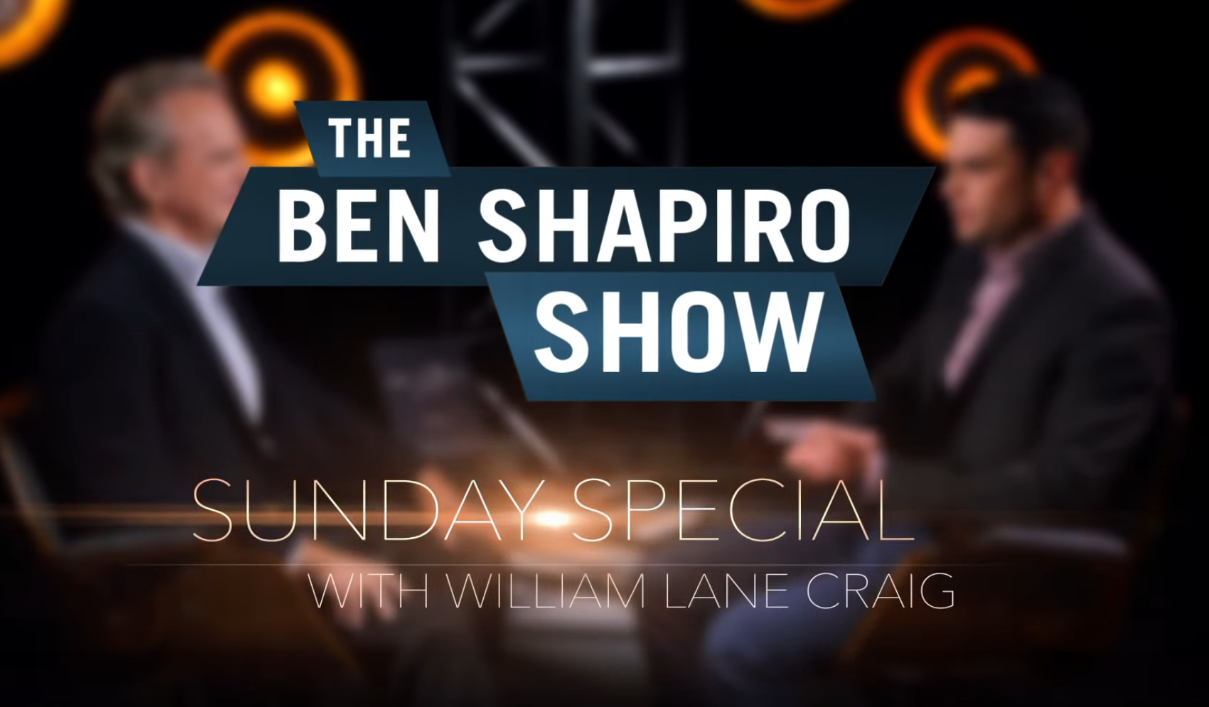
Dr. William Lane Craig interviewed on the Ben Shapiro Show Sunday Special

Dr. William Lane Craig on the Ben Shapiro Sunday special

I’m re-posting this old episode of the Ben Shapiro show.  They discuss arguments for God’s existence in the first 25 minutes. The spend the first 26 minutes on arguments for God,and  the next 16 minutes on Christian distinctives. They spend a bunch more time responding to common arguments for atheism, and finally Ben asks Dr. Craig how he became a Christian.

Summary:

William Lane Craig, philosopher, theologian, and best selling author of numerous books including “On Guard: Defending Your Faith With Reason And Precision,” joins Ben to discuss the hard sciences vs. philosophy, the cosmological and ontological arguments, Jesus, slavery, gay marriage, and much more.

Video:

The MP3 file is here.

Topics:

  • Why are we seeing such a decline in religious belief in America?
  • Why are mainline denominations in Christianity and Judaism emptying out?
  • What was the driver behind the move away from religion starting in the 1960s?
  • Why is their a gap in the university and in the broader culture between reason and religious belief?
  • What is the strongest argument for God’s existence?
  • What is the most compelling argument for God’s existence for this culture?
  • Respond to Richard Dawkins’ challenge that God needs a cause.
  • Why does the universe have to have a cause?
  • Does Darwinian evolution provide grounds for our awareness of objective moral values and duties?
  • What is the strongest objection to the cosmological argument?
  • What is the strongest objection to the moral argument?
  • What about the objection that the existence of the universe is just a “brute fact” and doesn’t need an explanation for it’s existence?
  • What about David Hume’s objection to the law of causality?
  • What about objections to the cause of the universe from apparently uncaused events in quantum mechanics?
  • What is the ontological argument, and why is it frequently dismissed?
  • How do we get from an unmoved mover to a moral God?
  • Which arguments show that God is a mind?
  • How do you show that God is present and active in time now?
  • How do you move from God as Creator, Designer and moral lawgiver to a God who has revealed himself to human beings?
  • Who does Jesus claim to be in the gospels, and what is the evidence that his claims were correct?
  • From the Jewish perspective, this narrative has some  problems. First, merely declaring yourself as the Messiah is not seen as a punishable offense.
  • Second, the real problem is that Jesus vision of himself as the Messiah is completely different than how Jews have understood the Messiah. The Messiah in Judaism has always been a political figure who is destined to restore the Kingdom of Israel, bringing more Jews back to Israel, etc.  Claiming to be God, though would be blasphemy and a punishable offense.
  • Why is resurrection proof of divinity? Wasn’t Lazarus also raised from the dead?
  • The gospels were written decades after the events they claim to describe. Should we still see them as reliable enough to infer that the resurrection really happened?
  • Couldn’t legends have been introduced in the gap between the events and the time that the events were recorded?
  • Is it enough for us to have a Creator God, or is there a reason for God to reveal himself to us?
  • Tell us about your experience debating atheist scholars on university campuses.
  • Has any an atheist ever caused you to doubt your arguments?
  • The problem of human evil is easy to respond to, but how do you respond to the problem of natural evil, i.e. – suffering from events in the natural world, such as birth defects or natural disasters.
  • Atheists like to bring up specific disagreements they have with the Bible, e.g. – same-sex marriage, abortion, slavery, genocide. How would you respond to those?
  • Regarding slavery in the Bible, isn’t it the case that people sometimes do things that are not prescribed by God, and the Bible merely records that?
  • How would you respond then to people who push for same-sex marriage by arguing that this is a case where God wanted same-sex marriage, but couldn’t press for it because the people were not capable at that time and in that culture?
  • When discussing specific issues of morality, do you try to argue from a natural law perspective or from the morality in the Bible?
  • How would you respond to someone like Jordan Peterson who approaches religion teachings pragmatically, focusing on behaviors rather than the rational grounding of those behaviors?
  • How do you speak to young people about God without them losing interest?
  • How did you become a Christian?
  • As the influence of Judeo-Christian religion recedes, what do you see filling the void, and how do you see that affecting Western civilization going forward?

Physicist Michael Strauss discusses Christianity and science at Stanford University

Christianity and the progress of science

This is one of my favorite lectures.

The lecture:

Dr. Strauss delivered this lecture at Stanford University in 1999. It is fairly easy to understand, and it even includes useful dating tips.

Here is a clip:

The full video can be watched on Vimeo:

Summary:

What does science tell us about God?
– the discoveries of Copernicus made humans less significant in the universe
– the discoveries of Darwin should that humans are an accident
– but this all pre-modern science
– what do the latest findings of science say about God?

Evidence #1: the origin of the universe
– the steady state model supports atheism, but was disproved by the latest discoveries
– the oscillating model supports atheism, but was disproved by the latest discoveries
– the big bang model supports theism, and it is supported by multiple recent discoveries
– the quantum gravity model supports atheism, but it pure theory and has never been tested or confirmed by experiment and observation

Evidence #2: the fine-tuning of physical constants for life
– there are over 100 examples of constants that must be selected within a narrow range in order for the universe to support the minimal requirements for life
– example: mass density
– example: strong nuclear force (what he studies)
– example: carbon formation

Evidence #3: the fine-tuning of our planet for habitability
– the type of galaxy and our location in it
– our solar system and our star
– our planet
– our moon

It’s a good lecture explaining a couple of basic arguments for a cosmic Creator and Designer. If you add the origin of life and the Cambrian explosion (Stephen C. Meyer’s arguments), then you will be solid on the basic scientific arguments for a Creator and Designer of the universe.

Positive arguments for Christian theism

Atheist Jerry Coyne explains why morality is impossible for atheists

Sherlock Holmes and John Watson about to do philosophy

Let’s review what you need in your worldview in order to have a rationally grounded system of morality.

You need 5 things:

1) Objective moral values

There needs to be a way to distinguish what is good from what is bad. For example, the moral standard might specify that being kind to children is good, but torturing them for fun is bad. If the standard is purely subjective, then people could believe anything and each person would be justified in doing right in their own eyes. Even a “social contract” is just based on people’s opinions. So we need a standard that applies regardless of what people’s individual and collective opinions are.

2) Objective moral duties

Moral duties (moral obligations) refer to the actions that are obligatory based on the moral values defined in 1). Suppose we spot you 1) as an atheist. Why are you obligated to do the good thing, rather than the bad thing? To whom is this obligation owed? Why is rational for you to limit your actions based upon this obligation when it is against your self-interest? Why let other people’s expectations decide what is good for you, especially if you can avoid the consequences of their disapproval?

3) Moral accountability

Suppose we spot you 1) and 2) as an atheist. What difference does it make to you if you just go ahead and disregard your moral obligations to whomever? Is there any reward or punishment for your choice to do right or do wrong? What’s in it for you?

4) Free will

In order for agents to make free moral choices, they must be able to act or abstain from acting by exercising their free will. If there is no free will, then moral choices are impossible. If there are no moral choices, then no one can be held responsible for anything they do. If there is no moral responsibility, then there can be no praise and blame. But then it becomes impossible to praise any action as good or evil.

5) Ultimate significance

Finally, beyond the concept of reward and punishment in 3), we can also ask the question “what does it matter?”. Suppose you do live a good life and you get a reward: 1000 chocolate sundaes. And when you’ve finished eating them, you die for real and that’s the end. In other words, the reward is satisfying, but not really meaningful, ultimately. It’s hard to see how moral actions can be meaningful, ultimately, unless their consequences last on into the future.

Theism rationally grounds all 5 of these. Atheism cannot ground any of them.

Let’s take a look at #4: free will and see how atheism deals with that.

Atheism and free will?

Here’s prominent atheist Jerry Coyne’s editorial in USA Today to explain why atheists can’t ground free will. (Note: link is dead)

Excerpt:

And that’s what neurobiology is telling us: Our brains are simply meat computers that, like real computers, are programmed by our genes and experiences to convert an array of inputs into a predetermined output. Recent experiments involving brain scans show that when a subject “decides” to push a button on the left or right side of a computer, the choice can be predicted by brain activity at least seven seconds before the subject is consciously aware of having made it. (These studies use crude imaging techniques based on blood flow, and I suspect that future understanding of the brain will allow us to predict many of our decisions far earlier than seven seconds in advance.) “Decisions” made like that aren’t conscious ones. And if our choices are unconscious, with some determined well before the moment we think we’ve made them, then we don’t have free will in any meaningful sense.

If you don’t have free will, then you can’t make moral choices, and you can’t be held morally responsible. No free will means no morality.

Here are some more atheists to explain how atheists view morality.

William Provine says atheists have no free will, no moral accountability and no moral significance:

Let me summarize my views on what modern evolutionary biology tells us loud and clear — and these are basically Darwin’s views. There are no gods, no purposes, and no goal-directed forces of any kind. There is no life after death. When I die, I am absolutely certain that I am going to be dead. That’s the end of me. There is no ultimate foundation for ethics, no ultimate meaning in life, and no free will for humans, either.

Richard Dawkins says atheists have no objective moral standards:

In a universe of blind physical forces and genetic replication, some people are going to get hurt, other people are going to get lucky, and you won’t find any rhyme or reason in it, or any justice. The universe that we observe has precisely the properties we should expect if there is, at bottom, no design, no purpose, no evil and no good, nothing but blind, pitiless indifference… DNA neither knows nor cares. DNA just is. And we dance to its music. (Richard Dawkins, River Out of Eden: A Darwinian View of Life (1995))

When village atheists talk about how they can be moral without God, it’s important to ask them to justify the minimum requirements for rational morality. Atheists may act inconsistently with their worldview, believing in free will, expecting praise and blame for complying with the arbitrary standards of their peer group, etc. But there is nothing more to morality on atheism that imitating the herd – at least when the herd is around to watch them. And when the herd loses its Judeo-Christian foundation – watch out. That’s when the real atheism comes out – the atheism that we’ve seen before in countries that turned their backs on God, and the moral law. When God disappears from a society, anything is permissible.