Tag Archives: Taxes

Bernie Sanders says his spending proposals will tax everyone, not just the rich

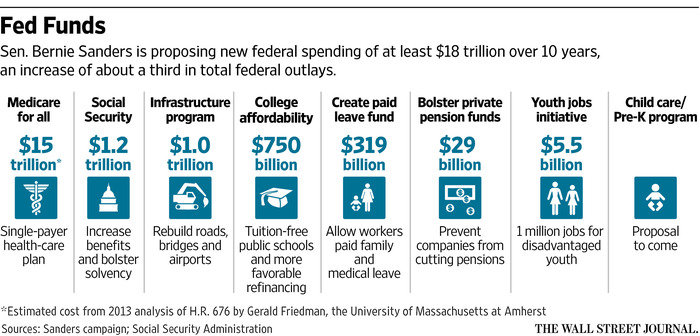
Wall Street Journal calculates cost of Sanders spending plan
Wall Street Journal calculates the cost of Bernie Sanders’ spending plan

This story is from ABC News.

Excerpt:

Sanders is perhaps best known in political life for his efforts to champion the middle class, saying that in order to bridge the widening wealth and income inequality gap in America, the country needs a revamped tax policy that forces Wall Street, big corporations, millionaires and billionaires –like Trump – to pay up – and doesn’t impose further taxes on the middle and working class.

However, when pressed by Stephanopoulos about whether the proposed Senate tax legislation he backs, which would use a payroll tax to fund a mandate for 12 weeks of paid family and medical leave from all U.S. employers, Sander confirmed that the bill would require taxing all citizens -– not just the top 1 percent.

“[The payroll tax] would hit everyone –- yeah, it would. But it would mean we would join the rest of the industrialized world and make sure that when a mom has a baby she can in fact stay home with that baby for three months, rather than going back to work at the end of one week,” Sanders said.

What most Democrats (all?) don’t understand, is that when you tax the rich, the costs filter down to consumers and employees. If a company is making a 5% profit (and Wal-mart makes a 3% profit), then slapping even a 5% tax increase on them will cause layoffs, outsourcing and other repercussions. We have a serious problem in this country with economic illiteracy – a widespread lack of familiarity with how the private sector works, and how jobs are created. For one thing, the public thinks that the average profit margin of companies is over 32%, when it fact it is much lower.
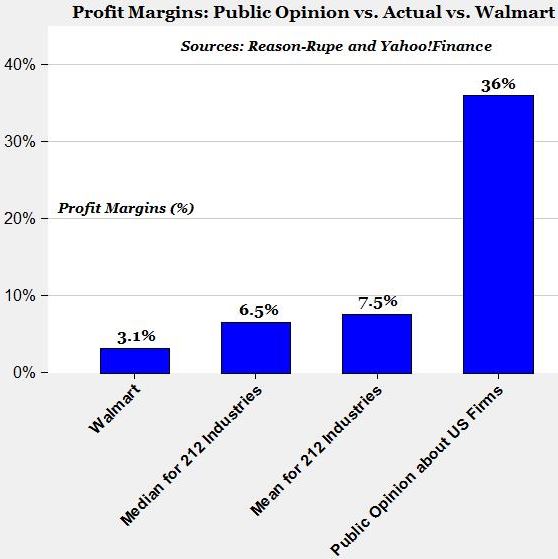
Public perceptions of corporate profit margins

So the real question is, how much does Bernie Sanders want to spend, and pass on to “the rich”? Because if it’s more than a 1% or 2% increase in corporate taxes, we are all – all of us – going to feel the burn. And it’s not going to a slight increase to our payroll taxes, it’s going to be a huge number of people losing their jobs, and the prices of consumer goods and services rising to pay for the new taxes.

How much does all this Bernie Sanders spending cost? 

The Wall Street Journal – which knows something about business and economics – has done an analysis of how much the socialist agenda of Bernie Sanders will cost. The final price tag? $18 trillion dollars!

Read it:

Sen. Bernie Sanders, whose liberal call to action has propelled his long-shot presidential campaign, is proposing an array of new programs that would amount to the largest peacetime expansion of government in modern American history.

In all, he backs at least $18 trillion in new spending over a decade, according to a tally by The Wall Street Journal, a sum that alarms conservatives and gives even many Democrats pause. Mr. Sanders sees the money as going to essential government services at a time of increasing strain on the middle class.

[…]To pay for it, Mr. Sanders, a Vermont independent running for the Democratic nomination, has so far detailed tax increases that could bring in as much as $6.5 trillion over 10 years, according to his staff.

A campaign aide said additional tax proposals would be offered to offset the cost of some, and possibly all, of his health program. A Democratic proposal for such a “single-payer” health plan, now in Congress, would be funded in part through a new payroll tax on employers and workers, with the trade-off being that employers would no longer have to pay for or arrange their workers’ insurance.

Investors Business Daily has more to say about Sanders’ proposals:

His “Medicare for All” single-payer health plan alone would cost roughly $15 trillion over a decade.

He wants the government to provide “universal” child care and pre-kindergarten programs, along with free tuition at any public college, and proposes spending an additional $1 trillion on infrastructure and expanding Social Security by $1.2 trillion. Add up just these and a few other items on Sanders’ list, and price tag tops $18 trillion over a decade.

[…]And this doesn’t count the massive costs of mandates and regulations Sanders wants to impose on businesses, such as a $15 minimum wage, plus mandatory paid medical leave, vacations and sick days.

He’d also make it far easier for unions to organize.

Keep in mind that when Obama became president, the national debt was about $8 trillion. Now it’s $18.5 trillion, thanks to the Democrats. And if Bernie Sanders is elected, it will go to over $36.5 trillion. This is what Bernie Sanders expects to solve by “taxing the rich”. And Hillary Clinton expects to get the money for her spending from “taxing the wealthy”, as she said in the CNN debate. Do the rich have enough money lying around for the Democrats to confiscate?

Can we pay for it by “taxing the rich”?

A while back, the libertarian Cato Institute had an article talking about who would pay for Obama’s $1 trillion health care plan. They asked whether Obama could pay for it by “taxing the rich”.

The answer is no:

Funding the new health-care plan on the backs of households making $200,000 or more per year would require permanently increasing their annual total tax payments by about 50 percent. So, for example, a household that currently pays $50,000 in federal income taxes would need to pay another $25,000. Remember, however, that Social Security and Medicare already face enormous shortfalls. Shoring up these programs — another Obama campaign promise — would require collecting 328 percent more tax revenue from the rich. No, we didn’t forget a decimal point: That is three hundred and twenty-eight percent.

And what follows from taxing the rich?

[…]A major tax increase causes the tax capacity of the rich to shrink gradually as two factors kick in. First, many of the households falling into Obama’s “rich” definition are married couples in which both partners are working professionals. When tax rates rise, the lower-earning spouses in these couples tend to work less. Often, they quit work entirely. Second, many of the “rich” are budding entrepreneurs and small-business owners. They finance their operations using their own after-tax income, or with after-tax resources from family and friends. Small-business innovation is the fuel for long-term economic growth. In fact, many of the largest companies in the United States today were either small or nonexistent just 25 years ago. Killing small business kills the American economy.

The rich in France abandoned France in droves when the socialist Francois Hollande passed a 75% top income tax rate. Why do Democrat voters think that this would not happen here? We have to learn economics by watching what happens after the policies are enacted, in other times and places. Higher taxes on the rich cause them to produce less, lowering tax revenues.

I myself have been planning to stop working within the next 5 years, exactly because I can see that the Democrat voters are taking us in the direction of massive taxes on employment. I don’t intend to be working when that happens. If enough people respond to higher tax rates like me, the Democrats are going to have an even bigger problem paying for their spending promises.
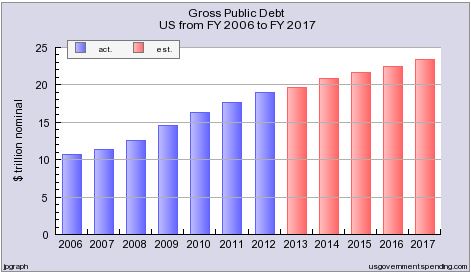
Eight years of socialism: more debt, more regulation, fewer Americans working:

Has the economy been doing well lately? When I ask Democrats that question, they often point me to the stock market. I know that the stock market has done very well in the last 8 years. But I really question which Democrat policies have been responsible for this winfall.

Certainly, policies like Obamacare, Dodd-Frank, green energy subsidies, blocking Keystone XL, creating a student loan bubble, and even loosening mortgage lending again to create another housing bubble, cannot cause any economics growth. My personal opinion is that all the growth came from adding over $10 trillion dollars to the debt – a process that started with the election of Nancy Pelosi and Harry Reid to the House and Senate majorities, respectively, in 2007.

Look at the national debt:

Gross public debt, Democrats control spending in 2007
Gross public debt, Democrats control spending starting in 2007

If you add $10 trillion to the national debt in 8 years then OF COURSE the stock prices will go up. You would look richer too if you took your credit card balance from $8,500 to $18,500. But what is behind all this consumer spending and government spending? Just trillions of dollars of new debt.

I think a better measure of how the economy is doing is to ask job creators how it is doing. For example, we can ask small businesses, since they are responsible for so much of the job creation in this economy.

Here’s an article from the Daily Signal about that.

It says:

More than five years after the end of the “Great Recession,” only 21 percent of small businesses* say they have fully recovered. During the recession, lack of sales ranked as the top problem small business faced. Taxes placed second, and “government regulations and red tape” placed third. And since 2012, at least one in five small business owners identify government regulations as their most important problem.

The reason for this is simple—small business owners directly feel the impact of federal regulation in the daily life of their businesses. The small business owner is often the main person in a business who bears the burden of complying with regulations and paperwork requirements. According to a 2010 study, small businesses spend $10,585 per employee on regulation, which amounts to 36 percent more per employee than larger companies spend.

With that as a backdrop, it is easy to see how small business owners continue to wonder why Washington just does not get it when it comes to regulation. For decades, Congress has sought to solve societal problems through mandates on business. Too many Americans without health insurance? Congress tries to solve that by requiring businesses to provide health insurance to their employees (regardless of whether or not they can afford it) or pay hefty penalties. Too many Americans unable to care for a sick relative? Congress seeks to address that by mandating that a business keep a position open three months out of every year for qualified employees, using a cumbersome reporting system.

Always entrepreneurial, with a keen focus on the bottom line, the American small business owner looks for ways to minimize the time and money spent on things other than running his or her business. Since many of these regulations wisely exempt the smallest of small businesses, some employers purposefully do not increase hiring because they do not want to have to comply with the regulatory regimes that await businesses that expand to 10, 15, and 50 or more employees.

This might be why the labor force participation rate is at a 38-year low.

CNS News explains:

A record 94,031,000 Americans were not in the American labor force last month — 261,000 more than July — and the labor force participation rate stayed stuck at 62.6 percent, a 38-year low, for a third straight month in August, the Labor Department reported on Friday, as the nation heads into the Labor Day weekend.

[…]In August, according to BLS, the nation’s civilian noninstitutional population, consisting of all people 16 or older who were not in the military or an institution, reached 251,096,000. Of those, 157,065,000 participated in the labor force by either holding a job or actively seeking one.

The 157,065,000 who participated in the labor force equaled only 62.6 percent of the 251,096,000 civilian noninstitutional population — the same as it was in July and June. Not since October 1977, when the participation rate dropped to 62.4, has the percentage been this low.

So… do you still think that the economy is in good shape? Any economy is going to look better if you take an $8.5 trillion debt and run it up to $18.5 trillion. But if you look a little closer, you see that small businesses are hard-pressed, and it’s affected the real unemployment rate.

Donald Trump should be running as a Democrat, he has no conservative views

Donald Trump should stick to Miss Universe pageants

I’ve been trying not to pay attention to the fact that a leftist is leading the Republican primary. You see, I’m actually familiar with Trump’s previous positions on things like taxes (he’s for raising them), partial-birth abortion, i.e. – infanticide (he supports it), amnesty (he’s for that), government-run health care (he’s for it)… and so on. In fact, Donald Trump’s record is not conservative on a single issue. He has never advocated for conservative policies. Not one. He’s a leftist, through and through.

What this 90-second video, showing Trump in his own words:

Leftist clowns like him do not change their positions short of some serious study, and there is no evidence that he has studied a thing.

Here’s Jonah Goldberg writing in National Review to express how frustrating it is to people like me who prefer conservative candidates who have actual records of achievement on conservative issues.

Jonah says:

Yes, I know Trump has declared himself pro-life. Good for him — and congratulations to the pro-life movement for making that the price of admission. But I’m at a total loss to understand why serious pro-lifers take him at his word. He’s been all over the place on Planned Parenthood, and when asked who he’d like to put on the Supreme Court, he named his pro-choice-extremist sister.

Is that real? Yes, you can read about it here. Trump has no pro-life record. You cannot believe anything that a person running for office says during his campaign speeches. We already had that happen when Obama promised so many things in speeches that he never delivered on. And yet here we are in a GOP primary and a bunch of lazy Republican voters are just believing everything that a candidate says, and not looking at his actual record.

More from Jonah:

In his embarrassing interview with Hugh Hewitt last night, Trump revealed he knows less than most halfway-decent D.C. interns about foreign policy. Twitter lit up with responses about how it doesn’t matter and how it was a gotcha interview. They think that Trump’s claim that he’ll just go find a Douglas MacArthur to fix the problem is brilliant. Well, I’m all in favor of finding a Douglas MacArthur, but if you don’t know anything about foreign policy, the interview process will be a complete disaster. Yes, Reagan delegated. But he knew enough to know to whom to delegate.

Yeah, guess what? A clown like Donald Trump knows nothing about foreign policy. He could not tell the difference between Iran’s Quds force and the Kurds in northern Iraq. I am only a software engineer, and even I have blogged about the Quds force, and their leader many, many times. I understand that lay people don’t need to know about the Quds force, or the threat they pose to us, but presidential candidates do need to know. Trump’s ignorance on national security and foreign policy ought to terrify us. We can’t afford to elect someone completely unqualified.

More from Jonah:

If you want a really good sense of the damage Donald Trump is doing to conservatism, consider the fact that for the last five years no issue has united the Right more than opposition to Obamacare. Opposition to socialized medicine in general has been a core tenet of American conservatism from Day One. Yet, when Republicans were told that Donald Trump favors single-payer health care, support for single-payer health care jumped from 16 percent to 44 percent.

I blogged before about the horrors of government-run health care in Canada and the UK. And yet the TV-watching clowns who support Trump cannot be bothered to look at the research. If Trump praises single-payer health care (and he has), does that one sentence from a clown override the good, solid data from studies? Are Republican voters too busy watching TV to do any research? Or do we just accept whatever a “confident” clown tells us without looking at the evidence for ourselves? Can facts be established by a clown’s confident words?

You know, I really thought that we were electing the leader of the free world here. Someone who has a record of moving laws and policies that solve the actual problems we are facing: Iran nuclear weapons, loss of religious liberty, abortion, gay marriage, demographic crisis, $18.5 trillion dollar debt, record low labor force participation, aging ballistic missile submarine fleet, only 10 carrier strike groups, aggression from Iran, Russia and China, rising health care costs, rising tuition costs, poorly-educated young Americans who can’t find work, aging Minuteman ICBMs, declining entrepreneurship because of over-regulation, Obamacare, Social Security funding, Medicare funding, welfare reform, Keystone pipeline, and on and on and on. I didn’t realize that we were so pleased with the last incompetent comedian we elected that we want to elect another one. Is this a serious country? Or do we think that presidential elections are for our amusement?

I really recommend that you take a look at this article from the leftist Washington Post, which looks over some of Trump’s past words, past actions, and past affiliations. In it, you will find that Trump does not have any record of achievements as a Republican. He just hasn’t moved the conservative ball forward in any way, shape or form.

Look:

Abortion

Then: On “Meet The Press” in 1999, Trump said he was “very pro-choice.” “I hate the concept of abortion,” he said. “I hate it. I hate everything it stands for. … but I just believe in choice.”
Now: In an interview with Bloomberg Politics in January, Trump said, “I’m pro-life and I have been pro-life.” He said he believed there should be exceptions in cases of rape, incest or the life of the mother.

Healthcare

Then: In an interview with Larry King in 1999, Trump said he was “very liberal when it comes to health care” and that he believes in “universal healthcare.”
Now: During his announcement, he called Obamacare “a disaster called the big lie” and said the deductibles were so high they were “virtually useless.”

Hillary Clinton

Then: Either Trump or his son donated to Clinton in 2002, 2005, 2006 and 2007, he invited her to his 2005 wedding in Florida, where she sat front row, and he’s donated at least $100,000 to the Clinton Foundation. He also said in an appearance on the Howard Stern show in the mid-2000s that she was a fantastic senator.
Now: On NBC on Wednesday, he called Clinton “the worst secretary of state in the history of our nation” and said she would be “a terrible president.”

The Stream has an article talking about where candidates stand on de-funding of Planned Parenthood. All the Republican candidates who have addressed the issue are either clearly for de-funding Planned Parenthood (Cruz, Carson, Fiorina, etc.), or even better – they’ve actually done it as governor (e.g. – Jindal, Walker, Perry, Bush, etc.). Trump is the only one who has waffled on the issue, which is not surprising given his past statements on abortion. Republican voters – there is a huge difference between “I de-funded Planned Parenthood as governor” and clowning in front of cameras. When assessing candidates, we have to look at the past record of the candidates, not their words during a campaign.