Tag Archives: Taxes

Stephen Harper’s Conservative Party cuts federal spending by 6.2%

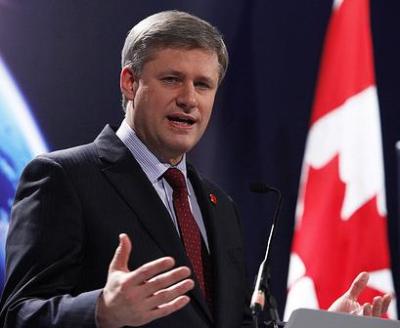
Prime Minister Stephen Harper

More news from up north. (H/T Ben)

Excerpt:

Federal government expenditures are set to fall next fiscal year by $16.5-billion, or 6.2%, with big cuts to regional development and environment programs, according to documents tabled Tuesday.

That would leave total expenditures for the 2011-12 year at $250-billion, with the bulk taken up by transfer payments to individuals and governments, and operating costs. Just over $30-billion of that expense is attributed to refinancing Canada’s debt.

The figures, contained in spending estimates provided by the Treasury Board, sees budget increases for departments entrusted with security and law enforcement – such as a 21% boost to jails — but cuts of roughly 20% to Environment Canada, Natural Resources Canada and Agriculture and Agri-Food Canada.

Government is supposed to be concerned with security and law enforcement, not with environmentalist wastefulness.

Here’s Paul Ryan. He would like to cut our budget by 6.2% – and maybe even more.

If Canada is cutting their government waste, then why can’t we?

There are a lot of programs that we could be cutting.

Excerpt:

The federal government could save billions in taxpayer dollars annually by consolidating duplicative government programs, according to a new report.

The newly-released report from the Government Accountability Office “makes us all look like jackasses,” Sen. Tom Coburn (R-Okla.) told reporters Monday night.

The conservative senator said the report — which identifies redundancies in more than 546 individual programs — reveals why the United States is $14 trillion in debt.

“Anybody who says we don’t look like fools up here hasn’t read the report,” he said.

[…]The GAO reviewed 34 areas (among them agriculture, defense and social services) where agencies, offices or initiatives have similar or overlapping objectives. The report also looked at 47 additional cost-saving opportunities related to more general government efficiency. For instance, the report said, “Improved corrosion prevention and control practices could help [the Defense Department] avoid billions in unnecessary costs over time.”

Addressing duplicative efforts on even a single issue could save billions, the report found. For instance, the GAO says the government could save up to $5.7 billion annually by addressing potentially duplicative policies designed to boost domestic ethanol production. Additionally, the Defense Department could save $460 million annually by making broader changes to the governance of its military health care system.

The report finds that there are 15 agencies involved in food safety, 80 programs involved in economic development and more than 100 involved in surface transportation. There are 10 agencies and 82 programs involved in teacher quality, and more than 20 agencies and about 56 programs involved in financial literacy efforts. There are about 2,300 investments across the Defense Department to modernize its business operations.

House Majority Leader Eric Cantor (R-Va.) said today that in order to foster long term economic growth, “we’re going to deal with the pressing issues of regulatory waste in our agencies, as well as long term issues facing our country with entitlement programs.”

This is why we have to stop giving private sector money to government. They don’t earn any money by making things or helping people – they don’t sell anything useful. They just steal money from the productive workers and businesses and then they waste it and run up trillion dollar deficits. This kind of corruption, fraud and waste would not survive in small businesses, and probably not even in big businesses. Business have to be efficient or they go bankrupt. They have to perform or their competitors will have them for lunch. The consumer is king in the private sector.

Related posts

Obama budget is a ten-year, $1.5 trillion tax hike over present law

Here’s the analysis of Obama’s budget. (H/T The Blog Prof)

Excerpt:

President Obama released his budget this morning.  Rather than focusing on Washington’s over-spending problem, the budget calls for higher taxes on families and small businesses to pay for even more government spending.  Under the Obama budget, tax revenues will grow from 14.4% of GDP in 2011 to 20% of GDP in 2021.  By comparison, the historical average is only 18% of GDP.

Tax hike lowlights include:

  • Raising the top marginal income tax rate (at which a majority of small business profits face taxation) from 35% to 39.6%.  This is a $709 billion/10 year tax hike
  • Raising the capital gains and dividends rate from 15% to 20%
  • Raising the death tax rate from 35% to 45% and lowering the death tax exemption amount from $5 million ($10 million for couples) to $3.5 million.  This is a $98 billion/ten year tax hike
  • Capping the value of itemized deductions at the 28% bracket rate.  This will effectively cut tax deductions for mortgage interest, charitable contributions, property taxes, state and local income or sales taxes, out-of-pocket medical expenses, and unreimbursed employee business expenses.  A new means-tested phaseout of itemized deductions limits them even more.  This is a $321 billion/ten year tax hike
  • New bank taxes totaling $33 billion over ten years
  • New international corporate tax hikes totaling $129 billion over ten years
  • New life insurance company taxes totaling $14 billion over ten years
  • Massive new taxes on energy, including LIFO repeal, Superfund, domestic energy manufacturing, and many others totaling $120 billion over ten years
  • Increasing unemployment payroll taxes by $15 billion over ten years
  • Taxing management capital gains in an investment partnership (“carried interest”) as ordinary income.  This is a tax hike of $15 billion over ten years
  • A giveaway to the trial lawyers—not letting companies deduct the cost of punitive damages from a lawsuit settlement.  This is a tax hike of $300 million over ten years
  • Increasing tax penalties, information reporting, and IRS information sharing.  This is a ten-year tax hike of $20 billion.

Add it all together, and this budget is a ten-year, $1.5 trillion tax hike over present law. That’s $1.5 trillion taken out of the economy and spent on government instead of being used to create jobs.

The “tax relief” in the budget is mostly just an extension of present law, and also some refundable credit outlay spending in the tax code.  There is virtually no new tax relief relative to present law in the President’s budget.

So then how can the Obama administration claim that they are being fiscally responsible? Let’s see how. (H/T Hyscience)

Excerpt:

The Obama administration’s statement that the government will not be adding to the debt by the middle of the decade clashes hard against the facts, Republicans say, leaving officials straining to justify the budget claim they’ve pushed repeatedly over the past few days.

As it turns out, the administration is not counting interest payments. That means the budget team plans to have enough money to pay for ordinary spending programs by the middle of the decade. But it won’t have the money to pay off those pesky — rather, gargantuan — interest payments. So it will have to borrow some more, in turn increasing the debt and increasing the size of future interest payments year after year.

So how then, visibly agitated Republicans asked, can the administration claim that its 2012 spending plan sets the country on a course to “pay for what we spend” in just a few years?

Hyscience also linked to this McClatchy news article.

Excerpt:

He overlooks the fact that the government still would have to borrow to pay interest on the debt, much of it run up on his watch. Despite achieving “primary balance” in fiscal 2017, the government would have to borrow $627 billion to pay $627 billion in interest. Interest payments would rise annually through 2021.

Debt would rise as well, according to Obama’s proposed budget. Despite the budget reaching “primary balance,” the total gross government debt would rise from $21.9 trillion in fiscal 2017 to $22.9 trillion in 2018, $24 trillion in 2019, $25.2 trillion in 2020 and $26.3 trillion in 2021.

In all, the debt would jump by nearly $4.5 trillion in the four years after the government supposedly would stop adding to the debt because it had achieved “primary balance” – and that’s according to his own budget.

And a non-partisan fact-checking organization has found that Obama is lying about the budget. You can bet that the mainstream media will be backing him up, though.

Fewer people are paying taxes because fewer people are married

Here is an interesting essay from The Family in America.

Here’s the problem:

Just two days before Tax Day this year, the Heritage Foundation was quick on the draw with a Backgrounder by Curtis S. Dubay citing IRS data showing that the bottom 50 percent of tax filers pay less than 3 percent of all income taxes. According to Dubay, “the rapid increase in the number of nonpaying tax filers caused by tax credits is leading the country to a dangerous tipping point.” Like other conservatives and libertarians, he fears that once the bottom half of tax filers pay no taxes whatsoever, they “could vote themselves an increasing share of government benefits at no cost to themselves.”

And here’s what’s causing the problem:

More important, this relatively new concern about the growth in the number of Americans paying no income taxes overlooks the social roots of the problem, particularly the decline of the most economically productive segment of the population: the married-two parent family.5 Consequently, few economic conservatives seem willing to connect the dots between the changing demographics of the American taxpayer, which Hodge at least acknowledges,6 and the growth of Americans paying no taxes. They seem more eager to blame the latter on the addition and expansion of refundable credits, especially the child tax credit, not changing demographics. Yet Roberton Williams of the Tax Policy Center, a joint project of the Urban Institute and the Brookings Institution, estimates that married couples are far less likely to be non-taxpayers in 2009 than single filers or head-of-household filers. In this last category, his model shows 72 percent paying no income taxes, the highest percentage of all tax filing categories. Only 38 percent of married-joint filers, and 26 percent of married-separate filers, pay no taxes.7

Indeed, the Tax Foundation’s own analysis of IRS data documents the decline in the proportion of married filers from 65 percent of returns in 1960 to 41 percent in the years 2000–02, and the dramatic growth of head-of-household filers, representing largely unwed mothers, from 2 percent to 15 percent during the same period. Moreover, looking at data from 2002 returns, the foundation finds that married couples, while they file less than half of all tax returns, pay nearly three-quarters of all income taxes paid by the American people.8 Even though the analysis does not include changes that might arise from the doubling of the child tax credit to $1,000 in 2003, the numbers nonetheless suggest that the growth in the number of Americans who pay no income taxes is driven more by the retreat from marriage than by the proliferation of credits in the tax code, as problematic as that might be. The numbers further suggest that if conservatives are serious about tax reform, they can no longer ignore the elephant in the room—the retreat from marriage and family life—that undermines the very economic growth they seek. Nor can they presume that a flatter tax system with lower rates and a wider base, favored by the  libertarian wing of the GOP, will lead to smaller government, as analysis by economist Gary Becker shows that countries with flatter tax systems tend to have larger governments.9 They must therefore be open to tax reform proposals that recognize the natural family as the social and economic ideal as well as reinforce the recovery of marriage and the child-rich family—not economic growth for its own sake—as centerpieces of American life.

This is yet another reason for fiscal conservatives to take notice that you cannot have economic growth if the traditional family is replaced with single-mother families. Single motherhood is not a situation where men are responsible and work hard as providers. It infantilizes men and rewards them for acting like nomads and barbarians. And the children who are raised without fathers are not going to be as mentally healthy or productive as the ones raised with fathers. The traditional family, with children raised by biological parents who are attached to them, is an important part of future economic growth. It’s all linked together – social conservatism and fiscal conservatism.