Tag Archives: Supply-side

Obamacare’s impact on ER wait times and low-wage workers

First, ER wait times. (H/T ECM)

Excerpt:

As the number of insured people goes up while health care reform takes place, the long waits and crowded lobbies at emergency rooms are anticipated to increase as well.

“We’re starting out with crowded conditions and anticipating things will only get worse,” American College of Emergency Physicians president Dr. Angela Gardner told the Associated Press.

Nearly 32 million more people will have health insurance as a result of changing health-care laws, and about 16 million are to be added to the Medicaid system, but that apparently won’t keep them out of the ER, the AP reported.

“Just because we’ve insured people [that] doesn’t mean they now have access,” Dr. Elijah Berg from Boston told the AP. “They’re coming to the emergency department because they don’t have access to alternatives.”

[…]Since 2006, when it began offering government-run health care to its residents, Massachusetts has been considered the test model for the federal health changes, requiring health coverage for everyone, but data has shown visits to the ER have continued to rise since the Massachusetts law took place.

ERs are already overly crowded, with the biggest users being those under the federal Medicaid plan. Many doctors limit the number of Medicaid patients that they see because of the low rate of reimbursement from the government.

Here’s what should have happened. Voters should have looked at Massachusetts and Tennessee and seen what government control of health care does to health care. Universal coverage increases demand, but supply stays the same because of onerous certifications, taxes and regulations that block new entrants. Somewhere along the line there will be a shortage. And that means waiting lists, abortion, denial of care, and eventually euthanasia in order to keep costs down.

But there’s more – from the Heartland Institute.

What about Obamacare’s impact on low-wage workers? (H/T Rob)

Excerpt:

The requirements of President Obama’s new health care regime could penalize low-wage workers and cause a further slowdown of hiring for positions at chain restaurants and other small businesses.

White Castle, a national fast food chain, recently announced it would slow planned expansion in the United States and curtail hiring at its numerous restaurant outlets thanks to Obama’s law, which the chain says will cut its earnings in half.

According to a White Castle representative, the requirement that employers pay a $3,000 fine to the federal government for every employee whose out-of-pocket cost of health insurance exceeds 9.5 percent of their income will destroy their business model.

[…]Diana Furchtgott-Roth, a health care analyst at the Hudson Institute in Washington, DC, says much of this process is out of the employer’s control.

[…]Furchtgott-Roth says this aspect of Obamacare is part of a larger trend toward government pricing low-skilled workers out of the U.S. economy.

“The burden of all these Obamacare provisions is going to fall more on America’s low-skilled workers—the workers at White Castle, Burger King, and so on. Because their labor will become more expensive for companies to use, we’re going to see more mechanized solutions, a trend that is already happening in Europe,” Furchtgott-Roth said.

Well, some of these people who don’t pay income taxes are certainly going to be getting a wake-up call. Larger companies like John Deere, Verizon, Valero, Caterpillar, etc. already announced that they were going to be taking huge hits to their bottom line as a result of Obamacare. All these good intentions and high-minded blabberings don’t amount to any benefits for American working families. Happy-talk wins elections, but it doesn’t pay the bills or feed the children.

Next time, we need to be more diligent at looking at what actually happens in other countries and even in our own states when people try to nationalize health care in order to provide universal coverage. We can have universal coverage – we just need to let people choose what level of coverage they want and we need to make market reforms to the health care industry. Choice and competition works better for consumers. That’s real health care reform.
Paul Ryan debates Robert Reich on Larry Kudlow show

Video is here. (9 minutes)

The topic is, “can you tax the rich without hurting the poor?” and on spending.

And one more. (1 minute)

Paul Ryan explains how GM repayed its government loans with other government loans.

How are big companies responding to Obamacare?

Caterpillar and John Deere. (H/T Hot Air via ECM)

Excerpt:

Caterpillar Inc. said Wednesday it will take a $100 million charge to earnings this quarter to reflect additional taxes stemming from newly enacted U.S. health-care legislation.

[…]The charge is expected to be a one-time cost, but Caterpillar has argued that higher taxes and other potential cost increases related to insurance coverage mandates in the legislation will hinder the company’s recovery this year after a 75% plunge in income during 2009.

“From our point of view, a tax increase like this cannot come at a worse time,” said Jim Dugan, a Caterpillar spokesman.

[…]Farm equipment maker Deere expects after-tax expenses to rise by $150 million this year as a result of the health care reform law President Barack Obama signed this week.

Most of the higher expense will come in Deere’s second quarter, the company said on Thursday. The expense was not included in the company’s earlier 2010 forecast, which called for net income of about $1.3 billion.

The law could raise expenses for large U.S. employers. Industrial companies, which typically have large numbers of retirees, may be among those facing the biggest bill. Caterpillar had argued before the legislation passed that health reform would put it at a disadvantage against global competitors.

And National Review reports on Verizon. (H/T ECM)

Excerpt:

Yesterday I posted a memo that Verizon sent to its employees concerning its view that the Democrats’ health-care bill would probably cause its costs to go up. Specifically, the memo keyed in on a change in the tax treatment of the Medicare Part D retiree drug subsidy. This is a subsidy that the government pays to employers that offer prescription-drug coverage to their retirees; it was created as part of the Medicare prescription-drug entitlement to encourage employers not to dump their retirees into the public system. As the Wall Street Journal editorial board reports today, the subsidy costs taxpayers $665 per person, “while the same Medicare coverage would cost $1,209.”

As part of their effort to keep their health-care bill deficit-neutral, the Democrats changed the law and exposed the subsidy to the 35 percent corporate income tax rate, adding $5.4 billion in revenue to the bill. In its memo to employees, Verizon warned that this tax change would make the subsidy “less valuable to employers, like Verizon, and as a result, may have significant implications for both retirees and employers.” This is a clear sign that Verizon and other employers will probably drop their retiree prescription-drug coverage, leaving Medicare Part D to pick up the slack.

UPDATE: More from National Review. (H/T ECM)

Excerpt:

AK Steele Holding Corp., “the third largest U.S. steelmaker by sales, said it will record a non-cash charge of about $31 million resulting from the health-care overhaul signed into law by President Barack Obama. The charge will be recorded in the first quarter of 2010.”

Valero Energy “will take a $15 million to $20 million charge to second-quarter earnings for the same reason.”

Medical-device maker Medtronic “warned that new taxes on its products could force it to lay off a thousand workers.”

And more from National Review. (H/T ECM)

Excerpt:

Wow: “U.S. companies employed 3.9 million fewer workers in January 2010 than they did one year earlier.”

If you will recall, when touting the stimulus, President Obama and his team declared that “a package in the range that the President-Elect has discussed is expected to create between three and four million jobs by the end of 2010 . . . More than 90 percent of the jobs created are likely to be in the private sector.”

90 percent of three million jobs would be 2.7 million jobs. Yet we’re 3.9 million lower than when we started.

To meet the goal by the deadline, the country would have to create 6.6 million jobs in the next nine months. or more than 733,000 jobs per month for three quarters of the year.

UPDATE 2: Now Business Week reports that AT&T is screwed.

Excerpt:

AT&T Inc. will book $1 billion in first-quarter costs related to the health-care law signed this week by President Barack Obama, the most of any U.S. company so far.

A change in the tax treatment of Medicare subsidies triggered the non-cash expense, and the company will consider changes to the benefits it offers current and retired workers, Dallas-based AT&T said today in a regulatory filing.

Hey! Do you know what causes outsourcing of jobs? DEMOCRATS. Democrats cause jobs to be shipped overseas. Democrats hate companies. Companies hire people. Democrats cause American manufacturing jobs to be shipped overseas. Democrats cause unemployment. That’s why the unemployment rate is double what it was under Ronald Reagan and George W. Bush. Democrats cause unemployment.

How do jobs get created, anyway?

Do you know what really works to create jobs?

I mean – do you know what actually has worked in the past to create jobs?

The Heritage Foundation reports:

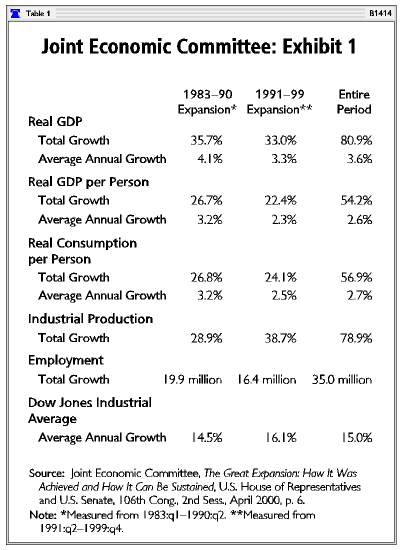
President Ronald Reagan’s record includes sweeping economic reforms and deep across-the-board tax cuts, market deregulation, and sound monetary policies to contain inflation. His policies resulted in the largest peacetime economic boom in American history and nearly 35 million more jobs.

See:

That’s what actually worked.

Free. Market. Capitalism. Works.