Couples who reserve sex for marriage enjoy greater stability and communication in their relationships, say researchers at Brigham Young University.
A new study from the Mormon college found that those couples who waited until marriage rated their relationship stability 22 percent higher than those who started having sex in the early part of their relationship. The relationship satisfaction was 20 percent higher for those who waited, the sexual quality of the relationship was 5 percent better, and communication was 12 percent better.
The study, published in the American Psychological Association’s Journal of Family Psychology, involved 2,035 married individuals who participated in a popular online marital assessment called “RELATE.” From the assessment’s database, researchers selected a sample designed to match the demographics of the married American population. The extensive questionnaire included the question “When did you become sexual in this relationship?”
Couples that became sexually involved later in their relationship – but prior to marriage – reported benefits that were about half as strong as those who waited for marriage.
[…]Sociologist Mark Regnerus of the University of Texas at Austin, who was not involved in the study, responded to its findings, saying that “couples who hit the honeymoon too early – that is, prioritize sex promptly at the outset of a relationship – often find their relationships underdeveloped when it comes to the qualities that make relationships stable and spouses reliable and trustworthy.” Regnerus is the author of Premarital Sex in America, a book forthcoming from Oxford University Press.
Because religious belief often plays a role for couples who choose to wait, Busby and his co-authors controlled for the influence of religious involvement in their analysis.
“Regardless of religiosity, waiting helps the relationship form better communication processes, and these help improve long-term stability and relationship satisfaction,” Busby said.
Young men and women growing up really need to be informed by their parents what they are going to want to be doing long term, and what they should be doing today to accomplish those goals. Young people benefit greatly from the guidance of older and wiser people, but in defining goals and defining the steps to reach those goals. To be a convincing parent, you have to be convinced yourself. And to be convinced yourself, you need to be seen as having knowledge, not just opinions, but knowledge. Having the right peer-reviewed papers at hand will help you to be a better parent.
My previous post on research showing how sex before marriage greatly reduces the stability of marriage.
Michael J. Behe, ‘Experimental Evolution, Loss-Of-Function Mutations and “The First Rule Of Adaptive Evolution”’, The Quarterly Review Of Biology, Volume 85, No. 4, December 2010
A.C. McIntosh, ‘Information and Entropy — Top-Down or Bottom-Up Development in Living Systems?,’ International Journal of Design & Nature and Ecodynamics, Vol. 4(4):351-385 (2009)
William A. Dembski and Robert J. Marks II, ‘Bernoulli’s Principle of Insufficient Reason and Conservation of Information in Computer Search’, Proceedings of the 2009 IEEE International Conference on Systems, Man, and Cybernetics, San Antonio, Texas (October 2009): 2647–2652
William A. Dembski and Robert J. Marks II, ‘Conservation of Information in Search: Measuring the Cost of Success,’ IEEE Transactions on Systems, Man and Cybernetics A, Systems & Humans, Vol. 39 (5):1051-1061 (September, 2009)
William A. Dembski and Robert J. Marks II, ‘The Search for a Search: Measuring the Information Cost of Higher Level Search,’ Journal of Advanced Computational Intelligence and Intelligent Informatics, Vol.14, No.5, 2010, pp. 475-486
Winston Ewert, George Montañez, William A. Dembski, Robert J. Marks II, ‘Efficient Per Query Information Extraction from a Hamming Oracle,’ Proceedings of the 42nd Meeting of the Southeastern Symposium on System Theory, IEEE, University of Texas at Tyler, March 7-9, 2010, pp.290-297
Winston Ewert, William A. Dembski and Robert J. Marks II, ‘Evolutionary Synthesis of Nand Logic: Dissecting a Digital Organism,’ Proceedings of the 2009 IEEE International Conference on Systems, Man, and Cybernetics. San Antonio, TX, USA – October 2009, pp. 3047-3053
Montañez G, Ewert W, Dembski WA, Marks II RJ (2010), ‘A vivisection of the ev computer organism: Identifying sources of active information’, BIO-Complexity 2010(3):1-6. doi:10.5048/BIO-C.2010.3
The blog post on ID.Plus has links to all the papers.
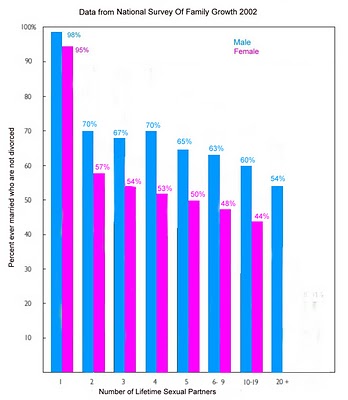
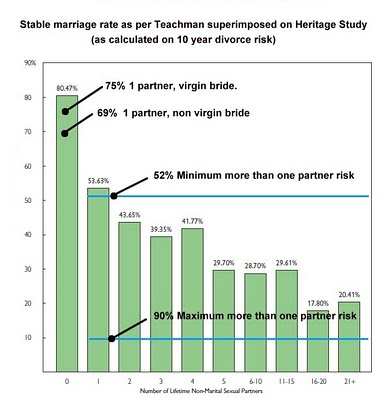
The results presented in this article replicate findings from previous research: Women who cohabit prior to marriage or who have premarital sex have an increased likelihood of marital disruption. Considering the joint effects of premarital cohabitation and premarital sex, as well as histories of premarital relationships, extends previous research. The most salient finding from this analysis is that women whose intimate premarital relationships are limited to their husbands—either premarital sex alone or premarital cohabitation—do not experience an increased risk of divorce. It is only women who have more than one intimate premarital relationship who have an elevated risk of marital disruption. This effect is strongest for women who have multiple premarital coresidental unions. These findings are consistent with the notion that premarital sex and cohabitation have become part of the normal courtship pattern in the United States. They do not indicate selectivity on characteristics linked to the risk of divorce and do not provide couples with experiences that lessen the stability of marriage.
[…]This limitation notwithstanding, the results presented here should shift attention away from research that focuses on the selection of individuals into cohabitation and premarital sex to a focus on the selection of individuals who do not marry the individuals with whom they first cohabit or initiate first sex. It may well be the case that, irrespective of the legal status of the relationship, the relevant distinction to make is between people who form multiple relationships and people who form a single, longer lasting relationship.
The graph:
Published in the Journal of Marriage and Family
(Click for larger image)
The Teachman study was not done by a conservative.
What is the point of a man being a virgin?
OK, I just wrote this part out in one fell swoop, and I am not sure if it is all relevant, but…
I wanted to consider the question of whether women should value the property of virginity in men from a Biblical perspective. Men have specific things they are supposed to do based on the Bible’s specifications. First, they have to be able to provide for the family financially. Second, they have to be able to protect the family from threats, including threats from false worldviews that lead to damage and destruction. Third, they have to be moral and spiritual leaders, nurturing their wives and children in moral values, moral duties, and their relationships with God.
Biblical men make good decisions all along their lives in order to satisfy these Biblical goals. In order to be a good provider, they study math and become engineers, which is hard and requires self-sacrifice. In order to be a good protector, they study science apologetics, philosophy of religion and the historical Jesus, which is hard and requires self-sacrifice. In order to be a good moral and spiritual leader, they guard their chastity and learn how to behave chivalrously, which is hard and requires self-sacrifice.
What women need to do is to do the research on everything including marriage/divorce/parenting, just like the research I talked about above, and generate a seriously Biblical set of criteria for choosing men that seriously satisfies the requirements for Biblical manhood. Women cannot expect good behavior from bad men. And they should actually affirm, approve, and encourage good behaviors in men – and not be resentful about having the obligation to build good men up with words and gifts.
What women need to do is to understand the behaviors that lead to stability and fidelity in a marriage – and that means studying research. Saying “I already know about the damage caused by divorce” is useless – it’s the knowledge of the evidence that changes how a woman makes decisions about men. Personal preferences can be changed at any time, but knowledge doesn’t vary depending on how you feel at any given moment.
For example, to test men for apologetics knowledge, it’s really easy – just ask them what the significance of cosmic microwave background radiation is, what chirality is, what the significance of 1 Corinthians 15:3-7 is, and what is the difference between the deductive and inductive problem of evil. If they can’t answer all four of those then you can’t marry them. Biblical manhood concerns are not check-boxes on the marriage application form – they’re long-form essay questions. Judging the man’s ability to do silly stuff, like get a tattoo or clown around in a bar, is just not relevant to making the marriage serve God. A woman’s personal preferences don’t decide here – evidence decides. (So long as the goal of marriage is to serve God, instead of to make women happy)
Men have a very specific role in marriages. They have to be able to teach the children about theology, apologetics and morality. When it comes to morality, women should not just believe what a man says. Instead, women need to look at what a man does. Specifically, she should look at what a man does representing his worldview, faith and morality to people who disagree with him. Go to his non-Christian co-workers and ask them what the man has told them about theology, apologetics and morality. Ask them for the reasons and evidences that were used in debates with them. That’s how you know what a man really thinks – it’s about what he is willing to say to people who he would rather not upset. Where standing up for the truth is really going to hurt his career and make him less popular. That is the true measure of his faithfulness. Not how well he speaks, sings and prays in church. What matters is whether he puts God above his own selfish needs for advancement and popularity. Is he willing to choose Christ over his own selfish desires? What is number one in his heart?
And finally, if a women chooses a bad man because she knows nothing about how to choose a good one, and hasn’t done any research about what a man has to be able to do to make a marriage stable, then she needs to stop blaming men and taking responsibility for her own poor decision-making. Choosing a man just because he makes you feel happy is not the best way to have achieve a stable marriage. You need to have better criteria than that, because you are going to answer for it later, especially if things go awry.
Evidence creates knowledge and knowledge binds the will
OK now back to the real topic of the post: the use of evidence to support Biblical moral values.
I like having evidence. I hate having to take stands for Biblical morality without evidence. If I can use the evidence for the Big Bang, the fine-tuning, the origin of biological information, the Cambrian explosion, the habitability fine-tuning and irreducible complexity to argue for theism, and then argue for the resurrection based on early sources and minimal facts, then I should have the exact same quality of data when defending moral values. If the Bible says something, I should be able to look at the best research and find that the Bible is correct.
You have to persuade a person during courtship by making them read and write about things, and dump them if they won’t do it. People can say anything during a courtship – make all kinds of promises and then suddenly just turn selfish and break them all. If they haven’t studied and tested these things out, because they think they know everything already, then you really can’t expect good behavior. It’s a crapshoot unless they’ve seen the evidence.

 WINTERY KNIGHT