Tag Archives: Student Loans

Is it “brilliant” to accumulate $185,000 of debt studying the humanities?

From the Des Moines Register, an article by Ms. Rehha Basu.

Excerpt:

Sixteen years ago, Patricia (P.J.) Johnston of Des Moines made the front page of this paper for collecting her diploma from Drake University at just 19. “Johnston was reading books on French existentialism while others her age were still buying comic books,” wrote reporter Tom Alex of the young woman who majored in religion and philosophy, dabbled in music and astronomy and found time to take part in online discussions on the Bible.

“I think I’m probably meant to be an academic,” Johnston was quoted as saying. And she has been, getting a master’s in one institution, going to seminary at another, doing field research in India in her area of interest — Indian Catholicism — and currently working toward a Ph.D in religious studies at the University of Iowa.

President Barack Obama came through Johnston’s university on Wednesday, where he said there is no greater predictor of success than a good education. “This country has always made a commitment to put a good education within the reach of everybody who’s willing to work for it,” Obama said. “That’s part of what made us special. … That’s a commitment that we need to reaffirm today.”

He talked about the untenable debt that’s limiting options for today’s college-goers — $25,000 on average — because tuition and fees have more than doubled since they were born.

Johnston didn’t get to hear him since she was teaching a class on Buddhism. But she knows a lot about educational debt. She has $185,000 in student loans to repay.

As it is, she sleeps on her office floor on the days she has to be in Iowa City, riding the Greyhound bus in from Des Moines. She helps support her mother with the approximately $16,000 she earns as a teaching assistant. But she is in danger of dropping out before getting her doctorate because she has hit her limit on loans, and most likely won’t be able to get a teaching assistant position next year because of cuts in undergraduate programs.

If that happens, she wrote me, she would be this far along, “facing the job market in my mid-30s with no marketable job skills of any kind.”

Johnston grew up on welfare and other forms of public assistance. Her divorced mother was unable to hold down a job for reasons that were never diagnosed. Johnston got through college with scholarships, grants, some help from her late grandmother, and only $18,000 in debt.

Student loans should not be connected to the government as they are now – they should be privatized. That way, taxpayers are not stuck with the bill if the person cannot make a career out of what they are studing. What is this person doing going abroad in India? What is she doing riding on Grayhounds? It makes no sense. If she had to go to a for-profit bank, then she would never get a student loan, because they know they would never get the money back. We have to have a system where people pay their own way, so that they can’t take risks with anyone else’s money but their own (or their loan guarantor’s). No taxpayer money should be available to them, and no taxpayer money should be given to subsidize universities, either – it just raises the cost of tuition. Once the number of students applying to the humanities is reduced because no loans are available, then tuition will come down for those who really intend to make a go of it.

I think a lot of the problem here comes from growing up without a father. Fathers teach their children to be practical because they worry more than mothers about the children not being able to be independent and fend for themselves.

UPDATE: The Captain comments on this story here.

UPDATE: This is from the woman’s Facebook page:

I have never asked anybody to pay my student loan debt for me, and I will pay it down someday, even if I have to eat ramen noodles for the rest of my life. I was willing to undertake my studies at any cost and at any degree of personal risk because I believe in God and I am convinced that I am doing what God is calling me to do. If you read the New Testament, you will find a great deal about how people are called to give up everything they own – houses and wealth and family and respectibility and everything else – to do whatever it is that God calls them to do. I am not brave and no longer optimistic, but I have tried to take God at his word.

I am not financing education entirely through student loan debt. I held work study jobs as an undergraduate, and have usually held some kind of on-campus employment. I have been a TA for the university for the last seven years. The fact is, government support of higher education is down and the cost of tuition has outpaced salaries to such a great degree in this country that virtually nobody is able to afford an education on their own wages without taking on a substantial burden of student loan debt. The vast majority of the anecdotes to the contrary concern degrees earned twenty or thirty years ago, before major structural changes in the financing of higher education – in the post-war years, government funding allowed the vast majority of expense for education to be met through Pell grants and scholarships, making it possible for many people to work themselves through school. That hasn’t been possible for most people in most degree programs for at least thirty years, and these nostalgic memories of an entirely different time and set of circumstances are not doing the debate on higher education financing in this country any good at all.

I am not a “professional student” nor am I taking an especially long time to pursue my degree – this is simply how long humanities education takes. http://chronicle.com/article/In-Humanities-10-Years-May/16231

If you only see value in STEM disciplines, I probably will not convince you that humanities education is valuable. There used to be a sense in this country that certain things had value and meaning in their own right, not simply because they produced nice technological gadgets or made bundles of money for businesses. Even conservatives such as Allan Bloom used to realize that it impoverishes us spiritually when we turn away from the humanities, the cultural legacy of Western society. Would that their political descendants had as much grace or wisdom.

She’s not being forced into this course of action. She’s choosing it deliberately, and she wants other people to pay to make her impractical flight from reality financially sound.
English professor decries the radicalization of the liberal arts on campus

From Pajamas Media, a post by a Canadian English professor at the University of Ottawa.

Excerpt:

When I finally landed a tenure-track position at a Canadian university, I was ecstatic and full of hope — exhilarated by the opportunity to teach students about literature and ideas and to have conversations with colleagues equally in love with literature and ideas. I didn’t realize that my experience as a university teacher of English would have much less to do with these passions than with the distortion of the university’s core mission in the name of pedagogical and political orthodoxy.

To begin with, the student writing that came across my desk left me aghast. I had taught before, but I was unprepared for the level of illiteracy, the stunted vocabularies, near-complete absence of historical knowledge, and above all the extraordinary apathy of many English majors. The most basic of expression rules — the difference between it’s and its, the incorrectness of “would of” for “would have,” the role of the apostrophe or semi-colon, the fact that “a lot” was two words — were beyond the grasp of the majority, no matter how often I reviewed grammar or devised mnemonic devices. And the sheer sloppiness and muddled thinking in the essays, where the titles of poems and authors’ names were frequently misspelled and dates were wildly inaccurate, suggested a fundamental indifference to the subject matter.

Not only was my students’ writing appalling, but I soon encountered their resentment at being told about it. “Who are you to tell me I can’t write?” was the attitude — once expressed in those very words. More than one student insisted that her other teachers had always rewarded her with high marks for her “creativity.” Most believed themselves more than competent. After sitting with one young woman explaining the cause of her failing grade, I was befuddled when her only response was a sullen: “This doesn’t exactly make me feel good.” When I responded that my job was not to make her feel good, she stood haughtily, picked up her paper with an air of injury, and left my office without another word. In her mind, I later realized, I had been unforgivably cruel.

I was up against it: the attitude of entitlement rampant amongst university students and nurtured by the utopian ideology that permeates modern pedagogy, in which the imposition of rules and identification of errors are thought to limit student creativity and the fostering of a hollow self-esteem takes precedence over the building of skills on which genuine self-respect might be established. In the Humanities subjects in particular — and in English especially, the discipline I know best — such a philosophy has led to a perilous watering down of course content, with self-validation seen as more important than the mastery of specific knowledge.

With this philosophy has come a steady grade inflation. The majority of students in English courses today can expect a B grade or higher merely for warming a seat and handing in assignments on time. The result, as I soon discovered, was a generation of students so accustomed to being praised for their work that when I told them it was inadequate, they simply could not or would not believe me. They seemed very nearly unteachable: lacking not only the essential skills but also the personal gumption to respond adequately to criticism.

I wonder what will happen when these students find out that the jobs they feel they are entitled to have have been shipped off to some country where young people don’t have all of this attitude, and where business owners pay a corporate tax rate less than half of what American businesses pay. My guess is that they will blame the very capitalists who warned them not to do what they did.

Unemployed college graduate ran up $90,000 of debt while studying English

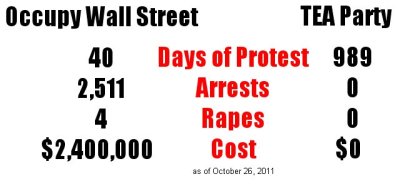
Occupy Wall Street vs Tea Party

And do you think he is out looking for jobs with his English degree? NO!

The L.A. Times explains. (H/T Dennis Prager)

Excerpt:

For almost a week, Nate Grant has sat cross-legged on a wall at the Occupy Wall Street encampment, holding a cardboard sign that bears his scrawled grievance: “Students Ought Not Be a Means of Profit.”

[…]It doesn’t take long before any conversation in the strikingly youthful crowd in Lower Manhattan turns to the loans many of the twenty-somethings have racked up. It’s not a central theme, like corporate greed and unemployment, but rather a subtext to all the chanting and marching.

Grant left Ithaca College in upstate New York in May with a degree in English and $90,000 in private and federal loans.

An honor student in high school, he could have had a “free ride” if he had gone to a public university in his home state. But he loaded up on student loans so he could enroll in Ithaca’s communications program to study film directing. Within a year, Grant became disenchanted with the program and switched his major.

Unable to find a good job that pays a decent wage using his degree, Grant decided this summer to join the military, hoping to take advantage of a student loan repayment program that could shave $60,000 off his debt.

“I just felt I had to do something to get this monkey off my back,” he said.

Since graduation Grant has been living with his parents in Little Egg Harbor, N.J., and doing odd jobs.

Oh, I hope this turnip doesn’t join the military. Although it would be good for him to get yelled at. It might help him to get his head out of his ass.

The entire student loan system should be privatized so that students who want to study subjects that are highly politicized cannot pay for it with anyone else’s money.

The use of taxpayer funds for college education has to be changed BEFORE the students can run up tens of thousands in debt. Loans should only be granted by corporations to students who are studying math, science, technology and engineering. It’s so easy for the government to hand out taxpayer money for degrees that are more about indoctrination than they are about producing a return on the investment. But it would be a lot less likely to happen if the person doing the lending actually expected to get the money back. We need to grow up as a society. There is no free lunch, somebody has to pay.

UPDATE: My bad, it looks as if some of the Occupy Wall Street protesters are being paid after all. Maybe he is one.

Excerpt:

The former New York office for ACORN, the disbanded community activist group, is playing a key role in the self-proclaimed “leaderless” Occupy Wall Street movement, organizing “guerrilla” protest events and hiring door-to-door canvassers to collect money under the banner of various causes while spending it on protest-related activities, sources tell FoxNews.com.

The former director of New York ACORN, Jon Kest, and his top aides are now busy working at protest events for New York Communities for Change (NYCC). That organization was created in late 2009 when some ACORN offices disbanded and reorganized under new names after undercover video exposes prompted Congress to cut off federal funds.

NYCC’s connection to ACORN isn’t a tenuous one: It works from the former ACORN offices in Brooklyn, uses old ACORN office stationery, employs much of the old ACORN staff and, according to several sources, engages in some of the old organization’s controversial techniques to raise money, interest and awareness for the protests.

Sources said NYCC has hired about 100 former ACORN-affiliated staff members from other cities – paying some of them $100 a day – to attend and support Occupy Wall Street. Dozens of New York homeless people recruited from shelters are also being paid to support the protests, at the rate of $10 an hour, the sources said.

At least some of those hired are being used as door-to-door canvassers to collect money that’s used to support the protests.

Sources said cash donations collected by NYCC on behalf of some unions and various causes are being pooled and spent on Occupy Wall Street. The money is used to buy supplies, pay staff and cover travel expenses for the ex-ACORN members brought to New York for the protests.

In one such case, sources said, NYCC staff members collected cash donations for what they were told was a United Federation of Teachers fundraising drive, but the money was diverted to the protests.

Sources who participated in the teachers union campaign said NYCC supervisors gave them the addresses of union members and told them to go knock on their doors and ask for contributions—and did not mention that the money would go toward Occupy Wall Street expenses. One source said the campaign raked in about $5,000.

I should have known that this was not so much grass roots as astroturf.