Tag Archives: Student Loan

Student debt forcing college graduates to put their plans on hold

First, from Yahoo News, some anecdotes to help everyone understand what faces young people trying to get an education and find a job. (H/T Captain Capitalism)

Excerpt:

We asked Yahoo News readers to tell us their experiences with student loan debt. Over 600 graduates (and not-quite graduates) of all ages emailed to share their stories. We’ll be sharing more of their stories in the next week over at our Tumblr.

Overwhelmingly, Yahoo News readers told us they felt burdened by their debt. “We do not like debt,” wrote Katelyn Fagan, who graduated from Brigham Young University in 2011. She and her husband have a combined student loan debt of just under $70,000. Fagan tried to work while in college, but wanted to focus on her academics. “Maybe I could have sought out other employment options (and I sometimes did) but school was my top priority.”

“Student loans have basically ruined my life,” says Tanya Carter, who graduated from the University of Toledo in 2008. She went to community college for two years before transferring, and attended classes part-time so she could also work. When Carter maxed out on federal loans, she turned to private loans to finish her degree. As a result of all that debt, she writes: “I never see myself owning a home, vehicle, or maybe not even getting married.”

The need to delay starting a family because of financial worries was a common concern. Lauren Dollard graduated from Fordham University in 2008 with $157,000 in debt, including interest. “My boyfriend won’t marry me because of my debt,” she says. “He doesn’t want it attached to his name (I know, this could also be an excuse).” She said she would trade her “fancy private school education” in a heartbeat to live “as an independent adult.”

April Flores graduated from San Diego State in 2008 with $80,000 in private loans and $30,000 in subsidized loans. “It is going to be hard to buy a house and start a family with our debt,” she writes. “We joke and say that our baby is Sallie Mae, but it is true! Education is invaluable, but I was not wise in my early 20s and did not make the right decisions when it came to my private loans.”

Flores was far from alone in bemoaning her failure to understand the implications of those promissory notes. Salvatore Aiello graduated from the University of South Carolina in 2009 with $68,000 in debt. “I blame ignorance in my pursuit of loans; my high school did a terrible job explaining our options when it came to financial aid,” he told us. “They made it seem that if I wasn’t rich or beyond poverty I would not have been able to go to college.” Aiello followed up with a second email—he and his girlfriend are now expecting their first child. They are, in his words, “very excited at the unexpected blessing but terrified.”

Here’s an article from the New York Times in which a professor explains what causes tuition rates to rise: (H/T Cato Institute)

ACADEMIC economists like to make fun of businesspeople: they want competition when they enter a new market but are quick to lobby for subsidies and barriers to competitors once they get in. Yet scholars like me are no better. We work in the least competitive and most subsidized industry of all: higher education.

We criticize predatory loans by mortgage brokers, when student loans can be just as abusive. To avoid the next credit bubble and debt crisis, we need to eliminate government subsidies and link tuition financing to the incomes of college graduates.

Nearly eight million students received Pell grants in 2010, costing $28 billion. In addition, the federal direct loan program, which allows nonaffluent students to get government-guaranteed loans at low interest rates, cost taxpayers $13 billion in 2010-11. Total subsidies to university education amount to $43 billion a year, including around $2 billion in Congressional earmarks — and that does not even include tax subsidies (for college funds); tax breaks (for university endowments, for example); and subsidies dedicated to research.

Just as subsidies for homeownership have increased the price of houses, so have education subsidies contributed to the soaring price of college. Between 1977 and 2009 the real average cost of university tuition more than doubled.

These subsidies also distort the credit market. Since the government guarantees student loans, lenders have no incentive to lend wisely. All the burden of making the right decision falls on the borrowers. Unfortunately, 18-year-olds aren’t particularly good at judging the profitability of an investment without expert advice, and when they do get such advice, it generally counsels taking the largest possible loan. The stock of student loans has reached $1 trillion, while the percentage of borrowers in default jumped to 8.8 percent in 2009 from 6.7 percent in 2007.

Last but not least, these subsidized loans keep afloat colleges that do not add much value for their students, preventing people from accumulating useful skills.

That article also contains the solution:

Investors could finance students’ education with equity rather than debt. In exchange for their capital, the investors would receive a fraction of a student’s future income — or, even better, a fraction of the increase in her income that derives from college attendance. (This increase can be easily calculated as the difference between the actual income and the average income of high school graduates in the same area.)

The solution is to privatize the entire student loan system, and make the loans conditional on future earnings. That way, universities will be chosen based on their ability to provide jobs to students, and students will have to justify to banks (who represent ordinary people who put money on deposit with an expectation of a return!) why they should get a loan and how they expect to pay it back.

But what has Obama actually done?

Let’s see:

The president, by way of administrative fiat, plans to continue redefining the federal student-loan industry, making taxpayers absorb the financial risks of federal direct lending and leading the country over a cliff into future funding shortfalls. On Wednesday, the president announced his executive order to reduce monthly student-loan payments, consolidate loans into direct loans, and offer loan forgiveness after 20 years, all in the name of college access.

President Obama’s executive action would cap monthly repayment at 10 percent of discretionary income and offer students an incentive for consolidating Federal Family Education Loans (FFEL) and direct loans into the direct-loan program, which administers loans directly to students, instead of having them issued by banks. Students will be given a 0.5 percent interest-rate reduction for switching to the direct-loan program.

But why the urgency to employ executive action to shift to the direct-loan program now? The federal government is currently lending to students at an interest rate of 6.8 percent while it is borrowing at less than 1 percent, and the difference is kept by the federal government and spent on other programs, like converting the popular Pell Grant program into an entitlement. The president is lobbying for more students to move to direct loans so that the government can spend the money elsewhere. As Rep. John Kline, chairman of the House Committee on Education and the Workforce, said, “It’s a pretty big slush fund.” Under the Healthcare and Education Reconciliation Act, all new federal student loans are now direct loans, but there are still $400 billion outstanding loans that are not.

But these “savings” are misleading, as future shortfalls are inevitable. These loans are riddled with risk. When pressed by a reporter about why students would want to pay back the loan if they will be forgiven anyway, Secretary Duncan simply said that “people want to do the right thing.” However, student-loan default rates have been increasing for nearly ten years and are now at 8.8 percent. On top of these high defaults, the jobless rate for Americans with at least a bachelor’s degree is now 5.1 percent, the highest since 1970.

As former CBO director Doug Holtz-Eakin wrote, “The Secretary of Education is now one of the top financial executives in the U.S., and Congress spent nearly all of the over-estimated ‘savings’ on the President’s health care reform and unaffordable education entitlements and will add more than a trillion dollars of risky loans to the national balance sheet by 2017.”

Just like the housing bubble, the Democrats have again made it easier for a certain segment of the population whose votes they wanted to borrow money – money that they now don’t have to pay back. Being a leftist means taking money away from people who earned it and giving it to others (students, universities) who don’t have to pay it back.

Related posts

Another looming debt crisis: law school students racking up $100,000+ in debt

Consider this scary article from the Competitive Enterprise Institute. (H/T Hans)

Excerpt: (links removed)

Federal financial aid policies haveencouraged law students to borrow increasing amounts to attend law school, despite the glut of lawyers (oddly, government policies encourage more people to go to law school, driving up law schooltuition, even as the Obama administration seeks to cut back on vocational education aimed at training the skilled blue-collar workers who are in desperately short supply in much of the country). The result, says law professor Brian Tamanaha, is a “Quickly Exploding Law Graduate Debt Disaster” in which most recent graduates of many law schools will never be able to pay off their staggering student loan debt. At the liberal Balkinization blog, Tamanaha notes that the average student has over $100,000 in debt just from law school at many schools…

[…]As one commenter noted earlier, federal financial aid and student loans have driven up law school tuition and student loan debt: “education loans . . . often have implicit government guarantees,” even those not explicitly backed by the government. As a result, “like the GSE’s, the supply of credit for education loans has continued to expand. So in a way colleges and universities, public and private have been in a bubble akin to the housing bubble. The benefits to the institutions are irresistible and so there is no way they will try to reign in costs and thus tuition. Not as long as students are willing and able to borrow.” When the bubble pops, taxpayers will be on the hook for countless billions of dollars (many graduates already are not repaying their student loans). “Why is college so expensive? A new study points to a disconcerting culprit: financial aid,” notes Paul Kix on page K1 of the March 25 Boston Globe. I and professors and education experts commented earlier on that study at Minding the Campus. Other studies also have concluded that increased federal financial aid, such as student loans, drives up college tuition, and you can find links to some of them here.

[…]When law school graduates are unable to pay off their student loans, lenders will come after their elderly parents who co-signed for the loans.  As the Washington Post notes, “Americans 60 and older still owe about $36 billion in student loans . . . Many have co-signed for loans with their children or grandchildren to help them afford ballooning tuition.”

According to the liberal New York Times, law schools do a woeful job of preparing students to practice law.

Excerpt:

The lesson today — the ins and outs of closing a deal — seems lifted from Corporate Lawyering 101.

“How do you get a merger done?” asks Scott B. Connolly, an attorney.

There is silence from three well-dressed people in their early 20s, sitting at a conference table in a downtown building here last month.

“What steps would you need to take to accomplish a merger?” Mr. Connolly prods.

After a pause, a participant gives it a shot: “You buy all the stock of one company. Is that what you need?”

“That’s a stock acquisition,” Mr. Connolly says. “The question is, when you close a merger, how does that deal get done?”

The answer — draft a certificate of merger and file it with the secretary of state — is part of a crash course in legal training. But the three people taking notes are not students. They are associates at a law firm called Drinker Biddle & Reath, hired to handle corporate transactions. And they have each spent three years and as much as $150,000 for a legal degree.

What they did not get, for all that time and money, was much practical training. Law schools have long emphasized the theoretical over the useful, with classes that are often overstuffed with antiquated distinctions, like the variety of property law in post-feudal England. Professors are rewarded for chin-stroking scholarship, like law review articles with titles like “A Future Foretold: Neo-Aristotelian Praise of Postmodern Legal Theory.”

So, for decades, clients have essentially underwritten the training of new lawyers, paying as much as $300 an hour for the time of associates learning on the job. But the downturn in the economy, and long-running efforts to rethink legal fees, have prompted more and more of those clients to send a simple message to law firms: Teach new hires on your own dime.

“The fundamental issue is that law schools are producing people who are not capable of being counselors,” says Jeffrey W. Carr, the general counsel of FMC Technologies, a Houston company that makes oil drilling equipment. “They are lawyers in the sense that they have law degrees, but they aren’t ready to be a provider of services.”

[…]Consider, for instance, Contracts, a first-year staple. It is one of many that originated in the Langdell era and endures today. In it, students will typically encounter such classics as Hadley v. Baxendale, an 1854 dispute about financial damages caused by the late delivery of a crankshaft to a British miller.

Here is what students will rarely encounter in Contracts: actual contracts, the sort that lawyers need to draft and file. Likewise, Criminal Procedure class is normally filled with case studies about common law crimes — like murder and theft — but hardly mentions plea bargaining, even though a vast majority of criminal cases are resolved by that method.

[…]“We should be teaching what is really going on in the legal system,” says Edward L. Rubin, a professor and former dean at the Vanderbilt Law School, “not what was going on in the 1870s, when much of the legal curriculum was put in place.”

Not only that, but the marketplace is saturated with lawyers already. When supply increases and demand decreases, prices fall. The new batch of lawyers are not going to be able to command the same salaries as the old batch.

Unemployed college graduate ran up $90,000 of debt while studying English

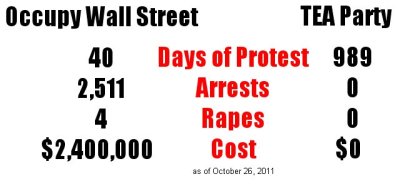
Occupy Wall Street vs Tea Party

And do you think he is out looking for jobs with his English degree? NO!

The L.A. Times explains. (H/T Dennis Prager)

Excerpt:

For almost a week, Nate Grant has sat cross-legged on a wall at the Occupy Wall Street encampment, holding a cardboard sign that bears his scrawled grievance: “Students Ought Not Be a Means of Profit.”

[…]It doesn’t take long before any conversation in the strikingly youthful crowd in Lower Manhattan turns to the loans many of the twenty-somethings have racked up. It’s not a central theme, like corporate greed and unemployment, but rather a subtext to all the chanting and marching.

Grant left Ithaca College in upstate New York in May with a degree in English and $90,000 in private and federal loans.

An honor student in high school, he could have had a “free ride” if he had gone to a public university in his home state. But he loaded up on student loans so he could enroll in Ithaca’s communications program to study film directing. Within a year, Grant became disenchanted with the program and switched his major.

Unable to find a good job that pays a decent wage using his degree, Grant decided this summer to join the military, hoping to take advantage of a student loan repayment program that could shave $60,000 off his debt.

“I just felt I had to do something to get this monkey off my back,” he said.

Since graduation Grant has been living with his parents in Little Egg Harbor, N.J., and doing odd jobs.

Oh, I hope this turnip doesn’t join the military. Although it would be good for him to get yelled at. It might help him to get his head out of his ass.

The entire student loan system should be privatized so that students who want to study subjects that are highly politicized cannot pay for it with anyone else’s money.

The use of taxpayer funds for college education has to be changed BEFORE the students can run up tens of thousands in debt. Loans should only be granted by corporations to students who are studying math, science, technology and engineering. It’s so easy for the government to hand out taxpayer money for degrees that are more about indoctrination than they are about producing a return on the investment. But it would be a lot less likely to happen if the person doing the lending actually expected to get the money back. We need to grow up as a society. There is no free lunch, somebody has to pay.

UPDATE: My bad, it looks as if some of the Occupy Wall Street protesters are being paid after all. Maybe he is one.

Excerpt:

The former New York office for ACORN, the disbanded community activist group, is playing a key role in the self-proclaimed “leaderless” Occupy Wall Street movement, organizing “guerrilla” protest events and hiring door-to-door canvassers to collect money under the banner of various causes while spending it on protest-related activities, sources tell FoxNews.com.

The former director of New York ACORN, Jon Kest, and his top aides are now busy working at protest events for New York Communities for Change (NYCC). That organization was created in late 2009 when some ACORN offices disbanded and reorganized under new names after undercover video exposes prompted Congress to cut off federal funds.

NYCC’s connection to ACORN isn’t a tenuous one: It works from the former ACORN offices in Brooklyn, uses old ACORN office stationery, employs much of the old ACORN staff and, according to several sources, engages in some of the old organization’s controversial techniques to raise money, interest and awareness for the protests.

Sources said NYCC has hired about 100 former ACORN-affiliated staff members from other cities – paying some of them $100 a day – to attend and support Occupy Wall Street. Dozens of New York homeless people recruited from shelters are also being paid to support the protests, at the rate of $10 an hour, the sources said.

At least some of those hired are being used as door-to-door canvassers to collect money that’s used to support the protests.

Sources said cash donations collected by NYCC on behalf of some unions and various causes are being pooled and spent on Occupy Wall Street. The money is used to buy supplies, pay staff and cover travel expenses for the ex-ACORN members brought to New York for the protests.

In one such case, sources said, NYCC staff members collected cash donations for what they were told was a United Federation of Teachers fundraising drive, but the money was diverted to the protests.

Sources who participated in the teachers union campaign said NYCC supervisors gave them the addresses of union members and told them to go knock on their doors and ask for contributions—and did not mention that the money would go toward Occupy Wall Street expenses. One source said the campaign raked in about $5,000.

I should have known that this was not so much grass roots as astroturf.