Tag Archives: Strategy

Should Christians expect to know God’s will by means of feelings and intuitions?

There are two views on the topic of decision making and the will of God. The view you learn in the church is called “the traditional view”. I call this view the feelings/intuition view. This view that elevates feelings / intuitions to the level of divine communications from God. The more practical view is called “the wisdom view”. I call this view the battlefield commander view. I am a proponent of the wisdom / commander view.

Let’s learn about the two different views:

[The traditional view is] that God has a plan for our lives and that we receive guidance through methods such as “open and closed doors”, “feeling led” and “the still, small, voice”.

[The wisdom view] holds that God does not have an “individual will” for our lives, but rather that all of God’s will can be summed up within two categories, God’s sovereign will and God’s moral will. Basically God’s sovereign will is all the things that god decrees will happen. It is hidden (mostly) from us, and does not play an active part in our decision, although some of it is revealed in the bible. God’s moral will is the part that we must concern ourselves with in making decisions. It is fully revealed in the bible and our decisions must be made within it. We may use wisdom in applying god’s moral will to our lives, or we may be in an area not covered by god’s moral will. We must finally submit in advance to God’s sovereign will, being prepared for him to sovereignty intervene and redirect us through whatever means he wills (see James).

Here’s a bit more from someone else:

Regarding the view that God has a personal will for us individually that we have to discern and find, J.I. Packer says, “The first thing to say is that the idea of guidance is actually a novelty among orthodox evangelicals. It does not go back farther than the last century. Second, it has led people to so much foolish action on the one hand, and so much foolish inaction on the other, as well as puzzlement and heartbreak when the ‘hotline’ to God seems to go silent, that it has to be discredited. Third, it must be said that Scripture gives us no more warrant constantly to expect personal ‘hotline,’ ‘voice-from-the-control-tower’ guidance than to expect new authoritative revelations to come our way for the guidance of the whole church.” (Hot Tub Religion, page 118).

As to the point of the question, how do I make decisions, I attempt to make decisions in light of three factors: God’s moral will, wisdom, and my personal desires. If something is opposed to God’s moral will, then I should obviously flee from it. If it’s not opposed, then I consider the wisdom of the choices. For example, would it be wise for me to marry a woman who loves Jesus, though we have nothing else in common? Probably not. If the options pass the criteria of wisdom, then I’m free to choose how I wish. If I’m offered two jobs, and both are honoring to God, and both would be wise to take, then I’m free to choose the job I would like more. I don’t need to put out a fleece or await some other confirmation from God. If it’s moral and wise, then the only question as to whether or not it will honor Him is my attitude.

Some examples of this model used in the Bible (in theological circles referred to as the Wisdom Model) are in Paul’s planning of a mission to Rome in Romans 1:9-15, 15:22-24, the Jerusalem Council (Acts 15:1-29), and Paul’s instructions for legal disputes (1 Cor 6:3-6).

The best book on this topic is Garry Friesen’s “Decision Making and the Will of God”. In it, you’ll find a full assessment about what the Bible teaches on this topic.

When I am trying to decide what will be effective, I look at Christian scholars, at their papers, books, and public debates. That’s effectiveness because it is addressed to a non-Christian audience in public with the force of reason and evidence. It is persuasion and it is addressed to rational minds. I want to change the minds of people who have a large influence on society on the whole. I don’t think that offering Christianity as life-enhancement or self-help is really “having an influence”. I think that offering Christianity as truth, with support, is “having an influence”.

So let me be clear about what I believe:

  • I don’t think that God normally talks to people directly
  • I don’t believe that life is an Easter egg hunt, filled with clues accessible only to emotion and intuition
  • I don’t believe that God expects people to discover a specific will for their lives using non-rational means
  • I think that people make up their own life plan that is consistent with the Bible
  • The goal of the life plan is to be effective, and there are no other considerations
  • I think that there are many good things a person can do, but that some are more effective than others
  • I think that with respect to the goal of serving God effectively, my happiness is expendable
  • I don’t think that the purpose of doing something for the Lord is to feel good about ourselves
  • I don’t think that people should choose ineffective things to do just because they like them
  • I don’t think that people should choose ineffective things to do just because they are good at them
  • I think people should do hard things that they don’t like – as long as it’s more effective
  • I don’t think that any course of action is as effective as any other – some plans accomplish more
  • I don’t think that life is totally unpredictable and irrational and subjective
  • I think that we can know what is or is not effective by studying and learning about the world
  • I think life is like a battlefield that must be surveyed, understood and acted upon deliberately

I think that every person is the commanding officer of his or her own life, and each person must study everything they can, make a plan that is consistent with the Bible’s moral prescriptions, execute the plan and achieve whatever they can achieve for the Lord. And the goal is not comfort or happy feelings, but real achievements. Not for the purpose of being saved, of course, because salvation is a free gift of God because of what Jesus did on the cross. Life is more like a battle than a vacation resort or a buffet or a shopping center. God’s will for us is not have happy feelings, but that we freely choose to sacrifice ourselves out of obedience and service to him. In my case, that means studying hard things, making money, saving money, and giving money away to good scholars, sponsoring good events and being persuasive to non-Christians. None of this necessarily makes me happy, but it does work to bring glory to God. I cried when I had to learn calculus, because it was so hard. But who cares? The main thing is that I have money now to sponsor Christian speakers or to give books to Christians to read, and God is happy with that.

I think that it is very important to realize that God is not impressed by our not being smart and not being effective. If we have the ability to be smart, then we should be smart, whether it makes us happy or not. If we have the ability to make money, then we should make money, whether it makes us happy or not. If we have the ability have a great influence, then we should have a great influence, whether it makes us happy or not. There will be plenty of time for happiness after we’re dead. But this life is a time of serving, and we should try to serve effectively, whether it makes us happy or not. With respect to God’s purposes in the world, my happiness is expendable.

Whenever someone questions my goals and plans by saying that I am asserting my will over God’s will, the first question I want to ask that person is this: “how do you know what God’s will is?” and “what is your basis for thinking that my plan to serve will not be effective?”. I want to know if I have misunderstood something about the way the world is, or miscalculated in some way. I want someone to look at my calculations and show where they are going to produce a less optimal result for the Lord. That’s the only concern I have – effectiveness for the Lord. Usually what I have found is that the other person wants to make the purpose of life their own happiness, and it makes them happier to choose what to do moment by moment, without having to study anything or make plans. It’s not that they have better goals (for God) or better plans (for God). It’s that they want their goals to be above God, and they don’t want to make plans other than to do whatever makes them happy.

This article by Greg Koukl may be helpful.

And I also found this summary of the Friesen book useful:

In nine parts.
On wargames, history and heroes: “this story shall the good man teach his son”

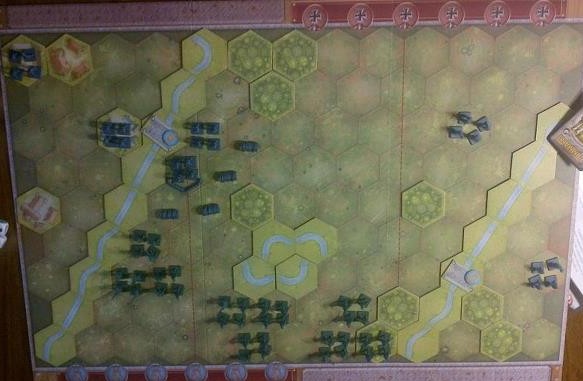
Memoir '44: Pegasus Bridge setup
Memoir ’44: Pegasus Bridge setup

Reposting this old post because Dina and I spent Friday night playing games again! And this is one of my favorite posts. Last night was Portal 2 and Orcs Must Die! 2.

Last night, I played through the Pegasus Bridge scenario from the Memoir ’44 wargame with Dina a few times. We actually played the online version of the game, using Steam. She was very gracious to play a wargame with me, which I don’t think is necessarily the first thing on most women’s lists of things to do on a Thursday night! I appreciated her agreeing to learn how to play and then playing with me several times. I think that Christians need to plan and execute more “together” activities like that – activities that involve interaction, co-operation, communication and engagement. We try to avoid doing things where we are both spectators. Playing wargames is not the only thing we do – we also do Bible study and cooking lessons (for me), for example.

Anyway, the point of this post is to express the deeper meaning behind playing wargames. I think that it is important to recognize and celebrate those who have demonstrated good character, whether it be now, or in the past. I think that it is important for us to search out the best role models ourselves, so that they will influence the way we act in our own lives. The second world war was a clear example of good versus evil. Anyone on the Allied side who demonstrated bravery and courage should be celebrated for safeguarding the security, liberty and prosperity that we enjoy today. In the case of Pegasus bridge, the hero is Major John Howard of the British paratroops.

Here is a quick re-cap of his exploits that day from the New York Times:

Maj. John Howard, the commander of glider-borne British infantrymen who seized the strategically vital Pegasus Bridge in the first battle of the D-Day invasion of Normandy, died Wednesday in a hospital in Surrey, England. He was 86 and had lived in Burford, near Oxford.

Under cover of night on June 6, 1944, six gliders carrying 181 officers and men of the Second Oxfordshire and Buckinghamshire Light Infantry landed on the eastern flank of a 60-mile invasion front on the northern coast of France. The regiment had a heritage going back to the battles of Bunker Hill and New Orleans, to Waterloo and to World War I. Now its soldiers were in the vanguard of the invasion of Hitler’s Europe.

Major Howard’s D Company was ordered to seize two bridges, one over the Caen Canal and the other spanning the parallel Orne River. If the Germans held on to those bridges, panzer units could move across them in a counterattack isolating 10,000 British paratroopers jumping behind the British invasion beach known as Sword, where infantry forces would arrive at daybreak. And Major Howard’s men sought to strike swiftly to prevent the Germans from blowing up the bridges if they were overwhelmed; the British needed those bridges to resupply their airborne units.

British Halifax bombers towed the gliders over the English Channel, then cut them loose.

Major Howard’s lead glider landed at 12:16 A.M., only 50 yards from the Caen Canal bridge, but the glider’s nose collapsed on impact, knocking everybody aboard unconscious for a few seconds. The soldiers quickly emerged, and over the next five minutes the men directly under Major Howard killed the surprised German defenders.

The nearby Orne River bridge was captured by other troops in Major Howard’s unit, and soon the words ”Ham and Jam,” signifying mission accomplished, were radioed to the airborne.

Two British soldiers were killed and 14 wounded in the operation.

Over the next 12 hours, British paratroopers and commandos reinforced Major Howard’s men, and British forces were able to move toward the city of Caen, their flank having been protected by the capture of the bridges.

On July 16, Major Howard received the Distinguished Service Order, Britain’s second-highest award for valor. On the 10th anniversary of D-Day, he received the Croix de Guerre Avec Palme from the French Government, which had renamed the Caen Canal span Pegasus Bridge, for the flying horse symbolizing the British airborne. The road crossing the bridge was later renamed Esplanade Major John Howard.

Why is this important? Well, it’s important to think on the things that are excellent. There are so many things in the culture that are not excellent that we are confronted with every day. We have to make it our business to do things together where goodness is celebrated. Especially when manly virtues like courage are celebrated. We don’t do that much anymore. And I think there’s a connection between wargames and Christian apologetics that we need to deliberately encourage.

Here’s an excellent passage from Shakespeare’s “Henry V” that makes the point:

This day is called the feast of Crispian:
He that outlives this day and comes safe home,
Will stand a tip-toe when this day is named,
And rouse him at the name of Crispian.
He that shall live this day, and see old age,
Will yearly on the vigil feast his neighbours,
And say, ‘To-morrow is Saint Crispian:’
Then will he strip his sleeve and show his scars,
And say, ‘These wounds I had on Crispin’s day.’
Old men forget: yet all shall be forgot,
But he’ll remember with advantages
What feats he did that day. Then shall our names,
Familiar in his mouth as household words,
Harry the King, Bedford and Exeter,
Warwick and Talbot, Salisbury and Gloucester,
Be in their flowing cups freshly remembered.
This story shall the good man teach his son;
And Crispin Crispian shall ne’er go by,
From this day to the ending of the world,
But we in it shall be rememberèd;
We few, we happy few, we band of brothers;
For he to-day that sheds his blood with me
Shall be my brother; be he ne’er so vile
This day shall gentle his condition:
And gentlemen in England, now a-bed
Shall think themselves accursed they were not here,
And hold their manhoods cheap whiles any speaks
That fought with us upon Saint Crispin’s day. (4.3.43)

This is from the famous speech in which King Henry charges his men to fight well before the famous Battle of Agincourt.

You can read more about the history of the British Airborne division and Pegasus bridge. The famous historian of the second world war Stephen E. Ambrose also wrote a history of the Pegasus bridge battle, called “Pegasus Bridge: June 6, 1944“. You won’t find many military historians better than Stephen E. Ambrose!

You might be surprised how many men are interested in military history and wargames, precisely because men instinctively look up to men like John Howard who embody qualities like bravery and courage. We have a dearth of moral character in this society. And we don’t do much to teach young men about manly virtues, even in the church. I think that it is important for us to think of creative ways for us to present good character to our young men. Young women should also learn about good character, because they must separate out the good men from the bad when they are courting.

Thanks to Dina for helping me to edit this post!

CBO report: Social Security to be bankrupt by 2030

From Investors Business Daily.

Full text, because this matters:

The $2.8 trillion Social Security Trust Fund is on track to be totally spent by 2030, the Congressional Budget Office said Tuesday.

That’s one year earlier than projected in 2013 and a decade earlier than the CBO estimated as recently as 2011.

The CBO delivered the warning in a gloomy long-term budget outlook that shows federal debt reaching 106% of GDP in 25 years, up from 74% now.

The rising debt would come despite revenue rising by 1.8 percent as share of GDP (from 17.6% to 19.4%)from 2014 to 2039 and despite spending other than health entitlements, Social Security and debt service shrinking by 2.5% of GDP (9.3% to 6.8%).

The challenge: Health care spending will rise by 3.1 percent of GDP (4.9% to 8%) and Social Security 1.4 points of GDP (4.9% to 6.3%), which will in turn push interest on the debt up to 4.7% of GDP from 1.3%.

Social Security’s cliff, now just 16 years away, is one that Washington would be crazy to approach. At that point, incoming revenue would be enough to pay less than 75% of scheduled benefits for all beneficiaries, whether just reaching retirement or 100 years old.

Up until the point of exhaustion, the trust fund provides legal authority — though no resources — for the government to pay all benefits despite Social Security’s burgeoning cash-flow deficit, which the CBO expects to reach $320 billion in 2024 alone.

The rapid deterioration in Social Security’s finances has a number of contributing factors. The drawn-out recovery from the deep recession and the extended period of low interest rates have sapped revenue and lowered the interest that Treasury pays to the trust fund based on program surpluses from 1984 to 2009.

On top of that, the CBO expects the underinvestment and long-term unemployment associated with the less-than-stellar recovery to have a lasting impact, boosting the natural rate of unemployment.

In February, the CBO significantly reined in its economic optimism, slashing its projection of the total amount of wages and salaries over the 2015-2023 period by about $3.2 trillion, or 3.6%.

Among the factors that the budget scorekeeper cited was ObamaCare’s work-diminishing effect, which the CBO now estimates to be three times as large as it supposed in 2010.

The CBO said that ObamaCare would reduce employment by 2 million full-time-equivalent workers in 2017, rising to 2.5 million in 2014.

This reduction would result in a decline in aggregate employee compensation averaging 1% from 2017 through 2024, or $1.05 trillion.

An IBD analysis pegged the revenue hit to Social Security from ObamaCare work disincentives at about $120 billion through 2024.

The reduced payroll-tax contributions into Social Security would, over time, result in modestly lower benefits for those who choose less work, but the cost savings from reduced benefits would offset only a portion of the lost revenue.

The nature of Affordable Care Act subsidies — they rise as income falls and decline as income rises — will make work “less attractive” by “creating an implicit tax on additional earnings,” the CBO said.

The work disincentive will lead some people to choose to work less, in part because subsidized health care will enable them to get by with less work.

In addition, the CBO expects ObamaCare to depress wages for lower earners when employers, over time, pass along the cost of the law’s employer-insurance mandate by holding back on wage increases. Lower wages, in turn, will provide another reason for some people to opt for less work, the CBO says.

While the CBO expects compensation to be lower “almost entirely” because people will choose to supply less work, the CBO also expects that some employers “will respond to the penalty by hiring fewer people at or just above the minimum wage.”

Another important factor clouding Social Security’s future: A greater share of earnings goes to those with income above the maximum subject to payroll taxes ($117,000 in 2014).

As a result, while rising longevity and the retirement of baby boomers will make benefits grow faster than the economy, Social Security’s tax revenue is expected only to keep pace with economic growth.

Look. I think there’s practical wisdom in this CBO report for Christians. We have to take into account data like this when making our life plans. And it’s not only Social Security we need to be scared of, Medicare is even MORE insolvent than Social Security. If you are under 40, these programs are not going to be there for you. You have to make other plans. You can’t be running your life plan as if these threats do not exist, because they do. Now I want to talk about how a defensive plan can be better than an offensive plan.

The neutral zone trap

Think of ice hockey and the neutral zone trap defense:

The defending team sets up so four players-usually both wings and both defense-remain in the neutral zone, while the center forechecks into the offensive zone. The center’s job is to block the passing lanes from the puck carrier, forcing him to carry the puck forward into the neutral zone. Once the puck carrier reaches the neutral zone, the center stays toward the center of the ice, forcing the puck carrier along the boards. Two of the other defending team’s players collapse in on the puck carrier, forcing him to dump the puck into their zone, forcing a turnover.

This plan allowed the New Jersey Devils to win the Stanley Cup against the high-powered Detroit Red Wings in 1995:

The following season, shortened by 34 games because of a lockout ordered by NHL owners, the Devils entered the playoffs as the No. 8 seed in the conference, with only a 22-18-8 record. In the West, the Detroit Red Wings looked invincible, cruising to the Stanley Cup Finals behind a galaxy of offensive stars.

But that’s when Lemaire went to work, putting his Devils through daily lessons in the trap, preaching constantly about being in the right defensive position at all times. It was hard, but it worked. The Devils upset three higher seeded Eastern teams to get to the Stanley Cup Finals, but remained prohibitive underdogs against the Red Wings.

Many predicted a sweep – and that’s what happened. What nobody predicted was that it would be the Devils who did the sweeping, thanks to a stifling trap that limited Detroit to seven goals in four games.

“They frustrated the heck out of us,” former Red Wings defenseman Mike Ramsey told the St. Paul (Minn.) Pioneer Press. “You weren’t trying to beat one guy. You were trying to beat four. They had enough talent and size where they didn’t have to play that way. But they knew what they were doing. Every player was on the same page.”

When coaches across the NHL saw how Lemaire was able to totally shut down such a great offensive team, the trap began to be copied by almost everyone. Roger Neilson had implemented a form of the trap with the expansion Florida Panthers from 1993-95, and his successor, Doug MacLean, took it even further. The neutral zone became almost impossible to navigate against the Panthers in the 1996 playoffs, and Florida suddenly found itself in the Stanley Cup Finals against the offensive-minded Avalanche. Criticized by the media about the trap, MacLean responded, “I like boring”.

Yes, and he likes winning,too. Sometimes people who appear to be risk-averse seem “scared” to others… but what matters is the scoreboard.

I hate to see young people making life plans while ignoring real life obstacles. The national debt, the demographic crisis, fertility (for women), etc. are real problems. Let’s take these threats into account when we are planning our lives. It’s just unwise to think that we can do whatever we want and then count on God to bail us out. We need to be practical. We live in challenging times, and we need to have prosperity and stability in order to protect our faith from external threats which are so often the root of despair and apostasy. The score on the scoreboard is not related to who took the biggest chances and felt the most excitement, it’s related to who actually scored. I feel excited when I win.