Tag Archives: Stimulus

CBO: Obama administration’s budget deficit is $1.17 trillion so far this fiscal year

Democrats control the House and Senate in 2007

From CNS News:

The federal deficit topped $1 trillion in the first 11 months of fiscal year 2012, according to the Congressional Budget Office, reaching $1.17 trillion, exceeding CBO’s August projections.

“CBO estimates that the Treasury Department will report a deficit of $1.17 trillion for the first 11 months of fiscal year 2012,” CBO said Monday.

CBO estimated that the government ran a $192 billion deficit during the month of August, up from the $70 billion deficit it ran in July.

In its updated projections, CBO estimated that the government will run a $1.13 trillion deficit in fiscal year 2012, which ends on Sept. 30 of this year. In order to hit that target, the government will actually have to run a surplus during September of $40 billion.

The government ran a $1.3 trillion deficit in fiscal year 2011, a figure the government could once again reach if its September deficit is as large as its August deficit.

I think it’s a safe bet that we’ll hit $1.3 trillion again for fiscal year 2012.

Recall that the last Republic budget, when Republicans still held the House and Senate, was $160 billion. Then Nancy Pelosi and Harry Reid came to power, and we are now in debt nearly $8 trillion more since the Democrats took over the budget in January of 2007. They have not submitted a new budget in almost 3 years – we are locked in to the high spending from their last massive budget.


A closer look at the Obama administration’s $525 million loan to Solyndra

From the Manhattan Institute. (H/T Tom)

Here’s the first thing to note about this story:

Both Republican and Democratic administrations have practiced a “green” industrial policy by supporting ventures that promised to pursue renewable, non-carbon-based energy production or energy conservation.

The DOE’s authority to issue loan guarantees for innovative, clean energy technologies, the Energy Policy Act of 2005, was passed by a Republican House and Senate and signed into law by George W. Bush. Under the law, Congress authorized the issuance of $4 billion in loan guarantees in 2007, and $47 billion in 2009 with the objective of encouraging the development of new technologies. [2] [3]

However, no DOE loan guarantees were made during the Bush administration. The DOE wanted to make a loan to Solyndra, but career officials at the Office of Management and Budget (OMB) did not approve it, on the grounds that the project was not financially sound.

The Section 1705 Loan Program was created by the 2009 American Reinvestment and Recovery Act, which amended the Energy Policy Act of 2005.[4] The 2009 stimulus bill gave the DOE an additional $3.95 billion for loan guarantees.[5]

So that’s where the money came from. It was “stimulus” money. And now the shocking part:

By November 2008, Solyndra had raised $450 million from investors and was applying for a loan guarantee from the DOE under the Energy Policy Act of 2005. But the loan was turned down in January 2009 in the waning days of the Bush administration, on the grounds that “there is presently not an independent market study addressing long term prospects for this company” and “there is concern regarding the scale-up of production assumed in the plan for Fab 2,” a second factory.[7]

On January 13, 2009, Lachlan Seward, director of the loan program at the DOE, wrote, “After canvassing the Committee it was the unanimous decision not to engage in further discussions with Solyndra at this time.”[8] Lachlan was referring to the DOE Credit Committee, which was composed of DOE officials.

When President Obama took office days later, the DOE’s tone changed. In a March 10, 2009, e-mail to an unnamed official, a senior adviser to Energy Secretary Steven Chu wrote, “The solar co [sic] board approved the terms of the loan guarantee last night, setting us up for the first loan guarantee conditional commitment for the president’s visit to California on the 19th.”[9] As events soon revealed, March 19, 2009, was a wildly premature target date for a presidential visit. In fact, President Obama didn’t visit Solyndra until May 2010.

E-mails dated 2009 depict White House and DOE officials rushing to sign off on the project so that Vice President Joe Biden could appear at the Fremont plant in September 2009 to trumpet the administration’s support for green jobs. There was confusion about who would go and when, as well as a palpable sense of urgency. Within the OMB—historically the most fiscally conservative agency in any administration—there was anxiety about premature planning and precedent.

On March 10, 2009, an OMB official whose name was blacked out by the administration before the e-mails were released to Congress wrote, “DOE is trying to deliver the first loan guarantee within 60 days from inauguration (the prior administration could not get it done in four years). This deal is NOT [sic] ready for prime time.”[10]

[…]On August 31, 2009, an unidentified OMB official wrote to Terrell McSweeny, domestic policy adviser to Vice President Biden, saying “We have ended up in the situation of having to do rushed approvals on a couple of occasions (and we are worried about Solyndra at the end of this week). We would prefer to have sufficient time to do our due diligence reviews and have the approval set the date for the announcement rather than the other way around.”[12] Regardless of these concerns, the loan was approved on September 3, and Biden announced it via satellite at Solyndra’s plant on September 4.

[…]On May 24, 2010, Valerie Jarrett, senior adviser to the president, forwarded a Cleantech Blog post by Philip Smith to Ron Klain, chief of staff to Vice President Biden. The post outlined the doubts of Pricewaterhouse Coopers, Solyndra’s auditors, about the company. It stated, “On a pure business analysis you have to agree with the auditors—they are not a going concern.”[14] Jarrett said to Klain in an e-mail, “As you know, a Going Concern letter is not good. Thoughts?”[15]

Although Jarrett and Klain knew that Solyndra would go under, two days later, on May 26, 2010, the president visited the newly built Solyndra manufacturing plant in Fremont, California, and declared, “It is here that companies like Solyndra are leading the way toward a brighter, more prosperous future …. We can see the positive impacts right here at Solyndra.”

Fascinating. This is what the government does with the money that it is borrowing from your children. This is what the “stimulus” efforts of the Obama administration amounted to. Not only was the Solyndra loan an opportunity to pay back a Democrat campaign fundraiser, but we now learn that it was also rushed through to provide Obama with a publicity opportunity. Is that the main job of the President of the United States? To waste money on photo opportunities?

U.S. GDP growth slows to 1.5% in second quarter

Remember, Democrats took the House and Senate in 2007
Democrats took the House and Senate in January 2007

From CBS Marketwatch.

Excerpt:

The U.S. economy slowed sharply in the second quarter, growing just 1.5% as consumers slashed spending and businesses grew more cautious about hiring and investing, underscoring that an already wobbly recovery is losing even more steam.

In the U.S., though, new government figures showed that growth in gross domestic product, the broadest measure of goods and services churned out by the economy, slowed sharply from the first quarter’s 2% annual rate and the fourth quarter’s 4.1%.

That downward slope in growth is worrisome to economists. As the economy loses steam, a pullback can become self-reinforcing as businesses and consumers worry about the future.

The slowing economy, along with government data showing the recovery has been weaker than thought, raises the specter that a sudden shock—such as an escalation of Europe’s crisis, or next year’s looming tax increases and spending cuts—could shove the U.S. back into recession.

[…]One of the biggest obstacles to recovery is a dearth of consumer spending, which accounts for two-thirds of demand in the economy.

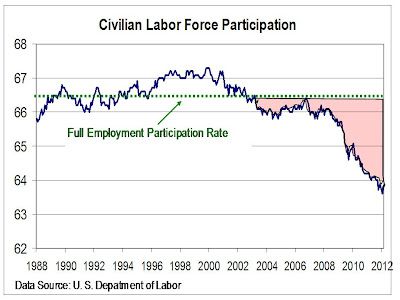
Spending rose 1.5% in the second quarter, lower than 2.4% in the first, reflecting weaker demand for cars and big-ticket items. A big reason is the stagnant labor market. Employers added fewer jobs in the second quarter than they have since the labor market began recovering in 2010.

“The economy is kind of being strangled,” said Bob Baur, chief global economist at Principal Global Investors. “We underestimated how much uncertainty may have contributed to a lack of desire to expand and hire.” Mr. Baur expects 2% to 2.5% growth in the second half of the year but has “grown more cautious,” he said.

[…]Businesses, meanwhile, appear to have grown more cautious about spending. The new GDP report showed that nonresidential fixed investment expanded 5.3% in the second quarter, less than the 7.5% in the first, though spending on equipment and software was healthy. Joseph Carson, an economist at Alliance Bernstein, said: “Uncertainty surrounding U.S. tax laws has created confusion and concern among companies, which has probably depressed investment spending.”

Remember, the Obama administration thinks that higher government dependency “stimulates” the economy:

House Minority Whip Steny Hoyer (D-Md.) said Tuesday that food stamps and unemployment insurance are the two “most stimulative” things you can do for the economy.

During a pen and pad briefing with reporters on Capitol Hill, Hoyer was asked if any Democrats are “reconsidering the wisdom” of letting the Bush tax cuts expire at year’s end for the top income earners given the still struggling U.S. economy.

“I haven’t talked to any who are of that mind,” said Hoyer. “If you talk to economists, they will tell you there are two things that are the most stimulative that you can do — one’s unemployment insurance, the other’s food stamps, okay?”

Of course, all that spending on unemployment and food stamps costs money, so they just borrowed that money from future generations of Americans – your children. The national debt is nearly $16 trillion, but they just keep borrowing. They don’t know what else to do, because they have no idea how jobs are created in the first place.

Republicans think that the best way to stimulate the economy is to create jobs by encouraging businesses to risk their capital in business ventures. But the Republicans aren’t in charge, so we are following the Democrat playbook. Many companies have responded to the Democrat plan to punish “the rich” by expanding their businesses in other countries that are less hostile to job creators. When you introduce burdensome regulations (EPA, Obamacare, Dodd-Frank, etc.) and high corporate taxes (35% – highest in the world!), that means that businesses can hire fewer people at home, and they are forced to expand elsewhere.