Ratings firm Egan-Jones cut its credit rating on the U.S. government to “AA-” from “AA,” citing its opinion that quantitative easing from the Federal Reserve would hurt the U.S. economy and the country’s credit quality.
The Fed on Thursday said it would pump $40 billion into the U.S. economy each month until it saw a sustained upturn in the weak jobs market.
In its downgrade, the firm said that issuing more currency and depressing interest rates through purchasing mortgage-backed securities does little to raise the U.S.’s real gross domestic product, but reduces the value of the dollar.
In turn, this increases the cost of commodities, which will pressure the profitability of businesses and increase the costs of consumers thereby reducing consumer purchasing power, the firm said.
In April, Egan-Jones cuts the U.S. credit rating to “AA” from “AA+” with a negative watch, citing a lack of progress in cutting the mounting federal debt.
Moody’s Investors Servicecurrently rates the United States Aaa, Fitch rates the country AAA, and Standard & Poor’s rates the country AA-plus. All three of those ratings have a negative outlook.
Could this have anything to do with the decision to print $40 billion a month to “stimulate” the economy? Once you’ve given up on letting businesses create jobs by lowering their taxes and removing burdensome regulations, then printing money is all you have left. But no one mistakes that for economic growth, least of all credit rating agencies.
The Federal Reserve announced a third round of quantitative easing Thursday afternoon, and it is big: A net $40 billion a month in additional purchases of mortgage-backed securities. And policymakers said additional accommodation will continue “for a considerable time after the economic recovery strengthens.”
[…]Ordinary Americans can expect to see higher gasoline prices. Quantitative easing also pushes up commodity prices — both by boosting demand for financial assets and by weakening the dollar.
Crude oil prices have been trending higher, and were up $1 to nearly $98 a barrel in mid-afternoon trade.
That will quickly filter down to gasoline prices at the pump. Gas prices moved back to $3.847 a gallon last week, the highest since April. They’ve risen for 10 straight weeks in part on anticipation that QE3 was coming. Gas prices could once again threaten the $4 level — it’s already well over that mark in California. And that’s with no major supply issues or feared disruptions around the world.
Higher oil and gas prices also could push food prices higher, by encouraging more corn burning to produce ethanol, as IBD’s Jed Graham recently noted. Corn prices are near record highs due to this summer’s historic drought.
The producer price index shot up 1.7% in August — the biggest jump in three years — on higher food and energy costs. Gasoline prices at the wholesale level exploded 13.6%. Food costs rose 0.9%, the most in nine months.
With job growth and wage gains so weak, higher food and gas prices will cut into consumers’ buying power on everything else. That will offset much of the modest QE3 benefits.
First and second round of quantitative easing:
Third round of quantitative easing:
It means they are going to print the money. There really is no difference between Barack Obama and Robert Mugabe when it comes to economic policy. The only thing stopping him is the Republican House and the conservative alternative media.
Declining U.S. labor force (structural unemployment/government dependency)
Labor force participation rate
Unemployment/population ratio
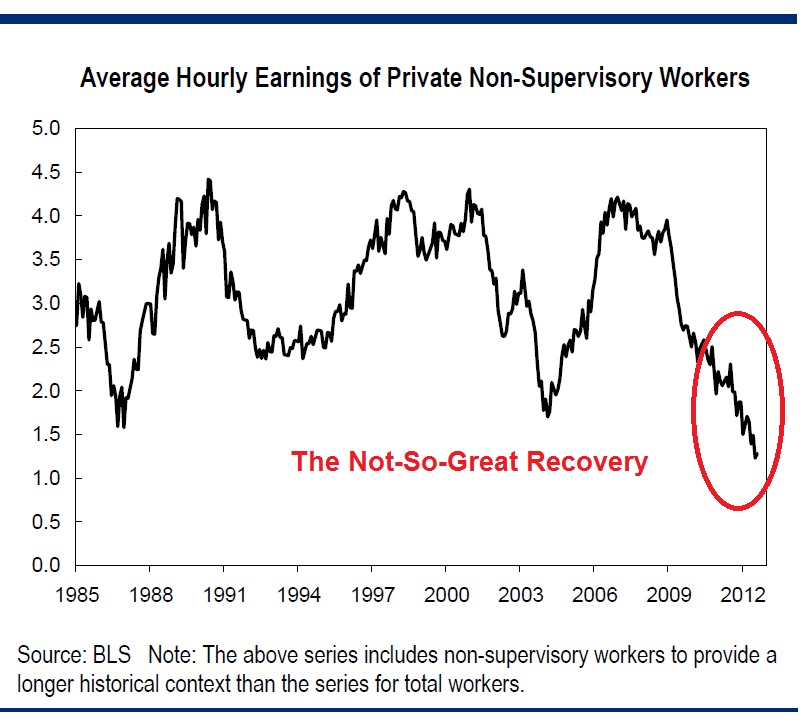
Average hourly earnings of workers
GDP growth
Economic competitiveness
Federal debt crisis
Risk of renewed recession
And here’s the detail of one that I haven’t mentioned much before on this blog:
5. Average hourly earnings were unchanged in the August jobs report, and are up just 1.7% over the past year. Not only does that match the slowest pace on record, but one you account for inflation, wages are flat to down.
The graph:
Average hourly earnings for workers way down under Obama
New income data from the Census Bureau reveal what a great job Barack Obama has done for the middle class as President. During his entire tenure in the oval office, median household income has declined by 7.3%.
In January, 2009, the month he entered office, median household income was $54,983. By June, 2012, it had spiraled down to $50,964. That’s a loss of $4,019 per family, the equivalent of losing a little less than one month’s income a year, every year. And on our current course that is only going to get worse not better…
[…]Three years into the Obama recovery, median family income had declined nearly 5% by June, 2012 as compared to June, 2009. That is nearly twice the decline of 2.6% that occurred during the recession from December, 2007 until June, 2009. As the Wall Street Journal summarized in its August 25-26 weekend edition, “For household income, in other words, the Obama recovery has been worse than the Bush recession.”
[…]Obama has failed the poor as well as the middle class. Last year, the Census Bureau reported more Americans in poverty than ever before in the more than 50 years that Census has been tracking poverty. Now The Huffington Post reports that the poverty rate is on track to rise to the highest level since 1965, before the War on Poverty began. A July 22 story by Hope Yen reports that when the new poverty rates are released in September, “even a 0.1 percentage point increase would put poverty at the highest level since 1965.”
Gateway Pundit adds:
Barack Obama is not just the food stamp president.
A record one in seven Americans is on food stamps today thanks to Barack Obama.
Barack Obama is also the poverty and pain president.
Under Obama, 6.4 million Americans are living below the poverty line and there is a record number of Americans living in deep poverty.
Moody’s Investors Service said Tuesday that it would probably cut its triple-A rating on U.S. government debt by a notch unless congressional leaders can strike a budget deal in the coming months to bring down the deficit.
“If those negotiations lead to specific policies that produce a stabilization and then downward trend in the ratio of federal debt to GDP over the medium term, the rating will likely be affirmed,” Moody’s said in a press release Tuesday. “If those negotiations fail to produce such policies, however, Moody’s would expect to lower the rating, probably to Aa1.”
The threat comes after one of the other big three ratings firms, Standard & Poor’s, downgraded the U.S. last year following the brawl in Washington over the debt ceiling.
This would be the second credit downgrade – both occurred because of Obama’s Marxist policies of “spreading the wealth around” to punish job creators and their employees.
Are you better off now than you were four years ago?

 WINTERY KNIGHT