
Tag Archives: Stem

Why is college so expensive? Why does university tuition cost so much?

The correct answer appeared in the radically leftist New York Times, of all places.

This is by Paul F. Campos, law professor at the radically leftist UC Boulder.

He writes:

[P]ublic investment in higher education in America is vastly larger today, in inflation-adjusted dollars, than it was during the supposed golden age of public funding in the 1960s. Such spending has increased at a much faster rate than government spending in general. For example, the military’s budget is about 1.8 times higher today than it was in 1960, while legislative appropriations to higher education are more than 10 times higher.

In other words, far from being caused by funding cuts, the astonishing rise in college tuition correlates closely with a huge increase in public subsidies for higher education. If over the past three decades car prices had gone up as fast as tuition, the average new car would cost more than $80,000.

Some of this increased spending in education has been driven by a sharp rise in the percentage of Americans who go to college. While the college-age population has not increased since the tail end of the baby boom, the percentage of the population enrolled in college has risen significantly, especially in the last 20 years. Enrollment in undergraduate, graduate and professional programs has increased by almost 50 percent since 1995. As a consequence, while state legislative appropriations for higher education have risen much faster than inflation, total state appropriations per student are somewhat lower than they were at their peak in 1990. (Appropriations per student are much higher now than they were in the 1960s and 1970s, when tuition was a small fraction of what it is today.)

As the baby boomers reached college age, state appropriations to higher education skyrocketed, increasing more than fourfold in today’s dollars, from $11.1 billion in 1960 to $48.2 billion in 1975. By 1980, state funding for higher education had increased a mind-boggling 390 percent in real terms over the previous 20 years. This tsunami of public money did not reduce tuition: quite the contrary.

[…]State appropriations reached a record inflation-adjusted high of $86.6 billion in 2009. They declined as a consequence of the Great Recession, but have since risen to $81 billion. And these totals do not include the enormous expansion of the federal Pell Grant program, which has grown, in today’s dollars, to $34.3 billion per year from $10.3 billion in 2000.

The more money that is attached to students, the more money universities charge – simple.

But where is the money going? Is it mostly going to research? To the classroom? To hire more and better professors?

No:

Interestingly, increased spending has not been going into the pockets of the typical professor. Salaries of full-time faculty members are, on average, barely higher than they were in 1970. Moreover, while 45 years ago 78 percent of college and university professors were full time, today half of postsecondary faculty members are lower-paid part-time employees, meaning that the average salaries of the people who do the teaching in American higher education are actually quite a bit lower than they were in 1970.

By contrast, a major factor driving increasing costs is the constant expansion of university administration. According to the Department of Education data, administrative positions at colleges and universities grew by 60 percent between 1993 and 2009, which Bloomberg reported was 10 times the rate of growth of tenured faculty positions.

Even more strikingly, an analysis by a professor at California Polytechnic University, Pomona, found that, while the total number of full-time faculty members in the C.S.U. system grew from 11,614 to 12,019 between 1975 and 2008, the total number of administrators grew from 3,800 to 12,183 — a 221 percent increase.

If you’re going to college or trade school, go to a low-cost school. Do a STEM degree or do a trade that pays well. Try to get tuition assistance even if it means going to a less prestigious school. And work at every opportunity you get in the most serious job you can find. Don’t spend your money – save it. Especially don’t spend your money on fun, vacations and alcohol. As soon as you grow up, you’re going to wish you could have it all back.
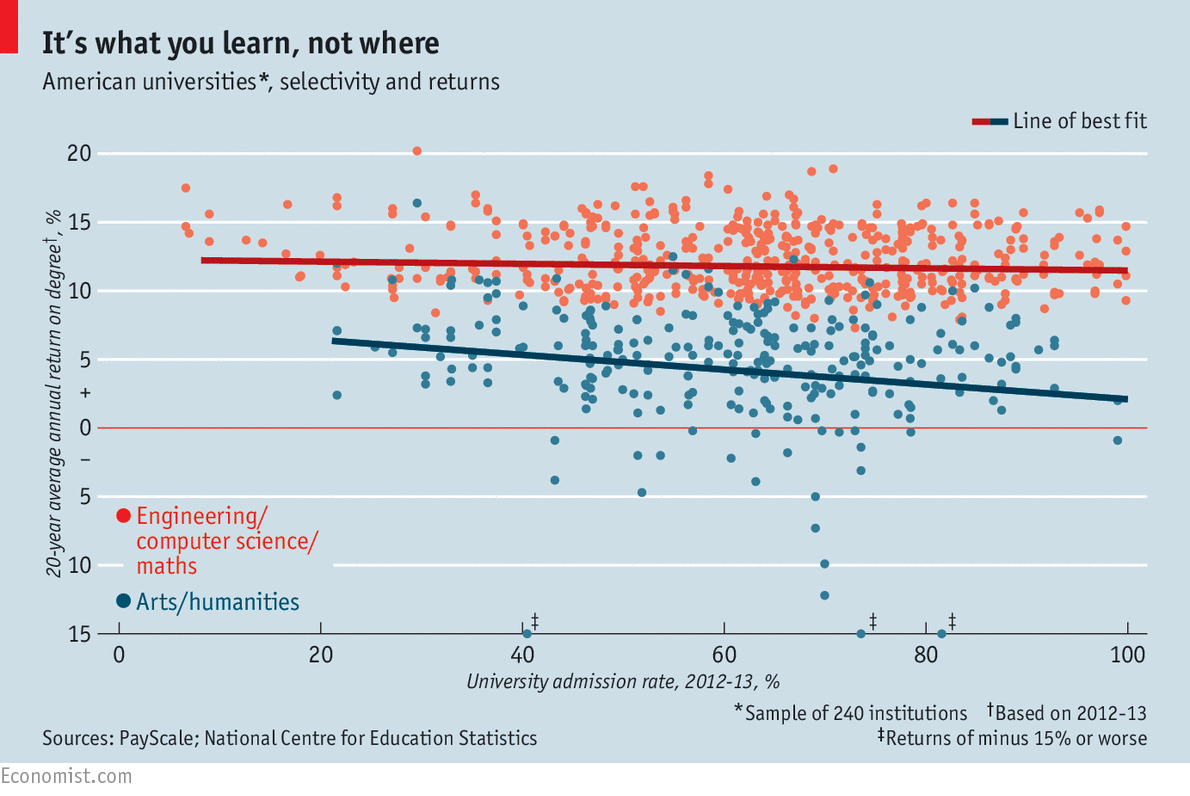
New study: what you study in college matters more than where you go to college

What you study matters more
What you study matters more (click for larger image)

This study was reported by the leftist The Economist.

They write:

A new report from PayScale, a research firm, calculates the returns to a college degree. Its authors compare the career earnings of graduates with the present-day cost of a degree at their alma maters, net of financial aid. College is usually worth it, but not always, it transpires. And what you study matters far more than where you study it.

Engineers and computer scientists do best, earning an impressive 20-year annualised return of 12% on their college fees (the S&P 500 yielded just 7.8%). Engineering graduates from run-of-the-mill colleges do only slightly worse than those from highly selective ones. Business and economics degrees also pay well, delivering a solid 8.7% average return. Courses in the arts or the humanities offer vast spiritual rewards, of course, but less impressive material ones. Some yield negative returns. An arts degree from the Maryland Institute College of Art had a hefty 20-year net negative return of $92,000, for example.

I think if you are looking for a great way to be out of debt before you are 30, it’s a great idea to do your first few years at community college, get rid of all your generic prerequisite courses, then move on to college/university to do your computer science/engineering courses, and then graduate.

Here is the nightmare scenario: you go study a non-stem major at an expensive university, come out with a ton of debt and NO JOB in your field. A much better solution is to go to a less-expensive, less-presitigious school that has a good STEM program in the area you want, and then get in and get out as quickly as possible. Make sure that you either do internships or work in the summer in your field. At this point, you should be willing to pay your employer for letting you work for them, or volunteer – you want to get a company name on your resume, and a name added to your references before you graduate and start looking for a real full-time job. Any pay they give you should be considered a bonus – that’s how important it is to work in your field before graduating. The before-graduation work experience will help you to know what skills are in demand, too – which will improve your course selection. You might even be able to get a mentor from the company you work for to advise you.

The longer you go without working related to your field, the harder it is to be competitive in the job market.  It’s very important to get debt paid off – especially now, because interest rates are going to be rising soon. You definitely want to start investing as soon as possible, so you can use that interest rate in your favor as you head towards retirement. It’s a rocky road ahead with an $18.5 trillion debt, a demographic challenge from the large number of retirees, and the decline of marriage and family. It makes sense to focus on financial issues as early as possible, and have a good plan.

Young Texan earns $140,000 a year, with a two-year degree and hard work

I love this story from the Wall Street Journal. I’m linking to the free version on Yahoo News, though!

Excerpt:

Justin Friend ’s parents have doctoral degrees and have worked as university lecturers and researchers. So Mr. Friend might have been expected to head for a university after graduating from high school in Bryan, Texas, five years ago.

Instead, he attended Texas State Technical College in Waco, and received a two-year degree in welding. In 2013, his first full year as a welder, his income was about $130,000, more than triple the average annual wages for welders in the U.S. In 2014, Mr. Friend’s income rose to about $140,000.

[…]The risks of a mismatch between costly university degrees and job opportunities have become clearer in recent years. Anthony Carnevale, director of the Center on Education and the Workforce at Georgetown University, said nearly a third of people aged 22 through 26 with a Bachelor of Arts degree either don’t have a job or are working at one that doesn’t require a university degree. The numbers are similar for young people with vocational degrees, but those lower-cost degrees don’t typically lead to heavy debts.

Student loan debt outstanding in the U.S. totaled $1.13 trillion as of Sept. 30, up by $100 billion from a year earlier, according to the Federal Reserve Bank of New York. (Mr. Friend has no debts.)

[…]Mr. Friend, who is single, typically works 72 hours a week, usually including at least one day of the weekend, often on an overnight shift. His base pay is more than $25 an hour, up from about $22 when he started in 2012. He gets overtime after 40 hours a week. Pay is doubled on Sundays and tripled on holidays. He receives health insurance, a 401k retirement plan and paid vacation.

With little free time, expenses are low. He rents a one-bedroom apartment for $1,080 a month in a building with a pool and gym. To stay in shape for mountain-climbing trips, he sometimes runs up and down steps wearing a weighted backpack.

He showed an early inclination to make things. “At three years old, he was using a screwdriver and a hacksaw skillfully,” said Dr. Vaughan, his mother. Later, dyslexia made writing and math a struggle for him.

In junior high school, he took a course in welding. Within a few years, he was earning money repairing fences and doing other welding jobs for neighbors.

A documentary on World War II stirred Mr. Friend’s interest in pulse jet engines, which were used by Germany to propel bombs. He and his father, Ted Friend, a professor of animal science at Texas A&M, together built such an engine. “We used a leaf blower to start it,” pumping in air needed to ignite the engine, the younger Mr. Friend said. “It ran on propane.” When he attached the engine to a golf cart, he said, the vehicle proved difficult to steer after reaching 30 miles an hour.

“Mom didn’t like it,” he said. “She thought I was going to blow myself up.” One of his goals is to put a jet engine on a motorcycle, he says, adding: “I’d try to make it as safe as I could.”

On a recent day, while country music played on a colleague’s radio, Mr. Friend used gas tungsten arc welding techniques to attach two steel parts destined for an oil apparatus. Wearing a T-shirt and Wrangler jeans, he hunched over work requiring the precision of a jewelry maker. After welding, he buffed the part with a wire brush. Colleagues would later X-ray the part to make sure the weld was flawless.

The long hours mean “it’s hard to have a life,” Mr. Friend said. Eventually, he said he may pursue an advanced degree in metallurgy and research welding materials and techniques. For now, he’s building up his savings.

He’s debt-free, and probably didn’t even need student loans for this program. You couldn’t say that about most college students these days – and the ones in non-STEM fields will never be able to pay their loans back. What causes people to go into programs that don’t produce a return on investment? I think I know why. I think that many Americans have the idea that life should be about personal fulfillment, and not about doing things that don’t feel right to them. Hard work doesn’t “feel” right to many young Americans. They want work to make them famous, and to make them happy. Well, work isn’t supposed to be like that. Work is about making money, and very often the most difficult degrees and jobs are the least fame-making, and the least happiness-inducing. This guy is a welder! It’s not glamorous.

I would advise my younger readers, especially my male readers, to take a page out of this welder’s handbook. Make a plan to avoid debt, and stick to it.