Unemployment for both women and African-Americans is higher today than it was when President Barack Obama first took office in 2009, according to federal government data.
Despite an economy that has technically been in recovery since June of 2009, many economic indicators are the same or worse than when President Obama gave his first address to a Joint Session of Congress in February 2009.
“We will rebuild, we will recover, and the United States of America will emerge stronger than before,” Obama said in that speech.
However, employment for African-Americans and women has not recovered and, in fact, is worse today than it was when Obama said those words.
At the end of January 2009, 12.7 percent of African-Americans were unemployed. Four years later, January 2013, the situation was worse, with unemployment higher at 13.8 percent.
Further, an additional 1.2 million African-Americans had left the workforce entirely during the same time period, with the number of those reported as not in the workforce rising from 10.3 million in January 2009 to 11.5 million in January 2013.
People not in the labor force are those who are younger than the retirement age who are unemployed and no longer looking for work, indicating they have either given up looking for work or gone into early retirement.
For women, the story is not much better. In January 2009, 6.9 percent of women in America were unemployed. By January 2013, 7.8 percent of women were unemployed.
Obama is proposing a hike to the minimum wage rate, so that employers are forced to pay the youngest and/or least skilled workers more money than they are worth. Will this lower unemployment?
When considering what economic policies to adopt, it is not enough to do what feels good. Liberals and conservatives agree that it is good to help the poor. Liberals think that higher minimum wage rates help the poor, and conservatives think that lower minimum wage rates help the poor. This is not a topic that is up for debate, though, because economists across the left-right spectrum agree on this one.
Take a look at this post from Harvard University economist Greg Mankiw.
He writes:
My favorite textbook covers business cycle theory toward the end of the book (the last four chapters) precisely because that theory is controversial. I believe it is better to introduce students to economics with topics about which there is more of a professional consensus. In chapter two of the book, I include a table of propositions to which most economists subscribe, based on various polls of the profession. Here is the list, together with the percentage of economists who agree:
A ceiling on rents reduces the quantity and quality of housing available. (93%)
Tariffs and import quotas usually reduce general economic welfare. (93%)
Flexible and floating exchange rates offer an effective international monetary arrangement. (90%)
Fiscal policy (e.g., tax cut and/or government expenditure increase) has a significant stimulative impact on a less than fully employed economy. (90%)
The United States should not restrict employers from outsourcing work to foreign countries. (90%)
The United States should eliminate agricultural subsidies. (85%)
Local and state governments should eliminate subsidies to professional sports franchises. (85%)
If the federal budget is to be balanced, it should be done over the business cycle rather than yearly. (85%)
The gap between Social Security funds and expenditures will become unsustainably large within the next fifty years if current policies remain unchanged. (85%)
Cash payments increase the welfare of recipients to a greater degree than do transfers-in-kind of equal cash value. (84%)
A large federal budget deficit has an adverse effect on the economy. (83%)
A minimum wage increases unemployment among young and unskilled workers. (79%)
The government should restructure the welfare system along the lines of a “negative income tax.” (79%)
Effluent taxes and marketable pollution permits represent a better approach to pollution control than imposition of pollution ceilings. (78%)
And that’s not all. There have actually been studies done on this, and they echo the consensus.
Consider this 2009 article from the Wall Street Journal that discusses some of the studies.
Excerpt:
Earlier this year, economist David Neumark of the University of California, Irvine, wrote on these pages that the 70-cent-an-hour increase in the minimum wage would cost some 300,000 jobs. Sure enough, the mandated increase to $7.25 took effect in July, and right on cue the August and September jobless numbers confirm the rapid disappearance of jobs for teenagers.
he September teen unemployment rate hit 25.9%, the highest rate since World War II and up from 23.8% in July. Some 330,000 teen jobs have vanished in two months. Hardest hit of all: black male teens, whose unemployment rate shot up to a catastrophic 50.4%. It was merely a terrible 39.2% in July.
[…]Two years ago Mr. Neumark and William Wascher, a Federal Reserve economist, reviewed more than 100 academic studies on the impact of the minimum wage. They found “overwhelming” evidence that the least skilled and the young suffer a loss of employment when the minimum wage is increased.
[…]State lawmakers are also at fault. At least 10 states have raised their minimum wages above the federal level in the last decade, largely in response to union lobbying and in the name of helping the working poor. Four states with among the highest wage rates are California, Massachusetts, Michigan and New York. Studies have shown in each case that their wage policies killed jobs for teens. The Massachusetts teen employment rate sank by one-third when the minimum wage rose by 88% between 1995 and 2008.
According to new numbers from the Labor Department, in 2008 only 1.1% of Americans who work 40 hours a week or more even earned the minimum wage. In other words, 98.9% of 40-hour-a-week workers earn more than the minimum. The data also show that teenagers are five times more likely to earn the minimum wage than adults. Minimum wage jobs are nearly all first-time or part-time jobs, and an estimated two of every three minimum wage workers get a pay raise within a year on the job.
You can read more about minimim wage and unemployment from my second favorite economist Walter Williams, and from my first favorite economist Thomas Sowell. This is an issue that matters to them, because they are both black, and blacks are the hardest hit by these policies – even though most blacks support these policies by voting overwhelmingly for socialists.
This issue is simple and straightforward. To help the poorest and least experienced workers, we have to take away any regulations that separate them from their first employer. From there, they will gain the experience to move up. Nobody stays in a minimum wage job all their lives. They move up when they get experience and a resume. That’s why that first job is so crucial. We have to make it easier for employers to get employees started in their careers.
What should we expect from the State of the Union speech tonight? We should expect Obama to argue against spending cuts, and for more spending.
Excerpt:
President Obama will use his State of the Union speech Tuesday to turn public opinion against automatic spending cuts and argue that some of the money to replace the cuts should instead come from higher taxes.
He will use the prime-time TV address to argue the economy would be damaged if $85 billion in automatic spending cuts were to go ahead on schedule on March 1, and will seek to set up Republicans to take the blame if they do.
The State of the Union address is also expected to highlight Obama’s second-term shift on the deficit.
From 2010 to 2012, the president consistently argued for new spending to spur on the economy, but also called for accompanying spending cuts and tax hikes to rein in the deficit.
But in his radio address on Saturday, Obama emphasized that the White House and Congress already have “cut our deficit by more than $2.5 trillion” through spending cuts and higher tax rates imposed on households with annual incomes above $450,000.
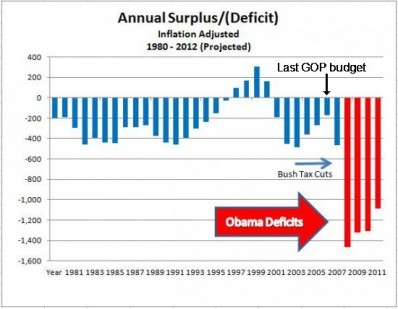
Look at the graph above. Does that look like we have cut our deficit? It used to be $160 billion in 2006/2007 under George W. Bush. Obama ran trillion dollar deficits for FOUR years. How is that cutting the deficit? What is Obama talking about? Bush added $4 trillion to the debt in 8 years, Obama’s added nearly $6 trillion to the debt in 4 years.
More:
A Congressional Budget Office report issued last week found the budget deficit will drop below $1 trillion this year to $845 billion, before falling further by 2015 to $430 billion.
In a more ominous sign, the same CBO report found an aging population and soaring healthcare costs would lead to an explosion in entitlement spending in later years, with budget deficits approaching $1 trillion again by 2023.
Obama thinks that not reforming entitlements is fiscally responsible. Should we believe that he knows what he is doing when it comes to the economy?
The Heritage Foundation says we shouldn’t believe Obama, because he lied the last time he gave a State of the Union speech.
Excerpt: (links removed)
Take a look at some of the promises Obama made back in 2009 during his first State of the Union.
“I pledged to cut the deficit in half by the end of my first term in office.”
During his first State of the Union, newly inaugurated President Obama vowed to cut the deficit in half by the end of his first term. Instead, Obama has averaged deficits nearly three timesthat of his predecessor.
For those who were concerned with President George W. Bush’s $4 trillion national debt, this pledge may have seemed like the “hope and change” the American people voted for in 2008. However, the reality of America’s additional debt over the past four years under the Obama Administration is staggering—almost $6 trillion in four years, on track to triple the amount Bush accumulated over his eight years as President. Now that Obama is heading into his second term, we’ve seen quite a change from the Barack Obama who thought $4 trillion in debt was“irresponsible” and “unpatriotic.”
“Over the next two years, this [stimulus] plan will save or create 3.5 million jobs.”
The President promised great things from the stimulus plan, but as Heritage’s J.D. Foster has said, we have to look at his record. He may have promised 3.5 million new jobs, but he’s 7.7 million jobs in the hole instead.
“…we must have quality, affordable health care for every American. It’s a commitment that’s paid for in part by efficiencies in our system that are long overdue.”
President Obama’s promise that Obamacare would provide health insurance for every American has been proven false. According to the Congressional Budget Office, 30 million Americans are projected to remain uninsured even after Obamacare is fully implemented.
The idea that Obamacare would improve the “efficiencies” of the health care system is laughable. Obama’s plan for “efficiencies” in the system was just slashing Medicare provider reimbursement rates to the tune of $716 billion to help pay for Obamacare. The mammoth law is going to take 127 million hours of paperwork per year for Americans to comply with it. And Members of Congress are already walking back their support for the law—they are grumbling about several parts of it and even repealed one part in the fiscal cliff deal.
What the Republicans should do is just walk out of there. Why sit there and listen to high-minded rhetoric that never amounts to anything? Well, except to make Obama feel good about himself.

 WINTERY KNIGHT