
Tag Archives: Spending

Bobby Jindal cuts Louisiana budget by 25%… and gets re-elected in landslide?

Gov. Bobby Jindal
Gov. Bobby Jindal

From the Philadelphia Inquirer.

Excerpt:

One gubernatorial election ended early this fall, when Louisiana Gov. Bobby Jindal won the state’s blanket primary Oct. 22. Under Louisiana’s system, all candidates of all parties are listed on the ballot, and if no one gets 50 percent, the top two finishers go to a runoff. Jindal blew past the threshold with 66 percent.

Jindal’s reelection was unusual in several respects. The only previous time the state has not had a runoff was his election in 2007. He is only the fourth Republican governor in the last 125 years in Louisiana, and one of those four switched over from the Democrats in office. Jindal’s best-known challenger this year was a schoolteacher, who raised less than 1 percent of the incumbent’s campaign treasury. The Democratic State Central Committee declined to endorse any candidate running on its party label.

But perhaps most unbelievable is that Jindal faced no serious competition after cutting state spending more than 25 percent. In January 2008, the state had a budget of $34.3 billion. This summer, Jindal signed into law a budget spending $25 billion. As governors from Harrisburg to Trenton to Columbus to Madison have learned, cutting a state’s budget is difficult enough; doing so without a significant backlash seems a politically impossible task.

A key part of Jindal’s story is recognizing that he took the helm of a state that had hit bottom: Decades of mismanagement and corruption had taken their toll even before Hurricane Katrina wreaked such devastation and exposed such colossal unresponsiveness in state government. The state, recognizing the bitter fruit of its traditions of colorful corruption, was ready to take a chance on a then-37-year-old Indian American congressman who speaks roughly 100 words per minute. The state was willing to try a new approach to governing; how much worse could it be?

Privatization played a big role in Jindal’s reinvention of state government, with private contractors taking over state-run operations for a lesser cost. The companies often hired the state workers who would often be the centerpiece of opponents’ criticism.

His administration privatized the state’s Office of Risk Management. Then the state’s Division of Administration privatized claims management and loss prevention in the self-insurance program, saving $20 million over five years. The Department of Health and Hospitals privatized six inpatient, residential-treatment programs around the state, saving $2.5 million. Separately, patients were moved from state-operated institutions that cost $600 or more per patient per day to community-based services and private group homes that average $191 per day, saving an additional $23.8 million.

Consolidation was another key element: The state’s Department of Revenue shrank from eight offices statewide to three. The Department of Children and Family Services consolidated its offices from 157 to 90, saving a total of $2.7 million.

But some of Jindal’s cuts are the old-fashioned kind. The state sold 1,300 vehicles from its fleet of automobiles. Louisiana’s Transportation Department shut down a ferry that was used by only 7,200 drivers per year, saving the state roughly three-quarters of a million dollars.

In fiscal 2011, Louisiana eliminated more than 3,500 full-time government positions. Add the 6,363 previous reductions during Jindal’s term, and that means a total of almost 9,900 full-time positions reduced since he took the oath, a savings of almost $600 million. Louisiana now has the lowest level of full-time state government employees in almost 20 years.

“You change people’s expectations and you make structural changes,” Jindal said, while racing around the state about three weeks before the election. “The most important is this cultural change, to say government is not the answer to everything. In a weird way, I want the office of governor to be less important than it is. What I mean by that is, there was an old joke that kids in Louisiana don’t grow up wanting to be president; they grow up wanting to be governor. You should want them to want to business leaders or doctors or teachers.”

Some cuts were more noticeable to the public, but Louisianans found shorter hours and workweeks at state facilities more palatable than complete shutdowns or higher taxes: Historic sites are now open five days a week instead of seven, pools at a half dozen state parks were closed on Mondays and Tuesdays this summer, and entrance stations at all state parks had shorter hours. Finally, 54,000 rank-and-file state workers are going without a raise for the second consecutive year.

Jindal’s first term was marked by several high-profile crises he successfully managed – Hurricane Gustav and the response to the BP oil spill, along with the Obama administration’s six-month moratorium on all drilling in the Gulf of Mexico – but the state’s economy has generally chugged along: Louisiana’s unemployment rate is 7.1 percent, two percentage points lower than the national average, and a comparably booming economy makes cuts in state spending much easier to take.

“If you have a good-paying job with benefits, you wouldn’t need the state to do so many things for you,” Jindal says. “You become less dependent, and that diminishes the role of the state and so you need fewer state employees, and it’s a virtuous cycle. You can lower taxes and lower government spending.”

Louisiana is a swing state. If Bobby Jindal can cut government spending in a swing state and get re-elected with 66% of the vote, then we do have hope that the American people will do the right thing. Maybe we just need to hit bottom with Obama so that we realize that competence does matter after all. We have a deep, deep bullpen for future elections. Governors like Scott Walker (Wisconsin), Rick Scott (Florida) and John Kasich (Ohio)would be excellent presidential candidates.  And of course we have Marco Rubio and soon-to-be senators Josh Mandel and Ted Cruz waiting in the wings.
Induced abortions, drinking and use of contraceptives all increase breast cancer risk

Here’s the latest study from the Journal of the American Medical Association (JAMA), showing that excessive consumption of alcohol is a rish factor for breast cancer.

Excerpt:

Consumption of 3 to 6 alcoholic drinks per week is associated with a small increase in the risk of breast cancer, and consumption in both earlier and later adult life is also associated with an increased risk, according to a study in the November 2 issue of JAMA.

“In many studies, higher consumption of alcohol has been associated with an increased risk of breast cancer. However, the effect of low levels of drinking as is common in the United States has not been well quantified,” according to background information in the article. “In addition, the role of drinking patterns (i.e., frequency of drinking and ‘binge’ drinking) and consumption at different times of adult life are not well understood.”

Wendy Y. Chen, M.D., M.P.H., of Brigham and Women’s Hospital and Harvard Medical School, Boston, and colleagues examined the association of breast cancer with alcohol consumption during adult life, including quantity, frequency, and age at consumption. The study included 105,986 women enrolled in the Nurses’ Health Study who were followed up from 1980 until 2008 with an early adult alcohol assessment and 8 updated alcohol assessments. The primary outcome the researchers measured was the risk of developing invasive breast cancer.

During the follow-up period, there were 7,690 cases of invasive breast cancer diagnosed among the study participants. Analyses of data indicated that a low level of alcohol consumption (5.0 to 9.9 grams per day, equivalent to 3-6 glasses of wine per week) was modestly but statistically significantly associated with a 15 percent increased risk of breast cancer. In addition, women who consumed at least 30 grams of alcohol daily on average (at least 2 drinks per day) had a 51 percent increased risk of breast cancer compared with women who never consumed alcohol.

The researchers also found that when examined separately, alcohol consumption levels at ages 18 to 40 years and after age 40 years were both strongly associated with breast cancer risk. The association with drinking in early adult life still persisted even after controlling for alcohol intake after age 40 years.

Binge drinking, but not frequency of drinking, was also associated with breast cancer risk after controlling for cumulative alcohol intake.

Now let’s take a look at some other factors that raise the risk of breast cancer.

Abortion and breast cancer

Many studies show a link between abortion and breast cancer.

Study 1: (September 2010)

Based on the expression of estrogen receptor (ER), progesterone receptor (PR) and HER2/neu (HER2), breast cancer is classified into several subtypes: luminal A (ER+ and/or PR+, HER2-), luminal B (ER+ and/or PR+, HER2+), HER2-overexpressing (ER-, PR-, and HER2+) and triple-negative (ER-, PR-, and HER2-). The aim of this case-control study is to determine reproductive factors associated with breast cancer subtypes in Chinese women. A total of 1,417 patients diagnosed with breast cancer in the First Affiliated Hospital, China Medical University, Shenyang, China between 2001 and 2009 and 1,587 matched controls without a prior breast cancer were enrolled.

[…]Postmenopause and spontaneous abortion were inversely associated with the risk of luminal tumors. By contrast, multiparity, family history of breast cancer and induced abortion increased the risk of breast cancer.

Study 2: (March 2010)

OBJECTIVE: To explore the risk factors of breast cancer for better control and prevention of the malignancy.

METHODS: The clinical data of 232 patients with pathologically established breast cancer were investigated in this 1:1 case-control study to identify the risk factors of breast cancer.

RESULTS: The history of benign breast diseases, family history of carcinoma and multiple abortions were the statistically significant risk factors of breast cancer, while breast feeding was the protective factor.

CONCLUSION: A history of benign breast diseases, family history of carcinoma and multiple abortions are all risk factors of breast cancer.

But wait, there’s more.

Birth control pills

Many studies showed that taking birth control pills caused an increased risk of breast cancer.

Study 1: (March 2003)

RESULTS: Among the youngest age group (<35 years, n = 545), significant predictors of risk included African-American race (RR = 2.66: 95% CI 1.4-4.9) and recent use of oral contraceptives (RR = 2.26; 95% CI 1.4-3.6). Although these relationships were strongest for estrogen receptor-negative (ER-) tumors (RRs of 3.30 for race and 3.56 for recent oral contraceptive use), these associations were also apparent for young women with ER+ tumors. Delayed childbearing was a risk factor for ER+ tumors among the older premenopausal women (Ptrend < 0.01), but not for women <35 years in whom early childbearing was associated with an increased risk, reflecting a short-term increase in risk immediately following a birth.

Study 2: (October 2008)

Oral contraceptive use ≥1 year was associated with a 2.5-fold increased risk for triple-negative breast cancer (95% confidence interval, 1.4-4.3) and no significantly increased risk for non-triple-negative breast cancer (Pheterogeneity = 0.008). Furthermore, the risk among oral contraceptive users conferred by longer oral contraceptive duration and by more recent use was significantly greater for triple-negative breast cancer than non-triple-negative breast cancer (Pheterogeneity = 0.02 and 0.01, respectively).

Why are these risk factors so prevalent today?

Now let’s put it all together by looking at this New York Times article by Nancy Bauer.

Excerpt:

If there’s anything that feminism has bequeathed to young women of means, it’s that power is their birthright.  Visit an American college campus on a Monday morning and you’ll find any number of amazingly ambitious and talented young women wielding their brain power, determined not to let anything — including a relationship with some needy, dependent man — get in their way.  Come back on a party night, and you’ll find many of these same girls (they stopped calling themselves “women” years ago) wielding their sexual power, dressed as provocatively as they dare, matching the guys drink for drink — and then hook-up for hook-up.

The article was written by:

Nancy Bauer is associate professor and chair of philosophy at Tufts University. She is the author of “Simone de Beauvoir, Philosophy, and Feminism,” and is currently completing a new book, “How to Do Things With Pornography.”

Her comments cause me to ask some questions. Where did women ever get the idea that they had to drink as much as men drink? Where did women ever get the idea that using contraceptives to enable hook-up sex was healthy and normal? Where did women ever get the idea that aborting their own unborn children was healthy and normal? Is there one unifying worldview that stipulates all of these beliefs? Why has this worldview become so popular that so many young women who now believe in it, rather than believing in traditional Judeo-Christian values?

Who is paying for all of this increased health care spending?

The total cost for breast cancer treatment, which raises medical insurance premiums (private health care) or taxes (single-payer health care), has been estimated to be between $1.8 billion and $3.8 billion dollars. In addition, the government spends billions of dollars each year on breast cancer research. All of this spending is costing taxpayers a lot of money, as people demand more and more government funding of breast cancer research and breast cancer treatment (with either private or single-payer health care).

We can’t wait: the do-nothing Democrat Senate is blocking 15 bipartisan jobs bills

Have you heard about “The Forgotten 15“? Here’s a news article by the Washington Times that explains it.

Excerpt:

Last week, the House passed a strongly bipartisan bill which would prevent a job-killing 3 percent withholding tax on all government contractors from going into effect. Even though the White House supports the measure, Mr. Reid, a Nevada Democrat, has chosen instead to bring another “small bite” from the president’s failed American Jobs Act to the floor. He wants to hike taxes on business owners so he can blow $60 billion in more stimulus for bike paths, choo-choo trains and bus stops.

Mr. Reid can’t even round up all the Democrats behind his partisan plan, but he continues to drag his feet on items that could pass because the last thing he wants to do is adopt legislation that gives the GOP the chance to take some credit with the public.

The Senate has not been this inactive in at least a quarter-century. As of Tuesday, the Senate had held 194 votes for the year, 54 fewer than at this time last year.

The intransigence has real-world implications. In March, the House passed a strongly bipartisan bill which would have stopped a court order from imposing duplicate and expensive regulations on farmers and ranchers. The Senate never brought the bill up for a vote, and on Monday a key deadline passed, allowing new regulations on pesticide applications to go into effect. That’s bad for jobs.

House Republican leaders want the public to know that they aren’t to blame for the stalemate on Capitol Hill. Speaker John A. Boehner produced a card listing the “forgotten 15” jobs bills that have passed the House but not the Senate. The Ohio Republican gave the card to members, telling them to carry it with them, hold it up at events at home, and flash it during interviews to remind Americans that Republicans are doing everything they can to address the employment situation.

The Democratic strategy is to set up Republicans as a foil for their 2012 re-election bids. Even though the congressional approval rating is down in the single-digits, Mr. Reid wants to draw a distinction between his party and the GOP by only bringing up bills that Republicans will oppose so his caucus can send out accusatory press releases.

The messaging is carefully crafted to fit with Mr. Obama’s latest campaign trail slogans about how “we can’t wait” for Congress to act. He showed his true motives on Tuesday when the president invited congressional Democrats to the White House to ostensibly talk about the jobs agenda. He has no plans to invite Republicans over to chat.

You can print a PDF of the The Forgotten 15 card right here.

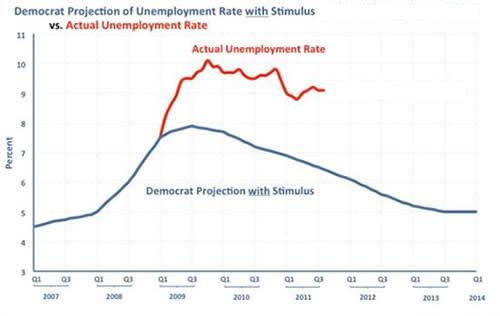
Remember, Democrats are great at spending money – not so good at creating jobs.

Projected vs Actual Unemployment With Stimulus 2011

Back in 2007, when the Republicans controlled the House and Senate, the unemployment rate was near 4%. FOUR PERCENT. And we had a deficit of $160 billion – NOT 1.6 TRILLION.

Let’s take a closer look at the Forgotten 15 from an article on John Boehner’s web site.

Excerpt:

Campaigning for another failed stimulus and more job destroying taxes, President Obama has repeatedly—and falsely—asserted that “Congress isn’t willing to move” legislation to facilitate job growth. While the president plays politics, House Republicans have been working and approving legislation to promote economic growth and job creation. The House has approved more than 15 bills that, if enacted, would immediately help to grow the economy without more failed stimulus spending. These bills are currently stalled in the Democrat-controlled Senate and the president has not encouraged the Senate to act.

Here is a sample:

4)  H.R. 1230—Restarting American Offshore Leasing Now Act: H.R. 1230 would require the Department of the Interior (DOI) to auction offshore oil and gas leases in the Central and Western Gulf of Mexico, as well as in an area off the coast of Virginia. The bill would help to reduce energy prices and promote job creation by expediting offshore oil and natural gas exploration in the Gulf of Mexico and the Virginia coast.

6) H.R. 1231—Reversing President Obama’s Offshore Moratorium Act:  H.R. 1231 would require that each five-year offshore oil and gas leasing program offer leasing in the areas with the most prospective oil and gas resources, and would establish a domestic oil and natural gas production goal.  The bill would essentially lift the President’s ban on new offshore drilling by requiring the Administration to move forward on American energy production in areas estimated to contain the most oil and natural gas resources.

7) H.R. 2021—The Jobs and Energy Permitting Act of 2011:  H.R. 2021 would eliminate needless permitting delays that have stalled important energy production opportunities off the coast of Alaska.  The bill would also eliminate the permitting back-and-forth that occurs between the EPA and its Environmental Appeals Board.  Rather than having exploration air permits repeatedly approved and rescinded by the agency and its review board, the EPA will be required to take final action – granting or denying a permit—within six months.

10) H.R. 1938— North American-Made Energy Security Act:  H.R. 1938 would direct the President, acting through the Secretary of Energy, to coordinate with all federal agencies responsible for an aspect of the President’s National Interest Determination and Presidential Permit decision regarding construction and operation of Keystone XL, to ensure that all necessary actions are taken on an expedited schedule.  The bill would promote job creation and energy security by ending the needless delay of the construction and operation of the Keystone XL pipeline.

11) H.R. 2587—Protecting Jobs From Government Interference Act:  H.R. 2587 would prohibit the National Labor Relations Board (NRLB) from ordering any employer to close, relocate, or transfer employment under any circumstance.

16)  H.R. 2433—Veterans Opportunity to Work Act:  H.R. 2433 would create or modify programs that provide employment and training services to veterans and service members separating from active duty.  The bill would also make changes to programs that offer home loan guarantees, ambulance services, and pension payments to qualifying individuals. Among other things, the bill would provide up to 12 months of Veterans Retraining Assistance to no more than 100,000 unemployed veterans that enter education or training programs at community colleges or technical schools to prepare them for employment in an occupational field that is determined by Department of Labor to have significant employment opportunities.

17) H.R. 674—To amend the Internal Revenue Code of 1986 to repeal the imposition of 3 percent withholding on certain payments made to vendors by government entities:   H.R. 674 would permanently repeal the imposition of 3 percent withholding on certain payments made to vendors by government entities. Currently, the imposition of the 3 percent withholding is set to take effect on January 1, 2013. If the 3 percent withholding tax were implemented as scheduled, government entities would be required to withhold 3 percent of payments to persons providing property or services to the government.  For example, on an invoice for $20,000 the government would pay the business $19,400 and withhold $600 as a preemptive tax.  These added costs would almost certainly translate into fewer private-sector jobs and higher costs for the government and taxpayers.

They are actually up to 17 jobs bills now.

And finally, I have to post this funny John Boehner clip:

We need more of that Mr. Boehner. I think that was a good opportunity to say “freaking” as well. Because he should be pissed off with this Solyndra-bailout President.