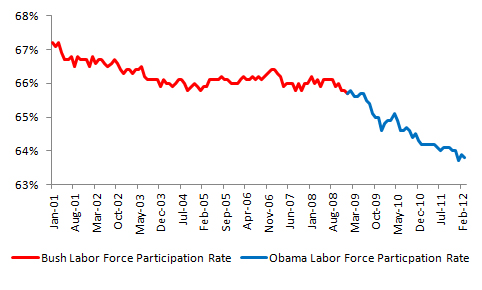
2. The jobless rate actually makes the labor market look better than it actually is. The rate only counts people who want a job but don’t have one. But the labor force participation rate was 63.8% in June, just above near modern-era lows. (It was 66.2% in January 2008 and 67.3% in April 2000). Otherwise, unemployment would be around 11%.
And #4:
4. Chronic unemployment. The average length of unemployment rose to 39.9 weeks in June, close to recent peak. It was 17.4 weeks at the January 2008 peak and 23.9 weeks in June 2009, when the recession officially ended. Long-term joblessness is particularly bad because skills erode or become obsolete, leading to permanent losses in income.
And #9:
9. Entrepreneurial activity fading. The number of startup firms has crashed from pre-recession highs, still near levels previously seen in the early 1980s, when the number of establishments was far lower. Establishments less than a year old, including those belonging to the same firm, totaled 556,553 in 2010, according to the latest Commerce Department data. That’s down 26% from the peak of 747,278 in 2006. Meanwhile, the number of employees at startups has plunged, with a greater share of new firms with no employees — one-man shops. Very small startups are less likely to invest or to grow, a bad sign for future hiring.
But it’s worse than that. The number of people going onto federal disability payments is outpacing the number of new jobs being created.
Even as unemployment among college graduates remains stuck above the national average at 9.3 percent, a Reuters/Ipsos poll of four-year college graduates finds that President Barack Obama leads his Republican challenger Mitt Romney 52 percent to 27 percent.
The poll’s findings are especially surprising given reports last month that, for the first time in American history, unemployment for college graduates eclipsed that of high school graduates. As Jed Graham of Investor’s Business Daily reported, “Out of 9 million unemployed in April, 4.7 million had gone to college or graduated and 4.3 million had not, seasonally adjusted Labor Department data show.”
Still, some unemployed college graduates say they are sticking with Mr. Obama in 2012: “I was really excited when Obama won,” said Joe Zmudczynski, a 2011 graduate of Michigan’s Ferris State University who now lives at home with his parents. “He’s still my favorite. It’s not like you can snap your fingers and everything gets better.”
Returning to the nest with mom and dad after college and even into the thirties is becoming increasingly more common, but also less stigmatized. Young adults who live with their folks are cheerful, upbeat even, about their choice.
That’s the finding of a new Pew report, released Thursday morning. Three in 10 young adults (aged 25 to 34) say they’ve lived at home recently during the down economy, and 78 percent said they were satisfied doing so. Another 77 percent said they were optimistic about their future finances.
The number of young adults living in a multi-generational household — which can be any combination of grandparents, parents and adult children — saw a steep uptick during the recent recession, after being on the rise since 1980, said Kim Parker, the study’s lead author and a senior researcher with Pew’s Social & Demographic Trends Project. Historically, such high rates of moving back home haven’t been seen since the late 1940s.
The college class of 2012 is in for a rude welcome to the world of work.
A weak labor market already has left half of young college graduates either jobless or underemployed in positions that don’t fully use their skills and knowledge.
Young adults with bachelor’s degrees are increasingly scraping by in lower-wage jobs — waiter or waitress, bartender, retail clerk or receptionist, for example — and that’s confounding their hopes a degree would pay off despite higher tuition and mounting student loans.
[…]Taking underemployment into consideration, the job prospects for bachelor’s degree holders fell last year to the lowest level in more than a decade.
[…]The figures are based on an analysis of 2011 Current Population Survey data by Northeastern University researchers and supplemented with material from Paul Harrington, an economist at Drexel University, and the Economic Policy Institute, a Washington think tank. They rely on Labor Department assessments of the level of education required to do the job in 900-plus U.S. occupations, which were used to calculate the shares of young adults with bachelor’s degrees who were “underemployed.”
About 1.5 million, or 53.6 percent, of bachelor’s degree-holders under the age of 25 last year were jobless or underemployed, the highest share in at least 11 years. In 2000, the share was at a low of 41 percent, before the dot-com bust erased job gains for college graduates in the telecommunications and IT fields.
Out of the 1.5 million who languished in the job market, about half were underemployed, an increase from the previous year.
The EPI is a left-wing think tank.
As if this were not bad enough, remember that the secular socialists have run the national debt up from 8 trillion to 16 trillion since taking over the House and Senate in January 2007. Labor union bailouts, green energy payoffs to Democrat fundraises, health care takeovers, and massive welfare spending, have to be paid back. Who is going to pay all of this back? Students with degrees in feminist studies and peace studies? And yet, incredibly, the government-run public school system and the universities have brainwashed these young fools into voting for their own dependence and enslavement. That’s what secularism and leftism offers young people: the road to serfdom.
ECM sent me this story about the most immoral and socialist province in Canada.
Excerpt:
Former Dunkin’ Donuts franchisees have been awarded a total of $16.4-million in damages from the company for losses suffered because of the “Tim Hortons phenomenon,” in which the donut shop saw almost all of its Quebec stores close in less than a decade as it lost market share, according to a superior court decision released Thursday.
The Quebec Superior Court ruled that Dunkin Donuts Canada Ltd. failed to protect and enhance its brand at the cost of the 21 franchisees and misled owners to get them to buy into a new strategy that ultimately failed.
“In this case, you have a very large franchisor with a successful chain and it’s facing a competitive threat by another large chain, i.e. Tim Hortons,” said Toronto-based franchise lawyer David Sterns of Sotos LLP. “And the judge’s view is that the franchisor couldn’t just cede the territory to the competitor, that it was incumbent on the franchisor to hold the ground for the system.”
There are currently 11 Dunkin’ Donuts stores left in Quebec, from a high of more than 200 in 1998.
In 2003 the franchisees launched the suit against Dunkin’ Brands — formerly Allied Domecq Retailing International Canada Ltd. — claiming they were induced under false pretenses to join a remodelling program that would boost sales by 15% in the first year and several subsequent years, which never happened.
The company also failed to live up to a promise to invest $40-million, half of which would come from franchise fees.
The lesson here for business owners and job creators is clear: never, ever start a business or expand a business in Quebec. They’re not just secular and anti-family, they’re socialist and anti-business.
Quebec’s austerity measures which include the raising of tuition fees for its post-secondary students have been headline news in Canada for the past month. In light of that, I thought that it was time to do a brief posting on Quebec’s financial situation.
Let’s start by looking at Quebec’s debt. Quebec is Canada’s second-most indebted province after Ontario and has the misfortune of having a bond credit rating that is in the lower middle of the pack, well below Alberta, Saskatchewan and British Columbia, Manitoba and below New Brunswick and Ontario at A+ (Standard and Poor’s), the same rating as Nova Scotia. This poor rating makes it more expensive for Quebec to service its debt. Quebec’s total debt in fiscal 2011 – 2012 is estimated to be $170.9 billion; this compares to Ontario’s estimated debt of $237.6 billion. Quebec’s debt nearly twice the size of all other provinces combined (excluding Ontario).
Quebec’s debt-to-GDP is estimated to be 51.2 percent in 2011 – 2012, the highest in Canada by a very wide margin with Ontario coming in second place at 37.2 percent and Nova Scotia coming in third place at 35.2 percent.
[…]If the Harper government follows through with its plans to wean Canada’s have-not provinces from the federal teat, Quebec may find it impossible to meet its fiscal goals. As well, when interest rates return to normal levels, Quebec’s expenditures on debt interest payments will become an ever-increasing portion of its overall spending. Since Quebec is already Canada’s most highly taxed regime, if the province hopes to meet its targets, it has only one choice – cut spending now.
It’s a worthless, backwards province that exists only by stealing money from hard-working provinces like Alberta and Saskatchewan. I hope Harper cuts them off – it’s not like they vote for him anyway. Let them eat grass and leaves for a few years.


 WINTERY KNIGHT