Tag Archives: South America

Michele Bachmann wins foreign policy debate, Santorum second

Here’s a summary from the highly-biased pro-Romney Jennifer Rubin of the Washington Post.

Excerpt:

The foreign policy debate Tuesday night was a surprise on many counts. It was lively and serious, which many debates haven’t been. Rep. Michele Bachmann (R-Minn.) exceeded expectations. Rick Santorum showed personal restraint (not complaining about the lack of attention) and displaying his depth of knowledge.

[Bashes Gingrich for a while]

[…]At the other extreme was Bachmann who was poised, informed and knowledgable throughout. She made clear that Obama’s lack of leadership is responsible for Iran’s progress on a nuclear weapon. She defended aid to Pakistan which is in our national security interest. She made an excellent point about sending our dollars to China, which in effect builds up its military at the expense of ours. She pivoted on an energy question to chide Obama for delaying on the Keystone pipeline. If she performs this well in future debates, look for her to make progress reclaiming support in Iowa.

[Praises Romney for a while]

[…]Santorum also had a strong night. He turned the conversation on the “war on terror” to a discussion of jihadism. He defended foreign aid (a smart, but not popular position). On the immigration issue he wove in his support for an economic plan focused on reviving American manufacturing. And he got Romney to agree in the closing round that we have an acute national security problem in this hemisphere. He was calmer and more presidential than he has been in past debates.

However, Gingrich definitely got stung by his support for amnesty. He may be smart, but he’s quite moderate on many issues. Not as liberal as Romney, though.

I think it’s time that the Republican party give Michele Bachmann another look. And I think Santorum is a solid on social and foreign policy issues. He’s just moderate on fiscal issues.

More about Michele Bachmann

Speeches:

Reactions from her first debate performance:

Profiles of Michele Bachmann:

And here are some of her media interviews and speeches in the House of Representatives.

Related posts

FARC terrorist leader Alfonso Cano killed by Colombian armed forces

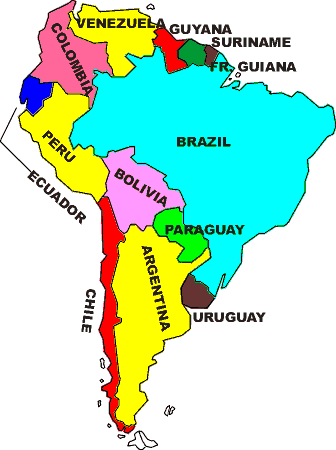
Map of South America

From the Heritage Foundation.

Excerpt:

The armed forces of Colombia have scored a major battlefield victory. They finally hunted down, confronted, and killed the leader of the narco-terrorist Revolutionary Armed Forces of Colombia (FARC), Guillermo Leon Saenz, widely known by his alias Alfonso Cano.

A guerrilla for decades, Cano assumed the top leadership of the FARC following the natural death of founder Manuel Marulanda (2008) and the elimination of senior figures Raul Reyes (2008) and Jorge Briceno (aka Mono Jojoy, 2010).

Seen by some as a modern-day version of the “good revolutionary,” Cano—a life-long advocate of armed violence and terrorism—fell in combat with the Colombian armed forces as they rappelled their way into his secret jungle hideout. Cano was also indicted in a U.S. court for drug trafficking along with dozens of other FARC leaders and had a $5 million price on his head.

FARC is a Marxist terrorist group.

The Economist reports that the Colombian economy is also doing well.

Excerpt:

WHEN the figures are finally tallied, Colombia may prove to have weathered the world recession better than any other of the larger Latin American countries. After a slight contraction at the end of 2008, the economy has been growing modestly this year. This resilience stems from continued foreign investment, an increase in government spending on public works and easier money: since December the central bank has cut interest rates by six percentage points, to 4%, a steeper drop than anywhere in the region outside Chile.

[…]President Álvaro Uribe’s security policies have helped to restore confidence. Investment soared, from 15% of GDP in 2002 to 26% last year, says Mr Zuluaga. Private business has retooled. After many delays, the government has issued licences to expand several ports; this month it hopes to award a contract for the first of four big road schemes, costing a total of $7.5 billion over four years. It hopes for investment of up to $50 billion in mining and oil over the next decade.

And liberal MSNBC has more on the booming Colombian economy.

Excerpt:

…Colombia’s revival is benefiting U.S. economic and political rivals as much as or more than the U.S. itself.

The long delay in signing the treaty allowed Latin America’s fourth-largest economy to strengthen ties with China. It also damaged U.S. credibility in the region, says Eric Farnsworth, vice-president of the Council of the Americas in Washington. “The delay in passing this called into question the United States’ reliability as a partner,” Farnsworth says. “There’s a strategic component to this. It’s not just about economics and trade.”

[…]As talks between the U.S. and Colombia dragged on, Colombia and China forged plans for a rail link between the Pacific and Caribbean that could draw freight away from the Panama Canal. Colombian President Juan Manuel Santos aims for a trade deal with South Korea. To tighten his connections to high-growth Asia, he’s also seeking membership in the Asia-Pacific Economic Cooperation group. “While Washington was debating whether the accord with Colombia was opportune, we advanced in our foreign policy strategy,” says Trade Minister Sergio Diaz-Granados.

Santos has cooperated more with his South American neighbors, organizing a meeting of finance ministers to discuss ways to protect their currencies and economies from the debt crisis in the U.S. and Europe. He supports a stock trading platform with Colombia, Chile, and Peru and wants to bring Mexico and Panama on board. Exports to Brazil have surged tenfold. While the U.S. remains Colombia’s biggest export market, with $16.8 billion in 2010 sales, up 30 percent from a year earlier, sales to China more than doubled last year, to $1.2 billion. Sales to the European Union are also rising, to $5.4 billion this year through August, more than in all of 2010. An EU trade accord could come next year.

The government has reduced cocaine cultivation 37 percent and halved the number of insurgents to about 8,000. Improved security has spurred enough growth to win an investment-grade credit rating from Standard & Poor’s as well as investment from billionaires. Colombia’s victories over the guerrillas opened up swathes of countryside to exploration for oil, gold, and coal. Mexican billionaire Carlos Slim’s push into crude has helped fuel foreign investment that the government says may reach a record $12 billion this year. The economy grew 5.2 percent in the second quarter.

The U.S. faces more competition from Colombia’s neighbors and Canada. In 2010, U.S. agricultural exports to Colombia fell more than 50 percent from 2008, to $827 million, as Argentina’s more than doubled, to $1 billion, according to a report by Senator Richard Lugar’s staff. Diaz-Granados attributes the U.S. setback to the delay in the free-trade agreement.

An August accord reduces or ends Colombian tariffs on Canadian wheat, paper, and machinery. Bank of Nova Scotia, Canada’s third-largest lender, agreed in October to buy 51 percent of Banco Colpatria Red Multibanca Colpatria for about $1 billion—Scotiabank’s largest international takeover. “This is not the Colombia of old,” says Brian J. Porter, group head of international banking for Scotiabank. “The more we looked at Colombia, the more excited we got about the economic potential.”

We really should have signed that trade deal 3 years ago – it would have helped out economy a lot.  But unions got Obama elected, and the unions decided that the trade deal needed to be held up for 3 years. And that’s one of the reasons why we’ve had over 9% unemployment. Our economic policy is being set by unions, not by economists. But in Colombia, economic policy is set by economists, not unions.

Planned Parenthood loses fight for $397,000 in taxpayer-funding

Good news from Life News.

The Planned Parenthood abortion business has lost its battle to keep a $397,000 taxpayer-funded contract in Memphis, Tennessee after pro-life advocates contacted members of the county commission requesting that the grant be given to someone else.

Shelby County Health Department director Yvonne Madlock had announced in September that , after significant lobbying from pro-life advocates, Christ Community Health Services would receive the $397,000 contract with the county for family planning rather than Planned Parenthood. Then, in a 6-4 party-line vote, the Shelby County Commission decided to postpone its decision and allow Planned Parenthood more time to make its case that it should continue receiving the tax money.

Now, the Shelby County Commission voted 9-4 on Monday to give Christ Community Health Services the family planning contract instead of renewing it with Planned Parenthood Greater Memphis Region. However, the Memphis Commercial newspaper reportsthat the abortion business has a pending bid protest with the county government.

[…]The money comes from the Title X family planning grants states are given by the federal government and Davidson County, the location of Nashville, made the decision earlier this year to move the recipient of its funding elsewhere from the Planned Parenthood abortion business. Because Shelby County was the lone holdout, pro-life advocates focused their efforts on persuading the county government to de-fund Planned Parenthood.

So, it sounds like things are not quite settled yet. But still – good news so far.

Related posts